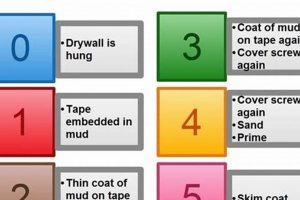
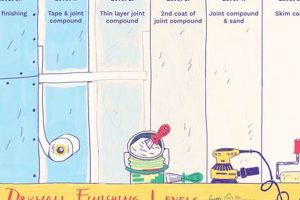
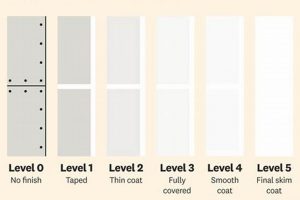
This represents the highest quality and most labor-intensive degree of smoothness achievable on a gypsum board surface. It involves embedding tape in joint compound, applying multiple coats of joint compound, and sanding until the surface is perfectly flat. A skim coat of joint compound is then applied to the entire surface. The result is a monolithic, uniform plane that is completely free of imperfections. An example would be in areas where dramatic lighting or dark/glossy paints are to be used, as any flaws would be readily apparent.
Its importance lies in providing an impeccable canvas for high-end decorative finishes. The benefits include enhanced aesthetic appeal and a perceived increase in property value. Historically, this level of finish was reserved for custom homes and upscale commercial spaces where a flawless appearance was paramount. The evolution of construction techniques and material science has allowed for more consistent and achievable results.
The following sections will delve deeper into the specific application scenarios where this superior smoothness is required, the techniques employed to achieve it, and the materials that are commonly used, as well as outlining potential challenges and strategies for successful execution.
Achieving a Superior Surface
The following tips offer guidance to ensure the successful attainment of the ultimate smoothness on gypsum board surfaces.
Tip 1: Quality Materials are Paramount. The selection of premium joint compounds, specifically those designed for skim coating, is critical. Avoid economy-grade compounds, as they may contain impurities that compromise the final finish.
Tip 2: Proper Preparation is Non-Negotiable. Ensure framing members are aligned and level. Any imperfections in the substrate will be magnified by the smooth surface. Repair any nail pops or screw protrusions before beginning the process.
Tip 3: Strategic Joint Compound Application is Key. Apply thin, even coats of joint compound. Avoid excessive build-up, as it increases the likelihood of shrinkage and cracking. Allow each coat to dry completely before applying the next.
Tip 4: Mastering the Art of Sanding. Employ a fine-grit sanding sponge or pole sander. Sand gently and evenly, using a circular motion. Over-sanding can expose the paper facing of the gypsum board, leading to imperfections.
Tip 5: Adequate Lighting is Essential. Use bright, directional lighting during both the application and sanding phases. This will reveal imperfections that may be missed under normal lighting conditions.
Tip 6: Skim Coating for Perfection. Apply a thin skim coat of joint compound over the entire surface. This will fill any remaining imperfections and create a truly monolithic surface.
Tip 7: Dust Mitigation Strategies. Use a vacuum with a HEPA filter to remove sanding dust. Dust can settle on the surface and create imperfections in subsequent coats.
Tip 8: Priming Before Painting. Prime the finished surface with a high-quality primer. This will ensure proper paint adhesion and provide a uniform base for the final coat.
Adhering to these principles provides a significant advantage in achieving the desired outcome: an exceptionally smooth and visually flawless wall or ceiling.
The subsequent sections will address common pitfalls encountered during this process and provide solutions for overcoming these challenges.
1. Surface Preparation

Surface preparation is inextricably linked to the successful attainment of the highest degree of smoothness. It forms the foundational basis upon which all subsequent steps depend. Inadequate preparation directly causes imperfections to become more apparent in the final product, undermining the entire purpose. This phase involves ensuring that the underlying framing is structurally sound, plumb, and level. Any deviations in the framing will translate into surface irregularities, necessitating extensive corrective measures during the finishing process. Screw or nail heads must be properly seated below the surface of the gypsum board without breaking the paper facing. Seams between boards must be flush, and any gaps must be filled with joint compound before proceeding. Failure to address these issues will result in visible lines and uneven surfaces.
A real-world example illustrates this point: consider a wall where the framing studs are not perfectly aligned. Without correction, the resulting surface will exhibit subtle undulations, which, when coated with a dark or glossy paint, become glaringly obvious. Similarly, improperly seated fasteners will create depressions that are impossible to conceal completely, even with multiple coats of joint compound. The importance of thorough surface preparation cannot be overstated; it minimizes the likelihood of defects, reduces the amount of corrective work required later, and ensures a more uniform and aesthetically pleasing result. Addressing these foundational elements reduces time and materials used, streamlining the overall process.
In conclusion, meticulous surface preparation is not merely a preliminary step but an essential component for achieving a superior-level surface. By ensuring a solid, even, and defect-free substrate, the chances of success increase substantially, while the potential for costly and time-consuming rework diminishes significantly. Overlooking this crucial phase compromises the project’s integrity, resulting in a less than satisfactory outcome. Thus, investing time and effort in surface preparation represents a wise allocation of resources, leading to a more professional and enduring final product.
2. Material Selection

The selection of appropriate materials is a critical determinant in achieving the exceptionally smooth, monolithic surface characteristic. The properties of joint compound, tape, and even primers directly impact the final aesthetic.
- Joint Compound Type
Different types of joint compound serve distinct purposes. Setting-type compounds are suitable for filling large gaps due to their minimal shrinkage, but their hardness makes them difficult to sand to a perfect feather edge. Topping compounds, formulated for the final coats, sand more easily but are not designed for substantial filling. A multi-stage approach using different compounds optimizes both filling and finishing. Inadequate selection leads to cracking, excessive shrinkage, or an inability to achieve a smooth transition.
- Gypsum Board Quality
The gypsum board itself influences the smoothness of the finished surface. Lower-quality boards may exhibit surface imperfections or inconsistencies in density, complicating the finishing process. Premium-grade boards with a smooth, uniform paper facing provide a more receptive base for joint compound application. For instance, boards specifically designed for skim coating offer enhanced adhesion and reduce the likelihood of bubbling or peeling.
- Taping Material
The type of tape used to reinforce seams affects the finished surface. Paper tape, while economical, requires embedding in joint compound and is susceptible to tearing if not handled carefully. Mesh tape, a self-adhesive alternative, provides greater strength but may require more joint compound to conceal its texture. The choice of tape influences the smoothness and durability of the finished seam.
- Primer Selection
Primer plays a vital role in preparing the surface for paint. A high-quality primer seals the joint compound, ensuring uniform paint adhesion and preventing the paint from soaking into the porous surface. Tinted primers can also help to conceal any minor imperfections that remain after finishing. Using an inappropriate primer can result in uneven paint coverage, highlighting imperfections that were previously imperceptible.
The strategic pairing of gypsum board, joint compound, tape, and primer streamlines the process and enhances the likelihood of achieving the desired result. Neglecting this foundational element results in a compromised finish, regardless of the skill applied during the finishing process.
3. Application Technique

The relationship between application technique and the achievement of the highest level of smoothness is direct and causative. Improper application of joint compound invariably results in a substandard surface, regardless of material quality or surface preparation. Achieving an impeccable surface necessitates the mastery of several key techniques. First, thin, even coats of joint compound are crucial; thick coats are prone to shrinkage, leading to cracking and surface irregularities. Second, maintaining a consistent angle and pressure with the drywall knife ensures a uniform layer of compound, minimizing ridges and inconsistencies. Third, feathering the edges of each coat blends the compound seamlessly into the surrounding surface, preventing visible lines or abrupt transitions. A common error is applying excessive pressure, which gouges the compound and creates depressions that are difficult to correct. Another mistake is failing to clean the drywall knife regularly, leading to the transfer of dried compound onto the surface, resulting in imperfections.
A real-world example illustrates this point: imagine two drywall finishers, both using the same high-quality materials and working on identical walls. One finisher, possessing refined application skills, applies thin, even coats, feathers the edges meticulously, and cleans the knife frequently. The other, lacking these skills, applies thick, uneven coats, neglects feathering, and uses a dirty knife. The result is a smooth, flawless surface on the first wall and a bumpy, uneven surface on the second. The difference lies solely in the application technique. Furthermore, consider the application of a skim coat a thin layer of compound applied over the entire surface. If applied unevenly, the skim coat amplifies any existing imperfections, rendering the surface unacceptable. Proper application, conversely, creates a uniform base for subsequent painting or texturing.
In conclusion, the application technique is not merely a procedural step but an essential ingredient in achieving a superior result. Mastering the art of applying thin, even coats, feathering edges, and maintaining clean tools represents a critical investment in the outcome. Deficiencies in application technique negate the benefits of high-quality materials and meticulous surface preparation, ultimately preventing the attainment of the desired smoothness. Therefore, diligent attention to application technique is paramount, ensuring a visually flawless wall or ceiling.
4. Sanding Precision

Sanding precision is a cornerstone of the highest quality gypsum board surface, inextricably linked to achieving a flawlessly smooth plane. It is the process through which imperfections introduced during the joint compound application are meticulously eliminated, creating a uniform substrate ready for final finishing. The level of smoothness dictates the degree of sanding required. Coarse grit sandpaper is employed initially to address larger ridges and imperfections, followed by progressively finer grits to refine the surface and eliminate sanding marks. Without precision, the surface will exhibit visible scratches, unevenness, or “fuzzy” textures, thereby failing to meet the standards. Real-world scenarios provide clear evidence of this principle. Walls finished using haphazard sanding techniques inevitably show noticeable imperfections under critical lighting conditions or when coated with glossy paints. Conversely, surfaces sanded with careful attention to detail offer a seamless, professional appearance.
The practical application of precision involves several key considerations. Selecting the appropriate sanding tools, such as sanding sponges, pole sanders, or orbital sanders, is crucial for achieving consistent results. Sanding sponges are well-suited for small areas and detail work, while pole sanders facilitate the efficient sanding of large surfaces. Orbital sanders offer the advantage of rapid material removal but require careful control to avoid creating swirl marks. Controlling dust during sanding is another important aspect. Employing a vacuum system equipped with a HEPA filter minimizes dust exposure and prevents airborne particles from settling back onto the surface, which can compromise the final finish. Furthermore, inspecting the surface frequently under directional lighting helps identify imperfections that may be missed under ambient lighting. This proactive approach allows for timely corrective action, ensuring a flawless result.
In summary, sanding precision is not merely a cosmetic touch but a fundamental component of the process. It directly impacts the visual quality, contributing significantly to its overall success. Challenges, such as uneven surfaces, excessive dust, and the potential for over-sanding, must be addressed through careful technique and appropriate tools. The understanding of its principles and the skill in its execution are essential for any professional seeking to consistently deliver surfaces of the highest quality. This meticulous approach transforms a potentially flawed surface into a testament of craftsmanship, a key indicator for evaluating the quality of the end result.
5. Lighting Conditions

Lighting conditions play a critical role in both the application and evaluation of surfaces. The quality and directionality of light directly impact the visibility of imperfections, influencing the entire process from joint compound application to final inspection.
- Application Illumination
Adequate lighting during the application of joint compound is essential for identifying imperfections in real-time. Directional lighting, such as spotlights or work lights, cast shadows that highlight ridges, depressions, and unevenness. Insufficient or diffuse lighting masks these flaws, leading to a substandard finish. Examples include using a bright work light positioned parallel to the wall surface to reveal subtle variations in texture.
- Sanding Assessment
The assessment of sanding quality relies heavily on lighting conditions. After sanding, the surface should be inspected under various lighting angles to ensure the complete removal of imperfections. Grazing light, where the light source is nearly parallel to the surface, accentuates even the smallest flaws. Professionals often use a “flashlight test,” shining a flashlight across the surface to identify areas requiring further attention. Failure to adequately assess sanding quality can result in visible defects under the final paint or finish.
- Final Inspection
Final inspection under representative lighting conditions is crucial to ensure the outcome is satisfactory. The lighting under which the finished surface will be viewed should be considered. For example, a hallway with recessed lighting requires a higher degree of smoothness than a closet with a single overhead bulb. Discrepancies between the inspection lighting and the intended lighting can lead to customer dissatisfaction. A surface that appears flawless under diffuse lighting may reveal imperfections when subjected to direct sunlight or dramatic artificial light.
- Color Perception
Lighting also influences the perception of color on the finished surface. Different light sources emit different wavelengths of light, affecting how colors appear. For example, a wall painted with a cool gray may appear blueish under fluorescent lighting and warmer under incandescent lighting. Understanding the impact of lighting on color perception is essential for selecting paint colors and ensuring the finished space aligns with the client’s vision. This nuanced understanding becomes increasingly important when aiming to highlight the perfection.
The integration of appropriate lighting throughout each stage of the process is paramount for achieving the ultimate smoothness. By carefully considering the direction, intensity, and color temperature of the light, professionals can ensure that the surface meets the highest standards of quality. This attention to detail elevates the final product, transforming a wall or ceiling into a testament of skill and craftsmanship.
6. Quality Control

Quality control is an indispensable element in achieving surfaces of the highest degree of smoothness. It functions as a systematic process to monitor and verify that each stage, from material selection to the final coat of paint, adheres to predetermined standards. Without rigorous quality control measures, inconsistencies and imperfections inevitably compromise the final result, rendering the endeavor unsuccessful.
- Material Inspection
Material inspection constitutes the first line of defense in ensuring a superior outcome. This facet involves verifying that all materials, including joint compound, gypsum boards, and primers, meet specified quality standards. For example, the joint compound must be free from impurities, the gypsum boards must be of the correct thickness and density, and the primer must provide adequate sealing properties. Failure to inspect materials can result in the use of substandard products, leading to issues such as cracking, poor adhesion, and uneven surfaces.
- Process Monitoring
Process monitoring encompasses the continuous observation and evaluation of each step in the surface process. This involves verifying that the joint compound is applied in thin, even coats, that the sanding is performed with appropriate grit sandpaper, and that the lighting conditions are adequate for identifying imperfections. A practical example includes using a checklist to track progress and document adherence to specific procedures. Neglecting process monitoring can lead to deviations from established standards, resulting in inconsistent results and rework.
- Interim Inspections
Interim inspections are strategically placed checkpoints throughout the process to assess the quality of work completed to that point. This may involve inspecting the surface after each coat of joint compound or after sanding to identify areas requiring further attention. A common practice is to use a bright light source to highlight any imperfections that may be missed under normal lighting conditions. Skipping interim inspections can allow minor issues to escalate into major problems, necessitating extensive corrective measures later in the process.
- Final Verification
Final verification represents the culmination of the quality control process, involving a thorough inspection of the finished surface to ensure it meets all specified requirements. This includes verifying that the surface is free from imperfections, that the paint or finish is applied uniformly, and that the overall appearance is consistent with project specifications. A real-world example is to use a calibrated gloss meter to measure the reflectivity of the surface and ensure it falls within acceptable parameters. Overlooking final verification can result in the delivery of a substandard product, leading to customer dissatisfaction and potential rework.
These facets are integral to maintaining consistent quality and adherence to standards. Consider a scenario where a dark, glossy paint is applied to a wall without these quality control measures. Any minor imperfections, invisible to the naked eye under normal lighting, would be glaringly apparent, thus underscoring the direct impact of quality control on achieving a visually flawless result. Its application transforms a potentially flawed surface into a smooth masterpiece, a testament to craftsmanship.
Frequently Asked Questions
The following section addresses common inquiries and misconceptions regarding this highest level of surface finishing.
Question 1: Is gypsum board surface always necessary for every project?
No. This represents a significant investment in both labor and materials, and is typically reserved for high-end residential or commercial projects where a flawless aesthetic is paramount. Lower levels are sufficient for many applications.
Question 2: What makes it different from other levels?
It distinguishes itself through the application of a skim coat of joint compound over the entire surface, effectively eliminating any imperfections and creating a monolithic plane. Lower levels do not involve this comprehensive skim coating process.
Question 3: Can any drywall contractor achieve this level of smoothness?
Achieving this standard requires a high level of skill and experience. Not all drywall contractors possess the expertise or attention to detail necessary to consistently deliver such results. Careful vetting of contractors is essential.
Question 4: What are the most common problems encountered when striving for this exceptional surface?
Common problems include imperfections in the framing, improper application of joint compound, inadequate sanding, and insufficient lighting during the finishing process. Addressing these challenges proactively is crucial for success.
Question 5: Is it more expensive than other finishes?
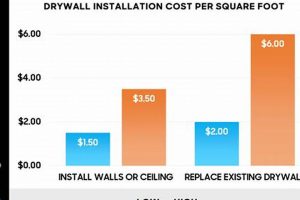
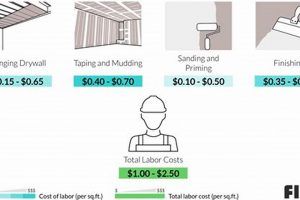
Yes. Due to the increased labor, specialized materials, and heightened level of skill required, it commands a premium price compared to lower-level finishes. Budget considerations should be carefully evaluated.
Question 6: What types of paint are best suited for walls with this surface?
Glossy or high-sheen paints are particularly well-suited, as they accentuate the smoothness and reflect light evenly. However, these paints also highlight any remaining imperfections, making it imperative that the is executed flawlessly. Dark colors also require this level of quality.
Achieving a level 5 surface involves a significant commitment of resources, but the resulting aesthetic elevates the overall quality and value of the space.
The next section will provide a comprehensive summary of the key takeaways from this exploration of the exceptional smoothness.
Conclusion
The preceding analysis has established the parameters and requirements for achieving surfaces of the highest caliber. It is not merely a superficial enhancement but a comprehensive system encompassing meticulous preparation, precise application, and rigorous quality control. The benefits extend beyond aesthetics, impacting the perceived value and longevity of the finished space. Successfully executed, it provides a substrate capable of showcasing premium paints and lighting designs, enhancing the overall architectural intent.
As construction standards evolve, the demand for such refined surfaces will likely increase, necessitating a deeper understanding of its principles and practices. Professionals seeking to differentiate themselves in the marketplace must master these techniques to meet the growing expectations for superior quality and visual excellence. Further research and training in this domain will prove invaluable in navigating the complexities of modern construction projects and delivering consistently exceptional results.