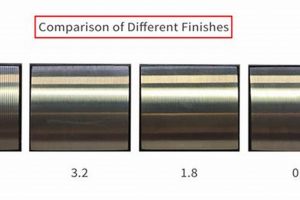
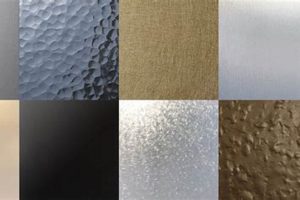
This surface treatment imparts a distinct aesthetic to metallic materials, characterized by fine, parallel lines that create a subtle texture. The appearance results from carefully abrading the metal with abrasive belts or wheels. Stainless steel appliances are a common example demonstrating this visual effect.
This type of treatment enhances the visual appeal of the material while offering practical advantages. It effectively minimizes the visibility of fingerprints and minor scratches, contributing to a cleaner, more durable look over time. Its use has expanded over decades, originating in industrial applications and becoming highly prized in design contexts demanding visual interest without excessive reflectivity.
The following sections will detail the specific techniques employed to achieve this effect, discuss common applications across various industries, and analyze the maintenance procedures necessary to preserve its appearance and longevity.
Preserving the Integrity of the Surface
Maintaining the desired appearance and extending the lifespan of this texture requires adherence to specific guidelines. The following recommendations outline best practices for cleaning, protection, and preventative care.
Tip 1: Routine Cleaning with Non-Abrasive Materials: Implement a cleaning schedule using soft cloths and mild, pH-neutral detergents. Abrasive cleaners or scouring pads will scratch and alter the intended texture.
Tip 2: Directional Wiping: When cleaning, wipe in the same direction as the grain of the surface. This prevents the introduction of swirl marks and maintains the uniformity of the finish.
Tip 3: Immediate Removal of Corrosive Substances: Promptly address spills of acidic or alkaline substances, such as cleaning solutions or food items. Prolonged exposure can lead to discoloration or pitting.
Tip 4: Application of Protective Coatings: Consider applying a specialized metal sealant or protectant. These coatings form a barrier against environmental contaminants and reduce the risk of oxidation.
Tip 5: Avoid Harsh Chemicals: Steer clear of chlorine-based bleaches or other aggressive chemicals that can etch or stain the surface. Opt for gentler alternatives specifically formulated for metal care.
Tip 6: Careful Handling to Prevent Scratches: Exercise caution when moving objects across the surface to minimize the potential for scratches. Use protective pads or cloths when necessary.
Tip 7: Regular Inspection and Preventative Action: Conduct periodic inspections to identify and address minor imperfections before they escalate into larger problems. Early intervention can significantly extend the lifespan of the finish.
By implementing these strategies, the integrity and aesthetic appeal of the treated metal can be preserved, ensuring long-term satisfaction with the material’s appearance and performance.
The subsequent sections will delve into specific applications, addressing unique challenges and further refining the approach to optimal maintenance and care.
1. Aesthetic Appearance

The visual characteristics imparted by this surface treatment significantly influence its selection for various applications. The subtle, linear texture creates a unique interplay of light and shadow, contributing to a sophisticated and modern aesthetic.
- Directionality of Grain
The consistent alignment of the brush marks dictates the visual flow across the surface. This directionality can be strategically employed in design to emphasize certain forms or create visual interest. For instance, on appliance panels, the grain is often oriented vertically to accentuate height. Deviations in grain direction are generally perceived as imperfections.
- Reflectivity and Sheen
This surface treatment diffuses light, resulting in a lower reflectivity compared to polished metal. This characteristic minimizes glare and reduces the visibility of minor surface imperfections. The resulting sheen is typically described as satin or matte, depending on the grade of abrasive used.
- Color Perception
The texture created by the process influences the way color is perceived. The micro-shadows cast by the brush marks can subtly darken the apparent color of the metal compared to a highly polished surface. This effect is more pronounced with darker metals such as bronze or blackened steel.
- Tactile Quality
While primarily a visual attribute, the surface texture also contributes to the tactile experience. The subtle ridges create a slightly textured feel, which can enhance the perceived quality and craftsmanship of the object. However, the texture should be fine enough to avoid feeling rough or abrasive to the touch.
In summary, the aesthetic appearance is a critical factor driving the application of this treatment. The control over directionality, reflectivity, color perception, and tactile quality allows designers to achieve a specific visual effect that enhances the overall design and functionality of metal components. The interplay of these elements results in a surface finish that is both visually appealing and functionally advantageous.
2. Scratch Resistance

The inherent texture introduced by this surface treatment directly contributes to its improved resistance to visible scratching. Unlike highly polished surfaces where even minor abrasions are readily apparent, the directional lines disrupt the uniform reflection of light. These lines effectively camouflage small scratches by blending them into the existing pattern. The degree of this effect is dependent on the grit size used during the finishing process; finer grits offer a more subtle appearance and less effective camouflage, while coarser grits provide greater scratch resistance but a more pronounced texture. This enhanced scratch resistance makes it suitable for applications where durability and maintaining a visually appealing surface under moderate wear conditions are essential, such as in architectural hardware and consumer electronics.
Consider the contrasting performance of a mirror-polished stainless steel versus this treatment on an elevator panel. A minor scrape on the polished surface will immediately create a noticeable flaw, reflecting light differently and drawing the eye. Conversely, a similar scrape on the treated surface will likely be less conspicuous, effectively masked by the pre-existing texture. In the realm of kitchen appliances, where repeated contact with utensils and cleaning implements is unavoidable, the advantages are equally apparent. The maintenance implications are significant, reducing the frequency of intensive polishing or refinishing required to preserve the aesthetic quality of the product. Moreover, this characteristic can extend the product lifecycle by minimizing the need for replacements driven by cosmetic damage.
In summary, the improved scratch resistance is a key benefit derived from the inherent texture of this finish. While not impervious to damage, the surface is demonstrably more resilient in concealing minor abrasions compared to highly polished counterparts. The selection process must consider the trade-off between the fineness of the texture and the degree of scratch resistance desired, carefully balancing aesthetic preferences with practical durability requirements. The texture’s ability to diffuse light and camouflage imperfections contributes significantly to the longevity and visual appeal of the material in demanding environments.
3. Surface Texture
The defining characteristic of this finish is its distinct surface texture, directly resulting from the mechanical abrasion process. This process, typically employing abrasive belts or wheels, imparts a series of fine, parallel lines to the metal surface. The resulting texture is not merely cosmetic; it is an integral component of the finish, affecting its appearance, tactile properties, and performance. The specific texture created is a direct consequence of factors such as the grit size of the abrasive material, the pressure applied during abrasion, and the speed of the process. Variations in these parameters lead to a range of textures, from subtle, almost imperceptible lines to more pronounced and coarser patterns. The specific application dictates the appropriate texture; finer textures may be preferred for decorative elements, while coarser textures provide enhanced grip or camouflage surface imperfections more effectively. Consider, for example, the contrasting textures found on a high-end watch casing (subtle) and a heavy-duty appliance handle (more pronounced). The controlled creation of this texture is paramount to achieving the desired aesthetic and functional properties of the final product.
The practical significance of understanding the relationship between the surface texture and the final product lies in the ability to tailor the finish to specific performance requirements. For instance, a specific surface roughness, quantified using parameters like Ra (average roughness) or Rz (average maximum height of the profile), can be engineered to optimize paint adhesion in applications where coatings are subsequently applied. Similarly, the texture can influence the coefficient of friction, making it suitable for components requiring enhanced grip. Furthermore, the texture affects the perceived quality of the metal, with finer textures often associated with higher-end products. Control over the texture also extends to mitigating manufacturing defects. The textured surface helps to mask minor scratches or blemishes that might otherwise be readily visible on a smooth, polished surface, reducing scrap rates and improving overall production efficiency. A real-world example is in automotive interiors, where the surface texture on metal trim components helps to conceal fingerprints and minor scratches that would be glaring on a polished surface.
In summary, the surface texture is inextricably linked to the identity and performance of a product with this treatment. Precise control over texture creation enables manufacturers to tailor the appearance, tactile qualities, and functional characteristics of metal surfaces to meet specific application demands. The ability to engineer the surface texture, from subtle visual enhancements to practical performance improvements, underscores its importance as a defining element of this finish and a critical consideration in product design and manufacturing. Understanding this relationship facilitates optimization of product performance and minimization of manufacturing defects, leading to enhanced product quality and customer satisfaction. The key challenge lies in consistently replicating the desired texture across large production volumes, requiring robust process control and quality assurance measures.
4. Manufacturing Process

The manufacturing process is inextricably linked to the characteristics of this finish. The specific techniques employed directly dictate the resulting texture, appearance, and performance properties of the treated metal. Consistency and control within the manufacturing process are paramount to achieving the desired aesthetic and functional outcomes.
- Abrasive Selection
The choice of abrasive material is a critical determinant of the surface texture. Abrasives vary in composition (e.g., aluminum oxide, silicon carbide), grit size (measured in numerical grades), and bonding material. Finer grit abrasives yield a smoother, less pronounced texture, while coarser grits create a more aggressive, textured surface. Aluminum oxide is commonly selected for general-purpose applications on stainless steel, while silicon carbide is often preferred for harder metals or where faster material removal is required. The careful selection of the appropriate abrasive type and grit size is essential for achieving the desired aesthetic and functional properties of the finish.
- Abrasion Technique
Various techniques can be employed to impart the characteristic lines onto the metal surface, including belt grinding, wheel polishing, and orbital sanding. Belt grinding involves passing the metal across a moving abrasive belt, while wheel polishing utilizes rotating abrasive wheels. Orbital sanding, often employed for finishing larger, flat surfaces, uses a rotating abrasive pad that moves in a circular motion. The choice of technique depends on the geometry of the workpiece, the desired surface finish, and the production volume. Belt grinding is commonly used for producing a linear finish on flat or cylindrical parts, while wheel polishing may be preferred for complex geometries or for achieving a specific level of surface refinement. The applied technique significantly impacts the uniformity, directionality, and overall appearance of the finish.
- Process Parameters
Beyond the abrasive material and technique, several process parameters influence the final outcome. These include the speed of the abrasive tool, the pressure applied to the workpiece, the feed rate of the workpiece, and the number of passes. Higher speeds and pressures generally result in a more aggressive finish with deeper lines, while lower speeds and pressures produce a finer, more subtle texture. Precise control over these parameters is essential for maintaining consistency and repeatability in the manufacturing process. Modern manufacturing facilities often employ automated equipment with programmable controls to ensure consistent process parameters and minimize variability. Regular monitoring and adjustment of these parameters are critical for maintaining the quality of the finish over time.
- Post-Processing Treatments
Following the abrasion process, various post-processing treatments may be applied to enhance the appearance or performance of the finish. These include cleaning to remove abrasive residue, passivation to improve corrosion resistance, and coating to enhance durability or alter the aesthetic appearance. Cleaning processes typically involve the use of detergents or solvents to remove residual abrasive particles and oils from the surface. Passivation treatments, commonly applied to stainless steel, involve immersing the metal in an oxidizing solution to form a protective oxide layer. Coatings, such as clear lacquers or powder coatings, can be applied to enhance durability, provide additional corrosion protection, or alter the color or gloss of the finish. The selection of appropriate post-processing treatments is essential for optimizing the long-term performance and aesthetic appeal of the finished product.
In conclusion, the manufacturing process is a critical determinant of the quality and characteristics of this surface. Careful selection of abrasive materials, appropriate abrasion techniques, precise control of process parameters, and the application of suitable post-processing treatments are all essential for achieving the desired aesthetic and functional outcomes. A thorough understanding of these manufacturing aspects is crucial for designers, engineers, and manufacturers seeking to specify, produce, and maintain metal components with this distinctive finish.
5. Maintenance Requirements

Preserving the aesthetic appeal and extending the lifespan of metal components with this finish requires adherence to specific maintenance protocols. The directional lines inherent in the texture, while offering enhanced scratch resistance, necessitate particular cleaning and care procedures. Deviations from recommended practices can lead to irreversible alterations in the surface appearance.
- Directional Cleaning
The defining characteristic mandates cleaning along the grain. Wiping perpendicular to the lines introduces swirl marks and disrupts the uniform appearance. Example: Stainless steel appliances should be cleaned using a soft cloth, moving in the direction of the visible lines. Failure to follow this practice results in an inconsistent sheen and diminishes the visual appeal.
- Abrasive Avoidance
Abrasive cleaners and scouring pads must be avoided to prevent scratching and alteration of the intended texture. The fine lines are susceptible to damage from harsh materials. Example: Utilizing a scouring pad on this type of stainless steel will create deep, unwanted scratches. Gentle, non-abrasive cleaners are recommended to maintain the integrity of the surface.
- Residue Removal
Prompt removal of spills and residues is essential to prevent staining and corrosion. Acidic or alkaline substances can etch the surface if left unattended. Example: Food spills on kitchen appliances should be cleaned immediately to avoid discoloration or pitting. Regular cleaning prevents the build-up of corrosive substances and preserves the finish’s appearance.
- Protective Measures
Application of protective coatings or sealants can enhance the finish’s resistance to environmental factors. These coatings create a barrier against moisture and contaminants. Example: Applying a stainless steel sealant to architectural elements exposed to the elements can minimize oxidation and maintain the finish’s luster. Protective measures extend the lifespan and minimize the need for frequent cleaning.
Adherence to these maintenance requirements ensures the long-term preservation of aesthetic and functional properties. Neglecting these guidelines can result in irreversible damage, diminishing the visual appeal and potentially compromising the structural integrity of the metal component. Proper maintenance is a critical investment in the longevity and performance of items featuring this type of finish.
Frequently Asked Questions about Brushed Finish Metal
The following questions address common concerns and misconceptions regarding the selection, application, and maintenance of metallic materials with this specific surface treatment.
Question 1: Is a brushed finish more scratch-resistant than a polished finish?
Yes, it generally offers greater resistance to the visibility of minor scratches. The pre-existing lines effectively camouflage superficial abrasions, making them less noticeable than on a highly polished surface.
Question 2: Can a brushed finish be applied to all types of metal?
It is applicable to a wide range of metals, including stainless steel, aluminum, and brass. However, the specific abrasion techniques and parameters may need to be adjusted based on the hardness and composition of the metal.
Question 3: How should brushed finish metal be cleaned?
Cleaning should be performed using a soft cloth and a mild, pH-neutral detergent. It is imperative to wipe along the direction of the grain to prevent the introduction of swirl marks. Abrasive cleaners should be strictly avoided.
Question 4: Does exposure to the elements affect brushed finish metal?
Prolonged exposure to harsh environmental conditions can lead to oxidation and discoloration. The application of a protective sealant can mitigate these effects and prolong the lifespan of the finish.
Question 5: Can a brushed finish be repaired if it becomes damaged?
Minor scratches and imperfections can often be repaired by lightly re-brushing the surface with an appropriate abrasive pad. However, deep scratches or significant damage may require professional refinishing.
Question 6: Is there a difference in the appearance of a brushed finish depending on the manufacturing process?
Yes, the specific abrasive material, abrasion technique, and process parameters all influence the final appearance of the finish. Variations in these factors can result in subtle differences in the texture, reflectivity, and overall aesthetic.
Understanding these factors is essential for making informed decisions regarding the application and care of this surface treatment, ensuring both aesthetic appeal and long-term durability.
The subsequent sections will delve into the sustainability aspects, focusing on material selection and environmental impact.
In Conclusion
This analysis has explored the multifaceted nature of surfaces prepared with a linear abrasion technique. It has highlighted the aesthetic qualities, manufacturing considerations, maintenance requirements, and scratch resistance properties. The manufacturing processes significantly influence the final appearance and must be carefully controlled to achieve the desired results.
Consideration of the points raised within this document is essential for the successful specification and application of this approach. Understanding the nuances of the process will ensure both the desired aesthetic and performance criteria are met. This knowledge contributes to informed decision-making and optimized outcomes in diverse manufacturing and design contexts.