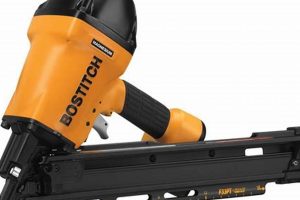
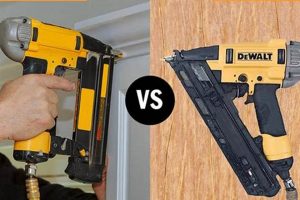
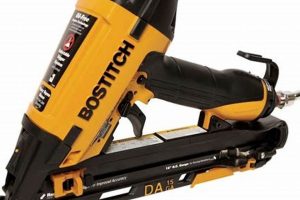
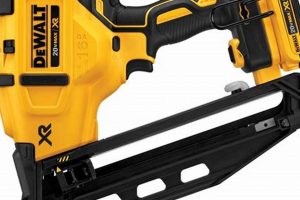
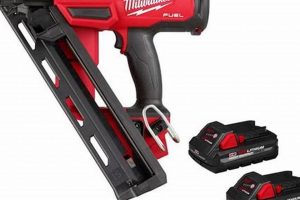
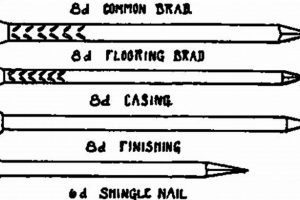
The category encompasses pneumatic or cordless tools designed to drive finish nails into wood for trim work, cabinetry, and other fine woodworking applications. These tools are frequently evaluated based on factors such as power, reliability, nail capacity, ease of use, and user feedback. An example would be a 16-gauge angled nailer consistently praised for its precision and durability in professional settings.
The significance of a well-performing tool in this category lies in its ability to ensure clean, consistent results in finish carpentry. Benefits include enhanced efficiency, reduced material waste, and improved overall project quality. Historically, advancements in nailer technology have led to lighter, more ergonomic designs, contributing to user comfort and productivity. Early models were often bulky and prone to jamming, whereas modern iterations incorporate features such as tool-free depth adjustment and integrated air blowers.
The following discussion will delve into various aspects of selecting a suitable tool from this category, including a comparison of different types, considerations for specific project needs, and an analysis of key features influencing performance and user satisfaction. This will provide a framework for informed decision-making when choosing equipment for finish carpentry applications.
Selection and Usage Guidance
This section provides critical guidance to optimize the selection and application of tools within this category, ensuring project success and user safety.
Tip 1: Gauge Selection: The gauge of the nail significantly impacts its holding power and visibility. Higher gauge nails (e.g., 18 gauge) are less visible but offer less holding strength, suitable for delicate trim. Lower gauge nails (e.g., 15 or 16 gauge) provide superior holding power for heavier materials but are more noticeable.
Tip 2: Angled vs. Straight: Angled nailers access tighter spaces, enhancing maneuverability. Straight nailers are generally more compact and may offer better balance for certain users.
Tip 3: Depth Adjustment: Precise depth adjustment prevents over-driving or under-driving nails. A tool-free adjustment mechanism facilitates quick and accurate depth setting, crucial for consistent results across varying wood densities.
Tip 4: Air Compressor Compatibility: Pneumatic models require a compatible air compressor. Ensure the compressor provides adequate CFM (cubic feet per minute) at the required PSI (pounds per square inch) to avoid performance limitations. Cordless models eliminate this constraint.
Tip 5: Jam Clearance: Nail jams disrupt workflow. A tool-free jam clearance mechanism allows for rapid removal of jammed nails, minimizing downtime.
Tip 6: Safety Features: Prioritize models equipped with safety features such as sequential actuation triggers. This mechanism prevents accidental firing, ensuring operator safety.
Tip 7: Maintenance: Regular maintenance, including cleaning and lubrication, extends the tool’s lifespan and maintains optimal performance. Refer to the manufacturer’s instructions for recommended maintenance procedures.
Adherence to these guidelines enhances the effectiveness of these tools, yielding professional-quality results while prioritizing operator safety and tool longevity.
The subsequent sections will explore the competitive landscape and provide a comprehensive evaluation of leading models currently available.
1. Precision
Precision, in the context of a finish nailer, refers to the tool’s ability to consistently drive nails to a predetermined depth and angle, without damaging the surrounding material. This capability directly impacts the quality of the finished product. Over-driving nails creates unsightly blemishes requiring patching, while under-driving results in protruding nail heads that can snag or cause injury. Variations in angle can lead to compromised structural integrity, especially in delicate trim work.
A primary cause of imprecision stems from inconsistencies in the tool’s firing mechanism or variations in air pressure (for pneumatic models). Examples of high-precision finish nailers include those with adjustable depth settings that allow for fine-tuning based on material density. Furthermore, some models feature narrow nose pieces designed to improve visibility and accurate nail placement. The significance of precision is amplified when working with expensive or intricate materials, where mistakes become costly and difficult to rectify. Cabinetry, fine furniture making, and historical restoration are areas where this is particularly critical.
Ultimately, precision ensures a professional, aesthetically pleasing result. Challenges to achieving it may include user error, inconsistent material density, or a poorly maintained tool. A clear understanding of the link between tool quality and precision is crucial for discerning purchasers seeking equipment capable of delivering superior results in demanding finish carpentry applications.
2. Reliability

The concept of reliability is fundamental to determining if a finish nailer qualifies as “best rated.” It describes the consistency with which the tool performs its intended function over an extended period, under varying conditions. An unreliable nailer introduces significant costs, including project delays, material waste from misfired nails, and potential rework due to inconsistent fastening. The impact of unreliability is particularly acute for professionals whose livelihood depends on efficient and accurate tool performance. Consider, for instance, a cabinet installer who experiences frequent jams or misfires with their nailer; the resulting delays can cascade through their schedule, affecting other projects and damaging their reputation. This establishes a clear cause-and-effect relationship where a tool’s reliability directly influences its practical utility and economic value.
Reliability encompasses several key performance indicators: consistent nail depth, minimal jamming, and durability of internal components. A “best rated” nailer exhibits consistent performance across a range of wood types and thicknesses, demonstrating its adaptability and robust design. The frequency of jams is a critical metric; a nailer prone to frequent jams significantly reduces productivity. The lifespan of the tool’s motor, battery (if cordless), and firing mechanism are also indicative of its overall reliability. Tools constructed with high-quality materials and precise manufacturing processes tend to exhibit greater reliability and longevity. An example is a pneumatic nailer with a hardened steel driver blade and a precision-engineered air cylinder, which are designed to withstand repeated use without degradation. Cordless models will require robust motors and long life, fast charging batteries to be considered reliable.
In summary, reliability is an indispensable component of a “best rated” finish nailer. Its importance extends beyond mere convenience, influencing productivity, project quality, and the overall cost of ownership. Recognizing the significance of this characteristic allows consumers to make informed purchasing decisions, prioritizing tools designed for consistent and dependable performance in demanding finish carpentry applications. Addressing potential issues such as material compatibility, proper maintenance, and selecting tools appropriate for the intended application is crucial for maintaining the nailers reliability over time.
3. Power

In the context of a “best rated finish nailer,” power denotes the tool’s capability to consistently and effectively drive nails into various wood types and densities. A direct correlation exists between sufficient power and the overall performance of the nailer, particularly when working with hardwoods or thicker trim materials. Insufficient power results in nails that are not fully set, requiring manual correction or risking structural weakness. This inefficiency can lead to project delays and diminished quality of the finished product. For instance, a finish carpenter installing oak trim requires a nailer with adequate power to ensure each nail is driven flush, creating a seamless and professional appearance. Therefore, power is a critical determinant in defining a “best rated” nailer because it directly affects the ability to achieve consistent and reliable fastening results.
The power requirements differ based on the type of nailer. Pneumatic models rely on compressed air, and their power is a function of the operating pressure and the design of the internal driving mechanism. Cordless models depend on the battery voltage and motor efficiency to deliver sufficient driving force. Consequently, both the CFM (cubic feet per minute) rating of an air compressor (for pneumatic nailers) and the voltage and amp-hour rating of a battery (for cordless nailers) become important considerations. Examples of practical applications include installing crown molding in a large room. Insufficient power to drive nails consistently into the ceiling joists will result in a substandard finish. In contrast, a nailer with adequate power guarantees a secure and aesthetically pleasing installation, reflecting the importance of choosing a tool with suitable specifications. The appropriate selection of nail sizes and types as well as proper tool maintenance also play a role in achieving optimal power and performance.
In conclusion, power is an indispensable attribute of a “best rated finish nailer.” It directly influences the tool’s ability to perform its intended function effectively and consistently across diverse materials and applications. The challenges of inadequate power lead to project delays, rework, and compromised quality. The comprehension of a nailer’s power capabilities is essential for informed purchasing decisions, ensuring the selection of a tool that meets the demands of the intended tasks and contributes to professional-grade results. The performance of the best rated tool reflects sufficient power, and that is important for professional finish nailers.
4. Ergonomics

Ergonomics plays a pivotal role in defining a “best rated finish nailer.” The tool’s design directly impacts user comfort, reduces fatigue, and mitigates the risk of repetitive strain injuries during prolonged use. A nailer lacking ergonomic considerations, even if possessing superior power and precision, can diminish productivity and potentially compromise user health. Consequently, ergonomics is a critical factor in evaluating the overall suitability and desirability of a finish nailer.
- Weight and Balance
A well-balanced nailer minimizes strain on the wrist and arm. Excessive weight exacerbates fatigue, particularly during overhead or extended use. A “best rated finish nailer” distributes weight evenly, allowing for comfortable and controlled operation. As an example, a lighter-weight cordless model may be preferred by professionals working on intricate trim projects requiring extended periods of use. The implications are reduced operator fatigue and enhanced precision in nail placement.
- Grip Design
The grip design significantly impacts user control and comfort. A textured, non-slip grip provides a secure hold, even with gloved hands, reducing the risk of slippage and improving accuracy. A “best rated finish nailer” incorporates an ergonomic grip that conforms to the natural contours of the hand, minimizing strain. Examples include models with over-molded rubber grips that provide a comfortable and secure hold. This contributes to reduced hand fatigue and improved control, leading to more precise nail placement and greater overall productivity.
- Actuation Force
The force required to activate the nailer directly impacts user fatigue. A “best rated finish nailer” requires minimal actuation force, reducing strain on the trigger finger and hand. Excessively high actuation force leads to fatigue and reduced accuracy, especially during prolonged use. Examples include models with adjustable actuation force settings, allowing users to customize the tool to their individual preferences and the demands of the task. This feature enhances comfort and minimizes the risk of repetitive strain injuries.
- Nosepiece Design and Visibility
The design of the nailer’s nosepiece affects visibility and accessibility in tight spaces. A compact nosepiece with a clear line of sight allows for precise nail placement in corners and along edges. A “best rated finish nailer” incorporates a nosepiece design that minimizes obstructions and maximizes visibility. Examples include models with narrow, angled nosepieces that provide access to confined areas. Improved visibility and accessibility contribute to more accurate nail placement and reduced material waste.
These ergonomic facets are essential for evaluating the “best rated finish nailer.” The design of the tool must prioritize user comfort, reduce fatigue, and minimize the risk of injury to achieve optimal performance and long-term user satisfaction. While performance is critical, ergonomics impacts the user’s ability to consistently deliver high-quality results over extended use, solidifying its value.
5. Durability
Durability, in the context of a “best rated finish nailer,” represents the tool’s capacity to withstand prolonged use under normal operating conditions without significant degradation in performance or structural integrity. A direct correlation exists between a finish nailer’s durability and its long-term value. Reduced durability leads to frequent repairs, premature replacement, and increased operational costs, negating any initial cost savings. A tool’s inability to endure routine usage diminishes its effectiveness and undermines its value proposition. For example, a finish carpenter relying on a nailer with a fragile housing or a motor prone to early failure faces project delays and diminished profitability. Therefore, durability is a critical determinant in evaluating a finish nailer as “best rated,” as it directly impacts the tool’s long-term reliability and cost-effectiveness.
The primary components influencing a nailer’s durability include material quality, construction methods, and the design of critical wear parts. High-quality materials, such as hardened steel for the driver blade and robust polymers for the housing, contribute significantly to the tool’s ability to withstand repeated stress and impacts. Precision manufacturing processes, including tight tolerances and secure fastening methods, further enhance structural integrity. Design considerations also play a crucial role; for instance, incorporating reinforced stress points and protective features around vulnerable components reduces the risk of damage from drops or accidental impacts. As an example, a pneumatic nailer with a hardened steel driver blade and a reinforced housing is better equipped to withstand the demands of daily use in a professional setting than a model constructed with inferior materials and less robust construction.
In summary, durability is an essential characteristic of a “best rated finish nailer,” directly influencing its long-term value and reliability. The challenges associated with inadequate durability include increased repair costs, reduced productivity, and premature tool replacement. The comprehension of the link between material quality, construction methods, design, and durability enables consumers to make informed purchasing decisions. Prioritizing tools constructed with robust materials, precision manufacturing, and thoughtful design ensures the selection of equipment capable of withstanding the rigors of professional use and delivering consistent performance over an extended lifespan. This is one of the most important criteria to review when searching for the best rated finish nailer.
6. Versatility

Versatility, in the context of a “best rated finish nailer,” signifies the tool’s capacity to perform a diverse range of fastening tasks efficiently and effectively. A direct correlation exists between a finish nailer’s versatility and its overall utility. Restricted versatility limits the tool’s applicability, necessitating the acquisition of multiple specialized nailers to accommodate varying project requirements. This increases tool inventory costs and can complicate workflow management. For example, a finish carpenter undertaking a project involving both delicate trim work and the installation of thicker door casings requires a nailer capable of handling a range of nail sizes and materials. A nailer with limited versatility necessitates the use of multiple tools or compromises in fastening quality. Thus, versatility is a critical determinant in evaluating a finish nailer as “best rated” because it directly impacts the tool’s adaptability and overall value.
The primary factors influencing a nailer’s versatility encompass nail gauge compatibility, adjustable depth settings, and the ability to handle various material densities. A finish nailer that accepts a range of nail gauges (e.g., 15-gauge to 18-gauge) offers greater flexibility in fastening different types of trim and molding. Adjustable depth settings allow for precise control over nail penetration, preventing over-driving or under-driving in varying material thicknesses. The ability to consistently drive nails into both softwoods and hardwoods further enhances the tool’s versatility. Consider a contractor who frequently undertakes diverse projects, from installing baseboards to building custom cabinets. A versatile finish nailer streamlines their workflow, eliminating the need to switch between multiple tools and ensuring consistent fastening quality across different applications. The practical benefit is a reduction in the number of tools required and increased job site efficiency.
In summary, versatility is an indispensable characteristic of a “best rated finish nailer,” directly influencing its utility and overall value. The challenges associated with limited versatility include increased tool inventory costs, reduced efficiency, and potential compromises in fastening quality. The understanding of the link between nail gauge compatibility, adjustable settings, material handling, and versatility enables consumers to make informed purchasing decisions. Prioritizing tools offering broad adaptability ensures the selection of equipment capable of addressing a wide range of fastening tasks, maximizing return on investment and contributing to professional-grade results. This ensures the best rated tool is ready for a myriad of tasks.
7. Value
Value, in the context of a “best rated finish nailer,” transcends mere monetary cost. It represents a holistic assessment integrating price with performance, durability, reliability, and versatility. This assessment determines whether the tool provides a justifiable return on investment over its operational lifespan.
- Initial Investment vs. Long-Term Costs
The initial purchase price constitutes only one facet of overall value. A seemingly inexpensive nailer may accrue significant long-term costs due to frequent repairs, premature replacement, or compromised project quality. Conversely, a higher-priced model, engineered for enhanced durability and reliability, can yield lower long-term costs by minimizing downtime and extending its service life. For example, a professional finish carpenter utilizing a durable, albeit more expensive, nailer for daily operations may experience fewer equipment failures and maintain consistent productivity, justifying the initial investment.
- Performance-to-Price Ratio
Value is intrinsically linked to performance relative to the price. A nailer delivering exceptional precision, power, and versatility at a competitive price point represents a high-value proposition. Conversely, a costly nailer failing to consistently deliver high-quality results offers poor value. Consider a scenario where two nailers, one priced moderately higher, consistently produce cleaner, more accurate nail placements with fewer misfires. The superior performance justifies the marginal cost increase, making it a more valuable choice.
- Durability and Longevity as Value Drivers
A nailer’s expected lifespan directly influences its value. A durable tool capable of withstanding rigorous use over an extended period provides greater value than a fragile model prone to early failure. For instance, a nailer constructed with high-quality materials and robust internal components may command a higher initial price but offers a significantly longer service life than a cheaper alternative. This extended service life translates to lower replacement costs and reduced downtime, ultimately providing superior value.
- Resale Value and Brand Reputation
The resale value of a nailer, influenced by its brand reputation and condition, contributes to its overall value. Tools from reputable manufacturers, known for producing reliable and durable equipment, typically retain higher resale value. This allows users to recoup a portion of their initial investment when upgrading or replacing their equipment. A well-maintained nailer from a recognized brand offers both dependable performance and the potential for future resale, enhancing its value proposition.
Integrating these facets paints a comprehensive picture of value. Selecting a “best rated finish nailer” requires a careful assessment of the tool’s purchase price, performance characteristics, durability, longevity, and potential resale value. The ultimate objective is to identify a tool that provides the optimal balance of these factors, delivering a justifiable return on investment and supporting consistent, high-quality results over the long term. The best rated tool offers premium value to the user in this category.
Frequently Asked Questions About Top-Rated Finish Nailers
This section addresses common inquiries regarding the selection, usage, and maintenance of high-performance finish nailers.
Question 1: What differentiates a finish nailer from a brad nailer or framing nailer?
Finish nailers utilize larger gauge nails (typically 15- or 16-gauge) designed for secure fastening of trim, molding, and cabinetry. Brad nailers use smaller gauge nails (typically 18-gauge) intended for delicate trim work where minimal visibility is desired. Framing nailers employ larger nails for structural applications, such as framing walls and roofs.
Question 2: What factors should be considered when selecting a pneumatic versus a cordless finish nailer?
Pneumatic nailers offer consistent power and are generally lighter than cordless models but require an air compressor and hose. Cordless nailers provide portability and freedom of movement but may be heavier and require battery charging. The choice depends on the specific project requirements and job site conditions.
Question 3: How does nail gauge affect the holding power and visibility of the finished nail?
Lower gauge nails (e.g., 15-gauge) provide greater holding power but are more visible. Higher gauge nails (e.g., 16-gauge) are less visible but offer reduced holding strength. The appropriate nail gauge depends on the material being fastened and the desired aesthetic outcome.
Question 4: What are the key maintenance procedures for ensuring the longevity and optimal performance of a finish nailer?
Regular maintenance includes cleaning the nailer, lubricating moving parts, inspecting for wear or damage, and properly storing the tool when not in use. Adhering to the manufacturer’s recommended maintenance schedule is crucial for maximizing the tool’s lifespan and maintaining consistent performance.
Question 5: What safety precautions should be observed when operating a finish nailer?
Safety precautions include wearing appropriate eye protection, keeping hands and body parts clear of the firing zone, using the correct nail sizes and types, and ensuring the tool is properly maintained. Familiarizing oneself with the tool’s operating manual and safety guidelines is essential before use.
Question 6: How can nail jams be prevented, and what steps should be taken to clear a jammed nail?
Nail jams can be minimized by using the correct nail sizes and types, maintaining proper air pressure (for pneumatic models), and ensuring the nailer is clean and well-lubricated. Clearing a jammed nail typically involves using a tool-free jam clearance mechanism or manually removing the obstruction with pliers, following the manufacturer’s instructions.
The selection of a finish nailer should be based on a thorough understanding of its intended use, performance characteristics, and maintenance requirements. Adherence to safety guidelines and proper maintenance procedures will ensure optimal performance and longevity.
The following section provides a summary of key considerations for selecting a top-rated finish nailer.
Concluding Remarks on High-Performing Finish Nailers
The preceding discussion has illuminated critical facets of selecting a “best rated finish nailer,” emphasizing precision, reliability, power, ergonomics, durability, versatility, and overall value. Each of these attributes contributes significantly to a tool’s ability to deliver consistent, professional-grade results in diverse finish carpentry applications. Effective selection hinges on aligning these characteristics with the specific demands of the intended tasks, ensuring both optimal performance and user satisfaction.
The pursuit of an optimal fastening solution mandates a comprehensive understanding of these performance dimensions. Continued advancements in tool technology promise further improvements in efficiency, precision, and user experience. Prioritizing informed decision-making, based on thorough evaluation and a clear understanding of project requirements, remains paramount in realizing the full potential of these tools and achieving superior craftsmanship.