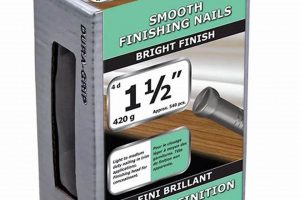
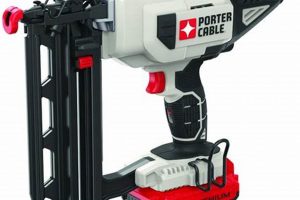
These slender fasteners, typically driven by a pneumatic nailer, are characterized by their fine gauge, specifically 16-gauge. This measurement indicates the wire’s diameter, with a higher gauge signifying a thinner nail. They are commonly employed in woodworking projects requiring minimal visibility and a refined appearance, such as attaching trim, molding, and cabinetry components. Their small size reduces the likelihood of splitting the wood, making them well-suited for delicate materials.
The significance of utilizing such a fastener lies in its ability to provide a secure hold while leaving a discreet entry point. Historically, similar fastening tasks were achieved using hand-driven brads or tacks. The advent of pneumatic nailers capable of driving these fine-gauge fasteners significantly improved efficiency and precision in finishing work. This type of fastener minimizes the need for extensive filling and sanding, thus saving time and preserving the aesthetic appeal of the finished piece.
The following sections will delve into specific applications, best practices for usage, and considerations for selecting the appropriate length and material for various woodworking endeavors. Furthermore, a comparison with other fastening methods will highlight the advantages and limitations, enabling a more informed decision-making process for achieving optimal results.
Essential Usage Considerations
Optimizing the performance and longevity of projects utilizing fine-gauge fasteners requires adherence to specific guidelines. The following tips provide essential considerations for ensuring secure and aesthetically pleasing results.
Tip 1: Material Compatibility: Ensure the fastener material is compatible with the substrate to prevent corrosion or discoloration. Stainless steel options are recommended for exterior or moisture-prone environments.
Tip 2: Nailer Adjustment: Calibrate the nailer’s pressure settings to prevent overdriving or underdriving the fastener. Overdriving can damage the surrounding material, while underdriving compromises holding power.
Tip 3: Proper Nail Placement: Strategically position fasteners to maximize holding strength and minimize visibility. Consider angling the fastener for increased grip in certain applications.
Tip 4: Avoid End Grain Nailing: Refrain from driving fasteners directly into end grain, as this provides minimal holding power. Employ alternative fastening methods or reinforce the joint when end grain connection is necessary.
Tip 5: Utilize a Nail Set: When a flush or countersunk finish is desired, employ a nail set to carefully drive the fastener below the surface without damaging the surrounding material.
Tip 6: Consider Adhesive Reinforcement: For applications demanding exceptional strength, supplement the fasteners with a suitable wood adhesive to enhance the overall joint integrity.
Tip 7: Pre-Drilling in Hardwoods: When working with dense hardwoods, pre-drilling pilot holes can prevent splitting and facilitate easier fastener insertion.
By implementing these tips, professionals and enthusiasts can effectively leverage the advantages of fine-gauge fastening for superior craftsmanship and durable results.
The subsequent sections will explore advanced techniques and troubleshooting methods to further refine the utilization of this valuable fastening method in diverse woodworking applications.
1. Gauge Precision
Gauge precision, in the context of fasteners, refers to the accuracy and consistency of a nail’s diameter. In the specific case of 16ga finish nails, this precision is paramount to ensuring proper functionality and optimal results. Variations in gauge, even slight deviations, can significantly impact the nail’s performance within a pneumatic nailer and the overall integrity of the finished product.
- Consistent Diameter
The designated 16-gauge specification demands a consistent diameter along the nail’s entire length. This uniformity ensures proper feeding and driving within the nail gun’s mechanism. Inconsistent diameter can lead to jams, misfires, and inconsistent setting depth, compromising efficiency and project quality.
- Holding Power Implications
Gauge precision directly influences the nail’s holding power. A nail with a diameter significantly below the specified 16-gauge will offer reduced resistance within the substrate, resulting in a weaker connection. Conversely, a diameter exceeding the specification may cause splitting or damage to the material being fastened.
- Compatibility with Nailers
Pneumatic nailers designed for 16ga finish nails are engineered to accommodate a specific range of diameters. Deviations from this range can cause malfunctions or damage to the tool itself. Precise gauge ensures seamless integration and reliable performance of the nailer.
- Aesthetic Considerations
The fine gauge of 16ga finish nails is valued for its ability to minimize visible entry points. However, variations in gauge can affect the resulting finish. Inconsistent gauge can lead to noticeable dimpling or uneven surfaces, detracting from the aesthetic appeal of the completed project.
In summary, gauge precision is not merely a technical specification but a crucial factor affecting the performance, reliability, and aesthetic outcome of projects employing 16ga finish nails. Adherence to the precise gauge ensures optimal functionality, minimizes potential issues, and contributes to a professional, high-quality finish.
2. Head Style

The head style of a 16ga finish nail directly impacts its functionality and the final appearance of the finished work. As a critical component, the head determines how the nail interacts with the surface of the material being fastened. Different head designs are engineered to serve specific purposes, influencing the level of concealment, holding power, and overall aesthetic. For instance, a brad head, characterized by its minimal size, is designed to be nearly invisible upon installation. This feature is advantageous in applications where a clean, unblemished surface is paramount, such as attaching delicate trim or molding. Conversely, a slightly larger, angled head may provide increased holding strength, particularly in softer materials or applications subjected to greater stress.
The selection of an appropriate head style necessitates a careful consideration of the project’s requirements. If the primary concern is minimizing the nail’s visibility, a brad head is generally preferred. This type of head is intended to be driven flush with or slightly below the surface of the material, leaving a small hole that can be easily filled and concealed. In situations where greater holding power is needed, and a slightly more visible fastener is acceptable, a head with a greater surface area may be chosen. The choice also depends on the capabilities of the nail gun being utilized. Some nailers are specifically designed to accommodate certain head styles, ensuring consistent and reliable driving of the fasteners. Using an incompatible nail head can lead to misfires, damage to the tool, or an unsatisfactory finish.
In summary, the head style of a 16ga finish nail is a key determinant of its performance and suitability for a given application. Proper selection, guided by the project’s specific needs and the capabilities of the chosen tools, is essential for achieving a professional and aesthetically pleasing result. The importance of understanding these variations cannot be overstated, as the wrong choice can compromise the structural integrity or visual appeal of the finished product. Careful consideration of the head style is therefore a fundamental aspect of successful woodworking and finishing projects.
3. Material Choices

The selection of the appropriate material for 16ga finish nails directly influences the longevity, performance, and aesthetic outcome of any woodworking or finishing project. Material choice is not arbitrary; it is dictated by the environmental conditions the finished work will endure, the type of wood being fastened, and the desired visual outcome. Incorrect material selection can lead to premature corrosion, discoloration of the surrounding wood, or a compromised structural connection. For example, using standard steel finish nails in an outdoor application will inevitably result in rust, weakening the joint and potentially staining the wood.
Commonly available materials for these fasteners include: bare steel, which is suitable only for interior, dry environments; galvanized steel, offering enhanced corrosion resistance for areas with moderate humidity; stainless steel, providing superior protection against rust and ideal for outdoor or marine applications; and coated varieties, often with a resin or polymer layer to improve grip and reduce the likelihood of staining in certain wood types. The interaction between the nail material and the wood species is also crucial. Certain woods contain tannins that can react with bare steel, causing unsightly discoloration. In such cases, stainless steel or coated fasteners are necessary. The cost differential between these materials is generally proportional to their level of protection, making it imperative to balance budgetary constraints with the long-term integrity of the project.
In conclusion, the choice of material for 16ga finish nails is a critical decision point that should be based on a thorough understanding of the project’s specific requirements and environmental context. Overlooking this aspect can lead to costly repairs or replacements in the future. Prioritizing appropriate material selection is therefore an essential element of professional craftsmanship and ensures the lasting quality of finished work.
4. Length Selection
Appropriate length selection is paramount to the effective use of 16ga finish nails, influencing holding power, aesthetic finish, and the prevention of structural compromise in woodworking projects. The fastener’s length must be carefully matched to the thickness of the materials being joined, accounting for penetration depth and substrate characteristics.
- Penetration Depth and Holding Power
Sufficient penetration into the substrate is essential for secure fastening. A general guideline dictates that the nail should penetrate at least two-thirds of the thickness of the second material. Insufficient penetration compromises holding power, leading to joint failure. Conversely, excessive length can result in the nail protruding through the back of the material, creating an undesirable visual outcome and a potential safety hazard.
- Material Thickness and Fastener Proportion
The combined thickness of the materials being joined dictates the appropriate nail length. For thin materials, such as attaching quarter-round molding, a shorter nail is necessary to prevent breakthrough. Thicker materials, such as cabinet face frames, require longer nails to achieve adequate holding strength. Failure to account for material thickness can lead to either inadequate fastening or visible nail protrusions.
- Wood Density and Nail Bending
Denser hardwoods require greater force to drive nails, increasing the risk of bending or deflection if the nail is too long and unsupported. Shorter, more rigid nails are often preferred in hardwoods to maintain accurate placement and prevent bending. Conversely, softer woods may require longer nails to compensate for the reduced holding power of the material.
- Aesthetic Considerations and Countersinking
The desired finished appearance influences length selection. If the nails are to be countersunk and filled, sufficient length must be available to allow for setting the nail below the surface without compromising holding power. However, excessive countersinking can weaken the joint. The selection process should strike a balance between aesthetic requirements and structural integrity.
The interplay between these facets underscores the importance of thoughtful length selection when utilizing 16ga finish nails. By carefully considering material thickness, density, desired finish, and penetration requirements, professionals can ensure secure, aesthetically pleasing, and structurally sound results. Inadequate length selection diminishes the effectiveness of these fasteners, undermining the quality of the finished product.
5. Nailer Compatibility
The term “Nailer Compatibility,” in the context of 16ga finish nails, denotes the crucial relationship between the specific fastener and the pneumatic or cordless nail gun designed to drive it. Compatibility is not merely a suggestion but a fundamental requirement for safe and effective operation. The design parameters of the nailer, including magazine capacity, feed mechanism, and driving force, are engineered around the precise dimensions and collated form of 16-gauge finish nails. Attempting to use a nailer incompatible with this specific gauge will invariably result in malfunctions, such as jamming, misfires, and potential damage to the tool. Furthermore, using the wrong gauge nail in a nailer can create a hazardous situation for the operator and surrounding individuals due to the risk of projectile nails or tool failure.
Examples of this critical relationship abound in practical applications. A trim carpenter tasked with installing delicate crown molding relies on a 16-gauge nailer to deliver the necessary fastening power without splitting the wood or leaving excessively large nail holes. The nailers magazine is specifically designed to accept strips or coils of collated 16ga finish nails. Using 18-gauge brad nails, which are thinner, would result in them not feeding properly. Conversely, attempting to load thicker 15-gauge nails would likely damage the nailer’s internal components. The correct combination ensures smooth and efficient operation, preserving the integrity of the trim and minimizing the need for filling and sanding.
In summary, nailer compatibility is an inextricable element of the 16ga finish nail system. Its importance stems from the need for safety, operational efficiency, and the achievement of desired finishing results. Understanding and adhering to nailer compatibility guidelines is therefore a prerequisite for professionals and hobbyists alike, ensuring that the tools and materials work in harmony to produce high-quality, lasting results. Failure to respect this essential consideration can lead to equipment damage, project failure, and, most importantly, potential injury.
6. Holding Power
Holding power, in the context of 16ga finish nails, is a critical performance characteristic that determines the fastener’s ability to resist withdrawal from the substrate material. It is a function of several interacting factors and is central to the structural integrity and longevity of any assembly utilizing these fasteners. The following facets outline the key elements influencing the holding power of 16ga finish nails.
- Nail Shank Design and Surface Texture
The shank of a 16ga finish nail, whether smooth, barbed, or twisted, directly impacts its holding power. Barbed and twisted shanks create mechanical interlock with the wood fibers, significantly increasing resistance to pull-out compared to smooth shanks. The surface texture, even at a microscopic level, influences friction and adhesion between the nail and the wood, contributing to overall holding capacity. An example includes comparing a smooth-shanked nail used for temporary joinery to a barbed nail intended for permanent structural applications, where the latter exhibits markedly superior holding capabilities.
- Material Density and Substrate Properties
The density and inherent properties of the substrate material play a substantial role in determining holding power. Softer woods, such as pine or fir, offer less resistance to nail withdrawal compared to denser hardwoods like oak or maple. The grain orientation, moisture content, and presence of knots or imperfections in the wood also affect the nail’s grip. A 16ga finish nail driven into the end grain of a softwood will exhibit significantly reduced holding power compared to the same nail driven into the face grain of a hardwood.
- Nail Length and Penetration Depth
The length of the 16ga finish nail and the depth to which it penetrates the substrate are directly proportional to its holding power. A longer nail, driven to a greater depth, engages more wood fibers, thereby increasing resistance to withdrawal. However, excessive length can lead to nail bending or breakthrough on the opposite side of the material. An example involves comparing a short nail used for attaching thin trim to a longer nail used for securing thicker molding, with the longer nail providing a more robust and durable connection.
- Driving Angle and Nail Placement
The angle at which the 16ga finish nail is driven and its placement relative to the joint or edge significantly impact holding power. Driving the nail at a slight angle, or toe-nailing, increases the surface area of contact with the wood fibers, enhancing resistance to pull-out. Placement too close to the edge of the material can cause splitting, reducing the effective holding capacity. A carpenter carefully angles finish nails when securing a mitered corner to maximize the joint’s strength and prevent separation over time.
These facets collectively determine the overall holding power of 16ga finish nails. The appropriate combination of nail design, material selection, length, and driving technique is essential for achieving secure, reliable, and long-lasting connections in woodworking and finishing applications. Ignoring these factors can compromise the structural integrity of the assembly and lead to premature failure.
7. Surface Finish

The surface finish of 16ga finish nails exerts a notable influence on both the aesthetic outcome and long-term performance of woodworking projects. The nail’s surface impacts its interaction with the surrounding material, influencing factors such as corrosion resistance, adhesion, and the visibility of the fastener. A smooth, clean surface facilitates easier driving and reduces the likelihood of damage to delicate materials, while specialized coatings can provide enhanced protection against environmental factors. For example, a galvanized coating on a 16ga finish nail significantly improves its resistance to rust and corrosion, making it suitable for use in damp or humid environments where uncoated steel would quickly degrade. The inherent properties of the surface are, therefore, intrinsically linked to the overall success and longevity of the finished product.
The practical implications of surface finish extend beyond mere aesthetics. Consider the use of resin-coated finish nails in woodworking applications involving softwoods. The coating reduces friction during driving, minimizing the risk of splitting the wood. Furthermore, the resin can act as an adhesive, improving the fastener’s holding power and creating a more secure joint. Alternatively, in high-end furniture construction where the fasteners must be virtually invisible, a brad-head nail with a polished surface is preferred. The polished surface minimizes light reflection, making the nail less noticeable after installation. Proper attention to surface finish minimizes the need for extensive filling and sanding, saving time and preserving the integrity of the surrounding wood.
In summary, the surface finish of 16ga finish nails is not a trivial detail but a critical design element that affects both the functional and aesthetic characteristics of the finished product. Understanding the properties and applications of different surface finishes enables informed decision-making, ensuring that the selected fastener is optimally suited to the specific requirements of the project. By carefully considering the surface finish, craftspeople can enhance the durability, visual appeal, and overall quality of their work, mitigating potential challenges related to corrosion, adhesion, and aesthetic integration.
Frequently Asked Questions
This section addresses common inquiries regarding the proper selection, application, and performance characteristics of 16ga finish nails in various woodworking and finishing tasks. The information presented aims to clarify misconceptions and provide guidance for achieving optimal results.
Question 1: Are 16ga finish nails suitable for structural applications?
No, 16ga finish nails are not intended for structural applications. Their smaller diameter and limited shank design provide insufficient holding power for load-bearing joints. They are best suited for secondary fastening tasks, such as attaching trim or molding.
Question 2: Can 16ga finish nails be used in exterior applications?
The suitability for exterior use depends on the nail material. Standard steel 16ga finish nails are prone to corrosion and should not be used outdoors. Stainless steel or galvanized options offer enhanced corrosion resistance and are more appropriate for exterior applications, although stainless steel is generally preferred for long-term durability.
Question 3: What is the recommended nail length for attaching 3/4″ trim?
As a general guideline, the nail should penetrate at least two-thirds of the substrate material. For 3/4″ trim, a 1 1/4″ to 1 1/2″ 16ga finish nail is typically recommended to ensure adequate holding power without excessive protrusion.
Question 4: What causes 16ga finish nails to bend during driving?
Nail bending can occur due to several factors, including excessive driving force, dense wood, or encountering knots. Using a nailer with adjustable depth settings, pre-drilling pilot holes in hardwoods, and selecting a shorter nail length can mitigate this issue.
Question 5: Can 16ga finish nails be used with all types of wood?
While 16ga finish nails can be used with most wood types, caution is advised when working with brittle or easily split woods. Pre-drilling pilot holes is recommended to prevent splitting, especially near edges or in hardwoods.
Question 6: Are there different head styles available for 16ga finish nails, and what are their purposes?
Yes, common head styles include brad and angled. Brad heads are designed for minimal visibility and are ideal for delicate trim work. Angled heads offer slightly increased holding power and are often used where a slightly more prominent head is acceptable.
The effective utilization of 16ga finish nails hinges on understanding their limitations and strengths, selecting appropriate materials and lengths, and employing proper driving techniques. Adherence to these guidelines promotes secure, aesthetically pleasing, and long-lasting results.
The subsequent section will provide a detailed comparison of 16ga finish nails with alternative fastening methods, highlighting the advantages and disadvantages of each approach in various woodworking contexts.
Conclusion
The preceding discussion has explored the multifaceted nature of 16ga finish nails, encompassing material selection, optimal application techniques, and critical performance considerations. The fine gauge of these fasteners renders them suitable for delicate finishing tasks where minimal visibility is paramount, yet their limitations regarding structural applications must be acknowledged. Factors such as substrate density, environmental conditions, and desired aesthetic outcomes significantly influence the selection of appropriate nail length, material, and head style. Adherence to established best practices is essential for achieving secure, aesthetically pleasing, and durable results.
Continued advancements in fastening technology and evolving material science promise further refinements in the performance and application of 16ga finish nails. A comprehensive understanding of these fundamental principles remains crucial for professionals and enthusiasts alike, enabling informed decision-making and facilitating the execution of high-quality woodworking projects. The enduring utility of this type of fastener underscores its importance in achieving refined and lasting craftsmanship.