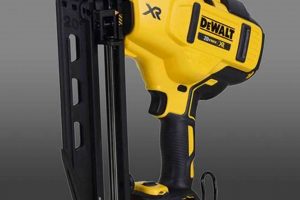
These slender fasteners, often measured in gauges exceeding 18, are designed to minimize visibility in finished woodworking projects. Their small head size allows them to be driven nearly flush with the surface, leaving a minimal hole that can be easily filled and concealed. An example of their application is in securing delicate trim work or attaching fine molding where a larger fastener would be aesthetically undesirable and could potentially split the wood.
The importance of using appropriate fasteners in woodworking cannot be overstated. The diminutive nature of these nails offers several benefits. They reduce the risk of splitting thin or fragile materials, preserve the aesthetic integrity of the finished piece, and allow for easier sanding and finishing. Historically, craftspeople relied on hand-forged brads and pins for similar applications. The modern iteration, manufactured with precision from various materials, represents a significant advancement in woodworking techniques.
The subsequent sections will delve into specific considerations for selecting the right gauge and length, examine the tools used for driving these fasteners, and explore best practices for achieving professional-looking results in a range of woodworking applications. The focus will be on ensuring secure attachment while maintaining the desired aesthetic outcome.
Tips for Utilizing Smallest Finish Nails
Employing these fine fasteners requires careful consideration to achieve optimal results and avoid potential issues. The following tips provide guidance for successful application in various woodworking and finishing tasks.
Tip 1: Select the Appropriate Gauge: The gauge of the fastener directly impacts its holding power and visibility. Higher gauge numbers indicate thinner nails, suitable for delicate materials where splitting is a concern. Lower gauge numbers provide increased strength for more robust applications.
Tip 2: Choose the Correct Length: The length of the fastener should be sufficient to penetrate deeply into the base material, ensuring a secure hold. A general guideline is to select a length that allows at least two-thirds of the nail to be embedded in the underlying wood. Excessive length can lead to protruding points or bending.
Tip 3: Employ a Nail Set: To avoid marring the surrounding surface, use a nail set to drive the head slightly below the wood’s surface. This allows for seamless filling and blending during the finishing process. Select a nail set with a tip diameter slightly smaller than the nail head.
Tip 4: Adjust Air Pressure (if using a nailer): When using a pneumatic finish nailer, adjust the air pressure to prevent over-driving the fasteners. Start with a lower pressure and gradually increase it until the nail is flush with the surface, without damaging the surrounding wood. Test on scrap material first.
Tip 5: Pre-Drill Pilot Holes (for Hardwoods): In dense hardwoods, pre-drilling pilot holes can prevent splitting and facilitate easier nail insertion. The pilot hole diameter should be slightly smaller than the diameter of the nail shank.
Tip 6: Space Nails Appropriately: Adequate spacing between fasteners ensures even distribution of holding power and prevents stress concentration. A general rule is to space nails approximately 1 to 2 inches apart, depending on the material thickness and the desired level of security.
Tip 7: Consider Adhesive Reinforcement: For applications requiring exceptional holding strength, combine the use of these fasteners with a suitable woodworking adhesive. This provides added bonding power and enhances the overall durability of the assembly.
Adhering to these guidelines contributes to achieving clean, professional-looking results when using these delicate fasteners, minimizing visibility and maximizing the aesthetic appeal of the finished project.
The subsequent section will address common problems encountered when using these fasteners and offer troubleshooting solutions.
1. Gauge Selection

Gauge selection is a fundamental consideration when working with these delicate fasteners. The gauge number directly correlates to the diameter of the nail shank; a higher gauge indicates a smaller diameter. The choice of gauge significantly influences the fastener’s holding power, visibility, and suitability for various materials.
- Holding Power and Material Integrity
Thinner, higher-gauge fasteners, such as 23-gauge nails, exert less stress on the material being fastened. This is particularly critical when working with delicate wood, thin trim, or fragile molding. A larger, lower-gauge nail may cause splitting or cracking in these materials, compromising the integrity of the finished piece. However, the reduced diameter also translates to lower holding power, making higher-gauge options unsuitable for applications requiring substantial strength.
- Visibility and Aesthetic Considerations
The primary advantage of using a high-gauge is the minimal visual impact it has on the finished surface. The small diameter of the nail shank and head results in a smaller entry hole, which is easier to conceal with wood filler or paint. This is crucial in applications where a clean, seamless appearance is desired, such as installing decorative trim or attaching delicate veneer. In contrast, a lower-gauge nail will leave a more noticeable mark, potentially detracting from the overall aesthetic.
- Tool Compatibility and Availability
The selection of gauge dictates the type of nail gun or hand-driving tool required. Higher-gauge nails typically require specialized nailers designed for fine finishing work. These nailers often feature precise depth adjustment and minimal recoil to prevent damage to delicate materials. The availability of specific gauges may also influence the selection process, as not all hardware stores carry the full range of options.
- Cost and Material Composition
The cost of these fasteners can vary depending on the gauge, material, and quantity purchased. Higher-gauge, specialized fasteners may be more expensive than their lower-gauge counterparts. The material composition, such as steel, stainless steel, or copper, also affects the price and suitability for different environments. Stainless steel is preferred for outdoor applications due to its resistance to corrosion, while steel is commonly used for interior projects.
In conclusion, the gauge selection for these fasteners involves a careful balance between holding power, aesthetic considerations, tool compatibility, and cost. The optimal choice depends on the specific requirements of the project, including the type of material being fastened, the desired level of visibility, and the necessary level of structural integrity. Careful consideration of these factors ensures that the selected gauge provides the best possible combination of performance and appearance.
2. Head Size

The head size of these fasteners is a critical dimension directly impacting their suitability for fine finishing work. Smaller head sizes are intrinsically linked to the utility of these fasteners, offering distinct advantages in applications where minimizing visibility is paramount. The relationship is cause-and-effect: a reduced head size leads to a less conspicuous finish. The importance of head size lies in its contribution to the overall aesthetic; a prominent head detracts from the clean lines and seamless appearance desired in finished carpentry. For example, when attaching delicate crown molding, a fastener with a large head would leave a noticeable indentation, requiring extensive filling and sanding to conceal. Conversely, a nail with a minimal head, often referred to as a headless pin, reduces the need for extensive post-installation work, preserving the integrity of the wood surface.
Practical applications further illustrate the significance of head size. Consider cabinet making, where drawer fronts and door panels require precise alignment and a flawless finish. The use of these fasteners with a reduced head size allows for subtle attachment without compromising the aesthetic. Similarly, in picture frame assembly, the head size directly affects the visual appeal of the finished product. Utilizing headless pins ensures that the focus remains on the artwork, rather than the method of securing the frame components. Furthermore, the material used for the head, whether steel or coated to match the surrounding surface, also contributes to its overall visibility. Selecting a fastener with a head designed for minimal visual impact is essential for achieving professional-grade results.
In summary, the reduced head size of these specialized fasteners directly contributes to their value in applications demanding a refined finish. The practical significance of understanding this relationship lies in the ability to select the appropriate fastener for a given task, minimizing post-installation work and preserving the aesthetic integrity of the project. Challenges may arise when balancing the need for a small head size with adequate holding power. In such cases, the use of adhesives in conjunction with these fasteners may be necessary. The connection between head size and overall aesthetic underscores the importance of meticulous attention to detail in fine woodworking and finishing.
3. Material Type

The selection of material type for these delicate fasteners is intrinsically linked to their performance and longevity in a given application. The material composition directly influences the fastener’s resistance to corrosion, its holding power within various substrates, and its visual impact on the finished project. The importance of material type stems from its role in ensuring structural integrity and preventing premature failure of the connection. For example, using standard steel nails in an outdoor application exposed to moisture will inevitably lead to rust, weakening the joint and potentially staining the surrounding wood. This necessitates the selection of corrosion-resistant materials such as stainless steel or specialized coatings for external use.
Practical applications illustrate the significance of material selection. In fine woodworking projects involving hardwoods, brass or copper fasteners may be preferred for their aesthetic compatibility and resistance to staining. These materials offer a softer appearance that complements the natural grain of the wood. Conversely, in construction applications requiring maximum holding power and resistance to shear forces, hardened steel fasteners are typically employed. The choice between bright, galvanized, or coated finishes depends on the specific environmental conditions and the desired level of concealment. Bright finish nails are suitable for interior applications where they will be covered with paint or filler, while galvanized or coated nails provide enhanced protection against corrosion in damp or humid environments. Furthermore, the shank design, such as smooth, barbed, or ringed, also affects the fastener’s holding power and suitability for different types of wood.
In summary, the material type of these fasteners profoundly affects their performance, durability, and aesthetic contribution to a project. Selecting the appropriate material requires careful consideration of the intended application, environmental conditions, and desired visual outcome. Challenges may arise when balancing the need for corrosion resistance with the desire for minimal visibility. The connection between material type and overall project success underscores the importance of informed decision-making in fastener selection.
4. Length Options
The available length options for these fasteners are a critical determinant of their applicability and performance in various woodworking and finishing tasks. Length dictates the depth of penetration into the materials being joined, directly influencing the holding power and stability of the connection. Inadequately sized fasteners fail to provide sufficient grip, leading to joint failure. Conversely, excessive length can result in protruding points or bending, compromising the aesthetic finish. This aspect is especially important when dealing with fragile materials that may split if too much force is applied.
Practical examples demonstrate the importance of selecting the correct length. When attaching thin trim to a cabinet face, a shorter fastener minimizes the risk of penetrating through the back of the cabinet. In contrast, securing baseboards to wall studs requires a longer fastener to ensure a solid connection through the drywall and into the supporting structure. The substrate material further influences the ideal length. Denser hardwoods necessitate a longer nail for adequate holding power compared to softer woods like pine. The angle of entry also plays a role; angled driving might require a slightly longer nail to achieve the desired penetration depth. For example, attaching shoe molding, often done at an angle, would require slightly longer nail to ensure it secures into the baseboard.
Therefore, understanding the relationship between fastener length, material thickness, substrate density, and application specifics is paramount for achieving secure and aesthetically pleasing results. A challenge arises when working with varying material thicknesses within the same project. In such cases, the selection may involve compromise or the use of multiple fastener lengths. The precise selection of appropriate length options significantly contributes to the overall quality and longevity of the finished product, highlighting the practical significance of this aspect in fine woodworking.
5. Application Method

The application method is intrinsically linked to the successful use of these delicate fasteners. The choice of application method influences the precision, speed, and ultimate quality of the finished connection. Whether employing manual techniques or utilizing pneumatic tools, careful consideration of the application method is crucial for achieving optimal results and minimizing potential damage to the surrounding material.
- Manual Hammering
Manual hammering, while requiring greater skill and precision, offers a tactile feedback that can be beneficial when working with delicate materials. The user has direct control over the force applied, reducing the risk of overdriving or splitting the wood. This method is particularly suitable for small-scale projects or intricate detailing where precision is paramount. However, manual hammering is significantly slower than pneumatic methods and can be fatiguing for larger projects.
- Pneumatic Nailers
Pneumatic nailers significantly increase the speed and efficiency of these fasteners’ application. These tools deliver consistent and controlled driving force, minimizing the risk of bending or damaging the fastener. However, careful adjustment of air pressure is essential to prevent overdriving, which can mar the surface of the workpiece. Pneumatic nailers are well-suited for larger projects and repetitive tasks where speed and consistency are crucial.
- Nail Sets
The use of nail sets is often necessary to drive the head of these fasteners slightly below the surface of the wood, allowing for seamless filling and finishing. A nail set is a small, hardened steel punch that is placed on the nail head and struck with a hammer. This technique requires precision to avoid damaging the surrounding wood. Nail sets are particularly important for achieving a professional-looking finish in fine woodworking projects.
- Pre-Drilling
In dense hardwoods, pre-drilling pilot holes can prevent splitting and facilitate easier nail insertion. The pilot hole diameter should be slightly smaller than the diameter of the fastener’s shank. This technique is particularly useful when working with hardwoods or when driving nails close to the edge of the wood. Pre-drilling adds an extra step to the application process but can significantly improve the quality and longevity of the finished connection.
The choice of application method for these fasteners ultimately depends on the specific requirements of the project, the type of materials being joined, and the desired level of precision and efficiency. Whether employing manual techniques or utilizing pneumatic tools, careful consideration of the application method is essential for achieving optimal results and ensuring the long-term integrity of the finished piece. The connection between application method and the successful use of smallest finish nails underscores the importance of skillful execution and attention to detail in woodworking and finishing.
6. Concealment Ability
Concealment ability, in the context of fine finishing, directly relates to the fastener’s capacity to blend seamlessly with the surrounding material, minimizing its visual impact. This characteristic is paramount when aesthetic considerations outweigh purely structural requirements. The reduced prominence of fasteners, due to their size and application method, ensures the focus remains on the craftsmanship of the piece, rather than the means of its assembly.
- Head Size and Profile
The head size is a primary factor influencing concealment ability. Smaller head sizes inherently present a reduced surface area for visual detection. Pin nails, for example, feature virtually nonexistent heads, allowing them to be driven almost entirely below the surface. The profile of the head, whether flat, cupped, or countersunk, also affects its visibility. Countersunk heads facilitate easier filling and blending, while flat heads, even when small, can still cast shadows that accentuate their presence.
- Material and Finish Matching
The material composition and finish of the fastener play a crucial role in its capacity to be concealed. Nails manufactured from materials that readily accept paint or stain, such as uncoated steel or brass, can be effectively disguised to match the surrounding wood. Conversely, fasteners with a glossy or reflective finish may draw unwanted attention, regardless of their size. The ability to select fasteners that complement the wood’s natural tone and texture contributes significantly to their overall concealment.
- Driving Technique and Depth Control
The method used to drive the fastener and the precision with which it is embedded directly impact its visibility. Overdriving the nail can damage the surrounding wood fibers, creating an unsightly depression that requires extensive filling. Conversely, underdriving leaves the head protruding, making it readily apparent. Precise depth control, achieved through careful manual hammering or the use of adjustable pneumatic nailers, is essential for maximizing concealment ability.
- Filling and Finishing Procedures
Even with meticulous attention to head size, material matching, and driving technique, minor imperfections may still be present. Filling the nail hole with a wood filler that closely matches the surrounding wood is a standard practice for achieving a seamless finish. Sanding the filler flush with the surface and applying a compatible finish, such as paint, stain, or varnish, further enhances the concealment. The skill with which these procedures are executed ultimately determines the success of the concealment effort.
Collectively, these facets demonstrate that concealment ability is not solely determined by the fastener itself, but also by the application techniques employed and the finishing procedures undertaken. Selecting the appropriate nail size represents only the first step in a process that demands attention to detail and a commitment to achieving a flawless aesthetic. The effectiveness of these delicate fasteners in maintaining visual harmony underscores their value in high-end woodworking and finishing applications.
7. Holding Power

Holding power, in the context of these delicate fasteners, refers to the capacity of the nail to resist withdrawal from the substrate material after insertion. While these fasteners excel in minimizing visual impact, their diminutive size inherently presents limitations in terms of holding strength. The interplay between these factors necessitates a careful balance between aesthetic considerations and structural integrity.
- Nail Shank Diameter and Surface Area
The diameter of the nail shank directly influences the surface area in contact with the surrounding wood fibers. A smaller diameter, characteristic of these fasteners, results in less frictional resistance to withdrawal. This reduced surface area necessitates careful consideration of the load-bearing requirements of the application. For instance, securing heavy moldings or applying significant stress to the joint may exceed the capabilities of these fasteners alone.
- Nail Length and Embedment Depth
The length of the nail and the depth to which it is embedded into the substrate are critical determinants of holding power. A longer nail, when fully embedded, provides greater resistance to withdrawal. However, the small size of these fasteners often limits the practical length that can be used without compromising aesthetics or increasing the risk of splitting the wood. Shallow embedment depths similarly reduce holding power, requiring careful assessment of the material thickness and density.
- Wood Density and Grain Orientation
The density of the wood and the orientation of the grain relative to the nail’s axis significantly affect holding power. Denser woods, such as oak or maple, offer greater resistance to withdrawal compared to softer woods like pine or cedar. Driving the nail perpendicular to the grain generally provides superior holding power compared to driving it parallel to the grain. The specific characteristics of the wood must be carefully considered when selecting these fasteners and assessing their suitability for a given application.
- Adhesive Reinforcement and Complementary Fastening Methods
To augment the holding power of these fasteners, adhesive reinforcement can be employed. Wood glues, when used in conjunction with the nails, provide additional bonding strength and resistance to withdrawal. In applications requiring significant load-bearing capacity, these fasteners may be used in combination with other fastening methods, such as screws or mechanical fasteners, to ensure structural integrity. These approaches serve to mitigate the inherent limitations in holding power associated with small finish nails.
The interplay between nail shank diameter, length, wood density, and the employment of adhesive reinforcement determines the overall holding power achievable with these fasteners. Their utility is maximized in applications where a clean aesthetic is prioritized, and the structural loads are within their limited capacity. For applications requiring greater strength, alternative fastening methods should be considered or combined with these delicate fasteners to achieve the desired balance of aesthetics and structural performance.
Frequently Asked Questions
This section addresses common inquiries regarding the application, selection, and limitations of these fine fasteners in woodworking and finishing tasks. The aim is to provide clear and concise answers to ensure optimal usage and project outcomes.
Question 1: What is the smallest gauge commonly available for finish nails?
The smallest commercially available gauge typically encountered is 23 gauge. These nails, often referred to as pin nails or micro pins, are characterized by their extremely fine diameter, rendering them suitable for delicate trim work and applications where minimal visibility is paramount.
Question 2: Are these nails suitable for structural applications requiring high load-bearing capacity?
No, due to their diminutive size and reduced shank diameter, these nails are not recommended for structural applications. Their primary function lies in securing lightweight materials and preserving aesthetic appeal, rather than providing significant load-bearing support. Alternative fastening methods should be employed for structural connections.
Question 3: What type of nail gun is required for driving the smallest gauge finish nails?
Specialized nail guns, specifically designed for fine finishing work, are required. These nailers feature a smaller nose piece and a more delicate driving mechanism to prevent damage to the surrounding material and ensure precise nail placement. Standard framing nailers are not appropriate for this purpose.
Question 4: How can splitting of the wood be prevented when using these nails in hardwoods?
Pre-drilling pilot holes, slightly smaller than the nail shank diameter, is highly recommended when working with hardwoods. This technique reduces the stress on the wood fibers during nail insertion, minimizing the risk of splitting. Additionally, carefully controlling the driving force, whether using manual or pneumatic methods, is crucial.
Question 5: What are the common materials used in manufacturing the smallest finish nails?
The most common materials are steel, often coated with a protective finish such as zinc or galvanization to prevent corrosion, and brass, which offers inherent corrosion resistance and aesthetic appeal. Stainless steel variants are also available for applications requiring maximum corrosion protection.
Question 6: How is the holding power of these nails maximized, given their small size?
Holding power can be enhanced by selecting the appropriate nail length, ensuring adequate penetration into the substrate material. Furthermore, the application of a suitable woodworking adhesive, in conjunction with these fasteners, provides added bonding strength and resistance to withdrawal.
The successful application of smallest finish nails hinges on a thorough understanding of their limitations and the appropriate techniques for maximizing their performance in specific woodworking and finishing contexts. Careful consideration of these factors ensures aesthetically pleasing and structurally sound results.
The subsequent section will delve into case studies illustrating best practices for using these fasteners in a variety of applications.
Conclusion
This exploration has delineated the characteristics, applications, and limitations associated with the smallest finish nails. Key considerations include gauge selection, material type, head size, length options, and proper application techniques, all of which profoundly impact the final outcome. These fasteners offer distinct advantages in achieving refined finishes where minimal visibility is paramount, provided their inherent limitations in structural applications are acknowledged and addressed.
Careful assessment of project requirements, material properties, and environmental factors is crucial for successful implementation. A discerning approach ensures that the benefits of these delicate fasteners are maximized, while mitigating potential risks to the integrity and longevity of the finished product. Further research and adherence to established best practices remain essential for continued advancements in woodworking and finishing techniques.