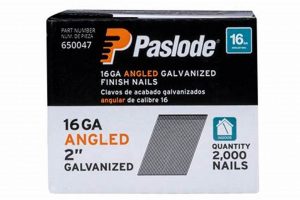
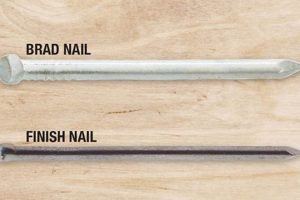
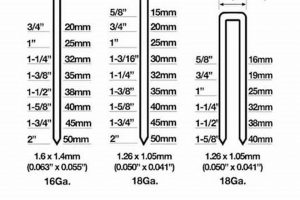
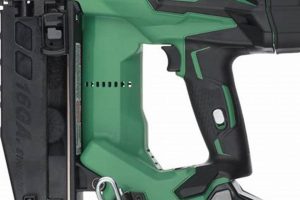
These fasteners, specifically designed for pneumatic finishing tools manufactured by Paslode, represent a critical component in trim and finish carpentry. They are typically collated strips of brads or angled finish nails, available in various gauges and lengths, intended for use within the specified nailer models. For instance, an 18-gauge brad nail, 1 1/4 inches long, would be an example of a commonly used type.
The significance of utilizing the correct fastener type stems from ensuring optimal tool performance, minimizing jamming, and achieving the desired aesthetic outcome. Employing these fasteners contributes to a professional, secure, and visually appealing finish in woodworking projects. Historically, the adoption of pneumatic nailers, and therefore, these specialized fasteners, has dramatically increased efficiency and precision compared to manual nailing methods.
The subsequent sections will delve into the specific gauges and lengths available, compatibility considerations with different Paslode finish nailer models, techniques for preventing common issues like nail bending or misfires, and best practices for selecting the appropriate fastener for various finishing applications.
Tips on Selecting and Using Paslode Finish Nailer Fasteners
The following guidelines offer practical advice for optimizing the performance and longevity of Paslode finish nailers through the correct selection and application of appropriate fasteners.
Tip 1: Consult the Nailer’s Manual: Always refer to the manufacturer’s specifications in the nailer’s manual to determine the acceptable gauge, length, and collation type of fasteners. Deviation from these recommendations can lead to tool malfunction or damage.
Tip 2: Match Fastener Length to Material Thickness: Select a fastener length that penetrates the material being fastened plus at least half the thickness of the receiving material. Insufficient penetration reduces holding power, while excessive length can protrude and require additional finishing.
Tip 3: Verify Fastener Collation: Ensure the fastener collation angle and material are compatible with the nailer’s magazine. Incorrect collation can cause feeding issues and jamming.
Tip 4: Inspect Fasteners Before Loading: Examine the fastener strips for signs of rust, damage, or bending. Discard any compromised fasteners to prevent tool malfunctions.
Tip 5: Adjust Nailer Depth Setting: Fine-tune the nailer’s depth setting to achieve a flush or slightly recessed nail head. This minimizes the need for filling and sanding, resulting in a cleaner finish.
Tip 6: Use Appropriate Safety Gear: Always wear safety glasses and hearing protection when operating a nailer. Errant fasteners or loud noise can cause serious injury.
Tip 7: Maintain Fastener Storage Conditions: Store fasteners in a dry environment to prevent corrosion. Moisture can weaken the collation and lead to feeding problems.
Tip 8: Consider Coating Type: Select fasteners with coatings appropriate for the environment. Galvanized or coated fasteners offer increased corrosion resistance in damp or exterior applications.
Adhering to these guidelines ensures proper tool operation, minimizes the risk of damage, and contributes to a professional quality finish on woodworking projects.
The subsequent sections will explore the specific applications of these fasteners in various woodworking tasks and delve into troubleshooting common issues encountered during use.
1. Gauge
Gauge, in the context of Paslode finish nailer nails, refers to the diameter of the fastener’s shank. This dimension directly impacts the holding power and the visibility of the nail head on the finished surface. A higher gauge number indicates a smaller diameter; consequently, an 18-gauge nail will be finer than a 15-gauge nail. Utilizing an inappropriate gauge can lead to either insufficient holding strength for the application or an unacceptably large and noticeable nail head, detracting from the aesthetic finish. For example, when attaching delicate trim, an 18-gauge fastener might be preferred to minimize splitting and visual impact. Conversely, for heavier trim or baseboards, a 15 or 16-gauge option may be necessary to provide adequate holding force.
The selection of the appropriate gauge also influences the type of Paslode finish nailer that can be used. Each nailer model is designed to accommodate specific gauge ranges. Attempting to use a fastener outside of the tool’s specified gauge can cause jams, misfires, and potentially damage the nailer. Consider the scenario where a user attempts to load 15-gauge nails into a nailer designed for 18-gauge fasteners; the larger diameter nails will not properly feed into the mechanism, rendering the tool inoperable and potentially causing internal damage.
In summary, gauge is a critical parameter in fastener selection for Paslode finish nailers. Proper matching of gauge to the application’s demands and the nailer’s specifications is essential for achieving a secure, aesthetically pleasing, and mechanically sound result. Failure to consider gauge can lead to both functional problems with the tool and aesthetic shortcomings in the finished project. Challenges include ensuring sufficient holding power while minimizing visual impact, necessitating a balanced approach based on the specific materials and intended use.
2. Length

The length of fasteners used in Paslode finish nailers is a critical parameter, directly impacting the integrity and appearance of the finished product. Selection of an appropriate length is essential for achieving secure fastening without compromising the aesthetic quality of the work.
- Material Thickness and Penetration
The fastener length must be adequate to penetrate both the material being fastened and the substrate. A general rule of thumb dictates that the fastener should penetrate the substrate by at least half the thickness of the material being fastened. For instance, when attaching a 1/2-inch trim piece to a wall stud, the fastener should penetrate the stud by at least 1/4 inch, requiring a fastener length of at least 3/4 inch. Insufficient penetration results in a weak hold, while excessive length may protrude, requiring additional finishing and potentially creating a safety hazard.
- Application Type and Load Requirements
The intended application dictates the required holding power. Applications subject to high stress or load, such as securing baseboards or crown molding, necessitate longer fasteners for increased shear strength. Conversely, delicate applications like attaching thin decorative trim may require shorter fasteners to minimize the risk of splitting the material. For example, securing heavy crown molding typically requires nails that are at least 2 inches in length, whereas attaching a small decorative fillet might only require 1-inch fasteners.
- Wood Type and Density
Different wood species possess varying densities, influencing fastener selection. Softer woods like pine require longer fasteners to achieve adequate holding power compared to denser hardwoods like oak or maple. This difference arises from the reduced resistance offered by softer materials. Consequently, when fastening two pieces of pine together, a longer nail is needed compared to joining two pieces of oak of the same thickness.
- Fastener Head Type and Countersinking
The type of fastener head and whether it is intended to be countersunk also influences length selection. When using fasteners with larger heads that sit proud of the surface, the fastener length must be adjusted accordingly. If the fastener is intended to be countersunk and filled, additional length may be necessary to accommodate the countersinking depth. An example is using a finish nail with a small head that is designed to be flush with the surface, which requires a shorter overall length than a brad nail that may be slightly countersunk and filled.
In summary, fastener length is a critical determinant of performance when utilizing Paslode finish nailers. Balancing the requirements of material thickness, application demands, wood density, and fastener head type ensures both a secure and aesthetically pleasing outcome. Ignoring these factors can lead to structural weaknesses, visual imperfections, and compromised overall quality of the finished work.
3. Collation

Collation, in the context of Paslode finish nailer nails, refers to the method by which individual fasteners are joined together to form a strip or coil. This assembly facilitates automated feeding into the nailer, ensuring consistent and efficient operation. The type of collation directly impacts the compatibility of the fastener with specific nailer models and influences the overall performance of the tool.
- Strip Collation (Linear)
Strip collation involves joining nails in a straight line using an adhesive or thin wire. These strips are loaded into the nailer’s magazine. The angle of the strip, typically straight or angled (e.g., 21 degrees or 34 degrees), must match the nailer’s specifications. Using an incorrect strip angle will prevent proper feeding. For instance, attempting to load a 34-degree strip into a nailer designed for 21-degree strips will result in jamming and tool malfunction. This collation method is common for framing and some finishing applications.
- Coil Collation (Circular)
Coil collation arranges the nails in a circular fashion, held together by wire or plastic. These coils contain a significantly higher number of fasteners than strips, reducing the frequency of reloading. Coil-fed nailers are often used in high-volume applications like sheathing or decking, where continuous operation is paramount. Compatibility is crucial; a Paslode finish nailer designed for strip collation cannot accept coil-collated fasteners and vice versa. The specific coil size and fastener orientation must match the nailer’s requirements.
- Adhesive Type and Environmental Considerations
The type of adhesive used in strip or coil collation can influence performance, particularly in varying environmental conditions. Some adhesives become brittle in cold temperatures, leading to strip breakage and feeding problems. Others may soften in high humidity, causing the fasteners to stick together. Selecting fasteners with an adhesive suitable for the expected working environment is essential. For example, a contractor working outdoors in winter may need to choose fasteners with a cold-weather adhesive to prevent malfunctions.
- Material of Collation (Plastic vs. Wire)
The material used for collation, whether plastic or wire, affects the cleanliness of the work environment and the potential for debris accumulation in the nailer. Plastic collation typically results in small plastic fragments being ejected during use, while wire collation produces small wire pieces. These fragments can accumulate and interfere with the nailer’s mechanisms. Regular cleaning of the nailer is necessary to prevent malfunctions caused by collation debris. The choice of collation material may also depend on personal preference or specific job requirements.
Therefore, understanding the nuances of collation is paramount when selecting fasteners for Paslode finish nailers. The collation type, angle, adhesive properties, and material directly impact the nailer’s performance, reliability, and the overall quality of the finished work. Mismatched or unsuitable collation can lead to tool damage, increased downtime, and compromised fastening results.
4. Material

The material composition of Paslode finish nailer nails exerts a significant influence on their performance, durability, and suitability for diverse applications. Selecting the appropriate material is critical to ensuring secure fastening and preventing corrosion or other forms of degradation.
- Steel Composition and Hardness
The steel alloy used in the nail’s construction dictates its hardness and tensile strength. Higher carbon content generally increases hardness but may also reduce ductility, potentially leading to brittleness and breakage. A properly hardened nail resists bending during driving and provides superior holding power. For instance, nails used in hardwood applications require a higher degree of hardness compared to those used in softwood. The steel’s temper also affects performance, ensuring the nail can withstand driving forces without deforming. Inadequate hardness can result in bent nails and failed fastenings.
- Surface Coating and Corrosion Resistance
Various surface coatings, such as galvanization (zinc coating) or polymer coatings, enhance corrosion resistance, extending the lifespan of the fastener and preventing staining of the surrounding wood. Galvanized nails are often employed in exterior applications or environments with high humidity. Polymer coatings offer additional protection and can also provide a degree of color matching to the finished surface. The thickness and uniformity of the coating are critical factors in determining its effectiveness. Inadequate coating thickness leaves the base metal vulnerable to corrosion, compromising the integrity of the joint.
- Fastener Head Material and Design
While the shank of the nail is typically steel, the head can be designed with variations in material treatment. Some nails have specialized head designs, such as brad heads or T-heads, which influence their visibility and holding power. The head material must be strong enough to withstand the impact force of the nailer without deforming or breaking. Properly designed nail heads ensure consistent setting depth and minimize the risk of blow-through. Inadequate head design or material strength can lead to inconsistent finishes and potential safety hazards.
- Adhesive Material and Strength
The adhesive used to collate the nails into strips or coils is also a critical material component. The adhesive must be strong enough to hold the nails together during handling and loading but must release cleanly during firing. The type of adhesive affects the nailer’s performance and the potential for residue buildup. Some adhesives are more susceptible to temperature variations or humidity, leading to premature strip breakage. Selecting nails with a durable and consistent adhesive ensures smooth operation and minimizes tool maintenance.
The material properties of Paslode finish nailer nails, encompassing the steel composition, surface coating, head design, and collation adhesive, are fundamental considerations in achieving reliable and aesthetically pleasing results. Proper material selection, aligned with the specific application and environmental conditions, ensures optimal fastening performance and long-term durability of the finished work.
5. Coating

The coating applied to Paslode finish nailer nails directly affects their performance, longevity, and suitability for various applications. As a protective layer applied to the base metal, the coating primarily serves to mitigate corrosion, reduce friction during driving, and, in some cases, enhance aesthetic appeal. The selection of an appropriate coating is therefore paramount to ensuring the fastener’s structural integrity and preventing premature failure. For instance, the absence of a protective coating on steel nails exposed to a humid environment will inevitably lead to oxidation, weakening the nail and potentially causing staining on the surrounding wood.
Different coating types offer varying degrees of protection and possess distinct characteristics. Galvanization, a process involving the application of a zinc layer, provides effective corrosion resistance, making galvanized finish nails suitable for outdoor applications or areas prone to moisture. Polymer coatings, on the other hand, can offer enhanced protection and can also be color-matched to the material being fastened, minimizing visual impact. The choice between these and other coating options, such as phosphate coatings for enhanced paint adhesion, depends on the specific requirements of the project and the environmental conditions to which the finished product will be exposed. Employing the wrong coating, or none at all, can compromise the integrity of the fastening and lead to costly repairs.
In summary, the coating on Paslode finish nailer nails is not merely a superficial detail but a critical component influencing their performance and durability. Careful consideration of the application environment and the specific properties of different coating types is essential for selecting the appropriate fastener and ensuring long-term reliability. Addressing potential challenges, such as coating damage during driving, often necessitates adjusting nailer settings or using specialized nail designs. A comprehensive understanding of coating types and their implications is therefore integral to achieving optimal fastening results in woodworking and construction projects.
6. Compatibility
The term “Compatibility,” when directly associated with Paslode finish nailer nails, denotes the precise alignment between the physical and functional characteristics of the fasteners and the specific nailer models designed to use them. This alignment extends beyond mere fit; it encompasses gauge, length, collation type, and head design to ensure reliable feeding, proper driving, and optimal performance. A mismatch in any of these factors can lead to nailer malfunctions, such as jamming, misfires, or damage to the tool itself. For instance, a Paslode nailer designed for 16-gauge nails will invariably malfunction if loaded with 18-gauge nails due to the discrepancy in shank diameter, disrupting the internal mechanisms of the tool. This underscores the critical role of compatibility in achieving intended results.
Real-world examples further illustrate the significance of compatibility. A contractor using the incorrect collation typeattempting to use a coil-collated nail in a strip-fed nailerwould immediately encounter feeding issues, rendering the tool unusable. Similarly, using nails that are too long for the application, even if they are of the correct gauge and collation, can result in the nail protruding through the back of the material, compromising both aesthetics and structural integrity. Therefore, adhering to the manufacturer’s specifications regarding fastener compatibility is not merely a suggestion, but a prerequisite for safe and effective operation. This understanding also extends to the angle of the nail strips, ensuring seamless feeding into the nailer.
In conclusion, compatibility is not a trivial attribute of Paslode finish nailer nails; it is a fundamental requirement dictating the operational effectiveness and longevity of the nailer. The cause-and-effect relationship between fastener selection and nailer performance is direct and undeniable. Selecting fasteners without verifying compatibility invites operational challenges and potential damage to the tool. The practical significance lies in maintaining both efficiency and quality in woodworking and construction tasks. Adherence to compatibility guidelines, as specified by Paslode, is paramount for professionals and DIY enthusiasts alike, ensuring the reliable and consistent performance of Paslode finish nailers.
Frequently Asked Questions
The following section addresses common inquiries concerning fasteners specifically designed for Paslode finish nailers. These questions aim to provide clarity on optimal usage and selection practices.
Question 1: What fastener gauge is appropriate for securing trim to drywall?
The selection depends on the trim’s thickness and weight. An 18-gauge brad nail is typically sufficient for lightweight trim, while a 16-gauge finish nail may be preferable for heavier pieces or those requiring greater holding power. Proper penetration into the underlying stud or framing is essential.
Question 2: Can generic fasteners be used in Paslode finish nailers?
While some generic fasteners may appear compatible, using those not specifically designed for Paslode nailers can lead to performance issues, including jamming and misfires. The specified collation, gauge, and length ensure optimal tool functionality and prevent damage.
Question 3: How does fastener length affect the quality of the finished product?
Insufficient length results in a weak hold, while excessive length can protrude through the material, requiring filling and sanding. The fastener length should penetrate the receiving material by at least half the thickness of the material being fastened.
Question 4: What are the implications of using corroded fasteners?
Corroded fasteners exhibit reduced holding power and can stain the surrounding wood. Furthermore, rust can damage the internal mechanisms of the nailer. Always inspect fasteners before use and discard any showing signs of corrosion.
Question 5: How frequently should Paslode finish nailers be cleaned to prevent issues related to fasteners?
The frequency depends on usage, but regular cleaning is recommended, particularly the nail magazine and driver blade. Accumulated debris from fastener collation can cause feeding problems and misfires. Refer to the manufacturer’s guidelines for detailed cleaning instructions.
Question 6: What considerations are important when selecting fasteners for exterior applications?
For exterior projects, corrosion-resistant fasteners are essential. Galvanized or stainless-steel nails are preferred to withstand exposure to moisture and the elements. Selecting fasteners with appropriate coatings minimizes the risk of rust and extends the lifespan of the project.
These FAQs address crucial aspects of selecting and utilizing Paslode finish nailer nails. Proper fastener selection and maintenance practices are paramount for achieving professional results and ensuring tool longevity.
The subsequent article sections will provide information about other tools
Conclusion
This exploration has underscored the critical role of appropriate fastener selection when utilizing Paslode finish nailers. The various aspects of these fasteners – gauge, length, collation, material, and coating – are not independent variables, but interconnected factors directly influencing tool performance and the quality of finished work. A comprehensive understanding of these properties is essential for any individual involved in trim carpentry or similar applications.
The continued adherence to manufacturer specifications and best practices in fastener selection will ensure optimal functionality, minimize equipment downtime, and contribute to enduring, aesthetically pleasing results. The diligent application of this knowledge fosters both efficiency and professionalism in the pursuit of quality craftsmanship. Furthermore, maintaining awareness of advancements in fastener technology and materials will contribute to ongoing improvements in woodworking practices.