![Nailing It: What Size Finish Nails for Baseboard? [Guide]](data:image/svg+xml;base64,PHN2ZyB4bWxucz0iaHR0cDovL3d3dy53My5vcmcvMjAwMC9zdmciIHdpZHRoPSI0NzQiIGhlaWdodD0iNTUiIHZpZXdCb3g9IjAgMCA0NzQgNTUiPjxyZWN0IHdpZHRoPSIxMDAlIiBoZWlnaHQ9IjEwMCUiIHN0eWxlPSJmaWxsOiNjZmQ0ZGI7ZmlsbC1vcGFjaXR5OiAwLjE7Ii8+PC9zdmc+ "Nailing It: What Size Finish Nails for Baseboard? [Guide] Best Final Touch: Elevate Your Projects with Professional Finishing")
The appropriate fastener length for securing baseboard trim is determined by several factors, primarily the thickness of the baseboard itself and the material into which it is being attached (e.g., drywall, plaster, or wood studs). Generally, longer fasteners offer a more secure hold, preventing the trim from pulling away from the wall over time. For instance, a baseboard that is 1/2 inch thick, being installed into drywall backed by wood studs, would typically require fasteners long enough to penetrate a sufficient distance into the stud to ensure solid adhesion.
Selecting the correct length and gauge of these fasteners is crucial for achieving a professional and lasting installation. Undersized fasteners may not adequately secure the baseboard, leading to nail pops and a loose trim. Conversely, overly long fasteners can pass completely through the wall studs or cause damage to the baseboard itself. Historically, carpenters relied on experience and visual assessment to choose the right fastener. Modern guidelines and fastener options offer a more precise and reliable approach, reducing the likelihood of installation errors and improving the overall longevity of the trim work.
The following sections will delve into specific recommendations for fastener dimensions, considering variations in baseboard thickness, wall construction materials, and desired aesthetic outcomes. Best practices for installation techniques that maximize the effectiveness of the chosen fasteners will also be discussed. This information aims to provide a comprehensive understanding of fastener selection for baseboard installation.
Fastener Selection Guidelines for Baseboard Installation
Optimal baseboard attachment relies on selecting appropriate fasteners. These guidelines address critical considerations for ensuring a secure and aesthetically pleasing installation.
Tip 1: Account for Baseboard Thickness. Measure the baseboard’s thickness accurately. The fastener length should extend at least one inch into the wall stud or backing material beyond the baseboards back surface. A baseboard with a 5/8 inch thickness typically benefits from a fastener at least 1 5/8 inches long.
Tip 2: Match Fastener Gauge to Wood Density. Softer woods like pine require a smaller gauge fastener (e.g., 18 gauge) to prevent splitting. Harder woods like oak may accommodate a larger gauge (e.g., 15 or 16 gauge) for increased holding power.
Tip 3: Consider Wall Material Composition. Drywall offers minimal holding strength. Always aim to anchor fasteners into underlying studs. In cases where stud access is limited, construction adhesive can supplement mechanical fastening.
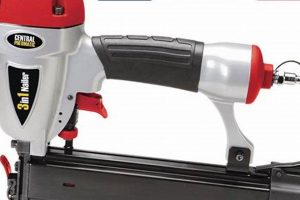
Tip 4: Employ a Nail Gun for Precision and Efficiency. A pneumatic or cordless nail gun ensures consistent fastener depth and spacing, leading to a more uniform and professional finish. Adjust the gun’s pressure to prevent over-driving, which can damage the baseboard surface.
Tip 5: Pre-Drill Pilot Holes in Hardwoods. When working with dense hardwoods, pre-drilling pilot holes minimizes the risk of splitting the wood. The pilot hole diameter should be slightly smaller than the fastener shank diameter.
Tip 6: Utilize a Consistent Fastener Spacing Pattern. Maintain a consistent spacing interval along the baseboard’s length, typically between 12 and 16 inches, depending on wall straightness and the baseboard’s flexibility. Closer spacing may be necessary in areas with significant wall irregularities.
Tip 7: Test Fastener Holding Power. Before committing to full installation, test the fastener’s grip by driving a few fasteners into representative sections of the wall. If the fastener pulls out easily, consider using a longer or larger gauge fastener, or supplemental adhesive.
Selecting fasteners according to these guidelines minimizes installation errors, enhances the longevity of the trim work, and contributes to an overall improved aesthetic quality. Attention to detail during fastener selection is a crucial element of successful baseboard installation.
The subsequent sections will address aesthetic considerations in fastener selection, including countersinking and filling techniques.
1. Baseboard Thickness

The dimension of “Baseboard Thickness” is a primary determinant in selecting appropriate fasteners for secure and aesthetically pleasing trim installation. The relationship between the board’s dimension and fastener length ensures the nail extends adequately into the wall stud, providing the necessary holding power.
- Minimum Nail Penetration
The primary goal is to achieve a minimum of one inch of nail penetration into the structural framing member, typically a wood stud. Therefore, the fastener’s length must exceed the baseboard’s thickness by at least this amount. For instance, a 1/2-inch thick baseboard necessitates a fastener that is at least 1 1/2 inches long to satisfy this requirement. Insufficient penetration leads to a compromised hold, resulting in nail pops and potential trim detachment.
- Accounting for Drywall Thickness
When baseboard is installed over drywall, the fastener must traverse this material before reaching the underlying stud. Standard drywall thickness is 1/2 inch or 5/8 inch. These dimensions must be factored into the overall calculation. Consider a 5/8-inch drywall covering a stud and a 1/2-inch thick baseboard. The appropriate fastener length should be at least 2 5/8 inches (5/8″ drywall + 1/2″ baseboard + 1 1/2″ stud penetration). Neglecting the drywall thickness results in inadequate stud engagement.
- Maximum Nail Length Considerations
While sufficient penetration is vital, excessively long fasteners pose risks. Overly long fasteners may protrude through the back of the wall or create unnecessary damage within the stud. A balance between adequate penetration and avoiding excessive length is essential. Evaluate wall construction to avoid contact with electrical wiring or plumbing lines within the wall cavity. A fastener length that is marginally longer than the calculated minimum provides a safety margin without risking unintended consequences.
- Fastener Head Countersinking
The baseboard’s thickness also influences the ease and effectiveness of countersinking the fastener head. Thicker baseboards provide more material to conceal the countersunk nail head with wood filler or putty. Conversely, very thin baseboards may not allow sufficient material for effective concealment. Therefore, the material available and the fastener’s design are important in achieving a smooth, finished surface.
In summary, baseboard thickness dictates minimum fastener length for adequate stud penetration, necessitating consideration of drywall thickness. Balancing penetration with preventing over-extension avoids wall damage. These interdependencies reinforce the centrality of correct measurement in the selection process.
2. Wall Stud Location

The effectiveness of baseboard installation is directly dependent on the precise determination of wall stud location. The primary purpose of fasteners is to secure the baseboard to the structural framing of the wall, primarily wood studs. When a fastener, even one of appropriate gauge and length, fails to penetrate adequately into a stud, it anchors solely within the drywall, an inherently weak material offering negligible holding power. This results in loose baseboard, nail pops, and a compromised aesthetic. Consider a scenario where a carpenter, unaware of the precise stud placement, drives a 2-inch fastener through half-inch drywall. If the stud is missed by even a small margin, the fastener’s holding capacity is drastically reduced, rendering the installation ineffective. A stud finder is useful to minimize errors.
Accurate stud location enables informed fastener selection. Once the carpenter knows the stud’s position behind the wall, the fastener length can be calculated based on the combined thickness of the baseboard and the drywall, plus a minimum of one inch penetration into the stud. In instances where studs are not regularly spaced or are difficult to locate, additional measures are necessary. Construction adhesive can supplement mechanical fastening, providing a temporary bond while the fastener cures. Alternatively, bridging techniques using small blocks of wood secured to adjacent studs can create a localized anchor point for the baseboard in areas where a stud is inaccessible. A combination of these techniques helps ensure the structural integrity of the installation.
In summary, wall stud location is an indispensable factor in determining the appropriate fastener length. Accurate stud identification is vital for proper fastener selection and secure baseboard attachment. Failing to properly consider it increases the risk of installation failure and diminished aesthetic value. Therefore, the time invested in accurately identifying stud positions represents a crucial component of successful baseboard installation.
3. Material Density

The density of both the baseboard material and the underlying wall studs is a critical determinant in selecting appropriate fasteners. Higher-density materials, such as hardwoods like oak or maple, require fasteners with greater shear strength and holding power to ensure a secure and lasting connection. Conversely, lower-density materials, such as pine or MDF (Medium-Density Fiberboard), are more prone to splitting or damage if overly aggressive fasteners are used. For instance, attempting to drive a thick, coarse fastener into a pine baseboard may cause the wood to split along the grain, compromising the integrity of the installation. The goal is to select a fastener that provides adequate holding force without causing structural damage to either the baseboard or the wall stud. The wall stud can also play a role. For instance, oak baseboard attached to pine studs needs an appropriately sized fastener that will sit tight in the oak while providing suitable grip within the pine.
Different fastener gauges and finishes are available to address material density considerations. Smaller gauge fasteners (e.g., 18 gauge) are typically preferred for softer woods to minimize the risk of splitting, while larger gauge fasteners (e.g., 15 or 16 gauge) offer increased holding power for denser materials. Additionally, pre-drilling pilot holes is a common practice when working with hardwoods to further reduce the likelihood of splitting and ensure proper fastener placement. The fastener material itself can also influence the outcome; hardened steel fasteners are better suited for penetrating dense hardwoods than softer materials. Applying these adjustments based on the materials at hand greatly influences the fastener length. A dense wood will require a longer fastener to penetrate deeper while a soft wood will not.
In summary, understanding the material density of both the baseboard and the wall studs is essential for selecting the appropriate fastener. A careful balance must be struck between achieving sufficient holding power and avoiding material damage. Factors such as fastener gauge, pre-drilling, and fastener material should be considered to optimize the installation’s structural integrity and aesthetic appeal. Correct material density assessment contributes to a lasting baseboard installation.
4. Fastener Gauge

Fastener gauge, a measurement of wire diameter, is a crucial determinant in the selection of appropriate fasteners for baseboard installation. It directly influences the holding power and the potential for splitting or damaging the baseboard material. Choosing the correct gauge is therefore critical for a secure and aesthetically pleasing installation.
- Holding Power and Withdrawal Resistance
A larger gauge indicates a thicker fastener, resulting in greater surface area in contact with the surrounding wood fibers. This increased surface area translates to enhanced holding power and resistance to withdrawal, preventing nail pops and ensuring the baseboard remains securely attached over time. However, increasing the gauge beyond a certain point can have detrimental effects, especially in softer woods.
- Risk of Splitting and Material Damage
Conversely, an excessively large gauge can exert undue stress on the wood fibers, leading to splitting, especially near the ends of the baseboard or in areas with tight grain patterns. This is particularly relevant when working with hardwoods, where pre-drilling pilot holes may be necessary to mitigate the risk of splitting. Selecting a smaller gauge reduces the likelihood of such damage, but may compromise holding power if the selected gauge is too small.
- Compatibility with Nail Guns
Fastener gauge directly dictates compatibility with various nail gun models. Each nail gun is designed to accommodate a specific range of fastener gauges. Attempting to use fasteners outside the gun’s specified range can result in malfunctions, misfires, and damage to the tool. Consulting the manufacturer’s specifications and selecting the appropriate fasteners for the tool are essential for safe and efficient installation.
- Aesthetic Considerations and Concealment
The gauge of the fastener also impacts the aesthetic outcome of the installation. Larger gauge fasteners create larger entry holes, requiring more extensive filling and sanding to achieve a seamless finish. Smaller gauge fasteners, while easier to conceal, may not provide adequate holding power for heavier or thicker baseboards. The selection process should consider the desired aesthetic outcome and the trade-offs between concealment and structural integrity.
Therefore, fastener gauge is an interrelated factor with baseboard dimensions, material density, and the tools employed. Understanding the effect of gauge size is a factor to baseboard attachment.
5. Aesthetic Outcome

The relationship between fastener selection and the visual appeal of baseboard installation is direct. Fasteners, despite their structural role, inherently impact the final aesthetic. The gauge and countersinking depth influence the visibility of the fastener itself, and the effectiveness of subsequent filling and finishing processes. For instance, an inappropriately large fastener gauge leaves a more prominent hole, demanding more filler and potentially resulting in a visible patch. Conversely, a fastener that is not properly countersunk protrudes above the surface, creating a noticeable imperfection that is difficult to conceal effectively. Therefore, choosing fasteners with dimensions appropriate for achieving a clean, seamless appearance is critical.
Achieving a high-quality aesthetic requires a balance between fastener strength and minimal visual intrusion. Strategies include employing smaller gauge fasteners when structurally feasible, utilizing nail sets to consistently countersink fasteners to the appropriate depth, and selecting wood fillers or putties that closely match the baseboard’s color and grain. In high-end installations, carpenters may opt for hidden fastening systems, which eliminate the need for visible fasteners altogether. This is done by attaching the baseboard using adhesive and/or concealed clips or brackets. Such a method requires careful planning and execution, but it results in a visually flawless finish. This approach highlights the extent to which aesthetic considerations can influence fastener selection and installation techniques.
In summary, fastener dimensions directly influence the aesthetic outcome of baseboard installation. Careful consideration of fastener gauge, countersinking depth, and concealment techniques are essential for achieving a professional-looking result. While structural integrity remains paramount, ignoring the aesthetic implications of fastener selection can detract from the overall quality of the finished space. Awareness of the interplay between these factors enhances the final visual appeal of the trim work. The appropriate choice contributes to both function and beauty.
Frequently Asked Questions
The following questions address common concerns and misconceptions regarding fastener selection for baseboard installation, offering clarity on best practices.
Question 1: What is the universally recommended dimension of fastener suitable for all baseboard installations?
No universally applicable fastener dimension exists. The appropriate length and gauge vary depending on the baseboard’s thickness, the material of the wall studs, and the desired aesthetic outcome. A dimension appropriate for one installation may be unsuitable for another.
Question 2: Does fastener length take precedence over fastener gauge, or vice versa?
Both fastener length and gauge are of equal importance. Insufficient length compromises holding power, while an inappropriate gauge risks splitting the baseboard. An optimal balance between these factors is crucial for successful installation.
Question 3: Is it possible to substitute construction adhesive for fasteners entirely?
While construction adhesive can augment mechanical fastening, it should not be considered a complete substitute. Fasteners provide the necessary clamping force while the adhesive cures, ensuring a lasting bond. Relying solely on adhesive increases the risk of failure.
Question 4: What measure will minimize the visibility of fasteners without compromising the integrity of baseboard?
Employing smaller gauge fasteners when structurally viable, carefully countersinking fastener heads, and using color-matched wood filler or putty can reduce the prominence of fasteners without sacrificing holding power. Hidden fastening systems offer a completely fastener-free aesthetic.
Question 5: Does the age of the wall studs influence the selection of dimensions?
Yes, the age and condition of the wall studs affect fastener selection. Older, drier studs may be more brittle and prone to splitting, necessitating smaller gauge fasteners and pre-drilling. Newer, softer studs may require longer fasteners for adequate penetration.
Question 6: How often is it necessary to adjust fastener dimensions to ensure secure installation?
Fastener dimensions may require adjustment throughout the installation process to accommodate variations in wall straightness, stud location, and baseboard material. Periodic assessment and adaptation are essential for maintaining consistent holding power.
In summary, selecting fasteners appropriately is a nuanced process. Careful consideration of all relevant factors, combined with vigilant monitoring during installation, helps ensure a secure and visually pleasing result.
The subsequent sections will address specialized applications and advanced techniques in baseboard installation.
Conclusion
The preceding discussion has underscored the multi-faceted considerations inherent in determining what size finish nails for baseboard are appropriate for a given installation. Factors ranging from baseboard thickness and material density to stud location and desired aesthetic outcomes necessitate a nuanced and informed approach. The selection process is not formulaic; rather, it demands careful assessment of each project’s unique characteristics to ensure a secure and visually appealing result. The interplay between these elements necessitates a comprehensive understanding of their individual impact and collective influence.
The information presented serves as a framework for informed decision-making. The responsible application of these guidelines fosters durable, visually consistent, and structurally sound baseboard installations. Continued diligence in material assessment and installation technique refinement remains paramount, ensuring that baseboard trim serves both its functional and aesthetic purposes effectively within built environments.