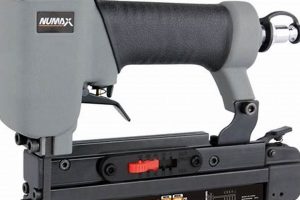
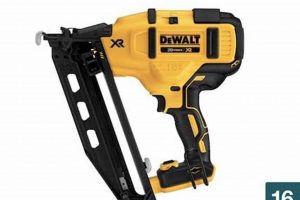
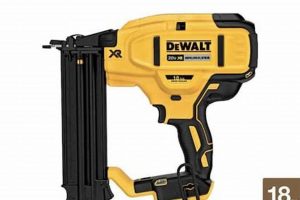
A pneumatic tool designed for driving 16-gauge finish nails into wood surfaces, often utilized in trim work, cabinetry, and other fine woodworking applications, represents a specific category of power tools. These tools are characterized by their ability to precisely and efficiently fasten materials without leaving prominent nail heads, resulting in a clean, professional finish. Examples of applications include installing crown molding, baseboards, door and window casings, and assembling furniture components.
The utilization of such a tool offers several advantages, including increased speed and efficiency compared to manual nailing, consistent nail depth, and reduced risk of damaging delicate materials. Historically, these tasks were performed manually, requiring significant time and skill. The introduction of pneumatic nailers has significantly improved productivity and accessibility for both professional carpenters and DIY enthusiasts. The affordability of certain brands further democratizes access to these tools.
The subsequent discussion will delve into considerations regarding the selection, operation, and maintenance of these tools, focusing on key features, safety precautions, and troubleshooting common issues, as well as comparing different models and brands available on the market to assist in informed decision-making.
Operating Tips for a 16 Gauge Finish Nailer
Proper operation and maintenance of a 16 gauge finish nailer are crucial for ensuring safe and effective use, maximizing the tool’s lifespan, and achieving high-quality results in woodworking projects.
Tip 1: Air Pressure Regulation: Always regulate air pressure according to the manufacturer’s specifications. Excessive pressure can drive nails too deep, damaging the workpiece, while insufficient pressure may result in nails not being fully set.
Tip 2: Consistent Contact: Maintain consistent and firm contact between the nailer’s safety contact tip and the workpiece surface. Inconsistent contact can lead to misfires or angled nail placement.
Tip 3: Proper Nail Selection: Utilize only 16-gauge finish nails that are compatible with the nailer. Incorrect nail sizes or types can jam the tool or damage its internal components.
Tip 4: Regular Lubrication: Regularly lubricate the nailer with pneumatic tool oil. Proper lubrication reduces friction, prevents premature wear, and ensures smooth operation.
Tip 5: Careful Storage: When not in use, store the nailer in a clean, dry environment. This prevents corrosion and damage to sensitive parts.
Tip 6: Pre-Test on Scrap Material: Before commencing work on a project, test the nailer on a piece of scrap material. This allows for pressure adjustments and ensures the nailer is functioning correctly.
Tip 7: Wear Safety Glasses: Always wear safety glasses to protect eyes from flying debris. Although finish nailers are designed to minimize risk, wood splinters or nail fragments can become projectiles.
These tips, when followed diligently, will contribute to a safer and more efficient workflow, extending the service life of the tool and improving the quality of finished projects.
Adherence to these operational guidelines will optimize the performance of the finish nailer, leading to superior woodworking outcomes.
1. Affordability

Affordability serves as a primary consideration for many consumers in the power tool market. With the 16 ga finish nailer offered by Harbor Freight, the economic aspect often becomes a key differentiator, influencing purchasing decisions and impacting project feasibility for both professionals and hobbyists.
- Initial Purchase Cost
The initial investment required to acquire this type of nailer is generally lower compared to equivalent models from established brands. This reduced upfront expense broadens accessibility, particularly for individuals or businesses operating with constrained budgets or those initiating small-scale projects. This lower barrier to entry, however, often warrants a comprehensive evaluation of long-term costs, including maintenance and potential replacement expenses.
- Total Cost of Ownership
While the initial price may be attractive, the total cost of ownership incorporates factors such as the durability of the tool, its operational efficiency, and the potential for repairs. A less expensive nailer may necessitate more frequent maintenance or have a shorter lifespan, ultimately offsetting the initial savings. Evaluating the availability and cost of replacement parts, as well as the energy consumption if pneumatically powered, contributes to a comprehensive assessment of long-term financial implications.
- Impact on Project Scope
The affordability of a tool directly influences the scope and feasibility of projects. A lower-cost nailer can enable individuals to undertake projects that might otherwise be financially prohibitive. However, any limitations in the tool’s performance or reliability could compromise the quality of the finished product or extend the project timeline. Therefore, aligning the tool’s capabilities with the specific demands of the project is essential to ensure satisfactory results.
- Competitive Positioning
The “harbor freight 16 ga finish nailer” occupies a distinct position within the competitive landscape, often appealing to budget-conscious consumers seeking a functional tool without the premium price tag. This positioning necessitates a trade-off between price and features, potentially affecting performance, build quality, and warranty coverage. A thorough comparison with alternative options allows consumers to weigh these factors and make informed decisions based on their individual needs and priorities.
In summary, while the affordability of the “harbor freight 16 ga finish nailer” presents an attractive proposition, a comprehensive evaluation of its total cost of ownership, impact on project scope, and competitive positioning is essential. By carefully considering these factors, consumers can determine whether the tool aligns with their specific requirements and budgetary constraints, ensuring a satisfactory and cost-effective outcome.
2. Gauge Compatibility

Gauge compatibility is a critical specification dictating the range of nail sizes a particular nailer can effectively utilize. In the context of a “harbor freight 16 ga finish nailer,” this characteristic defines the tool’s operational parameters and determines its suitability for various woodworking and finishing tasks. Mismatched gauges can lead to tool malfunction, project failure, or safety hazards.
- Nail Diameter and Tool Functionality
The “harbor freight 16 ga finish nailer” is specifically engineered to accommodate 16-gauge finish nails, characterized by a precise shank diameter. Deviation from this standard, either by using nails of a smaller or larger gauge, can result in jamming, misfires, or damage to the internal mechanisms of the tool. For example, attempting to load 15-gauge nails into a 16-gauge nailer will likely cause a significant jam, requiring disassembly and potentially damaging the tool’s magazine or firing pin. Conversely, using 18-gauge nails may result in inconsistent driving depth and inadequate holding power.
- Project Suitability and Nail Selection
The 16-gauge designation of the “harbor freight 16 ga finish nailer” implies its suitability for tasks requiring a balance between holding strength and minimal visibility of the nail head. Common applications include trim work, cabinetry, and furniture assembly, where a finer finish is desired. While the tool excels in these applications, its gauge limitation restricts its use in projects demanding larger, more robust fasteners. Selecting the appropriate nail gauge is therefore paramount for achieving desired aesthetic and structural outcomes.
- Magazine Capacity and Nail Strip Configuration
The magazine of the “harbor freight 16 ga finish nailer” is designed to hold strips of 16-gauge finish nails arranged in a specific configuration. This configuration, typically linear or slightly angled, ensures smooth and reliable feeding of nails into the firing chamber. Attempting to load nail strips that do not conform to the intended gauge or arrangement will impede the feeding mechanism, leading to operational disruptions. Understanding the correct nail strip configuration is essential for maintaining consistent and uninterrupted operation.
- Safety Implications of Gauge Mismatch
Using nails outside the specified gauge range of the “harbor freight 16 ga finish nailer” can compromise the tool’s safety features. Misfires, caused by incompatible nail sizes, can result in unintended nail discharge, posing a risk of injury to the operator or bystanders. Moreover, forcing incorrect nail gauges into the tool can damage the safety contact tip or trigger mechanism, increasing the likelihood of accidental activation. Adhering to the specified gauge range is therefore crucial for ensuring safe and responsible tool operation.
In essence, gauge compatibility is a fundamental aspect of the “harbor freight 16 ga finish nailer” that directly impacts its functionality, suitability, and safety. Understanding and adhering to the 16-gauge specification is essential for maximizing the tool’s performance and achieving successful woodworking outcomes.
3. Pneumatic Operation

The “harbor freight 16 ga finish nailer” relies on pneumatic operation, meaning it uses compressed air as its power source. This distinguishes it from electric or manual nailers. The compressor forces air into the nailer, which in turn drives the piston to fire the nails. This pneumatic action directly translates to the tool’s ability to efficiently and consistently embed nails into various materials, making it suitable for tasks requiring speed and precision. For instance, the repeated fastening of trim pieces in a home renovation project illustrates this benefit, where manually hammering would be significantly more time-consuming and less uniform.
The pneumatic operation of the “harbor freight 16 ga finish nailer” also affects its portability and setup. It necessitates the use of an air compressor and air hose. This configuration restricts its use to areas accessible by these support components. However, pneumatic operation typically offers a higher power-to-weight ratio compared to electric models, meaning the tool can deliver substantial driving force while remaining relatively lightweight. A practical application of this would be in constructing built-in shelving, where the user might need to navigate confined spaces while still needing a powerful and reliable fastening method.
In summary, the pneumatic operation of the “harbor freight 16 ga finish nailer” is a core attribute defining its performance characteristics and operational constraints. While it demands auxiliary equipment for air compression, it also provides a balanced blend of power and weight advantageous in many finish carpentry tasks. Understanding this relationship between pneumatic power and tool function is crucial for assessing its suitability for particular project requirements. The challenge, therefore, lies in balancing the portability limitations of pneumatic operation against its efficient nailing action for optimal project outcomes.
4. Application Specificity
The performance and utility of a “harbor freight 16 ga finish nailer” are intrinsically linked to its application specificity. This characteristic dictates the range of tasks for which the tool is best suited, directly influencing project outcomes and user satisfaction. Understanding these intended applications is critical for effective utilization and preventing misuse.
- Trim and Molding Installation
The “harbor freight 16 ga finish nailer” is primarily designed for installing trim and molding, where a balance of holding power and minimal surface marking is required. This includes baseboards, crown molding, door casings, and window casings. The 16-gauge nails used by this tool are thin enough to leave a small, easily concealed hole, yet strong enough to provide adequate fastening in these applications. The precision of the nailer ensures consistent nail depth, preventing damage to the trim and underlying surfaces. For example, installing delicate chair rail molding benefits from the tool’s ability to drive nails without splitting the wood, maintaining the aesthetic integrity of the trim.
- Cabinetry and Furniture Assembly
The assembly of cabinets and furniture also falls within the application scope of the “harbor freight 16 ga finish nailer.” It is suitable for joining smaller components where structural strength is not paramount. The tool facilitates the creation of tight, clean joints in drawer boxes, cabinet backs, and decorative furniture elements. However, it may not be appropriate for load-bearing joints or projects requiring heavy-duty fasteners. The light weight and maneuverability of the nailer are advantageous when working in confined spaces, such as inside cabinets or around furniture frames, allowing for precise nail placement.
- Light Woodworking Projects
The “harbor freight 16 ga finish nailer” can be effectively employed in various light woodworking projects, such as picture frame assembly, small box construction, and crafting decorative items. Its ability to drive nails flush with the surface and minimize splitting makes it ideal for projects where aesthetics are a primary concern. However, the tool’s limitations should be recognized when working with hardwoods or thicker materials that may require larger or more robust fasteners. In scenarios such as constructing small wooden gift boxes, the finish nailer provides the necessary precision and finesse for achieving a professional-looking result.
- Upholstery and Fabric Attachment (Limited)
While not its primary function, the “harbor freight 16 ga finish nailer” can be used in limited upholstery applications, specifically for attaching fabric to wooden frames. However, caution is necessary to avoid damaging the fabric or underlying material. The tool’s impact force may be excessive for delicate fabrics, potentially causing tears or punctures. When used in upholstery, it is best suited for securing heavier fabrics or materials to solid wood frames, where the risk of damage is minimized. Attaching canvas to a wooden artist’s frame, for instance, is a suitable application provided the user employs appropriate techniques and safeguards to prevent material damage.
In conclusion, the “harbor freight 16 ga finish nailer” excels in applications requiring a balance of holding power, minimal surface marking, and ease of use. Its application specificity centers on trim and molding installation, cabinetry and furniture assembly, and light woodworking projects. While it can be adapted for other tasks, such as limited upholstery work, its limitations must be acknowledged to ensure project success and prevent damage to materials. Therefore, users should carefully consider the intended application and material properties before utilizing this tool, ensuring it aligns with its designed purpose.
5. Power Source

The power source for a “harbor freight 16 ga finish nailer” is a defining characteristic that fundamentally shapes its functionality, portability, and overall suitability for various applications. As a pneumatic tool, it relies on compressed air, differentiating it from electric or combustion-powered alternatives. The implications of this dependency are significant, impacting both operational considerations and project planning.
- Compressed Air Requirements
The “harbor freight 16 ga finish nailer” necessitates an external air compressor to function. This compressor must be capable of delivering the appropriate pressure and volume of air, typically measured in pounds per square inch (PSI) and cubic feet per minute (CFM), respectively, as specified by the nailer’s manufacturer. Failing to meet these requirements can result in reduced nail-driving power, inconsistent performance, or even damage to the tool. For instance, a small pancake compressor may suffice for occasional trim work, while larger projects involving continuous nailing may require a more robust two-stage compressor.
- Air Hose and Fittings
In addition to the compressor, an air hose and appropriate fittings are essential components of the power delivery system. The hose must be of adequate length and diameter to minimize pressure drop and ensure sufficient airflow to the nailer. Similarly, fittings must be securely connected to prevent air leaks, which can compromise performance and waste energy. Examples include using a 3/8-inch diameter hose for longer runs and employing quick-connect fittings for easy tool changes. Proper maintenance of the air hose and fittings, including regular inspection for cracks or leaks, is crucial for safe and efficient operation.
- Portability and Accessibility
The reliance on compressed air inherently affects the portability and accessibility of the “harbor freight 16 ga finish nailer.” Unlike cordless electric nailers, it is tethered to the compressor by an air hose, limiting its range of movement. This can be a disadvantage in remote locations or on job sites where access to electrical power is restricted. However, the lightweight nature of the nailer itself, combined with the relative compactness of some portable compressors, can mitigate these limitations to some extent. For example, utilizing a gas-powered compressor allows for operation in areas without readily available electricity.
- Maintenance and Operational Costs
The pneumatic power source of the “harbor freight 16 ga finish nailer” introduces specific maintenance requirements and operational costs. Air compressors require regular maintenance, including draining moisture from the tank, lubricating moving parts, and replacing air filters. Additionally, the energy consumption of the compressor contributes to ongoing operational expenses. While pneumatic tools are generally considered durable and reliable, the associated maintenance and energy costs should be factored into the overall cost of ownership. Ignoring these aspects can lead to unexpected expenses and reduced tool lifespan.
In summary, the power source of the “harbor freight 16 ga finish nailer” plays a pivotal role in its performance, portability, and cost-effectiveness. Understanding the requirements for compressed air, the importance of proper air hose and fittings, the limitations on portability, and the associated maintenance and operational costs is essential for making informed decisions about its suitability for specific projects. The choice between pneumatic and electric nailers often hinges on a careful evaluation of these factors, considering the trade-offs between power, portability, and long-term expenses.
Frequently Asked Questions About the Harbor Freight 16 Gauge Finish Nailer
The following addresses common inquiries regarding the operation, maintenance, and compatibility of the specified tool. The information presented aims to provide clarity and assist in informed decision-making.
Question 1: What air pressure is optimal for operating this finish nailer?
The optimal air pressure typically ranges from 70 to 100 PSI. Consult the tool’s manual for precise specifications. Operating outside this range may lead to inconsistent nail depth or damage to the tool.
Question 2: What type of lubricant is recommended for this nailer?
Pneumatic tool oil, specifically formulated for air-powered equipment, is the recommended lubricant. Avoid using general-purpose oils or solvents, as these can damage internal components.
Question 3: Can this nailer be used with nails other than 16 gauge?
No. This nailer is specifically designed for 16-gauge finish nails. Attempting to use nails of a different gauge may result in jamming, misfires, or damage to the tool.
Question 4: What are common causes of nailer jams?
Common causes include incorrect nail gauge, damaged nails, insufficient air pressure, and lack of lubrication. Regular cleaning and maintenance can help prevent jamming.
Question 5: Is eye protection required when operating this nailer?
Eye protection, such as safety glasses or goggles, is mandatory. The potential for flying debris necessitates the use of appropriate personal protective equipment.
Question 6: How should this nailer be stored when not in use?
The nailer should be stored in a clean, dry environment, away from moisture and extreme temperatures. Disconnecting the air hose and applying a few drops of pneumatic tool oil before storage is also recommended.
These FAQs provide a foundation for understanding the basic operational requirements and limitations of the tool. Adherence to these guidelines promotes safe and effective use.
The subsequent section will delve into comparisons with other available options.
Concluding Remarks
The preceding analysis has explored diverse facets of the “harbor freight 16 ga finish nailer,” encompassing its functionality, applications, operational considerations, and maintenance requirements. A key takeaway is its positioning as an affordable, entry-level option suitable for specific tasks, primarily finish and trim work, cabinetry, and light woodworking projects. While its pneumatic operation necessitates an external air compressor, the tool offers a balance of power and weight conducive to efficient nailing. Gauge compatibility remains a critical factor, limiting its use to 16-gauge finish nails. Regular maintenance and adherence to safety guidelines are essential for optimal performance and longevity.
The ultimate suitability of this tool hinges on a comprehensive assessment of project demands, budgetary constraints, and operational preferences. Potential users are urged to weigh its capabilities against alternative options, considering long-term costs, maintenance requirements, and overall project objectives. Informed decision-making ensures the selected tool aligns with the intended application, promoting successful and efficient woodworking outcomes.