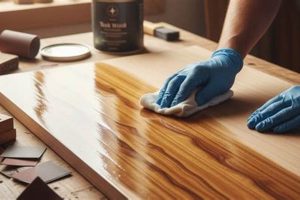
The selection of a surface treatment for wood countertops directly impacts their lifespan and resistance to wear and tear. These treatments create a protective barrier, shielding the wood from moisture, stains, and abrasions. For instance, a catalyzed varnish forms a robust, chemically resistant layer designed to withstand the rigors of daily use in a kitchen environment.
Protecting wood countertops is vital because it preserves their aesthetic appeal, simplifies cleaning, and extends their usability. Historically, oils and waxes were primary options, offering limited protection. Contemporary advancements have introduced products with enhanced durability and resistance to common household hazards, contributing significantly to the practicality and longevity of wood surfaces.
Understanding the performance characteristics of various wood countertop protectants is essential for making informed decisions. The subsequent sections will delve into specific coating types, application methods, and factors to consider when choosing the appropriate solution for individual needs and usage patterns.
Optimizing Wood Countertop Longevity
The following recommendations will facilitate the selection and application of a surface protectant, ultimately enhancing the lifespan and performance of wood countertops.
Tip 1: Prioritize catalyzed conversion varnishes and two-part polyurethanes. These options offer superior resistance to moisture, chemicals, and abrasion compared to traditional oils or waxes, making them suitable for high-use areas.
Tip 2: Evaluate the volatile organic compound (VOC) content. Lower VOC formulations contribute to improved indoor air quality, which is particularly relevant in residential settings. Consider water-based polyurethanes as a low-VOC alternative.
Tip 3: Adhere strictly to the manufacturer’s application guidelines. Proper surface preparation, including sanding and cleaning, is critical for optimal adhesion and performance of the chosen protectant. Inadequate preparation can lead to premature failure.
Tip 4: Apply multiple thin coats rather than a single thick coat. Multiple thin coats promote even curing, minimize the risk of runs or sags, and improve overall durability by creating a more uniform protective layer.
Tip 5: Allow ample curing time. The curing process allows the protectant to fully harden and achieve its maximum resistance properties. Consult the manufacturer’s specifications for recommended curing durations and environmental conditions.
Tip 6: Implement regular maintenance practices. Routine cleaning with appropriate products and avoidance of harsh chemicals or abrasive cleaners will help to preserve the integrity of the protective coating and prevent premature wear.
Tip 7: Consider professional application for complex protectant systems. Certain high-performance coatings, such as catalyzed varnishes, may require specialized equipment and expertise for proper application, potentially justifying professional installation.
Implementing these guidelines will ensure the selection and proper application of a protective coating, thus maximizing the durability and longevity of wood countertops in various environments.
The subsequent section will explore specific products and their respective applications, further clarifying the decision-making process.
1. Chemical Resistance

Chemical resistance is a pivotal attribute of any durable wood countertop finish. The ability to withstand exposure to a variety of substances is critical for preserving the integrity and appearance of the wood surface over time. A finish’s chemical resistance directly influences its susceptibility to staining, etching, and degradation, all of which compromise its protective qualities and overall lifespan.
- Resistance to Acidic Substances
Many common household items, such as lemon juice, vinegar, and certain cleaning products, are acidic. A finish lacking sufficient resistance to acidic substances will exhibit etching or discoloration upon contact. A durable finish must form a robust barrier, preventing these acids from penetrating the wood fibers and causing damage.
- Resistance to Alkaline Substances
Alkaline substances, including some detergents and drain cleaners, can also degrade wood finishes. Exposure to alkalis may result in softening or peeling of the finish layer. A chemically resistant finish will maintain its structural integrity even when exposed to alkaline solutions, ensuring continued protection of the wood.
- Resistance to Solvents
Solvents, such as nail polish remover, alcohol, and paint thinners, pose a significant threat to many wood finishes. These substances can dissolve or soften the finish, leading to irreversible damage. A durable finish should possess a high degree of solvent resistance to prevent penetration and subsequent deterioration.
- Resistance to Staining Agents
Food and beverages, particularly those with strong pigments (e.g., coffee, wine, beet juice), can stain wood countertops if the finish is not chemically resistant. The finish must create a barrier that prevents these staining agents from penetrating the wood pores, thereby preserving the countertop’s original color and appearance.
The aforementioned facets underscore the critical role of chemical resistance in determining the durability of a wood countertop finish. A finish that exhibits strong resistance to acids, alkalis, solvents, and staining agents will provide superior protection, ensuring the longevity and aesthetic appeal of the countertop. Consequently, selecting a finish with proven chemical resistance is a fundamental consideration for any wood countertop application.
2. Abrasion Resistance

Abrasion resistance, denoting a finish’s capacity to withstand mechanical wear from contact with other materials, stands as a critical determinant of a wood countertop’s longevity. In environments where countertops are subject to frequent use, impacting factors include sliding objects, cleaning implements, and general contact. A finish exhibiting subpar abrasion resistance will display scratching, marring, and eventual erosion of the protective layer. This compromises both aesthetic appeal and the barrier against moisture and staining, accelerating the degradation of the wood substrate. A lack of abrasion resistance directly diminishes the lifespan of wood countertops, necessitating premature refinishing or replacement. The selection of a finish possessing high abrasion resistance is, therefore, central to ensuring the enduring quality and functionality of wood countertops.
Quantifying abrasion resistance often involves standardized testing methods, such as the Taber abrasion test, wherein a weighted abrasive wheel rotates against the finished surface, measuring the loss of material after a specified number of cycles. Finishes formulated with hard, cross-linked polymers, like catalyzed varnishes and certain polyurethane formulations, generally demonstrate superior abrasion resistance compared to softer finishes like oils and waxes. The inclusion of additives, such as ceramic particles or aluminum oxide, can further enhance this property. Real-world examples illustrate the consequences of inadequate abrasion resistance: a countertop finished with a simple oil may exhibit noticeable scratches and wear patterns within a short period, while one protected by a high-performance polyurethane remains visually intact despite comparable use.
In summary, abrasion resistance is an indispensable component of a finish designed for durable wood countertops. The ability to withstand mechanical wear directly correlates with the lifespan, aesthetic quality, and protective function of the finish. Careful consideration of abrasion resistance during product selection, coupled with adherence to proper application and maintenance protocols, is essential for maximizing the value and utility of wood countertops in demanding environments. The challenges of balancing abrasion resistance with other desirable characteristics, such as ease of application and environmental impact, necessitates informed decision-making when choosing a suitable countertop finish.
3. Moisture Protection

Moisture protection is an indispensable characteristic of a durable wood countertop finish. The inherent susceptibility of wood to water damage necessitates a robust barrier to prevent absorption, swelling, warping, and decay. The efficacy of the finish in repelling moisture directly correlates with the longevity and structural integrity of the countertop.
- Hydrophobic Properties
A finish exhibiting hydrophobic properties repels water, preventing it from penetrating the wood fibers. This is achieved through the incorporation of water-repellent substances, such as waxes or silicones, into the finish formulation. Inadequate hydrophobic characteristics lead to water absorption, resulting in dimensional changes and potential structural compromise. For instance, a wood countertop finished with a water-based product lacking sufficient hydrophobic additives will be prone to water stains and swelling around sinks or areas of frequent spills.
- Vapor Permeability
While resisting liquid water is crucial, a durable finish should also possess a degree of vapor permeability. This allows moisture vapor trapped within the wood to escape, preventing buildup that can lead to blistering or delamination of the finish. A balance between water resistance and vapor permeability is essential for maintaining the stability of the wood substrate. A finish that is entirely impermeable to vapor may trap moisture, causing the finish to fail from within.
- Edge and End Grain Sealing
The edges and end grain of wood are particularly vulnerable to moisture absorption due to their open cellular structure. A durable finish must effectively seal these areas to prevent water from entering the wood. This often requires multiple coats or the application of a specialized edge sealer. Failure to adequately seal the edges and end grain will result in accelerated moisture damage and potential warping or splitting.
- Resistance to Condensation
In environments with high humidity or temperature fluctuations, condensation can form on the surface of wood countertops. A durable finish should resist damage from prolonged exposure to condensation, preventing water spots and discoloration. This requires a finish that maintains its protective properties even under conditions of high humidity. A countertop finish susceptible to condensation damage will exhibit a dull or cloudy appearance over time.
These facets underscore the multifaceted role of moisture protection in contributing to a finish’s overall durability. A finish that effectively combines hydrophobic properties, vapor permeability, edge sealing, and resistance to condensation will provide superior protection against moisture-related damage, ensuring the longevity and aesthetic appeal of wood countertops. Consequently, careful consideration of these moisture-related characteristics is paramount when selecting a finish for wood countertop applications.
4. UV Stability
Ultraviolet (UV) radiation from sunlight or artificial light sources presents a significant threat to the long-term integrity and appearance of wood countertops. Exposure to UV radiation catalyzes chemical reactions within the wood and the finish, leading to degradation of the lignin in the wood itself and the breakdown of the finish polymers. This manifests as discoloration, fading, cracking, and eventual loss of protective properties. Consequently, UV stability is a critical component of any finish intended to provide durable protection for wood countertops.
A finish lacking adequate UV stability will undergo rapid degradation, even under moderate exposure. For example, a countertop finished with a non-UV-resistant varnish and placed near a sunny window will exhibit noticeable yellowing or fading within a relatively short period. This discoloration is not merely an aesthetic issue; it signals a weakening of the finish, making it more susceptible to moisture, scratches, and other forms of damage. Conversely, a finish formulated with UV absorbers or stabilizers will significantly retard this degradation process, preserving the original color and protective qualities of the countertop for a considerably longer time. These additives function by either absorbing UV radiation and dissipating it as heat or by scavenging free radicals generated by UV exposure, thereby preventing or slowing down the chain reactions that lead to polymer breakdown.
In conclusion, UV stability is intrinsically linked to the concept of a finish designed for durable wood countertops. It is not merely a cosmetic consideration, but a fundamental aspect of the finish’s ability to provide long-term protection against the damaging effects of light exposure. Selecting a finish with proven UV resistance, particularly for countertops exposed to direct sunlight, is essential for maximizing the lifespan, preserving the aesthetic appeal, and maintaining the protective properties of wood countertops.
5. Application Complexity

The successful implementation of a durable wood countertop finish is significantly influenced by the complexity inherent in its application process. The relationship between application difficulty and ultimate performance is direct: improperly applied, even the most robust finish will fail to provide adequate protection, negating its inherent durability. The following facets delineate this connection.
- Surface Preparation Requirements
Many durable finishes demand meticulous surface preparation, including thorough sanding, cleaning, and sometimes the application of a primer or sealer. Catalyzed varnishes, for example, require a perfectly smooth and clean surface to ensure proper adhesion and prevent imperfections in the final finish. Failure to meet these stringent requirements can lead to adhesion failures, uneven sheen, or premature wear. A poorly prepared surface will compromise the longevity of even the highest-quality protectant.
- Application Technique Sensitivity
Certain durable finishes are highly sensitive to the application technique employed. Spray-applied finishes, such as two-part polyurethanes, require precise control of spray gun settings, distance, and application speed to achieve a uniform coating thickness and avoid runs, sags, or orange peel texture. Similarly, brush application of thick varnishes demands skill to prevent brush marks and ensure even coverage. Incorrect application techniques can result in aesthetic flaws and reduced protective capabilities.
- Environmental Control Necessities
The application of many durable finishes necessitates careful environmental control. Temperature, humidity, and airflow can significantly impact the curing process and the final quality of the finish. For instance, epoxy-based finishes require specific temperature ranges for proper curing, while high humidity can cause blushing or cloudiness in some varnishes. Failure to maintain suitable environmental conditions can lead to incomplete curing, compromised adhesion, and diminished durability.
- Multi-Coat System Protocols
Achieving optimal durability often requires the application of multiple coats of finish, each with specific drying and curing times. Two-component systems, such as epoxy resins, may involve intricate mixing ratios and precise pot lives, demanding meticulous adherence to the manufacturers instructions. Deviations from recommended protocols can compromise the finish’s chemical resistance, abrasion resistance, and overall protective properties.
The facets outlined above illustrate that the inherent qualities of a durable wood countertop finish are inextricably linked to the intricacies of its application. Ease of application is a trade-off with product durability. A finish’s theoretical performance potential is only realized through skilled application and adherence to recommended procedures, underscoring the critical role of applicator expertise in achieving long-lasting protection for wood countertops.
6. Maintenance Requirements

The selection of a finish intended to provide prolonged protection for wood countertops is inextricably linked to the maintenance demands it imposes. While a coating may exhibit exceptional initial resistance to wear and tear, its long-term effectiveness is contingent upon adherence to appropriate upkeep protocols. The frequency and complexity of maintenance tasks directly influence the sustained durability of the finish and, consequently, the lifespan of the countertop itself.
Finishes requiring minimal maintenance offer a distinct advantage in real-world applications. For example, a countertop treated with a catalyzed conversion varnish might only necessitate routine cleaning with mild soap and water. Conversely, a countertop finished with a natural oil may demand periodic reapplication of the oil to maintain its protective properties. Neglecting this reapplication can lead to the oil drying out, leaving the wood susceptible to staining and moisture damage. Similarly, finishes prone to scratching might require regular polishing to preserve their aesthetic appeal. Therefore, the perceived “durability” of a finish is a function not only of its inherent resistance to damage but also of the practical effort required to preserve that resistance over time.
In summation, the connection between maintenance needs and finish durability is a key consideration in the overall longevity of wood countertops. A finish that couples high initial durability with straightforward maintenance practices offers the most sustainable solution. Understanding this interplay allows for informed decision-making, ensuring that the chosen surface treatment effectively safeguards the wood while remaining practical for long-term care, ensuring maximum performance and aesthetic appeal with minimal ongoing effort.
Frequently Asked Questions
The following questions address common concerns regarding the selection and maintenance of wood countertop finishes, aiming to provide clarity and guidance for optimal performance.
Question 1: What constitutes “most durable wood countertop finish” and what factors define this durability?
The term refers to a surface protectant designed to withstand the rigors of daily use, resisting moisture, stains, scratches, and chemical exposure. Durability is determined by factors such as abrasion resistance, chemical resistance, UV stability, and adhesion properties.
Question 2: Are natural oils a viable option for durable wood countertop protection?
While natural oils enhance the aesthetic appeal of wood, they typically offer limited protection compared to synthetic coatings. Frequent reapplication is necessary, and resistance to moisture and chemicals is generally lower. Oils are best suited for surfaces with light use.
Question 3: How does the sheen level of a finish impact its durability?
Sheen level primarily affects the aesthetic appearance, not the inherent durability. However, matte finishes may show scratches more readily than glossier finishes due to their textured surface. The underlying composition of the finish dictates its resistance to wear.
Question 4: Is professional application essential for achieving a durable wood countertop finish?
Professional application is recommended for certain high-performance finishes, such as catalyzed varnishes and two-part polyurethanes. Proper surface preparation, specialized equipment, and expertise are crucial for optimal results. However, simpler finishes can be successfully applied by informed homeowners.
Question 5: What cleaning products are suitable for maintaining a durable wood countertop finish?
Mild, pH-neutral detergents are generally recommended. Avoid abrasive cleaners, harsh chemicals, and solvents, as these can damage the finish and compromise its protective properties. Always test cleaning products in an inconspicuous area before applying them to the entire surface.
Question 6: Can a damaged wood countertop finish be repaired?
Minor scratches and blemishes can often be repaired with touch-up kits or specialized refinishing products. However, extensive damage may require complete sanding and refinishing. The feasibility of repair depends on the type and severity of the damage, as well as the original finish used.
Selecting a surface treatment for wood countertops requires careful consideration of both its inherent properties and the application context. Proper selection and maintenance are key factors. The next section will explore specific products and their respective applications.
Assuring Wood Countertop Longevity
The preceding exploration of “most durable wood countertop finish” underscores the multifaceted nature of this selection process. Factors ranging from chemical and abrasion resistance to UV stability and application complexity critically influence the long-term performance of wood countertops. Selecting a surface treatment necessitates a thorough understanding of these variables and their interplay.
Ultimately, the decision regarding a finish should align with specific usage patterns and environmental conditions. Prioritizing informed selection, diligent application, and consistent maintenance will safeguard wood countertops, preserving their aesthetic value and functional utility for extended periods. Careful consideration yields lasting performance.