Achieving an even, unblemished surface when painting with a roller is a desired outcome for many painting projects. This result is characterized by the absence of stippling, roller marks, or uneven texture, presenting a flat and visually appealing plane. For example, a wall painted in a matte finish should appear uniformly colored, without any indication of the application method.
The benefits of a uniform surface are numerous, enhancing the aesthetic appeal of the painted area and often increasing the perceived value of the property. Historically, achieving this level of quality required significant skill and effort, but advancements in roller technology and paint formulations have made it more accessible to both professionals and DIY enthusiasts. A flat painted surface reflects light evenly, contributing to a more polished and professional look.
The subsequent sections will delve into the specific factors that contribute to attaining this desired result, including the selection of appropriate rollers, proper surface preparation techniques, and optimal painting methods.
Achieving a Flawless Painted Surface
The following recommendations aim to provide clear guidance on how to achieve a high-quality, even surface when painting, minimizing imperfections and maximizing the aesthetic appeal of the finished product.
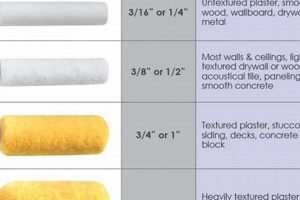
Tip 1: Select the Appropriate Roller Cover: The nap length, or thickness of the roller cover, is critical. Short naps (1/4″ – 3/8″) are best suited for smooth surfaces and low-sheen paints, while longer naps (1/2″ – 3/4″) are better for textured surfaces or paints with higher sheens. Using an inappropriate nap length can result in an uneven surface.
Tip 2: Prime the Surface Thoroughly: Proper priming is essential for adhesion and uniform paint absorption. Ensure the primer is compatible with both the surface and the topcoat. Uneven primer application will directly translate to an uneven paint finish.
Tip 3: Load the Roller Evenly: Submerge the roller cover halfway into the paint tray and roll it back and forth along the ribbed section to distribute the paint evenly. Avoid overloading the roller, as this will lead to drips and uneven application.
Tip 4: Use Consistent Pressure: Apply consistent pressure throughout each stroke. Varying the pressure will result in noticeable differences in paint thickness and texture.
Tip 5: Overlap Each Stroke: Overlap each stroke by approximately 2-3 inches to ensure complete coverage and avoid lines or gaps. This technique helps blend each pass for a seamless result.
Tip 6: Maintain a Wet Edge: Work in manageable sections and maintain a wet edge to prevent lap marks. Applying fresh paint over partially dried paint can create visible inconsistencies.
Tip 7: Use Quality Paint: Invest in high-quality paint, as it typically offers better coverage, durability, and leveling properties. Lower-quality paints may be more prone to creating an uneven surface.
Implementing these tips will contribute significantly to a professional-looking paint job characterized by an even, consistent surface texture and minimal imperfections. The resulting surface will be visually appealing and durable.
The subsequent section will discuss common issues encountered during roller painting and methods for rectifying them.
1. Roller Cover Selection

The selection of an appropriate roller cover is a critical determinant in achieving a smooth paint roller finish. The roller cover’s nap length, material, and density directly influence the texture and uniformity of the applied paint. A cover with an excessively long nap, intended for rough surfaces, will impart an undesirable stippled texture on a smooth wall, hindering the attainment of a seamless appearance. Conversely, a cover with insufficient nap will not effectively transfer paint to a textured surface, resulting in an incomplete and uneven coating.
The roller cover’s material also contributes to the final finish. Microfiber rollers, for example, are known for their ability to produce an exceptionally smooth result due to their fine fibers and minimal lint shedding. Foam rollers, although offering a smooth application, may not hold sufficient paint for efficient coverage. Furthermore, the density of the roller cover impacts paint absorption and release. A high-density cover holds more paint and releases it more evenly, minimizing roller marks and promoting a uniform layer of paint. Selecting the correct roller cover also affects the amount of effort needed and the overall look. For example, using a wrong roller cover will result in a lot of rework needed to get the look.
In summary, selecting the appropriate roller cover is paramount to attaining a uniform and aesthetically pleasing painted surface. Factors such as nap length, material composition, and density must be carefully considered based on the surface being painted and the desired finish. Failure to do so will invariably compromise the final result. Therefore, careful roller cover selection can be pivotal in achieving an even, smooth, and visually appealing painted surface, whereas the wrong selection would impact smoothness of the result paint.
2. Surface Preparation Critical
Achieving a smooth paint roller finish hinges significantly on proper surface preparation. The underlying principle dictates that any imperfections present on the substrate will inevitably manifest in the final painted surface. Consequently, meticulous attention to surface preparation is not merely a preliminary step, but a fundamental component in achieving the desired aesthetic outcome. Failure to adequately prepare the surface can lead to a variety of defects, including uneven texture, poor adhesion, and premature paint failure. For example, painting over a dusty or greasy surface will impede paint adhesion, resulting in peeling or blistering. Similarly, painting over existing imperfections, such as cracks or holes, will accentuate these flaws rather than concealing them, thus compromising the smoothness of the final finish.
The process of surface preparation typically involves several key steps: cleaning, repairing, and priming. Cleaning removes dirt, dust, grease, and other contaminants that can interfere with paint adhesion. Repairing involves filling cracks, holes, and other surface imperfections with appropriate patching compounds. Priming creates a uniform and receptive surface for the paint, enhancing adhesion and promoting even coverage. For instance, applying a primer to a porous surface, such as new drywall, seals the pores and prevents the paint from being absorbed unevenly, thereby ensuring a more consistent finish. In practical applications, a properly prepared surface not only enhances the aesthetic appeal of the painted surface but also extends its lifespan, reducing the need for frequent repainting. Preparing is not just for getting smooth finish, it protects it from long lasting from surface paint
In summary, the connection between surface preparation and a smooth paint roller finish is direct and undeniable. Adequate preparation lays the groundwork for a successful paint job, while neglecting this step can lead to a host of problems that detract from the final result. By investing the time and effort required for thorough surface preparation, individuals can significantly increase their chances of achieving a flawless and long-lasting painted surface. The challenges lie in the meticulous execution of each preparation step, but the rewards are evident in the superior quality and durability of the finished product.
3. Paint Quality Matters

The attainment of a smooth paint roller finish is inextricably linked to the quality of the paint employed. High-quality paints possess superior leveling properties, a critical characteristic that dictates how uniformly the paint film settles after application. Lower-quality paints often lack this attribute, resulting in visible brush or roller marks that detract from the desired smooth surface. The composition of high-quality paints typically includes a higher concentration of resins and pigments, which contribute to improved coverage, durability, and sheen consistency. For example, using a premium self-leveling paint on a previously textured wall will minimize the appearance of the texture, creating a flatter, more refined surface compared to using a less expensive paint. The cause-and-effect relationship is clear: superior paint quality directly contributes to a smoother, more aesthetically pleasing finish. Thus, the importance of paint quality is underscored as a primary component in the pursuit of a flawless painted surface, because it is the raw material to produce smooth outcome .
Furthermore, high-quality paints exhibit enhanced flow and wet-edge retention. This characteristic allows for smoother blending of subsequent roller strokes, minimizing lap marks and ensuring a more uniform appearance. A paint with poor wet-edge retention will dry too quickly at the edges, leading to visible lines and inconsistencies where adjacent strokes overlap. The practical significance of understanding this connection lies in the ability to avoid common painting pitfalls and achieve professional-quality results. Consider the application of a semi-gloss paint in a large room; using a high-quality paint with excellent wet-edge properties will mitigate the risk of lap marks, resulting in a consistent sheen and a more visually appealing finish. This is especially important for surfaces that are subject to high wear and tear, where the increased durability of premium paints can extend the lifespan of the painted surface and maintain its aesthetic appeal for a longer period, so having paint that can take wear and tear is important too.
In conclusion, the quality of paint is a crucial determinant in achieving a smooth paint roller finish. Superior leveling properties, enhanced flow, and increased durability inherent in high-quality paints directly contribute to a more uniform, aesthetically pleasing, and longer-lasting result. While the initial cost of premium paints may be higher, the long-term benefits in terms of both appearance and durability justify the investment. Challenges associated with achieving a professional-quality paint job are significantly reduced when high-quality paints are used, reinforcing the link between paint quality and the broader theme of achieving optimal results in painting projects. Investing on paint also reduce time used on rework or even re-paint, which can cost even more.
4. Application Technique Consistency
Attaining a smooth paint roller finish is significantly influenced by the consistency of the application technique. Deviations in the method of paint application can lead to visible imperfections and an uneven surface, compromising the overall aesthetic quality. Consistency ensures uniform paint distribution, minimizing variations in texture and sheen.
- Stroke Overlap Uniformity
Maintaining a consistent overlap between roller strokes is critical. Uneven overlap can result in variations in paint thickness, leading to visible lap marks or a striped appearance. A uniform overlap of approximately 2-3 inches ensures consistent coverage and blending of each stroke, minimizing the visibility of transitions. Inconsistent overlap can also highlight surface imperfections that would otherwise be less noticeable.
- Pressure Modulation Control
Applying consistent pressure on the roller is essential for uniform paint distribution. Varying pressure will result in uneven paint thickness, leading to differences in texture and sheen. Excessive pressure can cause the roller to slip or drag, creating lines or other imperfections. Conversely, insufficient pressure will result in inadequate paint transfer and incomplete coverage. Therefore, maintaining a constant, moderate pressure is paramount.
- Roller Loading Standard
Ensuring the roller is consistently loaded with paint is crucial for maintaining a uniform application. Inconsistent loading can lead to variations in paint thickness, resulting in an uneven surface. Overloading the roller will cause drips and runs, while underloading will result in thin, streaky coverage. A consistent and moderate loading technique ensures optimal paint transfer and a smooth finish.
- Directional Regularity
Maintaining a consistent direction when rolling the paint is also beneficial. While cross-hatching can sometimes be employed, it is vital that the final pass is always in the same direction to align the texture created by the roller nap. Varying the direction without a clear plan can lead to a jumbled and uneven texture. Consistent directional strokes contribute to a more uniform and professional-looking finish.
The facets of stroke overlap, pressure, roller loading, and directional approach all contribute to the achievement of a smooth paint roller finish. Any inconsistency in these areas can compromise the uniformity and aesthetic quality of the painted surface. By prioritizing consistency in these application techniques, individuals can significantly enhance the likelihood of achieving a desirable and professional-looking result, where the final application is smooth.
5. Pressure Control Paramount

Achieving a uniformly smooth paint roller finish is directly and significantly influenced by the consistency of pressure applied during the painting process. Variations in pressure result in an uneven distribution of paint, leading to discernible differences in texture and sheen across the painted surface. Excessive pressure can compress the roller nap, reducing its ability to hold and release paint, resulting in a thinner, potentially streaky application. Conversely, insufficient pressure fails to adequately transfer paint from the roller to the surface, leading to incomplete coverage and an uneven texture. The balance between these extremes is crucial for a flawless finish.
Consider a scenario where a painter applies varying pressure while painting a wall. Areas where more pressure is applied will exhibit a thinner paint film and potentially a different sheen due to the compression of the roller nap. In contrast, areas with less pressure will have a thicker paint film, leading to visible variations in texture and appearance. This inconsistency is particularly noticeable when painting with higher sheen paints, where variations in film thickness are more pronounced. Therefore, maintaining consistent pressure requires practice and a deliberate awareness of the force being exerted on the roller handle throughout the entire painting process. The right amount of paint will spread in the right amount of time.
In summary, pressure control is a non-negotiable element in achieving a smooth paint roller finish. The ability to maintain consistent, moderate pressure throughout the application process is directly correlated with the uniformity and aesthetic quality of the final result. Mastering this technique requires attention to detail and practice, but the rewards are evident in the enhanced appearance and overall quality of the painted surface. The challenge lies in developing a kinesthetic awareness of the pressure being applied, but the benefits far outweigh the effort, ensuring a professional-looking and aesthetically pleasing outcome as you apply on the surface to paint. The skill is hard to master, but the reward is very worth it.
6. Environmental Conditions Impact
The attainment of a smooth paint roller finish is significantly influenced by ambient environmental conditions. Temperature, humidity, and airflow each exert considerable effects on paint drying time, viscosity, and ultimately, the final appearance of the painted surface. Extremes in any of these factors can compromise the ability to achieve a uniform and defect-free finish. For instance, high humidity levels retard the evaporation of solvents in water-based paints, extending drying time and increasing the likelihood of runs, sags, or the entrapment of airborne particles within the paint film. Conversely, elevated temperatures and low humidity accelerate drying, potentially leading to brush or roller marks becoming more pronounced due to insufficient leveling time. Airflow, especially when excessive, can cause uneven drying, resulting in inconsistencies in sheen and texture. Therefore, understanding and managing environmental conditions are critical components of a successful painting project.
Practical implications of these environmental factors are numerous. In humid climates, it is advisable to paint during the driest part of the day, typically mid-morning to early afternoon, and to ensure adequate ventilation to promote airflow. When painting in hot, dry conditions, measures should be taken to slow down the drying process, such as using a paint extender or painting in the cooler parts of the day. Insufficient airflow can also lead to the accumulation of solvent vapors, posing health risks and potentially affecting the quality of the paint finish. Furthermore, direct sunlight exposure during the application process can cause the paint to dry too quickly, resulting in uneven color and potential blistering. As such, careful monitoring and control of environmental conditions are essential for ensuring optimal paint performance and minimizing the risk of defects.
In summary, environmental conditions exert a considerable influence on the achievement of a smooth paint roller finish. Temperature, humidity, and airflow each play a role in determining paint drying time, viscosity, and the final appearance of the painted surface. While challenges associated with controlling these factors may arise, particularly in outdoor painting projects, a proactive approach to managing environmental conditions can significantly increase the likelihood of achieving a professional-quality result. This involves careful planning, selecting appropriate paint formulations for the prevailing conditions, and implementing measures to mitigate the adverse effects of extreme temperatures, humidity levels, or airflow. Therefore, a comprehensive understanding of environmental factors is indispensable for anyone seeking to achieve a smooth and durable paint roller finish.
Frequently Asked Questions
The following addresses common inquiries and clarifies misconceptions related to achieving a uniform, defect-free painted surface using a roller.
Question 1: What is the primary factor determining the smoothness of a paint roller finish?
The selection of an appropriate roller cover is paramount. The nap length, material, and density of the roller cover directly influence the texture and uniformity of the applied paint. A cover ill-suited to the surface will invariably compromise the smoothness of the final result.
Question 2: How does surface preparation contribute to a smooth paint roller finish?
Proper surface preparation is foundational. Existing imperfections or contaminants will manifest in the final painted surface. Cleaning, repairing, and priming are essential steps to ensure proper paint adhesion and a uniform substrate.
Question 3: Does the quality of paint affect the smoothness of the roller finish?
Paint quality is a significant determinant. High-quality paints possess superior leveling properties, enabling the paint film to settle uniformly. Lower-quality paints often lack this characteristic, resulting in visible imperfections.
Question 4: How does application technique impact the achievement of a smooth paint roller finish?
Consistent application technique is crucial. Variations in stroke overlap, pressure, and roller loading can lead to uneven paint distribution and visible imperfections. A uniform approach ensures consistent coverage and blending of strokes.
Question 5: What role does pressure control play in achieving a smooth paint roller finish?
Maintaining consistent pressure throughout the application process is vital. Variations in pressure result in an uneven distribution of paint, leading to discernible differences in texture and sheen across the painted surface.
Question 6: How do environmental conditions affect the final paint roller finish?
Environmental conditions, such as temperature, humidity, and airflow, exert considerable effects on paint drying time and viscosity. Extremes in these factors can compromise the ability to achieve a uniform and defect-free finish.
In summary, achieving a uniformly smooth paint roller finish requires careful attention to roller cover selection, surface preparation, paint quality, application technique, pressure control, and environmental conditions.
The subsequent section will address troubleshooting common issues encountered during the roller painting process.
Achieving the Desired Outcome
The preceding discussion has illuminated the multifaceted aspects crucial to obtaining a “smooth paint roller finish.” From the initial selection of appropriate tools and materials to the meticulous execution of application techniques, each stage contributes significantly to the final result. Surface preparation, paint quality, consistent pressure, and awareness of environmental conditions are not merely procedural steps but integral components of a successful endeavor. Addressing these factors proactively minimizes the potential for imperfections and maximizes the aesthetic appeal of the painted surface.
The pursuit of a flawless, uniform surface reflects a commitment to quality and attention to detail. Further exploration of advanced painting techniques and ongoing advancements in paint technology promise to refine the process even further. Therefore, continued vigilance and adherence to established best practices remain essential for realizing the full potential of a “smooth paint roller finish” and achieving enduring aesthetic value.