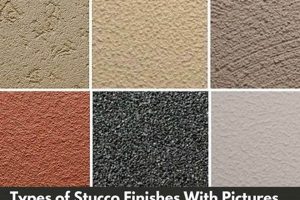
An interior wall coating incorporating fine aggregates, typically silica, imparts a textured surface. This specialized application offers an alternative to smooth finishes, creating visual interest through its subtle granular appearance. The aggregate, mixed directly into the plaster or applied as a subsequent layer, determines the coarseness of the final surface.
The resulting texture enhances aesthetic appeal and provides practical advantages. The uneven surface can effectively conceal minor imperfections in the underlying wall. Its durability makes it suitable for high-traffic areas. Historically, the use of textured coatings predates modern drywall construction, offering a cost-effective and readily available solution for achieving decorative effects.
Subsequent sections will delve into application techniques, suitable environments, and available color options. Understanding the preparation process and the impact of aggregate size on the final aesthetic will further illuminate the advantages of this wall finishing method. Finally, we will examine the maintenance requirements and long-term performance characteristics associated with textured interior surfaces.
Application Considerations for Textured Wall Coatings
The successful implementation of a textured wall surface requires careful planning and execution. The following guidelines offer practical advice for achieving optimal results.
Tip 1: Surface Preparation is Paramount: Ensure the substrate is clean, dry, and structurally sound. Patch any imperfections before applying the base coat to prevent inconsistencies in the final texture.
Tip 2: Aggregate Selection Matters: The size and type of aggregate significantly influence the overall aesthetic. Conduct sample applications using different aggregates to determine the desired texture.
Tip 3: Mixing Consistency is Critical: Thoroughly mix the aggregate with the plaster compound to ensure uniform distribution. Inconsistent mixing leads to uneven texture and potential structural weaknesses.
Tip 4: Application Technique Affects Texture: Employ consistent application techniques, whether using a trowel, spray gun, or other specialized tools. Varying the angle and pressure alters the texture’s appearance.
Tip 5: Curing Impacts Durability: Allow the plaster to cure completely according to the manufacturer’s instructions. Premature finishing or exposure to moisture can compromise the integrity of the surface.
Tip 6: Consider Environmental Factors: Humidity and temperature affect drying time. Maintain stable environmental conditions during application and curing to prevent cracking or shrinkage.
Tip 7: Sealing Enhances Longevity: Apply a sealant after the plaster has fully cured to protect against moisture, stains, and wear. Select a sealant compatible with the chosen plaster type.
Tip 8: Maintenance is Essential: Regular cleaning with mild detergents prevents the accumulation of dirt and grime. Avoid abrasive cleaners that can damage the textured surface.
Adherence to these guidelines promotes a long-lasting, visually appealing textured wall surface. Precise execution and proper maintenance are key to realizing the full potential of this wall finishing technique.
The subsequent section will examine common issues encountered during application and provide troubleshooting strategies. Further discussion will address the suitability of textured surfaces in specific architectural contexts.
1. Aesthetic Texture

The aesthetic texture achieved through the application of materials directly influences the visual character of interior spaces. It is a fundamental design element, particularly pertinent when considering applications such as wall coatings.
- Granularity and Visual Impact
The degree of granularity within the matrix determines the visual prominence of the texture. Finer aggregates provide a subtle, almost imperceptible texture, offering a sophisticated, understated aesthetic. Coarser aggregates create a more pronounced, rustic texture, lending a tactile quality to the surface. The choice of aggregate directly dictates the final visual effect, impacting the overall ambiance of the space. For instance, a lightly textured wall may complement a modern, minimalist design, while a heavily textured wall can enhance a traditional or rustic interior.
- Light Interaction and Shadow Play
The texture interacts with light, creating subtle shadows and highlights. These variations enhance the depth and dimensionality of the surface. The angle of light, both natural and artificial, influences the perceived texture. A highly textured finish may appear more dramatic under direct lighting, whereas a smoother finish will show subtle variations under diffused light. This interplay of light and shadow adds visual interest, preventing the surface from appearing flat or monotonous.
- Tactile Perception and Sensory Experience
The texture engages the sense of touch, contributing to the overall sensory experience of the space. A rougher finish may invite tactile exploration, while a smoother finish may be more visually appealing than inviting to touch. The tactile quality can evoke different emotional responses, influencing the perception of warmth, comfort, or sophistication. For example, a heavily textured wall might suggest warmth and rustic charm, while a smoother, finer texture can convey a sense of elegance and refinement.
- Concealment of Imperfections
The texture can effectively mask minor imperfections in the underlying substrate. The uneven surface disrupts the visual plane, diverting attention from irregularities. This is particularly useful in renovation projects or in spaces where achieving a perfectly smooth surface is challenging. The ability to conceal imperfections reduces the need for extensive surface preparation, offering a cost-effective solution for achieving a visually appealing finish.
The integration of aggregate-based coatings facilitates the creation of diverse aesthetic textures, ranging from subtle to pronounced, each offering unique visual and tactile properties. The successful implementation depends on careful consideration of the desired aesthetic effect, the interaction with light, and the tactile experience of the space.
2. Surface Durability
The longevity and resistance to wear of a sand finish plaster surface are directly related to several factors inherent in its composition and application. The presence of aggregate within the plaster matrix impacts its ability to withstand impact and abrasion. A properly mixed and applied plaster, incorporating appropriately sized and distributed aggregate, exhibits enhanced durability compared to standard plaster finishes. The aggregate acts as a reinforcing component, distributing stress and minimizing the potential for cracking or chipping under duress. For example, in high-traffic areas such as hallways or entryways, walls coated with sand finish plaster demonstrate a greater resistance to scuffs and dents caused by routine contact.
The selection of appropriate sealants further augments surface durability. Sealants provide a protective barrier against moisture penetration and staining, mitigating the degradation of the plaster over time. A properly sealed surface is also more resistant to cleaning agents, allowing for the removal of dirt and grime without compromising the integrity of the finish. In environments prone to humidity or frequent cleaning, such as kitchens or bathrooms, the application of a suitable sealant becomes essential to preserving the appearance and structural integrity of the sand finish plaster. The type of sealant must be compatible with the plaster composition to ensure proper adhesion and prevent discoloration or peeling.
In conclusion, the surface durability of sand finish plaster is a critical consideration, influencing its suitability for various applications. Factors such as aggregate size and distribution, application technique, and the use of sealants all contribute to its long-term performance. Understanding these interdependencies allows for informed decision-making, ensuring the selection and implementation of a plaster finish that meets the specific demands of its intended environment. Neglecting these considerations can lead to premature degradation, increased maintenance costs, and diminished aesthetic appeal. Therefore, a comprehensive understanding of these factors is paramount to maximizing the lifespan and performance of the finish.
3. Application Technique

The application technique employed directly determines the final aesthetic and structural integrity of a sand finish plaster surface. The manner in which the plaster is mixed, applied, and finished dictates the uniformity of texture, the bond strength to the substrate, and the overall durability of the coating. Improper mixing, for instance, can result in uneven distribution of the aggregate, leading to inconsistencies in the texture across the finished surface. Similarly, inadequate preparation of the substrate can compromise the bond between the plaster and the wall, increasing the risk of cracking or delamination over time. The use of inappropriate tools or techniques, such as applying the plaster in excessively thick layers or failing to properly trowel the surface, can also result in an uneven finish and reduced durability. Consider the example of applying a sand finish plaster in a bathroom; if the plaster is not applied evenly and properly sealed, moisture penetration can cause the plaster to deteriorate, leading to mold growth and structural damage.
The selection of application method profoundly influences the textured effect achieved. Trowel application, for instance, allows for greater control over the texture, enabling the creation of varied patterns and degrees of roughness. Spray application, conversely, typically produces a more uniform texture, suitable for large areas where consistency is paramount. The skill of the applicator plays a crucial role in achieving the desired outcome. A seasoned professional possesses the expertise to judge the appropriate plaster consistency, apply the material with precision, and manipulate the surface to achieve a specific texture. Novice applicators may struggle to achieve a consistent finish, leading to visible imperfections and requiring costly rework. The choice of application technique must therefore be carefully considered in relation to the desired aesthetic, the size and complexity of the project, and the skill level of the applicator. The effect of a spray vs. a trowel can be a rustic look or smoother, modern look, respectively.
In summary, the application technique is not merely a procedural step but a critical determinant of the success or failure of a sand finish plaster project. Careful attention to detail, proper substrate preparation, appropriate material selection, and skilled execution are essential for achieving a durable, aesthetically pleasing, and long-lasting finish. The challenges associated with improper application can lead to significant costs in terms of materials, labor, and potential rework. Therefore, a thorough understanding of the principles and best practices of sand finish plaster application is paramount for achieving satisfactory results and ensuring the longevity of the finished surface. These challenges are best addressed by comprehensive training and supervision of application personnel.
4. Material Composition

The constituent elements of a sand finish plaster fundamentally define its properties, influencing workability, texture, durability, and overall aesthetic. Understanding the interplay of these components is crucial for achieving desired results and ensuring long-term performance.
- Base Plaster Binder
The binding agent, typically gypsum or lime-based, provides the structural matrix for the plaster. Gypsum-based plasters offer faster setting times and improved hardness, suitable for interior applications requiring rapid turnaround. Lime-based plasters, conversely, exhibit greater flexibility and breathability, offering enhanced resistance to cracking in environments with fluctuating humidity levels. The selection of the appropriate binder directly impacts the plaster’s workability and its ability to accommodate movement within the building structure. For instance, a lime-based plaster is often preferred in historical restoration projects to maintain compatibility with original building materials and allow for natural moisture exchange.
- Aggregate Type and Size
The aggregate, primarily silica sand, determines the texture of the finished surface. The size and gradation of the sand particles dictate the coarseness or fineness of the texture. Finer sand creates a smoother, more subtle texture, while coarser sand produces a rougher, more pronounced effect. The shape of the sand grains also influences the final appearance. Rounded grains create a softer, more uniform texture, whereas angular grains produce a more irregular, textured finish. For example, using a blend of fine and coarse sand can create a unique, visually interesting texture that balances smoothness and tactile appeal.
- Additives and Modifiers
Various additives can be incorporated into the plaster mix to modify its properties. Retarders can slow down the setting time, providing greater workability in large-scale applications. Accelerators can speed up the setting time, allowing for faster completion of projects. Plasticizers improve the workability of the plaster, making it easier to apply and reducing the risk of cracking. Pigments can be added to tint the plaster, providing a wide range of color options. For instance, adding a water-resistant additive can enhance the plaster’s resistance to moisture, making it suitable for use in bathrooms or kitchens.
- Water Ratio
The proportion of water to dry ingredients critically impacts the workability and strength of the plaster. Insufficient water results in a stiff, unworkable mix that is difficult to apply and prone to cracking. Excessive water weakens the plaster, increasing the risk of shrinkage and reducing its durability. Maintaining the correct water ratio, as specified by the manufacturer, is essential for achieving optimal results. For example, a plaster mix that is too watery will sag during application and may not properly adhere to the substrate, while a mix that is too dry will be difficult to spread evenly and may crumble after drying.
The interplay of these components, carefully balanced and proportioned, determines the ultimate characteristics of the sand finish plaster. Understanding the specific roles of each ingredient and their influence on the finished product is essential for achieving desired aesthetic and performance outcomes. Precise control over material composition allows for customization to meet specific project requirements and environmental conditions.
5. Maintenance Requirements

The long-term performance of sand finish plaster is directly contingent upon adherence to specific maintenance protocols. The textured surface, while aesthetically pleasing, presents a greater propensity for accumulating dust and debris compared to smooth plaster finishes. Failure to address this accumulation can result in a diminished aesthetic appeal, potentially fostering microbial growth in humid environments. Regular dusting with a soft brush or vacuum attachment is essential to prevent the buildup of particulate matter. In instances of localized staining, gentle cleaning with a mild detergent and water is generally effective. Harsh chemicals or abrasive cleaners should be avoided, as they can damage the texture and potentially discolor the plaster. The frequency of cleaning depends on environmental factors and the level of traffic in the area. High-traffic zones may necessitate more frequent attention to maintain a clean and visually appealing surface.
The application of a sealant significantly impacts the ease and frequency of maintenance. A properly sealed sand finish plaster surface resists the penetration of liquids and stains, simplifying the cleaning process. Sealants also provide a protective barrier against abrasion, reducing the likelihood of surface damage from routine contact. The selection of an appropriate sealant is crucial; it must be compatible with the plaster composition to ensure proper adhesion and prevent discoloration. Reapplication of the sealant may be necessary periodically, depending on the sealant type and the environmental conditions. Ignoring the sealant’s role in protection and maintenance leads to increased vulnerability to staining and damage, resulting in more extensive cleaning efforts and potentially requiring costly repairs. Consider a restaurant setting where spills are common; a sealed sand finish plaster surface simplifies cleanup, preventing permanent staining and preserving the aesthetic integrity of the walls.
Understanding and implementing appropriate maintenance protocols are paramount for preserving the aesthetic appeal and extending the lifespan of sand finish plaster. Neglecting these requirements results in a compromised finish, necessitating premature repairs or replacements. Regular dusting, careful cleaning with appropriate agents, and the judicious application of sealants are all essential components of a comprehensive maintenance strategy. Addressing minor issues promptly prevents their escalation into more significant problems, ensuring the long-term durability and visual appeal of this distinctive plaster finish. The practical significance of adhering to these guidelines lies in the cost savings associated with reduced repair frequency and the sustained aesthetic value of the interior space.
Frequently Asked Questions
This section addresses common inquiries regarding the properties, application, and maintenance of the discussed plaster finish. Clarity on these points promotes informed decision-making.
Question 1: What distinguishes this specific plaster from other wall finishing options?
The defining characteristic lies in the incorporation of fine aggregates, typically silica, into the plaster matrix. This integration creates a textured surface, differentiating it from smooth plaster or drywall finishes. The presence of aggregate affects both the aesthetic appearance and the functional properties of the wall.
Question 2: Is specialized expertise required for successful application?
While not necessarily mandatory, experience in plaster application is highly recommended. Achieving a consistent and aesthetically pleasing finish necessitates understanding proper mixing techniques, application methods, and finishing procedures. Inexperienced applicators may encounter challenges related to texture uniformity and bond strength.
Question 3: Does this plaster finish offer any practical advantages beyond aesthetics?
Yes. The textured surface can effectively conceal minor imperfections in the underlying wall substrate. It is also recognized for its durability, particularly in high-traffic areas where resistance to scuffs and dents is beneficial. The addition of aggregate increases the plaster’s resilience.
Question 4: What are the primary maintenance considerations for surfaces?
Regular dusting is essential to prevent the accumulation of particulate matter within the textured surface. Stains should be addressed promptly using mild detergents and water. Harsh chemicals and abrasive cleaners are to be avoided, as they can damage the finish. Periodic resealing may be necessary to maintain its protective properties.
Question 5: Can color be incorporated into sand finish plaster?
Yes, color can be integrated into the plaster through the addition of pigments during the mixing process. This allows for a wide range of color options to suit various design preferences. The pigment should be compatible with the plaster composition to ensure even distribution and prevent discoloration.
Question 6: Is this type of plaster suitable for all interior environments?
It is generally well-suited for most interior spaces. However, consideration should be given to specific environmental factors. In high-humidity environments, such as bathrooms, proper sealing is crucial to prevent moisture penetration and mold growth. For areas subject to frequent contact, the durability of the chosen aggregate should be evaluated.
In summary, sand finish plaster presents a versatile wall finishing solution offering both aesthetic appeal and practical benefits. Proper application and diligent maintenance are essential for maximizing its long-term performance.
Subsequent sections will address advanced application techniques and explore the integration of decorative elements.
sand finish plaster
Throughout this exploration, the defining characteristics of sand finish plaster have been examined. Its composition, application techniques, maintenance protocols, and suitability for various environments have been thoroughly discussed. The integration of aggregate, primarily silica sand, into the plaster matrix creates a distinctive textured surface. Adherence to proper application methods and regular maintenance practices is paramount for ensuring long-term performance and aesthetic preservation.
The selection of a wall finish constitutes a critical design decision, influencing both the aesthetic character and functional properties of interior spaces. Therefore, a comprehensive understanding of sand finish plaster’s attributes is essential for informed decision-making. Further investigation into innovative application techniques and sustainable material sourcing represents potential avenues for future development within this domain.