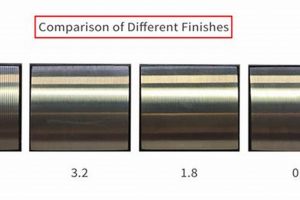
This surface treatment, characterized by a hazy or misty appearance, is often observed on metal, particularly blades. It results from a specific combination of polishing and finishing techniques that create a subtle, non-reflective texture. For example, a knife blade exhibiting this quality will possess a softened sheen, minimizing glare while enhancing visual appeal.
The significance of this treatment lies in its functional and aesthetic contributions. Historically, it was valued for its ability to conceal minor imperfections and reduce light reflection, making it practical for tools requiring low visibility. Beyond functionality, the subtle texture adds a layer of sophistication and craftsmanship, often appreciated in high-end cutlery and decorative metalwork. This contributes to both the user experience and the perceived value of the item.
Further exploration of the processes involved in achieving this effect, the materials best suited for it, and its diverse applications across various industries will be detailed in the subsequent sections.
Achieving the Ideal Kasumi Finish
Optimizing the application of this technique requires careful attention to detail and a thorough understanding of the involved processes. The following tips provide valuable guidance for achieving a high-quality result on various materials.
Tip 1: Grit Selection is Crucial. Begin with coarser abrasives to remove surface imperfections, then gradually transition to finer grits. Skipping grits leads to unevenness and a less refined outcome. For example, starting with a 400-grit sandpaper followed by 600, 800, 1000, and finally 1200 is a common practice.
Tip 2: Maintain Consistent Pressure. Applying even pressure during polishing ensures a uniform texture. Excessive pressure can create deep scratches, while insufficient pressure may result in an inconsistent finish. Use overlapping strokes to prevent directional lines.
Tip 3: Lubrication is Essential. Employ a suitable lubricant, such as honing oil or water, during the finishing process. This reduces friction, prevents heat buildup, and carries away abrasive particles, promoting a smoother, more consistent surface.
Tip 4: Choose the Right Abrasive Material. Different materials respond differently to various abrasive types. Aluminum oxide, silicon carbide, and diamond abrasives offer varying levels of aggressiveness and are suitable for different metals and ceramics. Selecting the appropriate abrasive is critical for achieving the desired result.
Tip 5: Directional Polishing Can Enhance the Effect. While random polishing creates a general hazy appearance, controlled directional polishing can accentuate the effect and create subtle patterns. Experiment with different polishing directions to achieve the desired aesthetic.
Tip 6: Consider the Material’s Properties. The hardness, density, and grain structure of the material being finished influence the outcome. Softer materials may require less aggressive abrasives and lighter pressure, while harder materials may require more aggressive techniques.
Tip 7: Clean Thoroughly Between Steps. Removing all abrasive residue between each grit progression is vital to prevent contamination and ensure the subsequent grit refines the surface properly. Use a clean cloth and appropriate solvent for cleaning.
Adhering to these guidelines ensures a refined and aesthetically pleasing result. Proper technique and material selection are paramount to maximizing the benefits of this finishing method.
The subsequent sections will delve into specific applications and case studies illustrating the practical implementation of these techniques.
1. Hazy Appearance

The “hazy appearance” is not merely a superficial characteristic; it is a defining attribute meticulously engineered into a surface. This aesthetic quality arises from the controlled micro-scratching introduced during the finishing process. These minute imperfections scatter light, preventing direct reflection and resulting in a softened, muted sheen. Consequently, the visual impact is one of depth and subtle texture, rather than a mirror-like reflection. The absence of direct glare contributes to enhanced visibility under varying lighting conditions, particularly advantageous in applications such as knife blades, where precision and clarity are paramount.
Consider the crafting of a traditional Japanese katana. The smith employs specialized stones and polishing techniques to achieve this distinct appearance on the blade’s surface. The resultant haziness not only elevates the aesthetic appeal but also serves a functional purpose by minimizing distracting reflections during use. Furthermore, the controlled micro-scratching contributes to the blade’s ability to grip and cut efficiently, enhancing its overall performance. Similarly, in certain types of decorative metalwork, the hazy effect can create a sense of depth and antiquity, adding visual interest and value to the piece.
In summary, the “hazy appearance” is an integral component, directly influencing both the aesthetic and functional qualities of the finished product. The deliberate manipulation of surface texture to scatter light is the key to achieving this characteristic, offering advantages in both visual appeal and practical performance. Further research should focus on the specific abrasive materials and techniques that best achieve this characteristic on different materials and applications.
2. Non-Reflective Texture

The defining characteristic of the surface treatment is its non-reflective texture, a crucial component achieved through controlled abrasion. This intentional disruption of the surface minimizes specular reflection, resulting in a softened, diffuse reflection pattern. The relationship is direct: a successful application yields a surface that interacts with light in a scattering manner, rather than reflecting it directly. The importance of this non-reflective quality lies in its ability to enhance visual clarity and reduce eye strain in various applications. For example, a knife blade with this texture reduces glare, improving the user’s focus and precision during cutting tasks.
The attainment of this texture is dependent on a multi-stage polishing process employing progressively finer abrasives. Each stage refines the surface, reducing the size and depth of the micro-scratches, ultimately leading to a subtle, uniform texture. In contrast to a highly polished, mirror-like surface that reflects light uniformly, the non-reflective surface diffuses light across its topography. The practical significance of this is evident in medical instruments where minimizing light reflection is critical for surgeons during procedures. Similarly, in photography equipment, interior components often feature non-reflective surfaces to prevent unwanted reflections that could compromise image quality.
In summary, the non-reflective texture is an inherent and essential attribute. It dictates its functional and aesthetic properties. Achieving this texture involves careful control of the finishing process to introduce and refine micro-abrasions, resulting in a surface that minimizes glare and enhances visual clarity. Understanding the relationship between controlled abrasion and the resultant non-reflective nature is crucial for optimizing its use in various industries.
3. Polishing Technique
The attainment of this finish is fundamentally dependent on the execution of a meticulous polishing technique. The method employed directly dictates the final surface characteristics and overall aesthetic. The following details the critical facets of polishing technique in relation to achieving this distinctive finish.
- Abrasive Selection
The selection of appropriate abrasives is paramount. Successive grades of polishing compounds, ranging from coarse to ultra-fine, are essential to gradually refine the surface. The choice of abrasive material (e.g., aluminum oxide, silicon carbide, diamond) must be tailored to the substrate material to ensure optimal material removal without introducing excessive surface damage. For instance, polishing a stainless steel blade requires different abrasives than polishing a softer metal like copper. Improper abrasive selection can lead to inconsistencies in the finish or even permanent surface defects.
- Polishing Medium
The use of a suitable polishing medium, such as water, oil, or a specialized polishing compound, is critical for lubricating the surface, preventing excessive heat buildup, and carrying away abraded material. The choice of medium directly influences the cutting action of the abrasive and the resulting surface finish. Water-based lubricants are often preferred for their cooling properties, while oil-based lubricants may provide a smoother, more refined finish. Without adequate lubrication, the polishing process can generate excessive heat, leading to surface discoloration or distortion.
- Pressure Control
Maintaining consistent and controlled pressure throughout the polishing process is crucial for achieving a uniform and consistent finish. Excessive pressure can result in deep scratches and uneven material removal, while insufficient pressure may lead to a poorly defined or incomplete finish. The appropriate pressure depends on the material being polished, the abrasive being used, and the desired outcome. Skillful application of pressure is a key differentiator between professional and amateur polishing results.
- Motion and Direction
The polishing motion and direction directly influence the final appearance of the surface. Uniform, overlapping strokes are essential for achieving a consistent and even finish. The direction of polishing can be varied to create subtle patterns or to enhance the overall aesthetic. For example, circular or figure-eight patterns are often used to blend polishing marks and create a hazy, diffused appearance. Failure to maintain consistent motion and direction can result in visible polishing lines or inconsistencies in the surface texture.
In summary, achieving the desired finish hinges on the precise execution of the polishing technique, encompassing abrasive selection, polishing medium, pressure control, and polishing motion. The nuances of each facet must be carefully considered to produce the characteristic hazy, non-reflective surface associated with this specialized finishing method. The interplay between these techniques dictates the final result, highlighting the importance of both knowledge and skill in their application.
4. Subtle Grain

The presence of subtle grain is intrinsically linked to the nature of this finish. This grain, barely perceptible to the naked eye, constitutes the microscopic texture that defines its characteristic hazy appearance. It is not an inherent property of the base material but rather an imparted feature resulting from the controlled abrasion of the surface during the polishing process. The depth, density, and uniformity of this grain determine the degree of haziness and the non-reflective quality of the finished surface. Without this subtle grain, the surface would exhibit a different reflective property, deviating significantly from the intended aesthetic and functional attributes. For example, consider a meticulously crafted Japanese blade: the subtle grain, visible upon close inspection, contributes to its reduced glare and distinctive visual appeal.
The technique employed to create this subtle grain involves the use of progressively finer abrasives. Each successive grade refines the surface, leaving behind a network of microscopic scratches. These scratches, while individually imperceptible, collectively scatter light, contributing to the non-reflective nature of the finish. The skill of the artisan lies in achieving a balance enough abrasion to create the desired haze but not so much as to introduce macroscopic defects. In practical applications, understanding the relationship between abrasive selection, polishing pressure, and the resulting grain structure is critical for achieving a consistent and predictable outcome. The aerospace industry provides a pertinent example: specialized components often require a similar low-reflectivity finish to minimize glare within the cockpit, achieved through precisely controlled surface treatments that induce a uniform, subtle grain.
In conclusion, subtle grain is a defining component, fundamentally shaping its aesthetic and functional properties. It is a manufactured attribute, resulting from controlled abrasion. The ability to manipulate and control this grain is essential for achieving the desired hazy, non-reflective surface, essential in cutlery and functional components. As technology advances, new methods are arising, but the core principles of creating the “Subtle Grain” stay at its ground.
5. Minimized Glare
The principle of minimized glare is intrinsically linked to this surface treatment, serving as both a defining characteristic and a functional advantage. The specific texturing techniques employed induce diffuse reflection, effectively scattering incident light across the surface rather than reflecting it directly. This scattering effect diminishes the intensity of reflected light reaching the observer’s eye, resulting in a significant reduction in glare. In applications where visual clarity and precision are paramount, such as surgical instruments or high-end cutlery, the mitigation of glare is crucial. For instance, a surgeon using an instrument with this surface treatment experiences reduced eye strain and improved visibility of the surgical field, potentially leading to enhanced surgical outcomes. Likewise, a chef using a knife featuring this finish benefits from increased control and accuracy due to the absence of distracting reflections. The minimization of glare is not merely an aesthetic consideration; it directly contributes to enhanced performance and reduced user fatigue.
The practical application of this principle extends beyond specialized tools and equipment. In architectural design, metal surfaces treated to minimize glare can contribute to improved visual comfort in interior spaces. By reducing the intensity of reflected sunlight, these surfaces can mitigate eye strain and create a more pleasant and productive environment. Similarly, in the automotive industry, interior components such as dashboards are often treated to minimize glare, improving driver visibility and safety. The specific techniques employed to achieve minimized glare vary depending on the material and application, but the underlying principle of diffuse reflection remains consistent. These techniques often involve micro-texturing the surface through controlled abrasion or chemical etching, creating a network of microscopic irregularities that scatter light.
In conclusion, the minimization of glare is an essential attribute, fundamentally shaping its functional value. The intentional manipulation of surface texture to achieve diffuse reflection is key to its application in various fields, from precision instruments to architectural design. The challenges in realizing this benefit lie in achieving a consistent and durable surface treatment that effectively minimizes glare without compromising other desirable properties such as corrosion resistance or aesthetic appeal. This integration showcases the importance of this attribute to improve precision performance and/or to have a more comfortable experience when used.
6. Surface Refinement
Surface refinement is a crucial element in achieving this characteristic surface treatment, acting as a primary determinant of its final aesthetic and functional properties. The process involves meticulously removing imperfections and creating a specific texture through controlled abrasion. The degree of refinement directly impacts the resulting haze, glare reduction, and overall uniformity of the finish. A poorly refined surface will exhibit inconsistencies, detracting from the desired visual appearance and potentially compromising its intended function. For example, consider the creation of a high-end chef’s knife: proper surface refinement is vital to achieving a visually appealing haze that also minimizes glare, enhancing both the knife’s aesthetic value and the user’s experience. The level of control and precision in surface refinement dictates the ultimate quality and performance of the applied technique.
The connection between surface refinement and this surface treatment also has practical implications for industries beyond cutlery. In the manufacturing of precision instruments, such as those used in medical or aerospace applications, surface refinement plays a pivotal role in minimizing light scattering and ensuring optimal performance. For instance, optical components require incredibly smooth surfaces to avoid unwanted diffraction and reflection. The refining process in such cases often involves specialized polishing techniques and advanced materials to achieve the required level of smoothness. Furthermore, the durability and corrosion resistance of the finished product can be enhanced through proper surface refinement, as a smoother surface is less prone to trapping contaminants and initiating corrosion. The success of these applications hinges upon the precise control of surface refinement, thereby connecting the aesthetic of the process with its functional benefits.
In conclusion, surface refinement is not merely a cosmetic step but an integral component, significantly impacting both the visual appearance and functional performance. The controlled removal of imperfections and creation of a specific texture are crucial for achieving the desired haze, minimizing glare, and enhancing durability. As technology advances, the demands for surface refinement become increasingly stringent, pushing the boundaries of polishing techniques and materials science. The importance of understanding this fundamental connection is paramount for optimizing the use of this type of finish across various industries, from the creation of artistic metalwork to the manufacturing of high-precision instruments.
Frequently Asked Questions About Kasumi Finish
This section addresses common inquiries and misconceptions surrounding the surface treatment, offering clarity and factual information to enhance understanding.
Question 1: What is the primary purpose of Kasumi Finish?
The primary purpose extends beyond aesthetics. While it imparts a characteristic hazy appearance, the process minimizes glare and enhances visual clarity. It also contributes to concealing minor surface imperfections.
Question 2: On which materials is Kasumi Finish typically applied?
This finish is most commonly observed on metal, particularly steel and its alloys, though its application extends to certain ceramics and composites where a non-reflective surface is desired.
Question 3: How does Kasumi Finish differ from mirror polishing?
Mirror polishing aims for maximum reflectivity, creating a highly polished, reflective surface. In contrast, this technique deliberately introduces microscopic abrasions to scatter light, resulting in a non-reflective, hazy appearance.
Question 4: Does Kasumi Finish affect the durability of the underlying material?
When properly executed, it should not significantly compromise the durability. However, aggressive or improper polishing techniques can potentially weaken the surface. Therefore, skill and precision are paramount.
Question 5: Is Kasumi Finish purely aesthetic, or does it offer functional benefits?
While offering an aesthetic appeal, this technique provides functional benefits. The reduced glare enhances visibility and reduces eye strain, particularly in applications such as cutting tools and precision instruments.
Question 6: What are the key considerations when attempting to achieve a Kasumi Finish?
Key considerations include abrasive selection, polishing pressure, lubrication, and the polishing medium. Careful attention to these factors is crucial for achieving a consistent and desirable result.
The key takeaway is that this surface treatment involves a balance between aesthetic appeal and functional performance, demanding precision and expertise in its execution.
The next section will explore the practical applications of Kasumi Finish across various industries, providing real-world examples and case studies.
Conclusion
The preceding exploration has detailed the nuanced aspects of this surface treatment, underscoring its aesthetic qualities, functional advantages, and the meticulous techniques required for its creation. From its subtle grain structure to its capacity for minimizing glare, this finish represents a deliberate interplay of science and artistry. The discussion has also clarified common misconceptions and highlighted the importance of proper execution to ensure both visual appeal and long-term durability.
The integration of this type of finish into various industries, from precision instrumentation to high-end cutlery, demonstrates its enduring relevance. Continued research into advanced polishing techniques and material applications will undoubtedly further refine and expand the scope of this unique and valuable process. As industries prioritize both performance and aesthetics, the demand for surfaces that embody visual sophistication and enhanced functionality will likely increase, ensuring the continued significance of this finish.


![Best Coating: Finish Thompson Pumps - [Longevity Tips] | Best Final Touch: Elevate Your Projects with Professional Finishing](https://bestfinaltouch.com/wp-content/uploads/2026/05/th-238-300x200.jpg "Best Coating: Finish Thompson Pumps - [Longevity Tips] Best Final Touch: Elevate Your Projects with Professional Finishing")