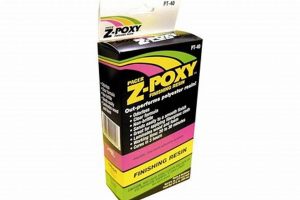
A durable, glossy surface coating frequently used in woodworking, it’s created by combining a resin and a hardener. This chemical reaction results in a tough, protective layer. Applied over wood surfaces, this coating enhances aesthetics and provides a robust shield against moisture, scratches, and other potential damage. Common applications include coating tables, countertops, and decorative wooden items.
The implementation of this type of coating offers several key advantages. It significantly extends the lifespan of wooden projects by creating a barrier against environmental factors. Its ability to self-level ensures a smooth, even appearance, adding to the visual appeal of the finished piece. The emergence of synthetic resins for this purpose in the mid-20th century revolutionized wood finishing, offering superior performance compared to traditional varnishes and lacquers.
Further discussion will delve into the specific types available, proper application techniques, safety precautions, and troubleshooting common issues encountered during its use. Understanding these elements is crucial for achieving professional-quality results and ensuring the longevity of woodworking projects.
Essential Guidance
Achieving a flawless and lasting result requires attention to detail and adherence to proven techniques. These guidelines offer insights into maximizing the potential of this protective layer.
Tip 1: Surface Preparation is Paramount: Ensure the wood surface is meticulously sanded and free of any dust, oils, or contaminants. Inadequate preparation can lead to adhesion issues and imperfections in the final coating.
Tip 2: Precise Mixing Ratios are Crucial: Strictly adhere to the manufacturer’s recommended mixing ratios for the resin and hardener. Incorrect ratios can result in incomplete curing, leaving a sticky or soft finish.
Tip 3: Control the Ambient Temperature: Apply the coating in a temperature-controlled environment, ideally between 70-80F (21-27C). Extreme temperatures can affect viscosity and curing time, potentially leading to bubbles or cloudiness.
Tip 4: Employ Proper Pouring and Spreading Techniques: Pour slowly and deliberately to minimize air entrapment. Use a spreading tool, such as a squeegee or brush, to evenly distribute the coating across the surface.
Tip 5: Implement Debubbling Strategies: Use a heat gun or propane torch to carefully remove any air bubbles that rise to the surface. Exercise caution to avoid scorching the coating or the underlying wood.
Tip 6: Multiple Thin Coats are Preferable: Apply several thin coats rather than one thick coat. This allows for better leveling, reduces the risk of air entrapment, and minimizes the potential for runs or drips.
Tip 7: Allow Adequate Curing Time: Provide sufficient curing time, as specified by the manufacturer, before sanding, handling, or subjecting the finished piece to use. Premature handling can damage the coating and compromise its durability.
By diligently following these recommendations, woodworkers can consistently achieve professional-grade results, enhancing both the aesthetic appeal and longevity of their projects.
The subsequent section will address potential challenges encountered during the finishing process and offer practical solutions to overcome them.
1. Clarity

Clarity, within the context of woodworking surfaces, refers to the degree of transparency exhibited by the cured finish. The degree of this transparency directly impacts the aesthetic appeal of the finished product. A high level of clarity allows the natural grain and color variations of the wood to be vividly seen, enhancing its inherent beauty. Conversely, a cloudy or opaque coating obscures the wood’s characteristics, diminishing its visual value. Poor mixing techniques, moisture contamination, or incompatible hardener/resin combinations can lead to a loss of clarity. For example, a table coated with a low-clarity surface will obscure the wood grain beneath, impacting the overall look of the product.
The achievement of optical purity relies on multiple factors during application. Precise mixing ratios, thorough degassing to eliminate air bubbles, and dust-free environments are crucial. Certain wood species with open pores may require sealing to prevent air entrapment in the surface coating, which can contribute to cloudiness. Furthermore, the choice of resin type influences final transparency; formulations designed for casting typically offer superior clarity compared to those intended for adhesive applications. Applying a clear, protective layer on a naturally-finished wood surface will dramatically enhance the wood grains of the product, which will emphasize the quality of the craftsmenship.
In summary, a clear application is a crucial determinant of visual quality. Maintaining meticulous control over preparation and application processes is essential to achieve the desired effect. Understanding the factors that influence the transparency of the coating allows woodworkers to optimize their techniques and produce high-quality, visually appealing finished pieces. Addressing any issues during application ensures the overall quality of the woodworking product.
2. Durability
Durability is a primary consideration in woodworking, especially when selecting a finish. The protective properties and lifespan of the finished piece are directly correlated with the chosen coating’s ability to withstand various environmental and mechanical stressors. Woodworking surface layers, known for their robust protective qualities, offer a notable enhancement to the longevity of woodworking projects.
- Scratch Resistance
Scratch resistance refers to the coating’s ability to withstand surface abrasion from contact with other objects. A durable formulation resists scratching, maintaining the aesthetic appeal of the wood surface over time. For example, a tabletop coated with a scratch-resistant finish will better withstand the daily wear and tear of utensils and other objects placed upon it, compared to a surface finished with a softer coating.
- Impact Resistance
Impact resistance describes the coating’s capacity to absorb and dissipate sudden forces without cracking or chipping. High impact resistance is particularly important for items subject to frequent handling or potential impacts. A bar top coated with an impact-resistant surface will be less susceptible to damage from dropped glasses or other heavy objects.
- Chemical Resistance
Chemical resistance indicates the coating’s ability to withstand exposure to various chemicals, such as household cleaners, solvents, and acids, without degradation. A surface with high chemical resistance will remain unaffected by spills and cleaning agents, preserving its appearance and integrity. Countertops and laboratory surfaces are often coated with chemically resistant formulations.
- Moisture Resistance
Moisture resistance reflects the coating’s ability to prevent water or humidity from penetrating the wood, which can lead to swelling, warping, and decay. A moisture-resistant surface is essential for outdoor furniture, marine applications, and items exposed to humid environments. The coating effectively seals the wood, protecting it from the damaging effects of moisture.
The long-term performance of woodworking projects hinges on the durability of the chosen surface layer. By providing resistance to scratches, impacts, chemicals, and moisture, these formulations significantly extend the lifespan and maintain the aesthetic value of finished wood pieces. Selection of an appropriate and durable surface is thus a crucial factor in any woodworking endeavor.
3. Leveling
Leveling, in the context of woodworking surfaces, refers to the ability of the applied material to self-distribute evenly across a surface, mitigating imperfections and creating a smooth, uniform plane. This property is particularly significant, where achieving a flawless, glass-like surface is often desired. Inadequate leveling can result in an uneven or wavy finish, detracting from the overall appearance and potentially compromising the functionality of the finished piece.
- Viscosity and Surface Tension
Viscosity, the measure of a fluid’s resistance to flow, and surface tension, the cohesive forces between liquid molecules, directly influence leveling characteristics. Lower viscosity allows the material to spread more easily, while higher surface tension promotes a flatter, more uniform surface. Formulations are often engineered to strike a balance between these properties for optimal leveling. An example is a thin layer applied to a tabletop will naturally spread to fill minor gaps and depressions.
- Working Time and Cure Rate
Working time, the period during which the material remains workable, and cure rate, the speed at which it hardens, affect the opportunity for leveling to occur. A longer working time allows more time for the material to self-level before hardening. However, a slow cure rate can also increase the risk of dust contamination or sagging. Balancing the working time with the cure rate is crucial for achieving a smooth, level finish. For example, if the curing process is too rapid, bubbles may be trapped.
- Substrate Preparation
The condition of the underlying wood surface significantly impacts the leveling process. Uneven surfaces, imperfections, or contaminants can hinder the material’s ability to self-level effectively. Proper sanding, cleaning, and sealing of the wood substrate are essential for achieving a level finish. Applying a surface to a properly sanded and sealed wood surface will be more effective at leveling than applying it to a rough, unsealed surface.
- Application Technique
The method of application plays a critical role in achieving a level surface. Proper pouring techniques, even spreading with a squeegee or brush, and the use of self-leveling compounds can all contribute to a more uniform finish. Pouring too quickly or applying uneven pressure during spreading can result in an uneven, wavy surface. The end result is a smooth glass-like surface across the wooden product.
The success of achieving a level finish depends on a combination of material properties, preparation, and application techniques. Woodworkers must carefully consider these factors to achieve the desired smooth, uniform surface. Addressing these elements is vital for achieving a smooth, glass-like surface when working on woodworking projects.
4. Adhesion

Adhesion represents a critical factor in the successful application and long-term performance of woodworking surfaces. The strength and durability of the bond between the coating and the wood substrate directly influence the finished product’s resistance to wear, environmental factors, and structural stresses. Insufficient adhesion leads to premature failure, resulting in peeling, cracking, and ultimately, the degradation of the protective layer.
- Surface Preparation and Mechanical Keying
Proper surface preparation plays a pivotal role in establishing a strong adhesive bond. Sanding the wood surface creates microscopic irregularities, increasing the surface area available for bonding. These irregularities provide a mechanical “key” for the coating, allowing it to grip the wood fibers more effectively. For example, sanding a glossy surface prior to application provides a texture for the coating to grip. Failure to adequately prepare the surface significantly reduces the bond strength and increases the risk of delamination.
- Chemical Compatibility and Interlocking
Chemical compatibility between the coating and the wood species is essential for optimal adhesion. Certain wood species contain oils or extractives that can interfere with the curing process and reduce the bond strength. In some cases, a primer or sealer may be required to create a compatible surface for the coating. At a molecular level, chemical interlocking enhances the adhesion process. This process involves the chemical reaction between the coating and the wood surface. For instance, an epoxy primer enhances surface interlocking with epoxy layers.
- Cleanliness and Contamination Control
Contaminants such as dust, oil, grease, or wax on the wood surface can significantly impede adhesion. These contaminants create a barrier between the coating and the wood, preventing a proper bond from forming. Thorough cleaning with appropriate solvents is necessary to remove any surface contaminants prior to applying the coating. For example, a solvent wipe ensures a clean, surface for the coating to grip. Even the smallest amount of debris can compromise the long-term integrity of the finish.
- Wetting and Capillary Action
Wetting refers to the ability of the liquid coating to spread and make intimate contact with the wood surface. Proper wetting is necessary to ensure that the coating fills all the surface irregularities and establishes a strong adhesive bond. Low surface tension promotes better wetting. Capillary action, the ability of a liquid to flow into narrow spaces, aids in drawing the coating into the pores of the wood, further enhancing adhesion. For instance, a well-formulated coating flows effectively into wood pores, maximizing the adhesion with the surface.
The strength of the bond between the surface and the wood represents a fundamental determinant of the finished piece’s quality and longevity. By meticulously addressing the factors that influence adhesion surface preparation, chemical compatibility, cleanliness, and wetting woodworkers can ensure a durable, long-lasting finish that enhances both the aesthetic appeal and structural integrity of their projects.
5. Curing

Curing represents a crucial phase in the application of surfaces used in woodworking. It is the chemical process by which the liquid coating transitions into a solid, durable layer. The ultimate performance characteristics of the finish, including hardness, chemical resistance, and clarity, are directly dependent on the proper execution of this process.
- Time and Temperature Dependence
The curing reaction exhibits a strong dependency on both time and temperature. Higher temperatures generally accelerate the curing process, while lower temperatures retard it. Manufacturers provide specific guidelines for curing times at various temperatures. Deviation from these guidelines can result in incomplete curing, leading to a soft or sticky finish, or conversely, overly rapid curing, causing cracking or distortion. For instance, a surface intended to cure in 24 hours at 75F (24C) may take several days to fully cure at 60F (16C).
- Mixing Ratios and Stoichiometry
The precise mixing ratio of resin and hardener is governed by the stoichiometry of the chemical reaction. An imbalance in these components can disrupt the curing process, resulting in a compromised finish. Insufficient hardener may leave uncured resin, while excess hardener can lead to brittleness. Adhering strictly to the manufacturer’s recommended mixing ratios ensures complete and proper curing. Using a mixing ratio outside the recommended parameters might result in a final layer that is either tacky or too brittle to protect the wood.
- Environmental Factors and Humidity
Environmental factors, particularly humidity, can influence the curing of certain formulations. High humidity levels can interfere with the curing reaction, potentially leading to a cloudy or hazy finish. Proper ventilation and humidity control are essential for achieving optimal curing, particularly in humid climates. Excessive moisture can inhibit the cross-linking of the resin chains during curing, resulting in a compromised finish.
- Curing Stages and Property Development
The curing process progresses through distinct stages, each characterized by specific property developments. Initially, the liquid coating undergoes a gelation phase, transitioning from a liquid to a semi-solid state. Subsequently, the material hardens and develops its final strength, hardness, and chemical resistance. Premature handling or stressing of the finish before it has fully cured can disrupt the process and compromise its performance. For example, placing heavy objects on a surface before it has fully cured can lead to surface indentations or distortions.
In summary, successful surface application in woodworking relies heavily on understanding and controlling the curing process. Maintaining precise control over time, temperature, mixing ratios, environmental factors, and curing stages is essential for achieving a durable, aesthetically pleasing, and long-lasting finish. Deviation from these elements will result in a woodworking product that will degrade sooner that it should.
6. Safety

The application of surface coatings in woodworking necessitates stringent adherence to safety protocols due to the inherent hazards associated with the chemicals involved. These products typically consist of epoxy resins and hardeners, which can pose significant health risks if mishandled. Direct skin contact can lead to dermatitis, characterized by irritation, redness, and itching. Inhalation of vapors may cause respiratory irritation, dizziness, and nausea. Eye contact can result in severe irritation and potential corneal damage. Therefore, a comprehensive understanding of safety measures is crucial to mitigate these risks and ensure a safe working environment.
The implementation of preventative measures is essential at all stages of the finishing process. Proper ventilation is paramount to minimize the concentration of airborne vapors. Respiratory protection, in the form of a NIOSH-approved respirator, should be worn during mixing, pouring, and sanding operations. Skin protection, including gloves and long-sleeved clothing, is necessary to prevent direct contact with the chemicals. Eye protection, such as safety glasses or goggles, is critical to safeguard against splashes and accidental exposure. Furthermore, the work area should be kept clean and free of flammable materials to prevent fire hazards. Real-world examples demonstrate the potential consequences of neglecting these precautions, ranging from mild skin irritation to severe respiratory distress and chemical burns.
In conclusion, safety is an indispensable component of woodworking. The potential health risks associated with surface coatings demand meticulous adherence to safety protocols. The use of personal protective equipment, adequate ventilation, and careful handling practices are critical to minimize the risk of exposure and ensure a safe working environment. Failure to prioritize safety can result in adverse health effects and compromise the quality and longevity of woodworking projects.
Frequently Asked Questions
This section addresses common inquiries regarding the application and properties of woodworking surface coatings, offering clarification and guidance for successful implementation.
Question 1: What is the typical lifespan of a properly applied woodworking surface?
The lifespan depends on several factors, including the formulation used, the level of wear and tear, and environmental exposure. Generally, a well-applied coating can last for many years, even decades, with proper care. Regular cleaning and avoidance of harsh chemicals contribute to longevity.
Question 2: What are the primary differences between various types of woodworking surface coatings?
The differences lie primarily in their chemical composition, hardness, scratch resistance, and UV resistance. Some formulations are designed for high-gloss finishes, while others offer a more matte appearance. The selection depends on the desired aesthetic and functional requirements of the project.
Question 3: Can woodworking surfaces be applied over existing finishes?
It depends on the compatibility of the existing finish and the new coating. In general, it is recommended to remove or thoroughly sand the existing finish to ensure proper adhesion. A test area should be conducted to assess compatibility prior to full application.
Question 4: How is bubble formation prevented during surface application?
Bubble formation can be minimized through proper mixing techniques, slow pouring, and the use of a heat gun or torch to release trapped air. Additionally, warming the resin and hardener slightly before mixing can reduce viscosity and facilitate bubble release.
Question 5: What are the best practices for cleaning woodworking surfaces?
Gentle cleaning with mild soap and water is generally recommended. Avoid abrasive cleaners, harsh chemicals, and excessive scrubbing, as these can damage the coating. A soft cloth or sponge should be used to prevent scratching.
Question 6: How is the appropriate thickness of the surface coating determined?
The appropriate thickness depends on the intended use and desired level of protection. Thicker coatings offer greater durability and scratch resistance, but can also be more prone to cracking or clouding. The manufacturer’s recommendations should be followed to achieve the optimal balance.
These FAQs provide a foundational understanding of this layer’s characteristics and application. Careful consideration of these factors ensures a successful and long-lasting finish on woodworking projects.
The following section will explore advanced techniques and specialized applications in woodworking.
Conclusion
This exposition has detailed the multifaceted nature of “woodworking epoxy finish.” The examination encompassed its definition, benefits, essential application guidelines, critical elements like clarity and durability, and indispensable safety measures. The analysis of frequently asked questions provided further practical insights into its usage and maintenance.
The successful implementation of “woodworking epoxy finish” requires a comprehensive understanding of its properties and careful adherence to established techniques. Mastery of these elements empowers woodworkers to achieve exceptional results, enhancing both the aesthetic appeal and longevity of their creations. Continued exploration and refinement of these methods will undoubtedly contribute to the advancement of the craft.