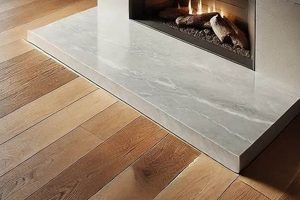
Achieving a level, polished surface on hardened cementitious material involves a series of deliberate techniques. These methods focus on manipulating the concrete during its plastic state and, subsequently, employing grinding or polishing processes after it has cured. Factors such as proper mixing, placement, consolidation, and curing all contribute to the ultimate surface quality.
A refined surface enhances aesthetics and improves the functionality of the concrete. It can increase resistance to wear, facilitate easier cleaning, and reduce the potential for dust generation. Historically, such surface treatments were primarily employed for industrial or commercial applications; however, they have gained popularity in residential settings due to their durability and modern appearance.
The subsequent sections will detail the essential steps for producing a superior, even surface. This includes discussing appropriate mix designs, proper placement and finishing techniques, and post-curing treatments such as grinding and polishing to obtain the desired result.
Achieving a Refined Concrete Surface
The following points outline vital procedures to ensure a high-quality surface is achieved.
Tip 1: Mix Design Optimization: The composition of the concrete mix is crucial. Use a mix with a lower water-to-cement ratio to minimize shrinkage cracking. Consider incorporating chemical admixtures, such as plasticizers, to improve workability without adding excess water. The aggregate gradation should be well-graded, reducing the likelihood of segregation and promoting a more uniform surface.
Tip 2: Proper Placement and Consolidation: Concrete should be placed in layers, ensuring each layer is adequately consolidated to remove air pockets. Vibratory equipment is recommended to achieve complete consolidation, especially around formwork and reinforcing steel. Over-vibration should be avoided as it can cause segregation of the aggregate.
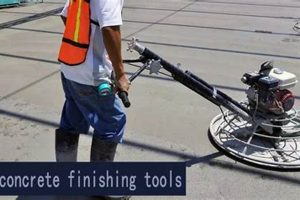
Tip 3: Timely Floating and Troweling: The timing of floating and troweling is critical. Floating should occur after the bleed water has evaporated from the surface, and the concrete has stiffened sufficiently to support the worker’s weight. Subsequent troweling should be performed in stages, with each pass applying increasing pressure to further refine the surface. Power trowels can provide a more consistent and efficient surface finish, particularly on large areas.
Tip 4: Controlled Curing Environment: Proper curing is essential to prevent rapid moisture loss, which can lead to cracking and dusting. Employ curing methods such as wet burlap, plastic sheeting, or curing compounds to maintain a consistently moist surface for at least seven days. The ambient temperature during curing should be maintained within a suitable range to optimize hydration.
Tip 5: Surface Grinding and Polishing (Post-Cure): After the concrete has fully cured, surface grinding and polishing can further refine the surface. Start with coarser grit diamond grinding pads to remove any surface imperfections and gradually progress to finer grits to achieve the desired level of smoothness and reflectivity. Dust control measures should be implemented during grinding and polishing.
Tip 6: Consider Surface Sealers and Hardeners: The application of surface sealers and hardeners enhances durability and resistance to stains and abrasion. These products penetrate the concrete surface, increasing its density and preventing the ingress of liquids. Select a sealer or hardener appropriate for the intended use and level of foot traffic.
These techniques, when carefully implemented, result in a durable and aesthetically pleasing finish. Adherence to these principles ensures a long-lasting and high-quality surface.
The following section will address common challenges encountered in achieving this goal.
1. Mix Consistency

Mix consistency is a foundational element in obtaining a level and uniform hardened cementitious surface. Deviations from an optimal mixture design can compromise subsequent finishing processes, leading to imperfections that are difficult or impossible to rectify post-cure.
- Water-to-Cement Ratio
The water-to-cement (w/c) ratio directly impacts the workability and strength of the concrete. Excess water increases bleeding, leading to water pockets and potential surface weakness. A lower w/c ratio reduces bleed water and enhances surface density, facilitating easier finishing. For example, a mix with a w/c ratio exceeding 0.5 typically exhibits increased surface cracking and dusting compared to a mix with a w/c ratio of 0.4 or lower. Achieving a smooth surface mandates precise control over this parameter.
- Aggregate Gradation
Aggregate gradation refers to the particle size distribution within the mix. A well-graded aggregate minimizes voids and promotes a cohesive mix. Segregation of aggregate, often resulting from poor gradation, creates inconsistencies in the surface texture. Instances of coarse aggregate protruding from the surface after troweling demonstrate the importance of proper gradation. The uniformity achieved by well-graded aggregate contributes directly to a smoother, more easily finished surface.
- Admixture Usage
Chemical admixtures, such as plasticizers and superplasticizers, modify the properties of the fresh concrete. Plasticizers enhance workability without increasing the w/c ratio, while superplasticizers significantly reduce water demand, leading to higher strength and density. The use of these admixtures results in a more homogeneous mix, allowing for easier placement and finishing. Projects that forgo admixtures often struggle to achieve the same degree of surface refinement.
- Mixing Procedures
Thorough and consistent mixing is paramount to ensure uniform distribution of all components. Inadequate mixing results in localized variations in cement hydration and aggregate distribution. These variations translate to inconsistencies in the surface characteristics, affecting the finish. Consistent mixing protocols, including specified mixing times and equipment calibration, are essential to achieve a homogenous mix conducive to the development of the desired refined surface.
Control over mix consistency, encompassing water-to-cement ratio, aggregate gradation, admixture usage, and mixing procedures, are all crucial to the development of a quality surface. Ignoring these factors will significantly impact the concrete’s aesthetic and functional qualities.
2. Proper Consolidation

Proper consolidation is an indispensable process for achieving a level, dense concrete surface. It directly impacts the removal of entrapped air voids within the freshly placed concrete, mitigating surface defects that compromise both aesthetics and durability. Insufficient consolidation leads to honeycomb, bugholes, and other surface irregularities, rendering the attainment of a refined surface virtually impossible. Real-world examples of improperly consolidated walls or slabs exhibit noticeable pitting and a coarse texture, far removed from a level surface. The use of appropriate consolidation techniques is therefore a prerequisite for superior surface quality.
The method and degree of consolidation are contingent upon the concrete mix design, the placement configuration, and the reinforcing steel density. Vibratory consolidation, whether through immersion vibrators or external form vibrators, is typically employed to induce flow and expel entrapped air. Over-vibration, however, can induce segregation of the mix components, resulting in a laitance layer at the surface, which is weak and prone to dusting. Careful monitoring of vibration duration and intensity is, therefore, crucial. In heavily reinforced sections, proper consolidation is particularly challenging, requiring specialized techniques to ensure complete void removal. The absence of proper consolidation in such scenarios results in a visually unappealing surface and reduced structural integrity.
In summary, proper consolidation constitutes a critical step in the overall process of creating quality concrete. Its influence on surface density, uniformity, and the elimination of air voids is paramount. While mix design and finishing techniques are important, their potential can only be fully realized when adequate consolidation is achieved. Neglecting this fundamental aspect inevitably results in surface defects that detract from the concrete’s appearance and its long-term performance.
3. Finishing Timing
The timing of finishing operations is a critical determinant of the ultimate surface quality. Executing these operations prematurely or belatedly can compromise the integrity and aesthetic appeal. Precise scheduling based on environmental conditions and concrete setting characteristics is essential.
- Evaporation Rate Considerations
The rate of surface moisture evaporation dictates the appropriate time window for floating and troweling. Rapid evaporation due to high temperatures, low humidity, or wind can lead to premature surface hardening, hindering proper finishing. Conversely, delayed evaporation extends the bleed water phase, delaying the start of finishing. Understanding and mitigating the effects of evaporation rate is therefore crucial. For instance, employing windbreaks or moisture barriers can moderate evaporation in adverse conditions.
- Bleed Water Management
Bleed water, the excess water rising to the surface after placement, must evaporate before finishing can commence. Working bleed water back into the concrete disrupts the cement hydration process and weakens the surface layer, leading to dusting and cracking. Allowing sufficient time for bleed water evaporation, or employing techniques such as blotting to accelerate the process, is imperative. Premature finishing over bleed water invariably results in a compromised surface.
- Concrete Stiffness Assessment
Concrete stiffness, or its resistance to deformation, is a key indicator of readiness for finishing. Applying pressure to the surface and observing the degree of indentation provides a practical assessment of stiffness. The concrete should be firm enough to support the weight of the finishing tools without excessive deformation. Objective measures, such as penetration resistance testing, offer more precise assessment. Correct assessment of stiffness ensures that the finishing operations are performed within the optimal window.
- Phased Finishing Approach
A phased finishing approach, involving multiple passes with progressively finer tools, maximizes the surface refinement. Initial floating compacts the surface and embeds aggregate particles. Subsequent troweling operations further densify the surface and eliminate minor imperfections. Each phase must be timed appropriately to leverage the evolving characteristics of the concrete. Rushing the finishing process invariably results in an uneven and imperfect surface.
The interplay between evaporation rate, bleed water management, concrete stiffness assessment, and the application of a phased finishing approach collectively determines the success. Accurate assessment of these factors is vital for achieving desired surface outcomes.
4. Curing Technique

The method of curing significantly influences the surface characteristics of hardened concrete. Inadequate curing protocols can negate the benefits of meticulous mix design, placement, and finishing techniques. Maintaining appropriate moisture and temperature levels during the curing period is crucial for optimal cement hydration and the prevention of surface defects.
- Moisture Retention
Sustained moisture availability is essential for complete cement hydration near the surface. Premature drying leads to surface shrinkage cracking and dusting, diminishing the smoothness. Curing methods such as wet burlap, continuous water spraying, or the application of liquid curing compounds create a moisture-rich environment. For example, a concrete slab cured with plastic sheeting retains significantly more surface moisture compared to an uncured slab, resulting in a denser, less porous surface.
- Temperature Control
Maintaining consistent temperature within an acceptable range promotes uniform cement hydration and minimizes thermal stress. Extremes in temperature, whether high or low, can lead to differential expansion and contraction, inducing surface cracking. Insulating blankets or controlled heating/cooling systems mitigate these effects. During cold weather conditions, failure to insulate can result in surface scaling and a rough texture.
- Curing Duration
The duration of curing influences the strength and durability of the surface layer. Extended curing periods allow for more complete cement hydration, resulting in a denser, more abrasion-resistant surface. While minimum curing durations are often specified in construction documents, extending the curing period beyond these minimums can further enhance surface properties. Instances where specified curing periods are shortened due to scheduling constraints often exhibit reduced surface hardness and increased susceptibility to damage.
- Curing Compound Selection and Application
When liquid curing compounds are employed, the selection of an appropriate product and its correct application are critical. The compound should be compatible with any subsequent surface treatments and applied uniformly at the recommended coverage rate. Non-uniform application or the use of incompatible products can result in discoloration or the formation of a sticky surface film, negatively impacting the overall surface appearance.
The connection between curing technique and surface characteristics is undeniable. Consistent application of appropriate methods is key to achieving improved surface durability and increased aesthetic appeal.
5. Surface Treatment

Surface treatment represents a crucial phase in achieving a hardened concrete surface that fulfills aesthetic and functional requirements. It encompasses post-curing processes designed to refine the as-cast surface, address imperfections, and enhance durability, thereby directly contributing to overall surface quality. The effects of surface treatments on concrete are demonstrably clear and long-lasting.
One primary purpose of surface treatment is to eliminate surface irregularities, such as laitance, minor cracking, and discoloration. Grinding, for instance, employs abrasive tools to remove a thin layer of the concrete surface, exposing a denser, more uniform matrix. This process not only enhances smoothness but also reveals the aggregate, contributing to a desired aesthetic. Polishing, a subsequent step, uses progressively finer abrasives to achieve a reflective surface, increasing resistance to staining and wear. The absence of such treatments often results in a surface that is susceptible to damage and less visually appealing.
Furthermore, surface treatments encompass the application of sealers and hardeners. Sealers penetrate the concrete matrix, reducing porosity and preventing the ingress of liquids and contaminants. Hardeners react chemically with the concrete, increasing its surface hardness and abrasion resistance. These treatments are particularly important in high-traffic areas or environments exposed to harsh chemicals. In industrial settings, the application of epoxy coatings provides a durable, chemical-resistant surface, significantly extending the lifespan of the concrete structure. It is evident that effective surface treatments are invaluable to achieving aesthetic qualities, durability, and surface uniformity, which ultimately define quality concrete structures.
Frequently Asked Questions
This section addresses common inquiries regarding the methods and considerations involved.
Question 1: What is the most critical factor in achieving a level hardened cementitious surface?
While multiple factors contribute, mix consistency, consolidation, finishing techniques, and curing protocols hold equal importance. Failure to address any one of these comprehensively compromises the overall outcome. Understanding the impact of each stage is crucial for achieving the desired refined result.
Question 2: Can a surface be effectively smoothed after the concrete has fully hardened?
Yes, surface grinding and polishing are effective methods for refining a hardened surface. These techniques involve the use of abrasive tools to remove surface imperfections and achieve a smoother texture. The extent of smoothing achievable depends on the initial condition of the surface and the grit levels used during grinding and polishing.
Question 3: Is it possible to over-trowel concrete, and if so, what are the consequences?
Over-troweling is indeed possible and detrimental. It seals the surface prematurely, preventing bleed water from escaping, which leads to blistering, delamination, and a weakened surface prone to cracking and dusting. Proper timing and controlled pressure during troweling are essential to avoid these issues.
Question 4: Are there specific concrete mix designs that are more conducive for a smoother surface?
Yes, mix designs with lower water-to-cement ratios, well-graded aggregates, and incorporating plasticizing admixtures facilitate smoother finishing. These mixes exhibit reduced bleeding and segregation, resulting in a denser, more uniform surface texture.
Question 5: What role does environmental temperature play in the finishing process?
Environmental temperature significantly impacts the evaporation rate of surface moisture, thereby influencing the timing of finishing operations. High temperatures accelerate evaporation, potentially leading to premature surface hardening. Conversely, low temperatures delay evaporation, extending the bleed water phase. Adjustments to finishing schedules and curing methods are necessary to accommodate these variations.
Question 6: Is the use of surface sealers necessary for surfaces, and what benefits do they provide?
The application of surface sealers is beneficial, enhancing durability, resistance to staining, and ease of cleaning. Sealers penetrate the surface, reducing porosity and preventing the ingress of liquids and contaminants. While not always strictly necessary, their use significantly extends the lifespan and maintains the aesthetic quality of the surface.
In summation, achieving polished concrete involves careful planning, execution, and control over each phase of the process. By adhering to best practices and addressing potential challenges proactively, one can attain the desired result.
The subsequent section will delve into troubleshooting techniques and best practices in the field.
Achieving Surface Refinement
The preceding sections comprehensively detailed various approaches to, how to get smooth finish on concrete. From optimizing mix designs and ensuring proper consolidation to carefully timing finishing operations and implementing appropriate curing techniques, each step plays a crucial role. Surface treatments, such as grinding, polishing, and the application of sealers, further refine the surface, enhancing both its aesthetic appeal and functional performance. A holistic approach, integrating these elements, is essential for consistently achieving desired quality of surface.
The pursuit of a high-quality surface on hardened cementitious materials demands diligence and a thorough understanding of the underlying principles. Careful planning, meticulous execution, and proactive problem-solving are indispensable for realizing optimal results. Continued research and development in materials science and construction techniques will undoubtedly lead to further advancements in the field, empowering practitioners to create even more refined surfaces in the future.