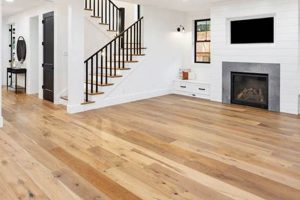
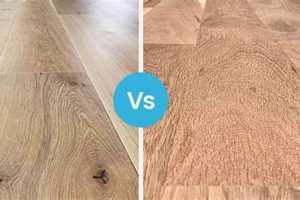
The choice between factory-finished and job-site finished hardwood flooring represents a fundamental decision in hardwood floor installation. One involves the application of protective coatings and stains in a controlled manufacturing environment, while the other entails these processes being completed after the floor is installed within a building.
The selection impacts durability, cost, and installation time. Factory finishes often offer superior hardness and uniformity due to controlled application. Job-site finishing allows for customization of color and sheen, and it can also mitigate slight imperfections that may arise during installation. Historically, job-site finishing was the standard; however, advancements in manufacturing have increased the popularity and quality of factory-finished options.
Understanding the distinctions in finish quality, installation procedures, customization options, and long-term maintenance requirements is crucial for selecting the appropriate flooring solution for any given project. These elements will be explored in greater detail to facilitate informed decision-making.
Guidance on Hardwood Flooring Selection
Careful consideration of several factors will lead to a successful hardwood flooring installation, whether opting for a factory or job-site finished product.
Tip 1: Evaluate the Subfloor. The subfloor must be level and structurally sound regardless of the finish type. Any inconsistencies will be amplified, affecting the final appearance and longevity. Professional assessment is advisable.
Tip 2: Consider the Environment. High-humidity environments may benefit from the stability offered by certain factory-finished products designed to resist moisture absorption. Job-site finishes can be more vulnerable if not properly sealed.
Tip 3: Assess Traffic Levels. High-traffic areas necessitate durable finishes. Factory-applied finishes, often using aluminum oxide, are known for their resistance to abrasion. Choosing appropriate finish hardness is essential.
Tip 4: Plan for Color and Sheen. While factory finishes offer a range of choices, job-site finishing allows for unparalleled customization. Precise color matching to existing decor is easier with on-site staining and sealing.
Tip 5: Factor in Installation Time. Factory-finished floors typically require less installation time as the finishing process is already complete. Job-site finishing adds several days for sanding, staining, and multiple coats of sealant, impacting project timelines.
Tip 6: Account for Odor and Dust. Job-site finishing generates significant dust and fumes. Proper ventilation and containment are mandatory. Factory-finished floors eliminate these issues, providing a cleaner installation process.
Tip 7: Budget Accordingly. While factory-finished materials might have a higher initial cost, the overall project price can be comparable, considering the labor involved in on-site finishing. Obtain detailed quotes for both options.
Understanding these points will allow for the selection of a hardwood floor that best meets the needs of the project, balancing aesthetic preferences with practical considerations such as durability and cost.
This guidance lays the groundwork for a successful flooring project. Further exploration of specific product lines and professional consultation is recommended before making a final decision.
1. Finish Durability

The longevity and resilience of a hardwood floor’s protective coating, referred to as finish durability, stands as a primary consideration when choosing between factory-applied (prefinished) and job-site applied (site finished) options. This aspect directly impacts the floor’s resistance to wear, scratches, and overall lifespan.
- Abrasion Resistance
Prefinished floors often incorporate factory-applied finishes, frequently utilizing aluminum oxide particles for increased abrasion resistance. This results in a harder, more scratch-resistant surface compared to traditional polyurethane finishes typically applied on-site. For example, a high-traffic hallway benefits significantly from the enhanced abrasion resistance of a prefinished floor. The implication is reduced wear and a prolonged lifespan in demanding environments.
- UV Curing and Finish Integrity
The controlled environment of a factory setting allows for UV curing of finishes, enhancing their cross-linking and overall strength. This process results in a more uniform and durable finish. Site-applied finishes, lacking this UV curing process, may be more susceptible to chipping or peeling over time. The benefit is greater longevity, especially in areas exposed to direct sunlight.
- Layer Thickness and Application Consistency
Prefinished floors often feature multiple, precisely controlled layers of finish, ensuring consistent coverage and thickness across the entire board. Site-finished floors rely on the skill of the installer to achieve uniform application. Variations in thickness or inconsistent coverage can lead to uneven wear patterns over time, compromising the floor’s aesthetic appeal and lifespan.
- Chemical Resistance
Certain factory finishes are engineered for enhanced chemical resistance, offering greater protection against household cleaners and spills. While site-finished floors can be sealed with chemical-resistant coatings, the long-term performance and resistance may not match those achieved through specialized factory processes. This is particularly relevant in kitchens or dining areas where spills are more likely to occur.
In summation, finish durability presents a tangible difference between prefinished and site-finished hardwood flooring. While on-site finishing allows for custom selection of protective coatings, the controlled application processes and advanced technologies employed in factory settings often result in a more durable and longer-lasting finish, translating to reduced maintenance and extended floor lifespan. This is a vital consideration when assessing the overall lifecycle cost and suitability of each flooring option.
2. Installation Timeline
The duration required for hardwood flooring installation represents a significant factor in project planning and execution. The choice between prefinished and site finished hardwood floors directly impacts the overall timeline, affecting occupancy schedules and associated costs.
- Sanding and Finishing Processes
Site finished hardwood floors necessitate multiple stages of sanding, staining, and sealing. Each coat requires drying time, typically spanning several days. Prefinished floors bypass these steps, significantly reducing the installation timeline. For example, installing site finished flooring in a 1000 sq ft home could add 3-5 days to the project compared to a prefinished alternative.
- Acclimation Period
While both types of hardwood require acclimation to the environment, the impact on the installation schedule differs. Site finished floors may benefit from a longer acclimation period prior to finishing to minimize post-installation movement. Prefinished floors, already sealed, may have a slightly shorter required acclimation time.
- Curing Time and Occupancy
Site finished floors require complete curing of the finish before the space can be occupied. This can add an additional 24-72 hours to the timeline, depending on the product and environmental conditions. Prefinished floors allow for immediate occupancy upon completion of the installation, minimizing disruption.
- Number of Installation Days
Prefinished floors require only the time needed for subfloor preparation and board installation, which may take approximately 2-3 days for the aforementioned example. In contrast, site finished floors often span 5-7 days due to the added finishing steps and curing time.
In summary, the installation timeline is substantially shorter with prefinished hardwood floors due to the elimination of on-site sanding and finishing. This difference should be carefully evaluated when considering the project’s time constraints, potential disruptions, and overall cost-effectiveness. Selecting prefinished hardwood can accelerate the project completion and reduce the overall timeline to floor installation, while site-finished floor installation is delayed and time-consuming.
3. Customization Options

The extent of customization available in hardwood flooring is a critical differentiator between factory-finished (prefinished) and job-site finished (site finished) options. The capacity to tailor the final appearance to specific aesthetic preferences can be a deciding factor in the selection process.
- Stain Color Matching
Site finished flooring offers unparalleled flexibility in stain color matching. Installers can blend custom stains to precisely match existing dcor or achieve a unique desired hue. Prefinished flooring, while available in a wide range of colors, may not offer the same level of granular control. An example would be matching new flooring to antique furniture; site finishing provides a distinct advantage in achieving a seamless integration.
- Sheen Level Selection
The sheen level, ranging from matte to high gloss, significantly impacts the floor’s overall appearance and light reflectivity. Site finishing allows for the selection of a specific sheen that complements the room’s lighting and design. Prefinished flooring offers a limited range of sheen options pre-determined by the manufacturer. A homeowner aiming for a modern, minimalist aesthetic might prefer the ultra-matte finish achievable through site finishing.
- Wood Grain Emphasis
Site finishing techniques, such as hand-scraping or wire-brushing, can accentuate the natural wood grain and texture. These techniques add character and visual interest. Prefinished floors may offer textured options, but the level of artistry and customization is typically less pronounced. A rustic-themed room would benefit from the enhanced grain definition achievable through site finishing.
- Board Width and Layout Patterns
While not directly related to the finishing process itself, the ability to select specific board widths and create custom layout patterns (e.g., herringbone, parquet) often complements site finishing. This allows for a cohesive, bespoke design. Prefinished options offer a variety of board widths, but intricate custom layouts may be more challenging due to precise dimensional requirements. A grand foyer might incorporate a custom parquet pattern best realized with site-finished materials.
Consequently, the level of desired customization is a primary factor in distinguishing between prefinished and site finished hardwood floors. While prefinished options offer convenience and a range of choices, site finishing provides the ability to tailor nearly every aspect of the floor’s appearance, ensuring a unique and personalized result. The selection hinges on the balance between design flexibility and project constraints, influencing the overall aesthetic outcome.
4. Cost Implications

The economic considerations associated with hardwood flooring projects are intrinsically linked to the choice between prefinished and site finished materials. The initial material cost often differs, with prefinished flooring sometimes presenting a higher per-square-foot expense due to factory finishing processes. However, this upfront cost must be balanced against the labor expenses associated with site finishing. Site finished floors demand professional sanding, staining, and sealing, potentially inflating the overall project expenditure. For example, while the raw lumber for site finishing may be cheaper, the added labor for a complex stain application could negate the savings and even exceed the cost of prefinished material. Therefore, accurate cost assessment requires a comprehensive comparison of material and labor estimates.
Further cost implications arise from potential delays and material waste. Site finishing is subject to weather-related delays impacting curing times, and errors in the sanding or staining stages can necessitate costly rework. Prefinished flooring, with its consistent factory finish, reduces the risk of such errors and shortens the installation timeline, thereby minimizing potential labor overruns. Consider a scenario where inclement weather prolongs the site finishing process by several days; the added labor costs and potential disruption to the project schedule can be substantial. Moreover, prefinished floors often lead to less material waste, as precise factory cuts minimize unusable offcuts.
Ultimately, a comprehensive cost analysis encompassing material expenses, labor rates, potential delays, material waste, and long-term maintenance requirements is crucial for making an informed decision. While prefinished flooring may initially appear more expensive, its reduced installation time, lower risk of errors, and potentially reduced material waste can lead to overall cost savings. The complexity of site finishing necessitates careful budgeting and risk assessment to avoid unforeseen expenses. The most cost-effective choice varies based on project scope, labor availability, and desired level of customization, demanding a balanced consideration of all associated expenditures.
5. Dust Containment
Dust containment is a significant consideration when evaluating prefinished versus site finished hardwood floors. Site finishing inherently generates substantial amounts of airborne dust due to the necessary sanding process. This dust comprises fine wood particles and potentially harmful volatile organic compounds (VOCs) released from the existing finish and the wood itself. Adequate dust containment strategies are essential to mitigate health risks and minimize disruption to the surrounding environment. Failure to properly contain dust can lead to respiratory irritation, allergic reactions, and contamination of other areas within the building. For example, during the refinishing of a hardwood floor in an occupied office building, inadequate dust containment resulted in the contamination of sensitive electronic equipment and triggered employee complaints about air quality, leading to costly remediation efforts and project delays. Therefore, the decision to opt for site finishing necessitates a thorough plan for dust management.
Effective dust containment typically involves the use of specialized equipment such as HEPA-filtered vacuum systems connected directly to sanding tools, sealing off the work area with plastic sheeting, and maintaining negative air pressure within the containment zone to prevent dust from escaping. These measures add to the overall cost and complexity of site finishing projects. Prefinished flooring, by contrast, eliminates the need for on-site sanding and finishing, thereby significantly reducing or eliminating dust generation. This makes prefinished options particularly attractive in environments where dust control is paramount, such as hospitals, schools, or homes with occupants sensitive to airborne particles. In a residential setting, the installation of prefinished flooring avoids the need to completely evacuate the premises and minimizes the risk of dust infiltrating ventilation systems and spreading throughout the house. The absence of sanding also removes the potential for VOC exposure associated with traditional site finishing.
In conclusion, dust containment represents a critical distinction between prefinished and site finished hardwood flooring. Site finishing necessitates rigorous dust control measures to protect occupant health and prevent environmental contamination, adding complexity and cost to the project. Prefinished flooring offers a cleaner, more straightforward installation process with minimal dust generation, making it a preferred choice when dust containment is a primary concern. Understanding these implications is essential for informed decision-making, balancing aesthetic desires with practical considerations related to health, safety, and environmental impact.
6. Subfloor Imperfections
Subfloor imperfections exert a significant influence on the final outcome of any hardwood flooring installation, making them a crucial consideration when choosing between prefinished and site finished options. The flatness, levelness, and structural integrity of the subfloor directly impact the aesthetic appearance, stability, and longevity of the hardwood floor. A compromised subfloor can lead to uneven surfaces, squeaks, and premature wear, negating the benefits of even the highest-quality hardwood material. For instance, a concrete subfloor with significant cracking or unevenness can telegraph these imperfections through prefinished planks, creating an unsightly and potentially unstable surface. Site finished flooring, due to the sanding process, offers a marginal capacity to mitigate minor subfloor irregularities, though it is not a substitute for proper subfloor preparation. The choice between prefinished and site finished hardwood, therefore, necessitates a thorough assessment and, if necessary, remediation of the subfloor.
The impact of subfloor imperfections also extends to the installation process itself. Prefinished hardwood, with its precisely milled and finished planks, demands a more level and uniform subfloor to ensure proper alignment and prevent gapping. Site finished flooring, while offering some leeway in accommodating minor undulations, still requires a stable and structurally sound base. Failure to address subfloor issues before installation can result in installation challenges, such as difficulty achieving proper plank alignment or the need for excessive shimming to compensate for unevenness. In a real-world example, the attempt to install prefinished hardwood over a poorly prepared plywood subfloor resulted in significant gapping between planks and a noticeable rocking motion in certain areas, necessitating a costly rework that involved leveling the subfloor and reinstalling the flooring.
In conclusion, subfloor imperfections represent a critical variable in the prefinished versus site finished hardwood flooring equation. A thorough assessment of the subfloor’s condition is paramount, and appropriate corrective measures must be taken to ensure a successful and long-lasting installation. While site finished flooring may offer a slight advantage in accommodating minor imperfections, proper subfloor preparation remains essential for both options. Ignoring subfloor issues can lead to compromised aesthetics, structural instability, and increased long-term maintenance costs, underscoring the importance of prioritizing subfloor integrity regardless of the chosen hardwood flooring type.
7. Maintenance Needs

The long-term upkeep of hardwood flooring is directly influenced by the choice between factory-applied (prefinished) and job-site applied (site finished) protective coatings. Maintenance requirements encompass cleaning protocols, refinishing cycles, and susceptibility to damage, all of which contribute to the lifecycle cost and aesthetic preservation of the floor.
- Cleaning Protocols and Product Compatibility
Prefinished floors, often coated with durable polyurethane or acrylic finishes, typically require only routine sweeping and occasional damp mopping with pH-neutral cleaners. Site finished floors, depending on the sealant used, may demand more specialized cleaning products to prevent damage or discoloration. Improper cleaner selection can lead to residue buildup or degradation of the finish, necessitating premature refinishing.
- Refinishing Cycles and Wear Layer
The frequency of refinishing depends on the wear layer thickness and the durability of the finish. Prefinished floors, particularly those with multiple coats and aluminum oxide additives, generally require less frequent refinishing compared to site finished floors with traditional polyurethane coatings. Heavy traffic areas will accelerate wear, necessitating more frequent maintenance interventions. The overall cost of floor ownership is affected by the need to refinish more or less frequently.
- Scratch Resistance and Repair Options
While all hardwood floors are susceptible to scratching, the type and severity of scratches can vary. Prefinished floors, with their hardened factory finishes, often exhibit greater scratch resistance. However, repairing scratches on prefinished floors can be more challenging, sometimes requiring plank replacement. Site finished floors allow for localized scratch repair through spot sanding and refinishing.
- Water Resistance and Spill Management
Both prefinished and site finished floors are vulnerable to water damage, but the protective coating provides a degree of resistance. Prompt spill cleanup is crucial to prevent water from penetrating the finish and causing warping or staining. Some factory finishes are designed to offer enhanced water resistance, but proper maintenance practices, such as using mats at entryways and promptly addressing leaks, are essential for preserving the floor’s integrity.
The maintenance needs of hardwood flooring should be a primary consideration when evaluating prefinished and site finished options. Prefinished floors often offer lower maintenance requirements due to their durable factory finishes, while site finished floors provide greater flexibility in repair and refinishing. An informed decision balances initial cost with the projected long-term upkeep expenses and aesthetic expectations.
Frequently Asked Questions
This section addresses common inquiries and misconceptions regarding the selection of hardwood flooring, specifically concerning factory-applied versus job-site applied finishing. The objective is to provide clear, concise answers to facilitate informed decision-making.
Question 1: Does prefinished flooring eliminate the possibility of sanding and refinishing in the future?
While prefinished hardwood often boasts a durable wear layer, sanding and refinishing remains a viable option to rejuvenate the floor’s appearance after years of use. The number of times a floor can be refinished depends on the thickness of the hardwood veneer or the solid wood itself.
Question 2: Is site finishing always the better choice for achieving a truly custom color?
Site finishing provides the greatest control over stain color. However, prefinished flooring manufacturers offer an expanding array of colors, and custom staining of prefinished planks is sometimes possible, although it can void warranties.
Question 3: Does the presence of pets necessitate a specific type of hardwood finish?
Homes with pets benefit from hardwood floors with enhanced scratch resistance. Prefinished floors with aluminum oxide finishes are often recommended. Regular nail trimming and the use of area rugs can also minimize pet-related damage.
Question 4: Does prefinished flooring preclude the installation of a border or inlay?
The installation of borders or inlays is achievable with both prefinished and site finished flooring. However, integrating a border with prefinished flooring may require precise cutting and fitting to ensure a seamless transition, and the touch-up work require skilled professional to handle. Site finished option is often preferred to minimize the visibility of seams.
Question 5: Does radiant floor heating impact the choice between prefinished and site finished floors?
Radiant floor heating systems are compatible with both prefinished and site finished hardwood, but careful consideration of wood species and moisture content is essential. Engineered hardwood is generally preferred due to its dimensional stability. Acclimation of the wood to the operating temperature of the heating system prior to installation is critical.
Question 6: Does the square footage of a project dictate the more appropriate flooring option?
While not a strict determinant, project size can influence the choice. Larger projects may benefit from the faster installation time of prefinished flooring, while smaller projects may lend themselves more readily to the customization available with site finishing. However, other factors, such as desired aesthetic and budget, often weigh more heavily in the decision.
These responses provide a foundational understanding of key considerations in hardwood flooring selection. Consulting with a qualified flooring professional is recommended to address specific project requirements and concerns.
The following section will delve into case studies illustrating the application of these principles in various real-world scenarios.
Prefinished vs Site Finished Hardwood Floors
The preceding discussion has explored the multifaceted decision of selecting between factory-finished and job-site finished hardwood flooring. Key differentiators include finish durability, installation timelines, customization capabilities, cost implications, dust containment considerations, subfloor requirements, and long-term maintenance obligations. A comprehensive understanding of these factors is essential for achieving optimal flooring performance and aesthetic satisfaction.
The selection should be predicated upon a thorough assessment of project-specific constraints and objectives. Informed deliberation will ensure a durable, aesthetically pleasing, and cost-effective hardwood flooring solution, contributing to the long-term value and enjoyment of the space. Continued advancements in both factory finishing technologies and job-site application techniques necessitate ongoing evaluation of the available options to ensure the best possible outcome.