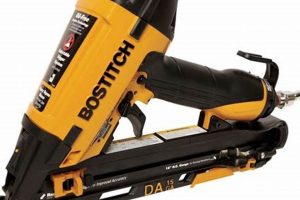
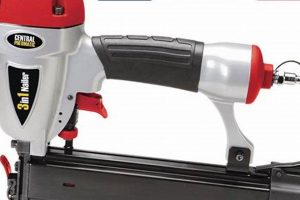
This power tool is a self-contained fastening device utilizing battery power to drive 16-gauge nails into various materials. Primarily used for detailed woodworking and trim applications, it offers the maneuverability of cordless operation combined with the precision expected for finishing tasks. Examples of use include installing crown molding, baseboards, door casings, and cabinet construction where a less visible nail head is desired.
The significance of such a tool lies in its portability and ease of use, eliminating the need for air compressors and hoses typically associated with pneumatic nailers. This enhances efficiency on job sites and allows for convenient operation in locations without readily available compressed air. Its development represents a technological advancement from traditional manual nailing methods and corded electric nailers, providing a more versatile solution for professionals and hobbyists alike. Historically, finish nailers initially relied on pneumatic power, with cordless electric models emerging later as battery technology improved.
Understanding the specific features and applications of this type of tool is crucial for selecting the right equipment for a given project. Key considerations involve battery life, nail capacity, depth adjustment mechanisms, and safety features. Further investigation into nail types, material compatibility, and maintenance procedures will ensure optimal performance and longevity of the device.
Operating Recommendations
The following guidelines are provided to ensure optimal performance, extend lifespan, and enhance safety when utilizing this tool.
Tip 1: Battery Management: Consistently charge the battery fully before each use. Avoid deep discharging, as this can reduce battery life over time. Store batteries in a cool, dry place when not in service.
Tip 2: Nail Selection: Employ only 16-gauge finish nails of the appropriate length for the materials being joined. Using incorrect nail sizes can result in jams, damage to the tool, or compromised fastening.
Tip 3: Depth Adjustment: Prior to beginning a project, adjust the nail depth to ensure nails are driven flush with the surface without damaging the surrounding material. Test the setting on scrap material first.
Tip 4: Material Compatibility: Be aware of the material’s density. Hardwoods require higher power settings or potentially pre-drilling to prevent bending or misfiring of nails.
Tip 5: Safety Precautions: Always wear appropriate eye protection and hearing protection when operating the tool. Keep hands and fingers away from the firing area. Disconnect the battery when performing maintenance or clearing jams.
Tip 6: Maintenance Procedures: Regularly clean the nail magazine and firing chamber to prevent build-up of debris. Lubricate moving parts according to the manufacturer’s recommendations.
Tip 7: Proper Storage: Store the tool in its case when not in use to protect it from dust, moisture, and physical damage. Remove the battery during prolonged storage periods.
Adherence to these recommendations will lead to increased user safety, more consistent results, and prolonged functionality of this power tool.
For troubleshooting common issues or obtaining advanced operational techniques, consult the manufacturer’s user manual or seek guidance from experienced professionals.
1. Power source
The power source is a critical determinant of the functionality and usability. Unlike pneumatic models reliant on external compressors, this tool operates exclusively on battery power. The battery’s voltage and amp-hour rating directly influence nail-driving force and runtime. Insufficient power results in incomplete nail insertion or tool stalling, whereas excessive power leads to material damage. For instance, a higher voltage battery (e.g., 18V vs. 12V) typically drives nails more consistently into hardwoods. Conversely, extended runtime, measured in amp-hours (Ah), enables completion of larger projects without frequent recharging. Therefore, the power source is not merely an accessory but an integrated component shaping the overall effectiveness.
Battery technology advancements, such as lithium-ion cells, significantly improved the performance of this tool. Lithium-ion batteries offer higher energy density, reduced self-discharge rates, and longer lifespans compared to older nickel-cadmium (NiCd) batteries. These advancements translate to lighter, more powerful tools capable of operating for extended periods. An example of this is the shift from NiCd to lithium-ion, which allowed for more compact tool designs without sacrificing power or runtime. Furthermore, quick-charging capabilities minimize downtime, allowing users to resume work faster. The power source dictates the operational envelope of the device and is a key factor in its practical application.
The type, capacity, and charging characteristics of the power source are pivotal to performance, portability, and overall utility. Selection of a this power tool should carefully consider project needs and assess battery specifications to ensure adequate power and runtime. The power source is an inseparable element determining its capabilities and limitations. Neglecting this fundamental aspect undermines the tools potential, impacting project quality and user satisfaction.
2. Nail capacity
Nail capacity, referring to the number of nails a magazine can hold, is a crucial characteristic directly influencing the efficiency of a cordless finish nailer 16 gauge. A higher nail capacity reduces the frequency of reloading, saving time and minimizing interruptions during projects. This is particularly important for large-scale tasks such as installing extensive trim or paneling, where frequent reloading becomes a significant hindrance.
The practical significance of nail capacity is evident on construction sites. For instance, a carpenter installing baseboards in a house with multiple rooms would benefit from a nailer with a larger capacity magazine, reducing the number of stops to refill the nail supply and consequently increasing productivity. Conversely, for smaller, more intricate projects, a compact nailer with a smaller capacity might be preferable due to its lighter weight and improved maneuverability in tight spaces. The relationship between nail capacity and cordless finish nailer 16 gauge performance centers on the balance between operational efficiency and ergonomic design.
Ultimately, selecting a this tool necessitates careful consideration of project scope and user preferences regarding nail capacity. While a larger capacity boosts continuous operation, it may add weight and bulk. This trade-off requires assessing the specific needs of the task at hand. Manufacturers commonly list nail capacity as a prominent specification, underscoring its impact on overall user experience. Choosing wisely ensures that the tool matches the demands of the intended application, maximizing both productivity and ease of use.
3. Depth adjustment
Depth adjustment is a crucial functionality directly affecting the quality and professional finish achievable with a cordless finish nailer 16 gauge. It refers to the mechanism that allows the user to control the depth to which a nail is driven into the work material. Proper depth adjustment prevents both nail protrusion (where the nail head sits above the surface) and overdriving (where the nail head sinks too far into the material, potentially damaging it).
- Material Density Compensation
Different materials offer varying resistance to nail penetration. Softwoods, such as pine, require less force compared to hardwoods like oak. The depth adjustment mechanism allows the user to compensate for these differences. Failure to adjust appropriately results in nails either not being fully driven into hardwoods or being overdriven and damaging softwoods. The ability to fine-tune depth ensures a consistent and professional finish across a variety of materials.
- Flush Finish Attainment
A primary goal in finish carpentry is achieving a flush finish, where the nail head sits perfectly level with the surface of the material. Depth adjustment mechanisms enable this by providing incremental control over the driving depth. Users can make small adjustments to achieve the desired result, ensuring that the nail head neither protrudes nor sinks into the material. Attaining a flush finish is essential for aesthetic appeal and provides a smooth surface for subsequent finishing operations such as painting or staining.
- Prevention of Material Damage
Overdriving nails not only detracts from the appearance of the finished product but also compromises the structural integrity of the material. In softer materials, overdriving can lead to unsightly dents and crushing of the surrounding wood fibers. Precise depth adjustment minimizes the risk of such damage, preserving both the appearance and strength of the workpiece. Properly adjusted depth settings also protect the nailer itself from unnecessary stress and wear, extending its lifespan.
- Types of Adjustment Mechanisms
Several types of depth adjustment mechanisms exist, including tool-free dials, thumbwheels, and stepped adjustments. Tool-free mechanisms allow for quick and easy adjustments without the need for separate tools, increasing efficiency on the job site. Thumbwheels offer precise, incremental control, enabling fine-tuning of the driving depth. Stepped adjustments provide predetermined depth settings, suitable for repetitive tasks with consistent material thickness. The choice of adjustment mechanism depends on user preference and the specific requirements of the project.
In conclusion, depth adjustment is integral to the functionality and versatility of a cordless finish nailer 16 gauge. It enables users to achieve consistent, professional results across a range of materials, preventing damage and ensuring a high-quality finish. The availability and effectiveness of the depth adjustment mechanism are critical factors to consider when selecting a nailer for finish carpentry applications. Whether installing delicate trim work or assembling sturdy cabinetry, precise depth control is essential for achieving optimal results.
4. Weight distribution
Weight distribution significantly affects the usability and ergonomics of a cordless finish nailer 16 gauge. An imbalanced tool leads to increased user fatigue, reduced precision, and potential safety hazards, particularly during extended use or when working in awkward positions. Even a slight imbalance amplifies over time, compromising the quality of the finished work. This characteristic is directly related to the placement of the battery, motor, and nail magazine within the tool’s housing. Optimizing weight distribution requires careful engineering to minimize strain on the user’s wrist and arm.
Consider two contrasting scenarios. In one, a finish carpenter installs crown molding overhead for several hours with a nailer whose weight is heavily biased towards the front. The constant upward pressure and imbalanced load lead to rapid muscle fatigue, resulting in imprecise nail placement and a higher risk of injury. Conversely, a nailer designed with a more centralized weight distribution allows the carpenter to maintain a more stable grip and consistent angle, minimizing fatigue and maximizing accuracy. Proper weight distribution is not simply a matter of comfort; it is a critical factor in maintaining both productivity and safety on the job site. Examples of good weight distribution involve designs that keep the center of gravity close to the user’s hand, reducing torque and improving control.
Therefore, weight distribution is an essential design consideration for cordless finish nailers. It is a key factor in user comfort, precision, and long-term productivity. Challenges in achieving optimal weight distribution stem from the need to balance power, battery capacity, and nail magazine size. Careful attention to this aspect during design and manufacturing is crucial for producing a tool that is not only powerful and efficient but also comfortable and safe to use. Understanding the significance of weight distribution empowers users to make informed purchasing decisions, selecting tools that best suit their needs and working conditions.
5. Safety mechanisms

Safety mechanisms integrated into cordless finish nailers 16 gauge are not mere add-ons; they constitute essential components directly influencing user safety and minimizing the risk of unintended nail discharge. These mechanisms function primarily to prevent accidental firing, ensuring the tool operates only when intentionally activated. A primary cause of workplace injuries involving nailers is unintentional nail discharge, often resulting from tool recoil or accidental trigger activation. The presence and proper functioning of safety mechanisms mitigate these risks.
A common safety feature is the contact actuation mechanism, requiring the nose of the nailer to be firmly pressed against the work surface before the trigger can be pulled. This prevents the tool from firing if dropped or if the trigger is accidentally engaged in open air. Another crucial mechanism is the sequential actuation mode, where the nose must be depressed before the trigger is pulled. Some models offer a switchable actuation mode, allowing users to select between contact and sequential modes, depending on the application. The importance of these mechanisms cannot be overstated. For instance, a finish carpenter working in confined spaces, such as inside a cabinet, relies heavily on these mechanisms to prevent accidental nail discharge that could cause serious injury. Regular inspection and maintenance of these safety features are critical; a malfunctioning contact tip or a sticky trigger can render the safety mechanisms ineffective.
The practical significance of understanding these safety mechanisms extends beyond mere compliance with safety regulations. It fosters a culture of safe tool operation, reducing the likelihood of workplace accidents and promoting a more productive work environment. Moreover, proper understanding and usage of these features prolong the lifespan of the tool by preventing unnecessary wear and tear from accidental firings. Consequently, safety mechanisms are inextricably linked to the safe, efficient, and reliable operation of cordless finish nailers 16 gauge, demanding conscientious attention from both manufacturers and users.
6. Maintenance needs

The operational longevity and consistent performance of a cordless finish nailer 16 gauge are directly contingent upon adherence to a regular and appropriate maintenance schedule. Neglecting maintenance tasks can lead to diminished performance, increased risk of malfunctions, and ultimately, premature tool failure. Consistent maintenance ensures both safety and efficiency.
- Cleaning and Lubrication
Accumulation of dust, debris, and residual nail fragments within the nail magazine and firing chamber can impede smooth operation and lead to jamming. Regular cleaning, using compressed air and a soft brush, is essential. Furthermore, lubrication of moving parts with a manufacturer-recommended lubricant reduces friction, minimizes wear, and ensures consistent nail driving force. For instance, failure to lubricate the piston can result in erratic nail depth and eventual piston seizure, rendering the tool inoperable.
- Battery Care and Storage
Lithium-ion batteries, commonly used in cordless nailers, require specific care to maximize lifespan and performance. Avoiding deep discharge, storing batteries in a cool, dry environment, and regularly cleaning battery terminals are crucial. Improper battery storage or handling can lead to reduced capacity, shortened runtime, or even battery failure. As an example, leaving a battery exposed to extreme temperatures can permanently damage its internal cells.
- Nail Magazine and Feeder Inspection
The nail magazine and feeder mechanism are critical for ensuring proper nail delivery into the firing chamber. Regular inspection for wear, damage, or misalignment is necessary. Bent or damaged nail guides can cause misfeeding, leading to jams and potentially damaging the firing pin. Replacing worn or damaged parts promptly maintains consistent and reliable nail feeding.
- Contact Tip and Safety Mechanism Examination
The contact tip and associated safety mechanisms are paramount for preventing accidental nail discharge. Regular inspection ensures the contact tip moves freely and engages correctly, and that the safety mechanism is functioning as designed. A worn or damaged contact tip can lead to unintentional firing or incomplete nail driving. Similarly, a malfunctioning safety mechanism compromises user safety and increases the risk of accidents.
In summary, addressing the maintenance needs of a cordless finish nailer 16 gauge is not optional, but rather a fundamental aspect of responsible tool ownership. Regular cleaning, lubrication, battery care, and component inspections are essential for ensuring optimal performance, extending tool lifespan, and maintaining user safety. Diligence in these areas translates to enhanced productivity, reduced downtime, and a lower overall cost of ownership.
7. Application scope
The application scope of a cordless finish nailer 16 gauge defines its versatility and suitability for a range of woodworking tasks. The gauge of the nail (16-gauge) determines the nail diameter, influencing the tool’s capacity for delicate finishing work versus more robust fastening applications. Understanding this tool’s applicable tasks is essential for selecting the appropriate tool for a project, ensuring efficient and effective performance.
- Interior Trim Installation
This tool excels in installing interior trim, including baseboards, crown molding, door casings, and window casings. The 16-gauge nail leaves a relatively small hole, minimizing the need for extensive filling and sanding prior to painting or staining. The cordless design provides maneuverability within confined spaces, such as corners and tight hallways, where a pneumatic nailer with an attached hose would be cumbersome.
- Cabinetry and Furniture Assembly
In cabinetry and furniture construction, the cordless finish nailer 16 gauge facilitates joining components such as face frames, drawer boxes, and decorative trim. The nail’s holding power is adequate for securing these elements while glue sets, or for permanently attaching lightweight components. Its precision is crucial for preventing splitting or damage to delicate wood pieces. Examples include attaching cabinet doors, installing drawer slides, or affixing decorative moldings.
- Paneling and Wainscoting
The tool is suitable for installing paneling and wainscoting, offering a balance between secure fastening and minimal visibility of the nail heads. When installing these decorative elements, consistent and flush nail placement is crucial for achieving a professional appearance. The depth adjustment feature allows for precise control over nail depth, preventing overdriving and damage to the paneling or the substrate.
- Craft Projects and Hobbyist Applications
Beyond professional applications, the cordless finish nailer 16 gauge extends to various craft projects and hobbyist endeavors. These can include picture framing, shadow box construction, and model building. The tool’s ease of use and portability make it accessible to users with varying skill levels. The relatively small nail size minimizes the risk of splitting thin or delicate materials, making it suitable for intricate and detailed work.
The varied application scope of a cordless finish nailer 16 gauge showcases its adaptability across diverse woodworking and construction tasks. From intricate trim work to robust cabinet assembly, its cordless design and 16-gauge nail size provide a versatile solution. Comparing it to other nailer types, such as framing nailers or brad nailers, clarifies its niche in applications requiring a balance of holding power and minimal aesthetic impact. Understanding its capabilities ensures optimal tool selection and project outcomes.
Frequently Asked Questions
The following addresses common inquiries regarding the operation, maintenance, and application of this specialized power tool. The information provided is intended to enhance understanding and promote safe and effective usage.
Question 1: What distinguishes a 16-gauge finish nailer from other nailer types?
A 16-gauge finish nailer utilizes nails with a specific diameter (16-gauge), offering a balance between holding power and minimal visual impact. Framing nailers use larger nails for structural applications, while brad nailers employ smaller, nearly headless nails for delicate trim work. This tool occupies a middle ground, suitable for applications where moderate holding strength and a less conspicuous nail hole are desired.
Question 2: What is the typical battery runtime expected from a cordless 16-gauge finish nailer?
Battery runtime varies depending on battery voltage, amp-hour rating, material density, and frequency of use. A higher voltage and amp-hour rating generally translates to longer runtime. In moderate use, a typical 18V, 2.0Ah battery can drive several hundred nails before requiring a recharge. However, working with hardwoods or operating the nailer continuously will reduce runtime.
Question 3: What safety precautions must be observed when operating a cordless 16-gauge finish nailer?
Eye protection is mandatory to guard against flying debris. Hearing protection is recommended, especially during prolonged use. The tool’s contact tip must be fully engaged with the work surface before pulling the trigger to prevent accidental nail discharge. Disconnecting the battery before performing maintenance or clearing jams is essential. Hands should be kept clear of the firing area at all times.
Question 4: What types of maintenance are required for a cordless 16-gauge finish nailer?
Regular cleaning of the nail magazine and firing chamber is necessary to prevent debris accumulation. Lubrication of moving parts, as specified by the manufacturer, is essential for smooth operation. Battery terminals should be cleaned periodically to ensure proper contact. The contact tip and safety mechanisms should be inspected regularly for wear or damage.
Question 5: Can a cordless 16-gauge finish nailer be used on all types of wood?
While versatile, this tool may not be suitable for all wood types. Softer woods, such as pine, present no significant challenges. However, denser hardwoods, such as oak or maple, may require higher power settings or pre-drilling to prevent nail bending or incomplete driving. Always test the nailer on scrap material before commencing work on the final piece.
Question 6: What are common causes of nail jamming in a cordless 16-gauge finish nailer?
Common causes include using incorrect nail sizes, bent or damaged nails, debris accumulation in the nail magazine or firing chamber, and insufficient battery power. Ensuring the correct nail type is used, regularly cleaning the tool, and maintaining adequate battery charge can minimize the occurrence of nail jams.
Adherence to these guidelines and answers facilitates optimal tool performance, extends service life, and enhances user safety.
The next section will delve into troubleshooting common issues encountered when using the tool.
Conclusion
This examination of the cordless finish nailer 16 gauge has encompassed its operational characteristics, maintenance requirements, safety protocols, and the breadth of its practical applications. Crucial aspects, including power source considerations, nail capacity management, depth adjustment techniques, ergonomic factors related to weight distribution, and the importance of integrated safety mechanisms, have been thoroughly addressed. The discussion has emphasized the necessity of regular maintenance and a comprehensive understanding of its capabilities for optimal utilization.
The cordless finish nailer 16 gauge represents a significant advancement in fastening technology, offering portability and precision. Continued adherence to recommended practices will ensure reliable performance and maximize the tool’s potential across diverse woodworking projects. Professionals should prioritize safety and thorough understanding for effective use.
![Nailing It: What Size Finish Nails for Baseboard? [Guide] | Best Final Touch: Elevate Your Projects with Professional Finishing](https://bestfinaltouch.com/wp-content/uploads/2026/04/th-510-300x200.jpg "Nailing It: What Size Finish Nails for Baseboard? [Guide] Best Final Touch: Elevate Your Projects with Professional Finishing")