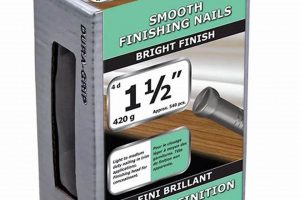
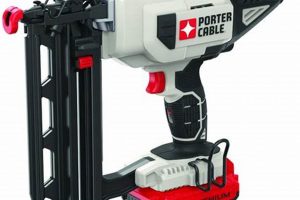
These slender fasteners, characterized by their small heads, are specifically designed for applications where concealment is paramount. Their primary function is to secure decorative trim and intricate woodwork while minimizing visual disruption to the finished surface. Due to their design, they allow for easy countersinking, enabling the nail head to be recessed below the surface of the material, subsequently filled, and sanded for an almost invisible appearance. An example is their use in attaching crown molding to a wall, where the aim is a seamless transition between the molding and the wall surface.
The employment of these fasteners offers several key advantages. They provide a neat, professional appearance by minimizing visible nail holes. This contributes significantly to the overall aesthetic quality of the project. Historically, these types of fasteners have been a staple in carpentry and woodworking due to their ability to provide a strong hold without detracting from the beauty of the wood itself. Their widespread use reflects a long-standing tradition of prioritizing both functionality and visual appeal in construction and design.
The following sections will delve into the different types available, the appropriate techniques for their application, and considerations for selecting the optimal size and material for various projects. Guidance will also be given on addressing common challenges encountered during installation, such as preventing wood splitting and achieving consistent countersinking depth.
Tips for Optimal Application
Effective use ensures a clean and durable finish. Consider the following guidelines for successful installation and lasting results.
Tip 1: Select the Correct Gauge and Length: The gauge should be fine enough to minimize splitting, while the length must be sufficient to penetrate the substrate securely. For thin materials, a smaller gauge is crucial. For thicker trim, a longer nail ensures a solid hold.
Tip 2: Utilize a Nail Set: A nail set is essential for consistently countersinking the head without damaging the surrounding wood. Position the set carefully to avoid marring the surface during the final hammer strike.
Tip 3: Pre-Drilling Hardwoods: When working with hardwoods, pre-drilling pilot holes prevents splitting. The drill bit should be slightly smaller than the nail’s diameter to ensure a tight fit.
Tip 4: Employ Proper Hammering Technique: Use controlled, deliberate hammer strikes. Avoid excessive force, which can bend the fastener or damage the material.
Tip 5: Space Nails Evenly: Consistent spacing enhances both the structural integrity and the visual appeal. A general rule is to space them every 6 to 12 inches, depending on the size and weight of the molding.
Tip 6: Consider Adhesive: In some applications, combining fasteners with a construction adhesive provides additional strength and reduces the likelihood of movement over time. Ensure the adhesive is compatible with both the trim and the substrate.
Tip 7: Address Imperfections Properly: After setting, fill any remaining holes with wood filler that matches the color of the molding. Sand smoothly once dry to achieve a seamless finish.
By adhering to these guidelines, projects will exhibit a high degree of precision and durability. The subtle details contribute significantly to the overall quality of the finished product.
The subsequent sections will explore best practices for selecting materials and resolving specific challenges encountered during installation, ensuring optimal results for a variety of applications.
1. Gauge Selection

Gauge selection, when utilizing slender fasteners for securing decorative trim, exerts a direct influence on both the aesthetic outcome and the structural integrity of the assembly. The gauge, referring to the fastener’s diameter, dictates the size of the hole it creates upon insertion. A gauge that is excessively large relative to the material’s density increases the likelihood of splitting, particularly in hardwoods or brittle composites. Conversely, a gauge that is too small may compromise holding power, leading to potential loosening over time. For example, when attaching delicate trim to a cabinet face frame, a finer gauge is preferable to minimize visible damage and ensure a clean, professional appearance. The choice of gauge is therefore a critical factor in achieving a balance between secure fastening and aesthetic preservation.
The practical significance of understanding gauge selection extends to various real-world applications. In installing baseboards, a balance must be struck between using a gauge large enough to adequately secure the molding to the wall and small enough to avoid significant damage to the baseboard itself or the wall behind it. Failure to consider the material properties of both the molding and the substrate can lead to unsatisfactory results, requiring time-consuming repairs or rework. Similarly, when working with intricate or delicate profiles, careful gauge selection can prevent splintering or distortion of the molding’s shape. Specialized projects, such as historical restoration, often require a meticulous approach to gauge selection to preserve the original character of the woodwork.
In summary, appropriate gauge selection is paramount when employing slender fasteners in trim work. Its effects are far-reaching, influencing both the visual appeal and the longevity of the installation. The process necessitates a careful consideration of the material characteristics and desired outcome. Overlooking this aspect introduces the risk of structural weaknesses and aesthetic imperfections, underscoring its importance in achieving a high-quality finish. While challenges such as assessing material density and predicting splitting behavior exist, the benefits of informed gauge selection are considerable.
2. Head Styles

Head styles represent a critical design element influencing the functionality and aesthetics of slender fasteners employed in securing decorative trim. The configuration of the head directly impacts the fastener’s ability to be concealed, the holding power it provides, and its compatibility with various application techniques. Understanding the nuances of different head styles is paramount for achieving optimal results in woodworking and trim installation.
- Brad Head
Brad heads are characterized by their diminutive size, designed for near-invisibility when set below the surface. Frequently used in delicate trim work, such as picture frames or intricate molding, they offer minimal visual disruption. Their small bearing surface, however, provides reduced holding power compared to larger heads. Careful selection of nail length and gauge is therefore crucial to compensate for this limitation.
- Slight Head (or Common Head)
Slight heads, sometimes referred to as common heads in the context of slender fasteners, offer a balance between holding power and concealment. Slightly larger than brad heads, they provide increased surface area for gripping the material but still allow for effective countersinking and filling. This style is suitable for applications where moderate strength is required, such as attaching baseboards or crown molding to walls.
- Headless Pins
Headless pins represent the extreme end of the concealment spectrum. Lacking a defined head, these fasteners rely entirely on friction for holding power. Primarily used in conjunction with adhesives, they are ideal for temporary fixation or for applications where the fastener is intended to be completely undetectable. Applications include securing veneer edges or holding intricate assemblies during glue-up.
- T-Head
T-Head is a distinct design where the head is shaped like the letter “T.” This shape allows for easy alignment during installation and provides a strong grip on the material. They are particularly useful in applications that require a clean, finished appearance without significant filling or sanding after installation.
The choice of head style must be informed by a thorough assessment of the project’s requirements, including the desired level of concealment, the required holding strength, and the material properties of the trim being installed. Selecting the appropriate head style is essential for ensuring both the structural integrity and the aesthetic appeal of the finished project.
3. Material Composition

The material composition of fasteners used in securing decorative trim directly influences their durability, corrosion resistance, and compatibility with different wood species and environmental conditions. The selection of an appropriate material is therefore a critical determinant of long-term performance and aesthetic preservation. Steel, stainless steel, and brass represent common material choices, each possessing distinct properties that render them suitable for specific applications. Carbon steel, while offering high strength, is susceptible to corrosion in humid environments. Stainless steel provides superior corrosion resistance, making it ideal for outdoor applications or installations in areas with high moisture levels. Brass offers both corrosion resistance and a decorative appeal, often employed when the fasteners are intentionally left visible.
The impact of material selection extends beyond the immediate physical properties of the fastener. For instance, using dissimilar metals in contact can lead to galvanic corrosion, a phenomenon where one metal corrodes preferentially to another when an electrolyte is present. This is particularly relevant in coastal environments or when working with treated lumber containing corrosive chemicals. An example is using carbon steel with pressure-treated lumber, which can accelerate corrosion of the fasteners. In contrast, stainless steel fasteners exhibit a high degree of compatibility with most wood types and treatments, minimizing the risk of adverse reactions. Moreover, the material’s hardness influences its ability to penetrate hardwoods without bending or breaking. Hardened steel fasteners are often required for securing trim to dense wood species, such as oak or maple. Using an inappropriate material can result in installation difficulties, compromised holding power, and premature failure.
In summary, the material composition of fasteners constitutes a crucial factor governing their suitability for use in trim installations. Considerations of corrosion resistance, compatibility with adjacent materials, and hardness are paramount. By carefully evaluating these factors, it is possible to select fasteners that ensure long-term structural integrity and aesthetic satisfaction. While challenges such as predicting environmental conditions and assessing material compatibility may exist, an informed decision-making process minimizes the risk of premature failure and costly repairs. Failure to do so can lead to structural weaknesses and aesthetic imperfections, underscoring its importance in achieving a high-quality finish.
4. Length Determination
Effective length determination is paramount when selecting slender fasteners for decorative trim. The length dictates the fastener’s penetration depth into the substrate, directly affecting holding power and the security of the installation. Insufficient length results in inadequate grip, leading to potential loosening or separation of the trim. Conversely, excessive length can protrude through the back of the substrate, creating a safety hazard or aesthetic blemish. The ideal length ensures a secure hold without compromising the integrity or appearance of the surrounding materials. For instance, when attaching quarter-round molding to a baseboard, the fastener should penetrate sufficiently into the wall framing, but not extend beyond the drywall on the opposite side.
The selection of appropriate length necessitates a careful assessment of the materials’ thickness and density. A general guideline suggests that the fastener should penetrate at least two-thirds of the combined thickness of the trim and substrate. However, variations in wood density and the presence of underlying structural members require adjustments to this rule. When fastening into a stud, a shorter length may suffice, whereas a longer fastener is necessary for securing trim to drywall alone. Furthermore, angled driving techniques can reduce the effective penetration depth, necessitating a longer fastener to compensate. In applications where the substrate is prone to splitting, such as near the edge of a board, a shorter fastener may be preferable to minimize the risk of damage.
In summary, accurate length determination is a critical component of successful trim installation using slender fasteners. Its effects influence the structural integrity and visual quality of the finished product. By considering factors such as material thickness, substrate density, and driving angle, the optimal length can be determined, ensuring a secure and aesthetically pleasing result. Overlooking this aspect introduces the risk of structural weaknesses and aesthetic imperfections. Attention to proper length selection minimizes the potential for future repairs and maximizes the longevity of the installation.
5. Countersinking Technique

Countersinking, in the context of securing decorative trim with slender fasteners, constitutes a crucial step in achieving a flush, aesthetically pleasing finish. This technique involves setting the fastener head below the surface of the material, thereby allowing for filling and concealment. Proper execution of countersinking directly impacts the final appearance and perceived quality of the installation.
- Purpose of Countersinking
The primary function is to create a recess for the fastener head, facilitating subsequent filling with wood filler or putty. This achieves a seamless surface, minimizing the visual impact of the fastener. For instance, in installing crown molding, precise countersinking allows for a smooth transition between the molding and the wall, enhancing the overall elegance of the room. Failure to countersink properly results in visible fastener heads, detracting from the finished appearance.
- Tools and Techniques
Countersinking is typically accomplished using a nail set and hammer. The nail set, a small metal tool with a cupped or pointed end, is positioned over the fastener head, and a controlled hammer strike drives the head below the surface. The technique requires precision to avoid damaging the surrounding wood. Alternative methods include using a countersinking drill bit, which creates a pre-set recess before fastener insertion. This is particularly useful in hardwoods or when uniformity is paramount.
- Depth Control and Consistency
Maintaining consistent countersinking depth is essential for a professional finish. Uneven depths create variations in the filler application, leading to noticeable imperfections. The depth should be sufficient to allow for adequate filler coverage, but not so deep as to weaken the surrounding wood fibers. Consistent application requires practice and attention to detail. Using a depth-setting nailer can aid in achieving uniform results, especially in large-scale installations.
- Addressing Wood Damage
Improper countersinking can result in wood damage, such as denting or splitting. To mitigate this, pre-drilling pilot holes is recommended, especially in hardwoods. Additionally, using a nail set with a broad, flat tip can distribute the force more evenly, reducing the risk of localized damage. If damage does occur, it should be carefully repaired with wood filler before finishing.
The facets of countersinking technique underscores its importance within the framework of securing decorative trim with slender fasteners. These are not isolated steps but rather elements of an integrated process. Effective countersinking is not simply about setting the fastener head below the surface; it is about mastering a comprehensive approach that considers material properties, tool selection, and technique refinement.
6. Wood Splitting

Wood splitting represents a significant challenge when employing slender fasteners for securing decorative trim. The act of driving a nail into wood exerts outward pressure, potentially exceeding the material’s tensile strength and resulting in a crack or split. This phenomenon compromises both the aesthetic appeal and the structural integrity of the installation.
- Gauge and Nail Diameter
The diameter of the fastener directly correlates with the risk of splitting. A larger gauge exerts greater radial force, increasing the likelihood of material failure, particularly in dense or brittle wood species. Employing a finer gauge minimizes this risk, albeit at the potential expense of reduced holding power. The appropriate selection balances secure fastening with the preservation of material integrity. For instance, hardwoods often necessitate pre-drilling to accommodate even small-gauge nails without splitting.
- Proximity to Edges and Ends
Fastening near the edges or ends of wood increases susceptibility to splitting due to reduced material support. At these points, the wood fibers are less constrained, allowing the outward pressure from the nail to more easily propagate a crack. Maintaining a sufficient distance from edges is crucial to prevent this occurrence. This distance varies depending on the wood species and fastener size. Mitigating measures include pre-drilling or using self-drilling fasteners.
- Wood Species and Grain Orientation
Different wood species exhibit varying degrees of resistance to splitting based on their density and grain structure. Denser woods, such as oak or maple, are more prone to splitting than softer woods like pine or fir. Grain orientation also plays a significant role, with fasteners driven parallel to the grain presenting a higher risk of splitting than those driven perpendicular. Consideration of these factors informs fastener selection and installation techniques.
- Techniques for Prevention
Several techniques mitigate the risk of wood splitting. Pre-drilling pilot holes creates a channel for the fastener, reducing the outward pressure on the wood fibers. Blunt-tipped fasteners displace rather than cut the wood, lessening the risk of crack propagation. Clamping the material during fastening provides support and reduces the likelihood of splitting. These techniques are particularly relevant when working with sensitive or valuable trim.
The facets of wood splitting, namely gauge and diameter, proximity to edges, wood species and grain orientation, and preventive techniques, underscores its importance within the framework of securing decorative trim with slender fasteners. Addressing wood splitting is not simply about preventing cracks; it is about mastering a comprehensive approach that considers material properties, tool selection, and technique refinement.
7. Concealment
Concealment represents a primary objective when utilizing slender fasteners for securing decorative trim. The visual impact of fasteners can detract significantly from the aesthetic appeal of the finished project. Therefore, techniques and materials are selected to minimize or eliminate the visibility of the fasteners, contributing to a seamless and professional appearance.
- Countersinking and Filling
Countersinking involves setting the fastener head below the surface of the trim, creating a recess that can be filled with wood filler or putty. The filler is then sanded flush with the surrounding material, effectively concealing the fastener. This method is commonly employed in installing crown molding, where a smooth, uninterrupted transition between the molding and the wall is desired. A slight variation in color matching between the filler and the molding may still reveal the location of the nail.
- Color-Matched Fasteners
Some manufacturers offer fasteners with pre-applied coatings that match common trim colors. While this eliminates the need for filling, the color match may not be perfect, particularly on custom-finished or aged trim. These fasteners are suitable for applications where absolute concealment is not critical, such as installing shoe molding along a baseboard. Precise color matching is essential to prevent the fasteners from being noticeable.
- Pin Nails and Adhesives
Pin nails, characterized by their extremely small diameter and minimal head, are often used in conjunction with adhesives to provide temporary support while the adhesive cures. These fasteners leave a very small hole, which may be virtually invisible without filling. This approach is well-suited for delicate trim work where minimal visual disruption is paramount, such as attaching decorative appliqus or thin veneers.
- Angled Fastening
Driving fasteners at an angle can aid in concealment by positioning the head in a less visible location. This technique, often used when attaching trim to corners, directs the fastener head towards an adjacent surface, making it less conspicuous. Proper execution requires precise aiming and consistent depth control to avoid the fastener protruding from the surface. Careful setting of air pressure and nailer angle is crucial to prevent nail blow-out.
These techniques are not mutually exclusive; they can be combined to achieve optimal concealment depending on the specific requirements of the project. The degree of effort dedicated to concealment often reflects the overall quality and aesthetic expectations of the finished product.
Frequently Asked Questions About Fasteners for Trim
The following questions address common inquiries and concerns regarding the appropriate selection and application of fasteners in trim work.
Question 1: What is the optimal nail gauge to mitigate splitting in hardwood molding?
A finer gauge, typically 18 gauge or smaller, is recommended. Pre-drilling pilot holes, slightly smaller than the nail’s diameter, is also advisable to further reduce the risk of splitting in denser wood species.
Question 2: How does nail length impact the stability of crown molding installations?
Adequate nail length ensures sufficient penetration into the wall studs or ceiling joists, providing secure attachment. A general rule is to penetrate at least 1.5 inches into solid wood framing members. However, consideration must be given to the thickness of drywall or plaster. Insufficient length may result in the molding detaching over time.
Question 3: Which material offers the best corrosion resistance for fasteners used in bathroom trim?
Stainless steel offers superior corrosion resistance in high-humidity environments like bathrooms. Galvanized steel provides some protection but is less durable than stainless steel. The selection of appropriate material safeguards against premature fastener failure and unsightly rust stains.
Question 4: What is the recommended technique for countersinking fastener heads without damaging the surrounding wood?
A nail set should be employed to drive the fastener head below the surface. The nail set should be positioned carefully to avoid slipping and marring the surrounding wood. Controlled, deliberate hammer strikes are crucial to achieve consistent depth without causing damage. Pre-drilling pilot holes can also reduce the force required and minimize the risk of splitting.
Question 5: How often should fasteners be spaced when installing baseboard molding?
A typical spacing is every 12 to 16 inches along straight runs and every 6 to 8 inches around corners and curves. The spacing may need to be adjusted based on the weight and dimensions of the molding. Proper spacing ensures even distribution of holding power and prevents the molding from pulling away from the wall.
Question 6: Is it necessary to use adhesive in conjunction with fasteners for trim installation?
Construction adhesive can provide additional holding power, particularly on uneven surfaces or in areas subject to high stress. However, it is not always necessary. The decision to use adhesive depends on the specific application and the desired level of security. If adhesive is used, ensure it is compatible with both the trim and the substrate.
Careful consideration of these factors is essential for achieving a secure, durable, and aesthetically pleasing trim installation.
The subsequent section will present a guide for troubleshooting common challenges encountered during trim installation.
Conclusion
The preceding analysis has explored the multifaceted considerations surrounding finishing nails for molding. From gauge selection and material composition to countersinking techniques and the mitigation of wood splitting, the discussion has underscored the importance of informed decision-making in achieving optimal results. The selection and proper application of these fasteners are critical determinants of both the aesthetic quality and structural integrity of trim installations.
The artful utilization of finishing nails for molding constitutes a cornerstone of fine woodworking and interior finishing. Mastery of the techniques described herein enables the realization of seamless, enduring, and visually compelling results. Continued attention to detail and ongoing refinement of skills are essential to upholding the highest standards of craftsmanship within the field.