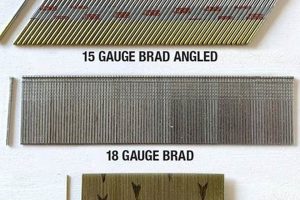
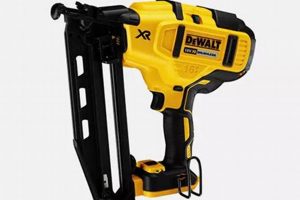
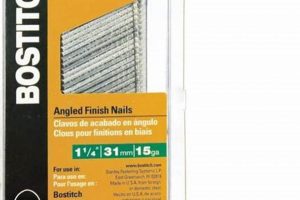
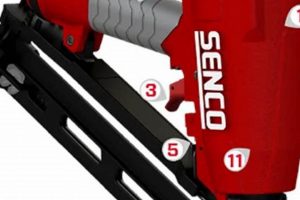
The tool under consideration drives slender fasteners into wood for trim and other fine woodworking applications. These devices are differentiated by the diameter of the nails they utilize, measured in gauge. A higher gauge number indicates a thinner nail. These are commonly pneumatic tools, though battery-powered options are also available, enabling flexibility across various job sites.
Employing one of these devices offers advantages in precision and finish quality. The small diameter of the fasteners minimizes the visibility of nail holes, reducing the need for extensive filling and sanding. This is particularly important in projects where aesthetic appearance is paramount, such as installing crown molding, baseboards, or door casings. Historically, these tasks were performed manually, resulting in increased labor time and potential inconsistencies. These tools significantly improve efficiency and consistency in such applications.
Therefore, understanding the nuances of selecting the appropriate gauge and considering factors such as power source, nail collation, and safety features are crucial for optimal performance and project success. The following sections will delve deeper into these considerations, providing a comprehensive overview of how to effectively utilize this tool for a variety of woodworking needs.
Essential Application Guidance
The following recommendations are intended to optimize the use of this type of fastening tool and enhance project outcomes.
Tip 1: Select Appropriate Nail Length: Always choose a nail length that provides adequate holding power without penetrating entirely through the material. This minimizes the risk of damage to the workpiece surface.
Tip 2: Adjust Compressor Pressure: Ensure the air compressor is set to the pressure recommended by the tool manufacturer. Over-pressurization can lead to nail blow-through, while under-pressurization can result in incomplete nail sets.
Tip 3: Maintain Consistent Nail Collation: Use nails that are properly collated and compatible with the nailer’s magazine. Misaligned or damaged collation can cause jamming and inconsistent firing.
Tip 4: Test Fire Before Beginning: Before starting a project, test-fire the nailer on scrap material of the same type and thickness. This allows for pressure adjustments and ensures the nailer is functioning correctly.
Tip 5: Angle Nailer Appropriately: For added holding strength, slightly angle the nailer when fastening trim to studs or other structural elements. This creates a mechanical interlock between the trim and the underlying material.
Tip 6: Use Safety Glasses: Always wear safety glasses to protect eyes from flying debris or accidental nail ricochets.
Tip 7: Apply a consistent technique : Use a consistent method for each nail being used. This method can include distance between nails, depth the nail is sent, and angle of the gun. This will help with the quality of work for your project
Implementing these guidelines will improve efficiency, reduce errors, and contribute to a professional-quality finish. Proper preparation and adherence to best practices are essential for successful project completion.
The subsequent sections will address specific project applications and advanced techniques for maximizing the potential of this versatile tool.
1. Nail Size

Nail size is a critical determinant in the operational effectiveness and suitability of a 15 or 16 gauge finish nailer. The gauge designation directly correlates to the diameter of the nail, influencing its holding power, visibility, and potential for splitting the workpiece. Understanding these relationships is paramount for selecting the appropriate tool and fasteners for a given application.
- Gauge and Material Thickness
The gauge number, inversely proportional to the nail’s diameter, dictates the tool’s appropriateness for various material thicknesses. A 16-gauge nail, being slightly thicker than a 15-gauge, provides greater holding power and is typically preferred for denser woods or heavier trim. Conversely, a 15-gauge nail may be favored for delicate work where minimizing the visual impact of the nail hole is paramount, such as installing thin veneers or intricate molding.
- Head Style and Visibility
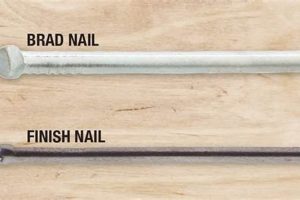
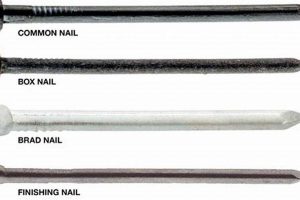
Nail size is intrinsically linked to the head style and the resulting visibility of the fastener. Both 15 and 16 gauge finish nailers utilize brad nails, which are designed with minimal heads to reduce the prominence of the nail. However, even within these categories, slight variations in head size can impact the final aesthetic. The choice between the two gauges often hinges on balancing the desired level of concealment with the required holding force.
- Impact on Splitting Potential
The diameter of the nail directly influences the potential for splitting the wood, particularly when working with hardwoods or near the edges of a workpiece. Smaller gauge nails, like those used in these nailers, reduce this risk compared to larger nails driven by framing nailers. However, careful consideration must still be given to the grain direction and density of the wood to mitigate any potential damage. Pre-drilling pilot holes can further minimize the risk of splitting, especially in dense or brittle materials.
- Compatibility and Availability
While both 15 and 16 gauge nails are readily available, compatibility with the specific tool model is essential. The nailer’s magazine is designed to accommodate a specific range of nail lengths and collation types. Using incompatible nails can lead to jamming, misfires, and potential damage to the tool. Verifying the manufacturer’s specifications and using recommended nail types is crucial for ensuring smooth and reliable operation.
The subtle differences in nail size between 15 and 16 gauge finish nailers dictate their specific applications and limitations. Careful consideration of material properties, aesthetic requirements, and tool compatibility is essential for achieving professional-quality results and preventing potential damage to the workpiece or the tool itself.
2. Power Source

The power source of a 15 or 16 gauge finish nailer dictates its operational characteristics and suitability for specific applications. Two primary power source options exist: pneumatic (air-powered) and cordless (battery-powered). Each type presents distinct advantages and disadvantages that directly influence the tool’s performance, portability, and overall utility.
Pneumatic nailers, traditionally the standard, rely on compressed air supplied by an external compressor. This connection provides consistent power and enables extended use without the need for battery replacements. This results in lighter weight compared to cordless options, reducing user fatigue during prolonged operation. However, the requirement for an air compressor and hose restricts mobility and may limit accessibility in certain job site environments. Cordless nailers, powered by rechargeable batteries, offer unparalleled portability and freedom of movement. They eliminate the constraints of air hoses and compressors, allowing for greater flexibility in various work settings, particularly remote locations or confined spaces. This comes at the cost of increased weight due to the battery pack, and potential limitations in runtime depending on battery capacity and usage intensity. Technological advancements in battery technology have significantly improved the performance and longevity of cordless nailers, making them a viable alternative for many applications.
The selection of a 15 or 16 gauge finish nailer based on its power source hinges on the specific needs of the project and the user’s priorities. Pneumatic models remain a reliable choice for high-volume, continuous applications where consistent power is paramount, and mobility is less of a concern. Cordless models offer enhanced flexibility and convenience for tasks requiring portability and ease of use, making them suitable for punch-list work, renovations, and locations where access to compressed air is limited. Considering the trade-offs between power, portability, and weight is essential for making an informed decision that aligns with the demands of the task at hand.
3. Collation Type

Collation type represents a fundamental aspect of 15 or 16 gauge finish nailer operation, directly impacting loading efficiency, nail feed reliability, and overall workflow. Collation refers to the method by which nails are joined together in a strip or coil for insertion into the nailer’s magazine. Two primary collation types exist: strip and coil, each presenting distinct characteristics influencing tool selection and performance. The strip type, typically plastic or paper collated, arranges nails linearly, loaded into a straight magazine. This configuration is common for finish nailers, offering a balance between magazine capacity and tool size. Coil collation, generally wire-welded, connects nails in a spiral, allowing for significantly larger nail capacity in a compact magazine. While less common in finish nailers due to size constraints, it can be found in models designed for high-volume applications. The choice of collation type directly affects the frequency of reloading, the physical dimensions of the nailer, and the ease with which nails can be loaded and advanced during operation. Improper collation can cause nail jams, misfires, and potential damage to the tool.
Real-world examples illustrate the practical significance of understanding collation type. A trim carpenter installing crown molding may prefer a strip-collated nailer due to its lighter weight and maneuverability in tight spaces. The relatively lower nail capacity is offset by the ease of reloading and the precision afforded by the tool’s design. Conversely, a manufacturer producing cabinet components in large quantities might opt for a coil-collated nailer, prioritizing the reduced downtime associated with fewer reloads. The increased nail capacity streamlines the production process, enhancing efficiency and minimizing interruptions. The selection is thus driven by the specific demands of the task, the working environment, and the desired balance between portability and productivity.
In summary, collation type is an intrinsic component of 15 or 16 gauge finish nailer functionality, influencing magazine capacity, loading efficiency, and overall tool performance. While both strip and coil collation serve the primary purpose of delivering nails to the firing mechanism, their distinct characteristics cater to different application needs. Understanding the nuances of each type empowers users to make informed decisions, optimizing tool selection and maximizing productivity while minimizing potential operational challenges. The compatibility of the nails being used is also crucial for seamless operation.
4. Adjustable Depth

Adjustable depth control is an indispensable feature on a 15 or 16 gauge finish nailer, providing the operator with the means to fine-tune the driving force and ensure consistent nail placement. This capability is essential for achieving a professional finish, preventing damage to the workpiece, and accommodating variations in material density.
- Flush Nailing and Countersinking
Adjustable depth allows for precise control over whether the nail is driven flush with the surface or slightly countersunk. Flush nailing is often desirable when the fastener will be concealed by paint or other finish. Countersinking, where the nail head is set slightly below the surface, is appropriate when filling the nail hole with wood filler for a seamless appearance. This level of control is unattainable without adjustable depth, potentially leading to unsightly finishes and increased rework.
- Preventing Overdriving
Overdriving, where the nail is driven too deep into the material, can cause unsightly depressions and weaken the joint. Adjustable depth mechanisms allow the user to reduce the driving force, preventing overdriving in softer woods or delicate trim. This safeguards the material’s integrity and maintains the aesthetic appeal of the finished product.
- Accommodating Material Variations
Wood density varies significantly, even within the same species. Adjustable depth control allows the nailer to adapt to these variations, ensuring consistent nail placement regardless of the material’s hardness. Without this feature, the operator would be forced to compensate manually, leading to inconsistent results and increased risk of damage.
- Optimizing Holding Power
While overdriving is detrimental, insufficient nail penetration also compromises joint strength. Adjustable depth enables the user to increase the driving force when working with denser materials, ensuring adequate nail penetration and optimal holding power. This is particularly important in applications where structural integrity is a concern, such as assembling furniture or installing door casings.
In conclusion, adjustable depth control significantly enhances the versatility and precision of a 15 or 16 gauge finish nailer. It empowers the operator to adapt to a wide range of materials and applications, ensuring consistent, professional results while safeguarding the integrity and aesthetic appeal of the finished product.
5. Safety Features

The integration of safety features into the design and operation of 15 or 16 gauge finish nailers is paramount, mitigating potential hazards associated with high-speed fastener delivery. These features aim to protect both the operator and bystanders from accidental injuries, contributing to a safer and more productive work environment.
- Contact Trip Mechanisms
A primary safety feature is the contact trip mechanism, requiring the tool’s nose to be fully depressed against the workpiece before firing. This prevents accidental nail discharge if the trigger is inadvertently engaged while the tool is not properly positioned. Examples include dual-action triggers requiring both nose contact and trigger pull to operate, reducing the risk of unintended nail firing. The effectiveness of this mechanism hinges on proper maintenance and user adherence to operating instructions.
- Sequential Actuation
Sequential actuation systems demand a specific sequence of actions typically, depressing the contact trip first, followed by pulling the trigger. This contrasts with bump actuation, where continuous trigger engagement allows for rapid nail placement by simply bumping the nose against the work surface. Sequential actuation reduces the likelihood of accidental firing compared to bump fire options, which, while increasing speed, have a higher associated risk.
- Adjustable Exhaust Ports
Adjustable exhaust ports deflect expelled air away from the operator’s face and work area. This minimizes the risk of airborne debris entering the user’s eyes or disrupting the work surface. Some models feature 360-degree adjustable ports, providing customizable exhaust direction to accommodate various work positions and environments. Redirecting the exhaust also reduces the potential for disturbing loose materials or finishes.
- Safety Glasses Requirement
While not integrated into the tool itself, emphasizing the mandatory use of safety glasses is an inseparable component of safe nailer operation. The high velocity of nail discharge can result in ricochet or fragmentation, posing a direct threat to eyesight. Safety glasses provide a crucial barrier against such hazards, significantly reducing the risk of eye injuries. Compliance with safety eyewear requirements is a fundamental responsibility of both the operator and the worksite supervisor.
These safety features, when properly implemented and adhered to, markedly reduce the potential for injury associated with 15 or 16 gauge finish nailers. Regular inspection and maintenance of these features, coupled with consistent use of personal protective equipment, are essential for promoting a safe working environment and minimizing the risk of accidents. Failure to prioritize safety can lead to severe injuries and significant project delays.
6. Application Versatility
The adaptability of a 15 or 16 gauge finish nailer across diverse projects constitutes a significant factor in its overall value. This versatility stems from the balance between fastener size, power, and maneuverability, rendering it suitable for a range of tasks extending beyond basic trim work. The following points outline key facets of this application versatility.
- Interior Trim and Molding Installation
The primary application involves installing interior trim such as baseboards, crown molding, door casings, and window sills. The tool’s ability to drive small-gauge nails minimizes visible holes, contributing to a clean, professional finish. Examples include securing intricate molding details where larger fasteners would be aesthetically unacceptable. Its relative lightweight construction enables extended use without significant fatigue, facilitating efficient installation across entire rooms or houses.
- Cabinetry and Furniture Assembly
These tools are frequently employed in assembling cabinet face frames, securing drawer boxes, and attaching decorative elements to furniture. The fine gauge of the nails reduces the risk of splitting thin wood stock, a crucial consideration in cabinetmaking. For instance, when constructing a dovetail drawer, a finish nailer can reinforce the joint while maintaining a seamless appearance. Similarly, attaching decorative trim to a dresser or table benefits from the tool’s precision and minimal impact.
- Staircase Construction and Repair
Securing stair treads, risers, and balusters often necessitates a fastener that provides adequate holding power without compromising the visual appeal of the finished staircase. A 15 or 16 gauge finish nailer can be used in conjunction with adhesives to reinforce these joints, ensuring stability and preventing squeaks. For example, a finish nailer can secure a stair tread to the underlying stringer while concealing the fasteners under a runner or carpet. During repairs, it allows for discreetly securing loose components without requiring extensive disassembly.
- Crafting and DIY Projects
The ease of use and maneuverability of these nailers make them valuable tools for a wide range of crafting and DIY projects. From building picture frames and shadow boxes to assembling decorative shelves and small storage units, the tool provides a fast and efficient means of fastening components. For instance, constructing a birdhouse or small garden planter benefits from the tool’s ability to quickly secure wood pieces without requiring screws or bolts. This versatility extends the tool’s applicability beyond professional woodworking, making it accessible to hobbyists and homeowners.
These examples illustrate the breadth of applications for a 15 or 16 gauge finish nailer. Its ability to drive small, relatively inconspicuous fasteners with precision and speed makes it a valuable asset in diverse projects ranging from detailed trim work to general construction and crafting endeavors. The tool’s adaptability underscores its importance in both professional and amateur woodworking environments.
Frequently Asked Questions
This section addresses common inquiries regarding the selection, operation, and maintenance of tools designed for driving 15 or 16 gauge finish nails. The information provided aims to clarify misconceptions and offer practical guidance for effective tool utilization.
Question 1: What is the primary difference between a 15 gauge and 16 gauge finish nailer?
The primary distinction lies in the nail diameter. A 15 gauge nail is slightly thicker than a 16 gauge nail. This difference impacts holding power and visibility, influencing the choice for specific applications.
Question 2: Is an air compressor always required for operation?
The necessity of an air compressor depends on the tool’s power source. Pneumatic models necessitate an external compressor, while cordless models, powered by batteries, do not. Cordless models offer enhanced portability.
Question 3: What factors determine the appropriate nail length?
The ideal nail length should provide adequate penetration for secure fastening without protruding through the material’s opposite side. The thickness of the materials being joined is the primary determinant.
Question 4: How does collation type affect tool performance?
Collation, the method of joining nails in a strip or coil, influences magazine capacity, loading efficiency, and potential for jamming. The optimal choice depends on the frequency of use and desired balance between tool size and nail capacity.
Question 5: What safety precautions are essential during operation?
Essential safety precautions include wearing safety glasses, understanding the contact trip mechanism, and adhering to the manufacturer’s operating instructions. These measures minimize the risk of accidental injury.
Question 6: How does adjustable depth control enhance tool versatility?
Adjustable depth control allows for precise nail setting, preventing overdriving or underdriving. This feature accommodates variations in material density and ensures a consistent, professional finish across diverse applications.
This compilation aims to provide fundamental knowledge regarding the utilization of these tools. Adherence to recommended practices ensures safe and efficient operation.
The subsequent section will delve into specific case studies and practical applications, further illustrating the capabilities of these tools.
Conclusion
The preceding exploration has detailed the characteristics, operational considerations, and diverse applications of the 15 or 16 gauge finish nailer. From nuanced nail size distinctions to power source options, collation types, safety mechanisms, and adjustable depth features, a comprehensive understanding of these factors is paramount for informed tool selection and effective project execution. The versatility of this tool, spanning trim installation, cabinetry, furniture assembly, and DIY projects, underscores its value across various woodworking disciplines.
Therefore, careful evaluation of project requirements and adherence to best practices are essential for maximizing the potential of the 15 or 16 gauge finish nailer. Continued advancements in tool technology and a commitment to safety will undoubtedly shape the future of this essential woodworking implement, ensuring its enduring relevance in both professional and amateur environments. Investing in knowledge and prioritizing safe operation remain crucial for realizing the full benefits of this tool and achieving consistently high-quality results.