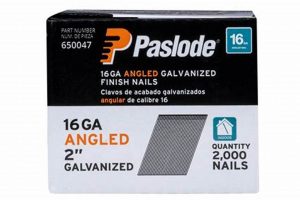
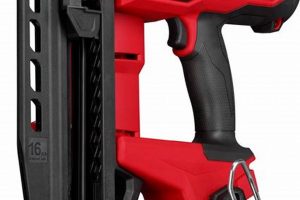
Thin, small-headed fasteners are essential for securing decorative molding along the bottom edge of interior walls. These fasteners, designed for minimal visibility and maximum holding power in wood trim, are typically driven at an angle and then set below the surface with a nail set. This process ensures a clean, professional appearance and prevents obstruction of the painted or stained finish.
The use of these specialized fasteners provides a secure, almost invisible attachment, greatly enhancing the aesthetic appeal of interior spaces. Their small size reduces the likelihood of splitting the wood and makes concealing the fastener easy. Historically, their application dates back to when precise carpentry and attention to detail were paramount in building construction and interior design.
The subsequent sections will explore factors to consider when selecting the appropriate gauge and length, proper installation techniques for optimal performance, and how to achieve a seamless finish that complements the overall room design.
Installation Tips for Optimal Results
Proper installation is crucial to achieving a professional finish and ensuring the long-term stability of the molding. Consider the following guidelines for optimal performance.
Tip 1: Select the Appropriate Gauge and Length: The fastener’s gauge should be fine enough to minimize splitting the molding. Length should penetrate adequately into the wall framing behind the drywall, typically requiring a minimum of 1.5 inches of penetration into the stud.
Tip 2: Angle the Fasteners: Driving the fastener at a slight angle, approximately 15-20 degrees, provides increased holding power. This angled approach creates a mechanical interlock that resists pulling.
Tip 3: Use a Nail Set: Always employ a nail set to countersink the fastener’s head slightly below the surface of the molding. This allows for seamless filling and painting or staining.
Tip 4: Space the Fasteners Appropriately: Maintain consistent spacing, generally every 12-16 inches along straight runs. Closer spacing may be required in areas with curves or where the molding is prone to movement.
Tip 5: Avoid Overdriving: Overdriving the fastener can damage the surrounding wood fibers, compromising holding power and creating an unsightly depression. Use a consistent, controlled hammering technique.
Tip 6: Pre-drill Hardwoods: When working with hardwoods, pre-drilling pilot holes can prevent splitting and ensure easy insertion. Select a drill bit slightly smaller than the fastener’s shank.
Tip 7: Consider Adhesive: For enhanced adhesion, apply a thin bead of construction adhesive to the back of the molding before installation. This provides supplemental holding power and helps to fill minor gaps.
By adhering to these best practices, one can ensure a secure, aesthetically pleasing installation that enhances the overall quality and appearance of the interior space. Attention to detail during installation contributes significantly to a long-lasting and visually appealing result.
The subsequent section will explore methods for concealing and finishing the fastener locations to achieve a flawless, professional appearance.
1. Gauge

The gauge of a fastener used in attaching decorative molding represents its diameter; a higher gauge number indicates a thinner fastener. The selection of an appropriate gauge is crucial in applications involving baseboard trim. Using a gauge that is too large relative to the thickness and density of the molding can cause splitting, resulting in damage to the trim piece and compromising the aesthetic appeal of the installation. Conversely, a gauge that is too small may lack the necessary shear strength to securely hold the molding in place over time.
For instance, when working with a thin, soft wood such as pine, a higher gauge fastener (e.g., 18-gauge) is often preferred to minimize the risk of splitting. In contrast, when securing thicker, denser hardwood trim, a lower gauge fastener (e.g., 15- or 16-gauge) may be necessary to provide adequate holding power. Pre-drilling pilot holes is often employed in conjunction with lower-gauge fasteners in hardwoods to mitigate splitting. The correct gauge selection depends significantly on the specific properties of the molding material and the substrate to which it is being attached.
Therefore, understanding the relationship between gauge and the characteristics of the materials involved is paramount. Choosing the appropriate gauge enhances the longevity and visual quality of the installation. Ignoring this aspect can lead to costly repairs, wasted materials, and a subpar finished appearance. In conclusion, the appropriate gauge should be chosen on per-project basis, taking the wood’s properties into consideration.
2. Length

The length of fasteners employed in securing decorative molding, such as baseboard, directly impacts the stability and longevity of the installation. Appropriate selection of fastener length is paramount for ensuring a robust attachment to the wall framing while minimizing the risk of protrusion or insufficient holding power.
- Penetration Depth
The length must allow for adequate penetration into the wall stud or other structural element behind the drywall. A general rule is to ensure at least 1.5 inches of penetration into solid wood. Insufficient penetration results in a weak connection, increasing the likelihood of the molding detaching over time due to normal stresses or impacts. For example, if the drywall is 0.5 inches thick and the baseboard is 0.75 inches thick, a fastener length of at least 2.75 inches (0.5 + 0.75 + 1.5) would be required.
- Material Thickness
The thickness of the molding itself influences the minimum acceptable length. A thicker molding necessitates a longer fastener to ensure that a sufficient portion of its length engages the structural element behind the wall. Consider a situation where a particularly thick, custom-milled baseboard is being installed; a standard-length fastener might prove inadequate, requiring the use of longer fasteners to compensate for the increased material thickness.
- Fastener Protrusion
Selecting a length that is excessively long poses the risk of protrusion through the back of the wall or stud. Protrusion is undesirable as it can create hazards, interfere with electrical wiring or plumbing, and compromise the structural integrity of the wall. A careful calculation of the required length is therefore essential to avoid such problems. In renovations, unseen obstructions such as existing wiring or pipes could influence the optimal fastener length.
- Molding Material
The material of the baseboard can also inform the choice of length. Denser hardwoods might require slightly longer fasteners compared to softer woods like pine, owing to the increased resistance to penetration. Furthermore, some composite materials may require specialized fasteners with optimized thread designs and corresponding lengths for secure attachment.
The optimal fastener length is therefore a carefully considered parameter, dependent upon the thickness of the baseboard, the depth of penetration into the wall stud, and the characteristics of the material itself. Correct length contributes significantly to a durable and aesthetically pleasing installation. A length improperly selected can compromise the integrity of the installation and create future maintenance concerns.
3. Angle

The angle at which a fastener is driven into baseboard trim is a critical determinant of its holding power and resistance to withdrawal. A perpendicular insertion, while seemingly straightforward, provides limited mechanical interlock with the wood fibers. Conversely, driving the fastener at an angle, typically between 15 and 30 degrees relative to the surface, creates a more substantial frictional force and a greater resistance to pull-out forces. This angled approach essentially wedges the fastener within the wood, increasing the overall stability of the attached molding.
Consider a scenario where baseboard is installed along a wall that experiences seasonal temperature and humidity fluctuations. These variations induce expansion and contraction in the wood, placing stress on the fasteners. If installed perpendicularly, the fastener is more likely to loosen over time, leading to gaps and potential detachment. However, if installed at an angle, the fastener’s angled shank resists these forces more effectively, maintaining a secure connection. Moreover, the practice of countersinking further enhances this effect. Setting the head of the fastener below the surface allows for the application of wood filler, creating a physical barrier that further inhibits movement and maintains a flush, seamless finish.
In conclusion, the angular installation of these fasteners is not merely a stylistic choice; it is a fundamental engineering principle applied to carpentry. The angled approach maximizes holding power, mitigates the effects of environmental factors, and contributes significantly to the long-term integrity and aesthetic appeal of baseboard trim. Failure to appreciate and implement this technique can result in compromised installations, necessitating frequent repairs and undermining the overall quality of the finished space.
4. Spacing

The distance between fasteners securing baseboard trim directly affects the uniformity of its attachment and resistance to warping or separation from the wall. Inadequate spacing can result in sections of the baseboard pulling away from the wall, particularly in areas prone to moisture or temperature fluctuations, thereby compromising the aesthetic appearance and potentially leading to structural issues. Proper spacing, conversely, distributes the holding force evenly, ensuring a secure and consistent bond along the entire length of the trim. For instance, if the interval between fasteners is too great, the center of the baseboard may bow outwards, creating an unsightly gap between the wall and the trim.
Practical application of this principle necessitates considering both the material of the baseboard and the substrate to which it is being attached. Softer woods or materials with high expansion coefficients generally require closer spacing than denser, more stable alternatives. In situations where the substrate is uneven or the wall is not perfectly plumb, reduced intervals between fasteners can compensate for these imperfections, ensuring a flush and level installation. A common recommendation is to space fasteners every 12 to 16 inches along straight runs and more frequently around corners or curves to maintain a secure fit.
Understanding the influence of spacing is paramount for achieving professional-grade results in baseboard installations. While adherence to general guidelines is beneficial, recognizing the specific conditions of each project and adjusting spacing accordingly is crucial. Challenges may arise in older homes with irregular wall surfaces, necessitating careful consideration and adaptation of spacing strategies. Prioritizing appropriate spacing minimizes the likelihood of future problems and contributes significantly to the long-term integrity and visual appeal of the installed baseboard.
5. Countersinking

Countersinking is an essential step in the installation of decorative molding, particularly when utilizing small fasteners. This technique involves setting the head of the fastener slightly below the surface of the wood, creating a recess that allows for concealment and a smooth, professional finish.
- Aesthetic Considerations
The primary purpose of countersinking is aesthetic. By recessing the fastener head, the installer creates a void that can be filled with wood filler, putty, or a similar material. This process effectively conceals the fastener, resulting in a seamless surface that is visually appealing. Without countersinking, the exposed fastener heads would detract from the overall appearance of the molding, particularly when the trim is stained or painted.
- Surface Preparation
Countersinking is integral to proper surface preparation for painting or staining. An exposed fastener head can interfere with the uniform application of paint or stain, creating uneven textures and inconsistent color absorption. Filling the countersunk hole ensures a consistent surface that allows for smooth and even finishing, resulting in a high-quality, professional-looking result.
- Preventing Protrusion
Over time, wood can expand and contract due to changes in humidity and temperature. Without countersinking, minor shifts in the wood could cause the fastener heads to protrude slightly above the surface of the molding. This protrusion can not only be unsightly but also create a potential hazard, such as snagging clothing or causing minor injuries. Countersinking mitigates this risk by providing space for minor wood movement without exposing the fastener head.
- Structural Integrity
While primarily an aesthetic consideration, countersinking also contributes indirectly to the structural integrity of the molding installation. By allowing for the complete filling of the fastener hole, countersinking ensures that the fastener is fully supported by the surrounding wood. This support can help to prevent the fastener from loosening over time, maintaining a secure connection between the molding and the wall.
In summary, countersinking is not merely a cosmetic step but a critical component of a well-executed baseboard installation. This technique is essential for achieving a smooth, professional finish, ensuring long-term aesthetic appeal, and contributing to the overall durability and stability of the trim work. Failure to countersink can result in a subpar finish, detracting from the intended elegance of the molding and potentially leading to future maintenance issues.
6. Concealment

Concealment of fastener locations is an integral step in achieving a professional finish when installing baseboard trim. The careful obscuration of these fasteners transforms a functional attachment into a seamless architectural detail, enhancing the room’s overall aesthetic.
- Wood Filler Selection and Application
The selection of a suitable wood filler is paramount. The filler must match the color and grain pattern of the baseboard material to ensure a cohesive appearance. Application involves pressing the filler firmly into the countersunk fastener hole, ensuring complete coverage and eliminating air pockets. After drying, the excess filler is carefully sanded flush with the surrounding surface. Failure to properly match the filler or thoroughly fill the void will result in visible imperfections.
- Caulking as a Concealment Method
In some instances, particularly when dealing with painted baseboards, caulk may be employed for concealment. A thin bead of paintable caulk is applied over the fastener location, filling the countersunk area. After drying, the caulk is sanded smooth and painted to match the surrounding trim. This method is particularly effective for filling minor imperfections and creating a seamless transition between the baseboard and the wall. However, caulk is not suitable for stained finishes as it does not accept stain evenly.
- Color Matching and Finishing Techniques
Achieving effective concealment requires meticulous attention to color matching. The selected wood filler or caulk must closely resemble the color of the baseboard, whether painted or stained. Achieving a perfect match may necessitate custom tinting or blending of different filler shades. Furthermore, appropriate finishing techniques, such as sanding and sealing, are essential for creating a uniform surface that seamlessly integrates the filled areas with the surrounding trim. Variations in color or texture will compromise the concealment efforts.
- Addressing Imperfections and Ensuring Longevity
Even with careful application, minor imperfections may remain after filling and sanding. These imperfections can be addressed through additional layers of filler, meticulous sanding, or the application of a primer or sealer. Ensuring the longevity of the concealment involves selecting high-quality materials and employing proper application techniques. Using inferior fillers or failing to adequately prepare the surface can result in cracking, shrinkage, or discoloration over time, compromising the aesthetic appeal of the installation.
These facets of concealment demonstrate that it is not merely a superficial step in the process. Effective techniques require careful material selection, precise application, and meticulous finishing to achieve a visually seamless and durable result. These considerations enhance the overall quality and longevity of baseboard installations.
Frequently Asked Questions
This section addresses common inquiries regarding the appropriate fasteners for securing baseboard trim, focusing on best practices and optimal performance.
Question 1: What type of fastener is most suitable for baseboard installation?
Small-diameter fasteners, often 15- or 16-gauge, are generally recommended. These minimize splitting and allow for easy concealment.
Question 2: What length of fastener is required for attaching baseboard to drywall over studs?
The length should be sufficient to penetrate at least 1.5 inches into the stud behind the drywall. Measure the thickness of the baseboard and drywall, then add 1.5 inches to determine the minimum required length.
Question 3: At what angle should the fasteners be driven?
Fasteners should be driven at a slight angle, approximately 15-20 degrees, to increase holding power.
Question 4: What is the recommended spacing between fasteners along a straight run of baseboard?
A spacing of 12-16 inches is typically appropriate for straight runs. Closer spacing may be necessary in areas with curves or uneven surfaces.
Question 5: Is it necessary to countersink the fastener heads?
Yes, countersinking allows for the application of wood filler or caulk to conceal the fastener and create a smooth, professional finish.
Question 6: What can be done to prevent splitting when fastening into hardwood baseboard?
Pre-drilling pilot holes slightly smaller than the fastener diameter is advisable when working with hardwoods to prevent splitting.
Proper selection and installation are crucial for a secure and aesthetically pleasing baseboard installation. Consider all factors for optimal results.
The subsequent section provides a comparative analysis of different types of fasteners used in interior trim applications.
Finishing Nails Baseboard
The preceding exploration has detailed the crucial role of small, specialized fasteners in securing baseboard trim. Factors such as gauge, length, angle of insertion, spacing, and proper countersinking techniques directly impact the longevity and visual appeal of the finished installation. Deviation from established best practices can result in compromised structural integrity and diminished aesthetic quality.
Therefore, thorough comprehension of these principles and diligent application of appropriate techniques are essential for professionals and homeowners alike. A commitment to precision and quality ensures a lasting and visually refined outcome, underscoring the significance of informed decision-making in the realm of interior trim work.