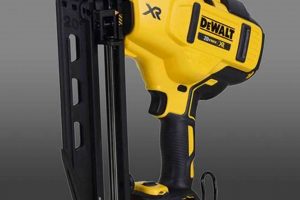
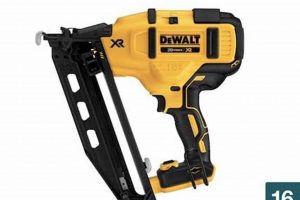
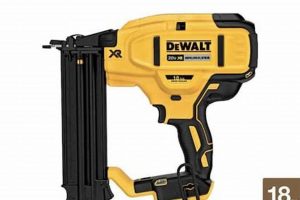
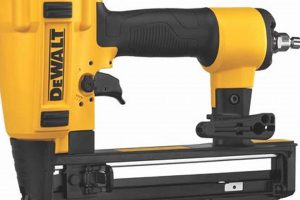
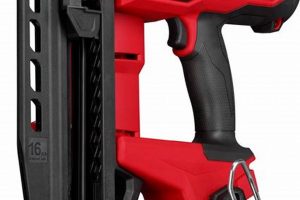
An analysis of user feedback and expert evaluations pertaining to pneumatic or cordless tools designed for driving finish nails. These assessments typically cover aspects such as power, precision, ease of use, durability, and value for money. For instance, a report might detail the performance of a 16-gauge angled tool compared to a 15-gauge straight tool, highlighting differences in nail capacity, application suitability, and potential for workpiece damage.
The availability of comprehensive tool assessments is critical for informed purchasing decisions in both professional and DIY woodworking contexts. Benefits include minimized risk of acquiring unsuitable equipment, enhanced project quality through selection of appropriate tools, and potentially reduced long-term costs associated with repairs or replacements. Historically, reliance on word-of-mouth and manufacturer specifications often led to mismatched tool selection; formalized reports address this gap by providing objective data and user experiences.
Subsequent sections will delve into specific facets of evaluating these tools, including the criteria used to determine performance ratings, common issues identified by users, and a comparison of leading brands currently available on the market. The objective is to provide readers with the necessary knowledge to critically assess available resources and make well-informed choices when selecting the optimal tool for their specific needs.
Guidance Derived From Examining Tool Assessments
The following recommendations are based on recurring themes and insights found within reports pertaining to these tools. Adherence to these suggestions may contribute to improved user experience and project outcomes.
Tip 1: Gauge Selection: Carefully consider the appropriate nail gauge for the intended application. Higher gauge tools (e.g., 18-gauge) produce smaller holes, suitable for delicate trim work, while lower gauge tools (e.g., 15-gauge) offer greater holding power for heavier materials.
Tip 2: Angle vs. Straight Magazine: Angled magazine tools often facilitate access in tight corners; however, nail availability may be more limited than with straight magazine models. Evaluate project requirements to determine the optimal configuration.
Tip 3: Power Source Considerations: Pneumatic tools typically offer consistent power and lighter weight, but require an air compressor. Cordless models provide greater portability but may exhibit reduced runtime and higher initial cost. Assess project scope and accessibility to power sources before choosing.
Tip 4: Depth Adjustment Mechanism: A readily adjustable depth-of-drive mechanism is crucial for achieving flush nail sets and preventing surface damage. Prioritize tools with easily accessible and precise adjustment features.
Tip 5: Jam Clearance: Nail jams are a common occurrence. Tools with user-friendly jam clearance mechanisms minimize downtime and frustration. Examine available tools for ease of access and tool-less clearing features.
Tip 6: User Comfort and Ergonomics: Extended use can lead to fatigue. Consider handle design, weight distribution, and vibration dampening when selecting a tool to enhance user comfort and reduce strain.
Tip 7: Safety Features: Prioritize tools with safety mechanisms such as contact-trip or sequential-trip firing modes to prevent accidental nail discharge. Understand the operating principles of each mode before use.
By considering the insights provided in these evaluations and applying these recommendations, users can increase the likelihood of selecting an appropriate and effective tool for their woodworking or construction endeavors.
The ensuing sections will explore specific models and brands frequently cited in evaluations, providing a comparative analysis to further assist in the decision-making process.
1. Accuracy of ratings

The validity of assessments related to tools is paramount for effective decision-making. The trustworthiness of a report directly influences a consumer’s ability to select a tool that meets their specific project requirements and performance expectations. Inaccurate ratings can lead to suboptimal purchasing decisions, resulting in wasted resources and project complications.
- Testing Methodologies and Standards
The foundation of rating accuracy lies in the rigor of testing methodologies. Standardized testing protocols, such as those established by industry organizations, provide a benchmark against which tools are evaluated. A report should explicitly state the testing parameters, including nail penetration depth, air pressure consistency (for pneumatic tools), battery life (for cordless tools), and jam rate. A lack of transparent testing standards undermines confidence in the accuracy of stated performance metrics.
- Sample Size and Statistical Significance
A rating derived from a small sample size may not accurately reflect the broader performance characteristics of a specific model. Statistical significance ensures that observed performance differences between tools are not simply due to random chance. Reputable evaluations incorporate a sufficient sample size and employ statistical analysis to validate findings, thereby increasing the reliability of the assigned ratings. Ratings lacking statistical support should be viewed with skepticism.
- Bias Mitigation Strategies
Potential bias can significantly compromise rating accuracy. A report should disclose any potential conflicts of interest, such as sponsorship by tool manufacturers. Blind testing, where evaluators are unaware of the tool’s brand or model, can minimize subjective bias. Furthermore, a transparent review process, allowing for independent verification of results, enhances the credibility and trustworthiness of the rating system.
- Calibration and Measurement Precision
The precision of measurement instruments directly impacts the accuracy of performance ratings. Properly calibrated tools are essential for obtaining reliable data on factors such as nail firing speed, air consumption, and noise levels. A report should specify the calibration standards employed and the margin of error associated with measurements. Ratings based on imprecise or uncalibrated instruments are inherently suspect.
These facets underscore the critical importance of evaluating the methodology behind reports. Consumers should seek out resources that prioritize objective testing, transparent reporting, and mitigation of potential biases. Ultimately, the validity of these reports hinges on the strength of the underlying methodology, enabling consumers to make well-informed choices and acquire tools that meet their needs.
2. Consistency across sources

Evaluations of tools gain credibility and practical value when findings are consistent across multiple independent sources. Agreement between reports from various professional testing organizations, user surveys, and trade publications strengthens the assertion that observed performance characteristics are inherent to the tool itself, rather than artifacts of a specific test environment or biased evaluation.
Inconsistent reports, conversely, raise concerns about testing methodologies, sample sizes, or potential biases. For example, if one report praises a particular model for its jam-free operation, while several others cite frequent jamming issues, a prospective buyer should investigate further. This might involve examining the specific test conditions in each evaluation to identify possible explanations for the discrepancy, such as differences in nail type or air pressure. Divergences do not necessarily invalidate a single assessment, but mandate cautious interpretation and cross-validation.
Ultimately, the convergence of multiple independent assessments provides the most reliable basis for informed tool selection. When reports align on key metrics such as power, precision, durability, and ease of use, a consumer can be more confident that their purchase will meet expectations. Prioritizing resources that aggregate and synthesize evaluations from diverse sources is a strategy for minimizing risk and maximizing the likelihood of acquiring a suitable tool for a given application.
3. Depth of testing

Comprehensive assessments of tools are distinguished by the extent to which various performance aspects are investigated. Superficial reports, which merely reiterate manufacturer specifications or offer cursory observations, provide limited value to prospective buyers. In contrast, thorough evaluations delve into multiple facets of tool operation, offering a more holistic understanding of capabilities and limitations. The impact of limited assessment is that users cannot assess tool performance in practical tasks.
Deeper investigations examine factors such as nail penetration consistency across different wood types, air consumption rates for pneumatic models, battery runtime under various load conditions for cordless versions, and long-term durability under simulated use scenarios. Furthermore, thorough testing includes assessments of ergonomic design, ease of maintenance, and the effectiveness of safety features. The assessment is helpful for choosing a suitable model.
A more profound investigation into reports reveals issues like inconsistent nail depth at varying air pressures, premature battery failure following extended use, or difficulties in clearing jammed nails. Consequently, assessments that prioritize comprehensive testing methodologies empower consumers to make informed choices, mitigating the risk of acquiring tools that fail to meet performance expectations or exhibit hidden design flaws. It also facilitates a better match between tool capabilities and project requirements, ultimately contributing to enhanced project quality and reduced operational costs.
4. User experience variety

The breadth of user perspectives incorporated into reports is a critical determinant of their practical value. Reliance solely on expert evaluations or controlled laboratory tests can overlook real-world challenges encountered by diverse users in varied work environments. Factors such as skill level, project scale, frequency of use, and environmental conditions all influence user experience and, consequently, the assessment of a tool’s suitability. For example, a pneumatic model lauded by professionals for its consistent power may be deemed cumbersome by a hobbyist due to the requirement for an air compressor and hoses. Similarly, a cordless version praised for its portability may exhibit inadequate runtime for contractors engaged in large-scale projects.
To enhance the robustness of assessments, a comprehensive report incorporates feedback from users with varying levels of expertise and project demands. This includes soliciting input from novice DIY enthusiasts, experienced woodworkers, and professional construction crews. Gathering feedback through online forums, customer reviews, and direct user surveys allows for a more nuanced understanding of a tool’s strengths and weaknesses across different applications. A report that considers a wide range of user experiences is more likely to provide prospective buyers with an accurate and realistic portrayal of a tool’s performance in their specific context.
Ultimately, the inclusion of diverse user experiences in reports promotes informed decision-making by highlighting potential limitations or challenges that may not be apparent from purely technical specifications or controlled tests. A tool deemed exceptional by experts may prove impractical or unsuitable for users with different skill sets or project requirements. By prioritizing assessments that incorporate a broad spectrum of user perspectives, consumers can mitigate the risk of acquiring tools that fail to meet their individual needs and expectations, leading to increased satisfaction and improved project outcomes.
5. Consideration Application

The appropriate employment scenario acts as a crucial filter through which all assessments should be viewed. Tool A, lauded within reports for cabinet construction, may prove inadequate for large-scale baseboard installation due to nail capacity or ergonomic limitations. Conversely, Tool B, celebrated within assessments for framing applications, might damage delicate trim due to excessive power. The selection of one over the other hinges on a granular comprehension of task-specific requirements.
Real-world projects showcase the interplay between assessment and application. An individual undertaking a furniture refinishing project prioritizes maneuverability and minimal surface marring, placing greater value on assessments highlighting fine depth adjustment and lightweight design. A contractor, however, engaged in installing window casings, necessitates assessments emphasizing nail holding power and rapid firing capability. Both individuals may consult the same repository of information, but extract disparate conclusions based on predetermined task parameters. Consider a scenario where a reviewer praises a tool’s compact size for tight spaces; this feature is highly valuable for intricate trim work but irrelevant for open-area flooring projects.
Failing to contextualize assessments within the intended application inevitably leads to suboptimal tool selection. Relying solely on aggregate ratings or generalized commendations, without discerning the specific context in which the tool was evaluated, invites misapplication. Therefore, users must actively correlate assessment metrics with project demands, prioritizing evaluations that mirror the specific tasks at hand. The utility of a “finish nailer review” is thus maximized by aligning tool characteristics with the envisioned application parameters, resulting in informed purchasing decisions and minimized project-related setbacks.
Frequently Asked Questions
The following section addresses common inquiries related to reports concerning pneumatic and cordless tools designed for driving finish nails, aiming to clarify misunderstandings and provide a deeper understanding of their utility.
Question 1: What is the significance of nail gauge in tool assessments?
Nail gauge, referring to the diameter of the nail, directly impacts holding power and visibility of the entry point. Assessments often differentiate performance based on gauge, advising on appropriate applications for 15, 16, and 18-gauge tools. Reports highlight the trade-offs between holding strength and aesthetic considerations associated with each gauge.
Question 2: How do assessments account for differences between pneumatic and cordless models?
Evaluations address distinctions in power source, noting the consistent power delivery of pneumatic tools versus the portability of cordless options. Battery life, recharge time, and air compressor requirements are crucial metrics in comparative analyses, providing users with insights into the operational characteristics of each type.
Question 3: What role does depth-of-drive adjustment play in tool assessments?
Depth-of-drive adjustment, dictating the extent to which nails are driven below the surface, is a pivotal factor in preventing surface damage and ensuring consistent results. Assessments scrutinize the ease and precision of adjustment mechanisms, highlighting models that offer fine-tuned control over nail placement.
Question 4: Why are jam clearance mechanisms emphasized in tool evaluations?
Nail jams are a common occurrence during tool operation, potentially causing delays and frustration. Evaluations assess the accessibility and user-friendliness of jam clearance mechanisms, favoring models that offer tool-less solutions and minimize downtime. Reports often detail the frequency and severity of jamming incidents observed during testing.
Question 5: How do safety features factor into tool assessment ratings?
Safety mechanisms, such as contact-trip and sequential-trip firing modes, are critical components influencing overall tool safety. Assessments analyze the effectiveness of these mechanisms in preventing accidental nail discharge, emphasizing models that adhere to established safety standards and minimize the risk of injury.
Question 6: Do evaluations consider ergonomic design and user comfort?
Prolonged tool use can lead to fatigue and discomfort. Evaluations address ergonomic considerations, such as handle design, weight distribution, and vibration dampening. Reports often highlight models that prioritize user comfort, reducing strain and improving overall handling during extended operation.
Understanding these points enhances a person’s ability to effectively interpret the material. Thoroughly understanding report methodology leads to better user decisions.
The ensuing section will focus on popular brands and models mentioned in various assessments, giving a clearer guide for selecting from available choices.
Comprehensive insights into tools assessments
The preceding analysis explored multifaceted aspects of tool reports. Key discussion points encompassed the significance of rating accuracy, the crucial role of source consistency, the value derived from deep investigations, the integration of diverse user experiences, and the paramount importance of aligning tool attributes with specific applications. Each element contributes to the overarching goal of informed decision-making when selecting equipment.
The acquisition of appropriate tools hinges on rigorous report evaluations, promoting enhanced project outcomes and minimized expenditures. Continued diligence in critical assessments ensures optimal equipment selection and sustained project success.