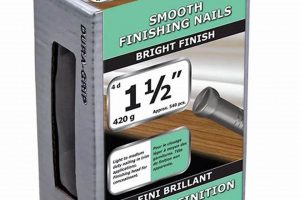
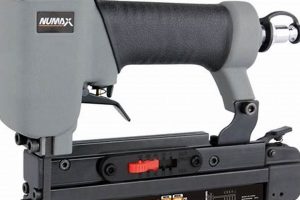
This type of fastener is a slender metal pin, typically made of steel, characterized by its 16-gauge diameter. It is commonly used in woodworking projects where a less conspicuous appearance is desired. Examples of its application include attaching trim, molding, and cabinetry where minimal visibility of the fastener is crucial.
Its value stems from its ability to provide a secure hold while leaving a small entry point. This characteristic is beneficial in reducing the need for extensive filling and sanding, preserving the aesthetic quality of the finished product. Historically, this type of fastener represents an evolution in fastening technology, providing a balance between holding power and aesthetic considerations compared to larger, more prominent fasteners.
Understanding the properties and applications of this specific fastener is fundamental to selecting the appropriate materials and techniques for various woodworking and construction tasks. The subsequent sections will explore specific use cases, optimal driving methods, and factors to consider when choosing this type of fastener over alternatives.
Tips for Using 16 Gauge Finishing Nails
These guidelines will ensure efficient and aesthetically pleasing results when working with this type of fastener in various woodworking projects.
Tip 1: Select the Appropriate Length: The fastener’s length should be sufficient to penetrate deeply into the substrate material while avoiding complete pass-through. A general guideline is to choose a length that penetrates at least two-thirds of the combined thickness of the materials being joined.
Tip 2: Employ a Nail Set for Finishing: To conceal the fastener head, utilize a nail set and hammer to drive it slightly below the surface of the wood. This allows for filling the resulting depression with wood filler or putty for a seamless appearance.
Tip 3: Consider Grain Direction: When driving the fastener near the edge of a board, align the direction of force with the wood grain to minimize the risk of splitting. Pre-drilling a pilot hole may also be necessary in dense or brittle woods.
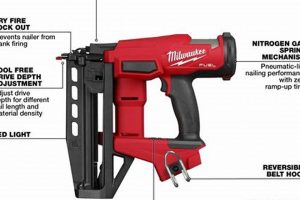
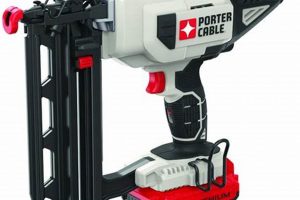
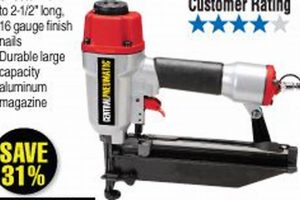
Tip 4: Use a Pneumatic Nailer for Efficiency: For larger projects or repetitive tasks, a pneumatic nailer designed for this type of fastener significantly increases speed and precision. Ensure the nailer’s pressure is adjusted to avoid overdriving or damaging the wood surface.
Tip 5: Choose Corrosion-Resistant Options: In environments with high humidity or potential for moisture exposure, opt for stainless steel or galvanized versions. This prevents rust and ensures the longevity of the fastening.
Tip 6: Minimize Visible Damage: This fastener’s primary benefit is its discreet nature; thus, it’s ideal to use on finish trim or cabinets to avoid large noticeable holes.
Following these tips results in a more secure and professional-looking finish, minimizing visible imperfections and enhancing the overall quality of woodworking projects.
Applying these techniques ensures optimal performance. Subsequent sections will cover detailed application advice and troubleshooting for various project types.
1. Gauge (Diameter)

The gauge, specifically referring to diameter, is a fundamental characteristic that defines a fastener. In the context of this discussion, its significance is particularly pronounced as it directly relates to the intended applications and performance of the 16-gauge variety. Understanding the implications of this dimension is crucial for selecting the appropriate fastener for a given task.
- Definition and Measurement
Gauge refers to a standardized measurement of the diameter of the fastener’s shank. A smaller gauge number indicates a larger diameter, and vice versa. In the case of a 16-gauge fastener, the diameter is approximately 0.0625 inches. Accurate measurement and adherence to gauge standards are essential for ensuring compatibility with nail guns and predictable performance in application.
- Impact on Holding Power
The diameter directly influences its holding power. A larger diameter generally translates to greater resistance to pull-out forces. However, the relatively small diameter of a 16-gauge fastener is deliberately chosen to minimize splitting of wood and reduce the visibility of the fastener in finished projects. The balance between holding power and aesthetic considerations is a key factor in selecting this gauge.
- Aesthetic Considerations
One of the primary advantages of a 16-gauge fastener is its minimal visual impact. The small diameter creates a smaller entry and exit wound in the wood, making it easier to conceal with wood filler and sanding. This is particularly important in applications such as trim work and cabinetry where a clean, professional appearance is paramount.
- Compatibility with Tools
Proper performance depends on compatibility with pneumatic nailers and hand-driving tools designed for that gauge. Using the incorrect gauge with a specific tool can lead to jamming, misfires, and damage to both the tool and the workpiece. Adherence to manufacturer specifications is critical for safe and efficient operation.
The gauge of a fastener, specifically the 16-gauge variety, represents a trade-off between holding strength, aesthetic appearance, and tool compatibility. Its small diameter makes it ideal for applications where concealment is important, while still providing adequate holding power for light to medium-duty tasks. When selecting the right fastener, careful consideration of the material properties and project requirements is essential.
2. Head Style

Head style significantly influences the performance and aesthetic outcome when utilizing a 16-gauge fastener. The design of the head determines the degree to which the fastener is visible, its holding power, and the ease with which it can be concealed. Therefore, careful consideration of head style is critical for achieving desired results.
- Brad Head
The brad head is characterized by its small, nearly nonexistent profile. This design minimizes visibility, making it suitable for applications where a flush, unobtrusive finish is desired. Examples include attaching delicate trim and molding where the fastener should be virtually invisible. The minimal head, however, offers reduced pull-through resistance compared to other head styles.
- Slightly Countersunk Head
This head style features a slightly tapered shape designed to sink partially into the material. This provides a balance between holding power and concealment. It is often employed in applications where the fastener needs to be driven flush with the surface and then filled for a seamless appearance. The tapered shape aids in creating a clean, countersunk hole.
- Chisel Point Head
The chisel point head has a partially flattened side. This design improves the fasteners direction through the substrate. It is often found in collated fasteners designed for nail guns. By controlling direction, the chisel point decreases the risk of wood splitting.
The choice of head style for a 16-gauge fastener is a trade-off between holding power and aesthetic considerations. While brad heads offer the most discreet finish, slightly countersunk heads provide improved holding power and ease of concealment through filling. Matching the head style to the specific application ensures optimal performance and a professional-looking result. Headed variations offer the highest holding power but are more visible.
3. Material Composition

Material composition is a crucial determinant of the performance, lifespan, and applicability of a 16-gauge fastener. The choice of material directly impacts the fastener’s resistance to corrosion, its strength, and its suitability for different environments and materials. The most common materials are steel (with various coatings) and stainless steel, each offering distinct advantages and disadvantages.
Steel fasteners are frequently used in interior applications due to their cost-effectiveness and adequate strength. However, unprotected steel is susceptible to rust and corrosion, limiting its use in damp or outdoor environments. To mitigate this, steel fasteners are often coated with zinc (galvanized), which provides a barrier against moisture. Galvanized versions extend the fastener’s usability to some exterior applications, such as trim work. Stainless steel provides superior corrosion resistance compared to coated steel. It is suitable for demanding environments, such as marine applications or when working with treated lumber containing corrosive chemicals. Real-world examples include using stainless steel fasteners in boat building or in constructing decks with pressure-treated wood. Selecting the correct material composition ensures structural integrity and prevents premature failure due to corrosion, which can lead to costly repairs.
In summary, material selection for this type of fastener should be driven by the specific demands of the project and the environmental conditions to which the fastener will be exposed. Using appropriate material will ensure it delivers dependable long-term holding power. While steel options can be the correct choice for interior uses, stainless steel variants are necessary for exterior use.
4. Length Variation

The length of the fastener is a crucial parameter directly influencing its holding power and the integrity of the materials being joined. For a 16-gauge finishing nail, length variation refers to the range of available lengths within this specific gauge, typically spanning from 1 inch to 2.5 inches. Selecting an inappropriate length can lead to structural weakness, material damage, or aesthetic imperfections. For instance, using an overly short nail in a thick piece of trim will result in inadequate penetration and a weak hold, while an excessively long nail may protrude through the back of the material, creating an unsightly and potentially hazardous condition.
Real-world applications underscore the significance of length variation. In cabinet making, precisely sized fasteners are essential for securing face frames without penetrating the cabinet sides. Similarly, when attaching delicate moldings, a shorter nail minimizes the risk of splitting the wood. Conversely, longer nails are necessary for fastening thicker pieces of trim or for providing additional holding power in structural applications where aesthetics are less critical. Therefore, the appropriate length must be selected based on the specific materials being joined, their thicknesses, and the desired level of holding strength.
In conclusion, understanding and appropriately applying length variation within the context of a 16-gauge finishing nail is fundamental to achieving secure, aesthetically pleasing, and structurally sound results. The selection process demands careful consideration of material properties and project requirements, balancing holding power with the need for a clean, unobtrusive finish. Failure to address length variation adequately can compromise the overall quality and longevity of the project.
5. Applications
The applications for a 16-gauge finishing nail are directly linked to its physical characteristics. Its relatively small diameter and head size are the primary determinants of its suitability for specific tasks. This type of fastener finds its niche in scenarios where a balance between holding power and minimal visibility is paramount. These characteristics make it suited for applications where aesthetic considerations are just as important as securing two pieces of material together.
A common application is in the installation of interior trim work, such as baseboards, crown molding, and door casings. The small head size allows for easy concealment with paint or wood filler, resulting in a seamless finish. Cabinet making is another significant area of use. The fastener secures face frames to cabinet boxes, attaches decorative panels, and assembles drawers. Furniture making, particularly in delicate or intricate designs, benefits from the use of these fasteners to minimize visual disruption to the finished product. In each of these examples, the consequences of using a larger, more conspicuous fastener would be a reduction in the overall aesthetic quality of the work.
Understanding the relationship between the physical properties of the fastener and its applications is crucial for effective project planning. Choosing the appropriate fastener can prevent damage to the materials being joined and ensure a high-quality, professional finish. While larger fasteners may offer greater holding power, the discreet nature of the 16-gauge finishing nail makes it an indispensable tool for achieving a refined and visually appealing result in specific woodworking and construction tasks. The selection of this type of fastener represents a strategic choice to prioritize aesthetics alongside functionality, making it a critical component in achieving desired outcomes in numerous applications.
Frequently Asked Questions
This section addresses common inquiries and misconceptions regarding the application, selection, and properties of 16-gauge finishing nails, providing clarity for optimal usage.
Question 1: What distinguishes a 16-gauge finishing nail from other types of nails?
A 16-gauge finishing nail is characterized by its specific diameter (approximately 0.0625 inches), which is smaller than that of common nails but larger than that of brad nails. This gauge provides a balance between holding power and minimal visibility, making it suitable for trim work and other delicate applications.
Question 2: In what scenarios are 16-gauge finishing nails most appropriate?
These nails are best suited for projects where a discreet fastener is required, such as attaching trim, molding, and cabinet face frames. Their small size minimizes the need for extensive filling and sanding, preserving the aesthetic quality of the finished piece.
Question 3: Are there limitations to the load-bearing capacity of 16-gauge finishing nails?
Due to their relatively small diameter, these nails are not designed for heavy-duty structural applications. They should not be used in situations where significant weight or stress is involved, such as framing or load-bearing supports.
Question 4: Can 16-gauge finishing nails be used with all types of wood?
While versatile, dense hardwoods may require pre-drilling to prevent splitting when using these nails. Softer woods generally do not require pre-drilling. Wood density is a critical factor in fastener selection.
Question 5: What is the best method for concealing 16-gauge finishing nails?
The preferred method involves using a nail set to drive the nail slightly below the surface, followed by filling the resulting depression with wood filler or putty. Sanding smooth provides a seamless appearance.
Question 6: Are there different materials or coatings available for 16-gauge finishing nails?
Yes, these nails are available in various materials, including steel, galvanized steel, and stainless steel. The choice depends on the environment and the potential for corrosion. Stainless steel is recommended for outdoor or high-moisture applications.
These answers clarify common concerns related to the use of 16-gauge finishing nails. Understanding these factors contributes to successful project execution and optimal results.
The following section will address techniques for selecting and using pneumatic nailers designed for this type of fastener.
Conclusion
The preceding discussion has comprehensively examined the 16 gauge finishing nail, outlining its defining characteristics, appropriate applications, and critical considerations for optimal use. From its specific gauge dimension to the impact of head style and material composition, each factor plays a vital role in its performance. This type of fastener serves as a specialized tool, offering a balance between holding power and aesthetic subtlety in woodworking and related disciplines.
The judicious selection and proper application of this specific fastener are essential for achieving professional results. Ignoring the principles outlined herein may lead to compromised structural integrity, diminished aesthetic quality, or premature failure of joined materials. Therefore, careful attention to the nuances of this fastener is warranted for practitioners seeking to uphold standards of craftsmanship and durability in their respective fields.