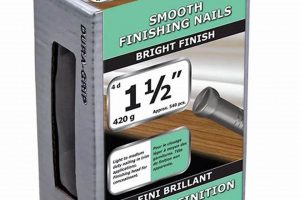
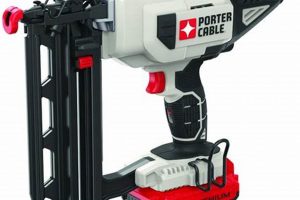
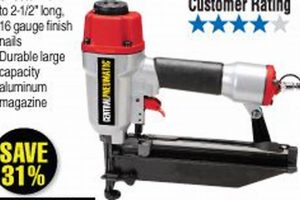
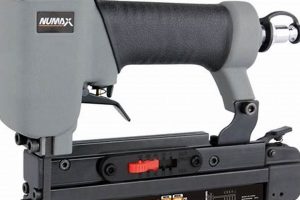
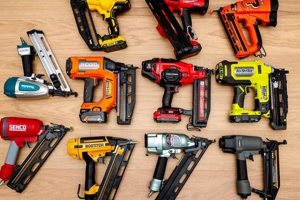
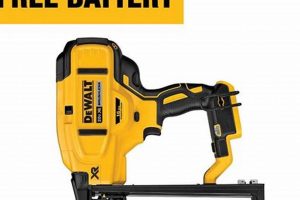
A cordless tool designed for driving finish nails into wood surfaces, utilizing a battery as its power source, offers portability and convenience on job sites. The devices are commonly employed in applications such as trim carpentry, cabinet installation, and furniture construction, where a clean and precise finish is essential. They eliminate the need for air compressors and hoses, increasing maneuverability and reducing setup time.
The adoption of battery-powered nailers represents a significant advancement in construction technology. These tools enhance job site efficiency by removing the constraints associated with pneumatic systems. Benefits include reduced noise pollution, simplified transport, and increased operator safety by eliminating tripping hazards. Historically, pneumatic nailers were the industry standard, but battery-operated models have gained prominence due to their improved practicality and performance.
The following discussion will delve into the specific features, operational aspects, and maintenance considerations associated with this type of cordless fastening tool, providing a comprehensive overview for prospective users and industry professionals.
Operating and Maintenance Guidance
The following recommendations aim to optimize the performance and longevity of cordless finish nailers.
Tip 1: Battery Management: Ensure optimal battery life by adhering to the manufacturer’s charging guidelines. Avoid extreme temperatures during storage and charging to prevent degradation. Regularly inspect battery terminals for corrosion and clean as needed.
Tip 2: Nail Selection: Employ only the recommended nail gauge and length specified by the tool manufacturer. Deviating from these specifications can lead to jamming or tool damage. Confirm nail collation is compatible with the magazine.
Tip 3: Depth Adjustment: Accurately adjust the drive depth to prevent over-driving or under-driving nails. Perform test drives on scrap material of similar density to the target workpiece before commencing the primary task.
Tip 4: Regular Cleaning: Periodically clean the nailer’s nosepiece and magazine to remove debris that may impede nail feeding. Use compressed air or a specialized cleaning tool for this purpose.
Tip 5: Contact Trip Maintenance: Inspect the contact trip mechanism for wear or damage. A malfunctioning contact trip can compromise safety and accuracy. Replace the contact trip if necessary.
Tip 6: Lubrication: Apply a light lubricant to the appropriate moving parts as recommended by the manufacturer. Avoid over-lubrication, which can attract dust and debris.
Tip 7: Storage Practices: Store the tool in a dry and secure location to prevent environmental damage and unauthorized use. Remove the battery when storing the tool for extended periods.
Adherence to these guidelines will contribute to the safe, efficient, and reliable operation of the cordless finish nailer, maximizing its service life.
The subsequent section will address potential troubleshooting scenarios and recommended solutions.
1. Battery Runtime
Battery runtime is a critical performance parameter for cordless finish nailers, directly influencing productivity and job site efficiency. For the tool in question, extended battery life translates to fewer interruptions for recharging, enabling completion of tasks more rapidly. Several factors affect the attainable runtime of a single battery charge.
- Battery Amp-Hour (Ah) Rating
The amp-hour rating of the battery pack serves as a primary indicator of potential runtime. A higher Ah rating signifies a greater capacity to store electrical energy. A battery pack rated at 5.0 Ah, compared to one rated at 2.0 Ah, will theoretically provide more than double the operational time under similar usage conditions. The selection of the battery Ah rating should be proportional to the demands of the task at hand.
- Nail Driving Frequency
The frequency with which the nailer is used significantly impacts battery consumption. High-volume nailing applications, such as fastening extensive trim, will deplete the battery more rapidly than intermittent usage in smaller projects. Operators should anticipate reduced runtime under high-demand conditions.
- Material Density
The density of the material being fastened influences the amount of energy required per nail driven. Driving nails into hardwoods, such as oak or maple, demands greater force than driving them into softwoods like pine. Consequently, battery runtime will be reduced when working with denser materials.
- Operating Temperature
Ambient temperature can affect battery performance. Extreme temperatures, whether hot or cold, can diminish battery capacity and reduce runtime. Maintaining batteries within the recommended operating temperature range ensures optimal performance and longevity.
Optimizing battery runtime for cordless finish nailers involves careful consideration of these factors. Selecting batteries with appropriate Ah ratings, managing nail driving frequency, accounting for material density, and controlling operating temperature all contribute to maximizing tool efficiency and minimizing downtime on the job site.
2. Nail Capacity
The nail capacity of a cordless finish nailer dictates the number of nails the tool’s magazine can hold before requiring a reload. Within the context of a cordless finish nailer, this specification directly impacts workflow efficiency. A higher nail capacity reduces the frequency of interruptions for reloading, allowing for more sustained periods of continuous operation. This is particularly crucial in large-scale projects where minimizing downtime is essential for maintaining productivity and adhering to deadlines. For instance, a carpenter installing baseboards in multiple rooms would benefit significantly from a nailer with a higher capacity compared to one with a smaller capacity, reducing time spent refilling and therefore speeding up the overall installation process.
Variations in nail capacity among different models are influenced by several factors, including the physical size of the magazine and the design of the nail collation system. Some models may prioritize a compact design, which inherently limits nail capacity, while others may sacrifice compactness for the ability to hold a larger quantity of nails. The type of nails used also influences capacity, as different gauges and lengths may require varying magazine configurations. Furthermore, the mechanism for feeding nails into the firing chamber must be reliable, regardless of magazine capacity, to prevent jamming or misfires, which can negate the time saved by a larger magazine. The selection of a nailer should therefore be based on a balance between desired capacity, tool size, and nail feeding reliability.
In summary, nail capacity is a significant feature influencing the operational effectiveness of a cordless finish nailer. Understanding its relationship to workflow efficiency, project scale, and tool design considerations allows users to make informed decisions, selecting tools that best align with their specific needs and operational contexts. The practical challenges of choosing the optimal capacity involve balancing the benefits of extended runtime with potential trade-offs in tool size and maneuverability.
3. Depth Adjustment
Depth adjustment, as a feature on a cordless finish nailer, directly influences the quality and precision of fastening applications. The ability to control the driving depth of the nail is a critical component, impacting the appearance and structural integrity of the finished product. In the context of a cordless finish nailer, the depth adjustment mechanism allows the user to set the precise penetration depth, ensuring that the nail is driven flush with the surface without damaging the surrounding material. For example, when attaching delicate trim to a cabinet, a shallow depth setting prevents the nail from passing entirely through the trim, leaving an unsightly exit hole on the reverse side. Conversely, when fastening thicker pieces of wood, a deeper setting ensures that the nail is adequately embedded for secure and lasting connection.
The design of depth adjustment systems varies across different models of cordless finish nailers. Some tools employ a tool-free adjustment dial or knob, providing incremental control over the driving depth, while others utilize a more basic system requiring the use of a separate tool. Regardless of the specific mechanism, the effectiveness of the depth adjustment depends on its precision and consistency. A well-calibrated system ensures that the selected depth is accurately replicated with each nail driven, minimizing the need for manual adjustments and reducing the risk of errors. In scenarios such as installing crown molding or chair rails, where consistent nail depth is essential for achieving a seamless finish, a reliable depth adjustment mechanism becomes indispensable for maintaining a professional standard of workmanship.
In conclusion, depth adjustment is an integral function in the performance and utility of a cordless finish nailer. Accurate and consistent depth control contributes to the aesthetic appeal, structural soundness, and overall quality of the final product. While the specific implementation of depth adjustment may vary, its importance as a feature directly linked to precision fastening remains paramount. Understanding and utilizing the depth adjustment capabilities effectively is crucial for maximizing the potential of the cordless finish nailer and achieving optimal results in a wide range of finish carpentry applications.
4. Brushless Motor

The integration of a brushless motor into a cordless finish nailer significantly affects its operational characteristics and overall performance. Brushless motors, unlike their brushed counterparts, eliminate the physical contact between brushes and the commutator, reducing friction and wear. This inherent design difference yields several key advantages directly applicable to the function of a cordless finish nailer. One prominent effect is increased motor efficiency, which translates to extended runtime per battery charge. With less energy lost to friction, a greater proportion of the battery’s power is used to drive nails. For example, a professional carpenter using a brushless nailer throughout an entire workday will experience fewer battery changes compared to using a brushed model. Another key consideration is the extended lifespan of brushless motors. The absence of brushes removes a common point of failure, resulting in greater durability and reduced maintenance requirements. This prolonged operational life is particularly relevant in demanding construction environments where equipment is subject to heavy use and potential abuse. The presence of a brushless motor also provides greater control over the tools performance. The electronic control systems governing brushless motors enable precise adjustments to speed and torque, allowing users to optimize the nailers performance for different materials and nail sizes. Brushless motors often produce less noise during operation, which can be a notable benefit in noise-sensitive environments.
The utilization of a brushless motor directly impacts the force and speed with which nails can be driven. The enhanced efficiency enables the motor to deliver consistent power throughout the battery’s discharge cycle, reducing the likelihood of incomplete nail sets as the battery nears depletion. This consistent performance is crucial for maintaining a high standard of workmanship, particularly when working with hardwoods or thicker materials that require greater driving force. Brushless motors contribute to lower operating temperatures due to the reduced friction. This reduces the risk of overheating, even during prolonged use, further enhancing the tool’s reliability and lifespan. The ability of brushless motors to deliver high torque at low speeds makes them particularly suitable for driving longer nails, ensuring consistent and secure fastening in various applications.
In summary, the incorporation of a brushless motor into a cordless finish nailer offers multiple benefits, ranging from extended runtime and increased lifespan to enhanced control and consistent performance. These advantages collectively contribute to improved efficiency, reduced maintenance, and enhanced user experience, making brushless motors a highly desirable feature in modern cordless power tools. The absence of brushes eliminates a frequent maintenance requirement, thus decreasing downtime and promoting increased productivity. Ultimately, the presence of a brushless motor represents a notable advancement in cordless finish nailer technology, providing significant advantages for both professional and DIY users.
5. Ergonomic Design
Ergonomic design plays a crucial role in the usability and efficiency of a cordless finish nailer. The design directly affects user comfort, reduces fatigue, and contributes to the overall safety and productivity on job sites. Factors considered in ergonomic design of this tool include weight distribution, grip comfort, and the placement of controls.
- Grip Design and Material
The design of the grip directly influences the user’s control and comfort. A well-designed grip incorporates contours that conform to the hand, reducing strain during prolonged use. Materials such as over-molded rubber or textured polymers provide a secure, non-slip surface, enhancing grip stability and minimizing hand fatigue. In a cordless finish nailer, a comfortable and secure grip enables more accurate nail placement and reduces the risk of accidental misfires.
- Weight and Balance
The weight and balance of a tool are critical for minimizing user fatigue. A well-balanced tool reduces the amount of force required to hold and maneuver it, enabling longer periods of operation without discomfort. Cordless finish nailers often incorporate lightweight materials and optimized weight distribution to achieve this balance. Proper balance reduces strain on the wrist and forearm, contributing to improved control and accuracy.
- Control Placement and Accessibility
The placement and accessibility of controls, such as the power switch, depth adjustment, and mode selector, are essential for efficient operation. Ergonomic designs position these controls within easy reach of the user’s fingers, minimizing the need to shift grip or interrupt workflow. Intuitive control layouts enable quick adjustments and mode changes, enhancing productivity and reducing the risk of errors.
- Vibration Reduction
Prolonged exposure to vibration can cause hand-arm vibration syndrome (HAVS), a serious occupational hazard. Ergonomic designs incorporate vibration-dampening features, such as isolation mounts and cushioned components, to minimize the transmission of vibration to the user’s hand and arm. This reduces the risk of HAVS and enhances user comfort during extended periods of operation, increasing tool longevity.
The culmination of these ergonomic considerations directly influences the performance and user experience associated with the cordless finish nailer. A tool that incorporates these features effectively will be more comfortable to use, reduce the risk of injury, and improve overall productivity on the job site. The ergonomic design of a cordless finish nailer is not merely an aesthetic concern but a functional necessity that impacts the well-being and efficiency of the user.
6. Maintenance Schedule

A structured maintenance schedule is paramount for preserving the operational efficiency, extending the lifespan, and ensuring the safe usage of a cordless finish nailer. Consistent adherence to a defined maintenance protocol mitigates potential equipment malfunctions, reduces downtime, and upholds the tool’s intended performance standards.
- Daily Inspection and Cleaning
Prior to each use, a thorough inspection of the cordless finish nailer should be conducted. This includes examination of the battery terminals for corrosion, the magazine for obstructions, and the contact trip mechanism for damage. Cleaning the tool’s exterior, particularly the nosepiece, with a dry cloth removes accumulated debris that can impede functionality. Neglecting daily cleaning can lead to misfires, reduced power, and premature wear of critical components.
- Battery Care and Storage
The lithium-ion battery powering the cordless finish nailer requires specific maintenance to maximize its lifespan. This includes avoiding full discharges, storing the battery in a cool, dry place, and using only the manufacturer-recommended charger. Regular battery cycling, involving periodic full charge and discharge cycles, can help maintain optimal performance. Improper battery care can significantly reduce runtime and lead to premature battery failure, impacting the tool’s overall usability.
- Nail Collation and Magazine Maintenance
Using the correct nail collation type, as specified by the manufacturer, is crucial for reliable nail feeding. The magazine should be periodically cleaned to remove nail fragments and debris that can cause jams. Inspecting the magazine spring for proper tension ensures consistent nail advancement. Neglecting magazine maintenance can result in misfires, nail feed failures, and increased wear on internal components.
- Lubrication and Component Inspection
Specific components of the cordless finish nailer, such as the firing pin and drive track, may require periodic lubrication to ensure smooth operation. The tool’s manual outlines recommended lubrication points and intervals. Additionally, a visual inspection of critical components, such as the motor housing and contact safety, should be performed to identify any signs of damage or wear. Timely lubrication and component replacement can prevent costly repairs and extend the tool’s service life.
Implementing a comprehensive maintenance schedule for the cordless finish nailer, encompassing daily inspections, battery care, magazine maintenance, and lubrication, is essential for ensuring its reliability, longevity, and safe operation. Consistent adherence to these protocols minimizes the risk of equipment failure and maximizes the tool’s value over its operational lifespan. A well-maintained tool not only performs optimally but also contributes to a safer working environment.
7. Fastener Type

The selection of the appropriate fastener type is intrinsically linked to the operational effectiveness and project outcome when utilizing a cordless finish nailer. This interdependence stems from the specific design parameters of the tool, which are engineered to accommodate a predetermined range of nail gauges, lengths, and head configurations. Deviation from the specified fastener parameters can induce tool malfunction, diminished performance, and compromised structural integrity of the finished application. As an example, attempting to load an 18-gauge brad nail into a tool designed for 15-gauge finish nails will invariably lead to jamming and potential damage to the nail feeding mechanism. Conversely, utilizing nails that exceed the maximum length capacity of the magazine renders the tool inoperable.
Beyond the immediate compatibility issues, the fastener type directly influences the aesthetic quality and load-bearing capacity of the completed task. Finish nails, characterized by their small head size, are intended for applications where concealment is paramount, such as attaching trim or molding. Using a larger-headed nail in these scenarios would detract from the visual appeal. Similarly, structural applications necessitate the selection of fasteners with adequate shank diameter and holding power to withstand anticipated stresses. The tool itself relies on consistent fastener dimensions for proper cycling and driving. Variations in nail diameter or head thickness can affect the force required to drive each nail, potentially leading to inconsistent depth and compromising the uniformity of the finished surface. For example, if a softer material fastener is used then the driving force may be too high and leave a mark.
In conclusion, the relationship between the specified fastener type and the efficient functioning of a cordless finish nailer is not merely a matter of mechanical compatibility but extends to the overall quality, structural soundness, and aesthetic outcome of the project. Understanding and adhering to the manufacturer’s recommendations regarding fastener specifications is critical for maximizing the tool’s performance, minimizing the risk of malfunctions, and achieving professional results in a variety of finish carpentry applications. Proper consideration of fastener type ensures both optimal tool operation and the desired end-product characteristics.
Frequently Asked Questions about Cordless Finish Nailers
This section addresses common inquiries concerning the operation, maintenance, and application of cordless finish nailers, providing objective information to enhance user understanding and promote safe and effective tool utilization.
Question 1: What is the expected battery runtime for a cordless finish nailer under typical usage conditions?
Battery runtime varies depending on factors such as battery amp-hour rating, material density, and nail driving frequency. A 5.0 Ah battery, under moderate usage, typically provides sufficient power for a full workday. High-volume applications or denser materials will reduce runtime. Consult the manufacturer’s specifications for detailed runtime estimates.
Question 2: What type of nails are compatible with a cordless finish nailer?
Compatibility is dictated by the tool’s gauge and length specifications. The nailer is designed for specific collation types, typically straight or angled strip. Using incorrect nail types can lead to jamming and tool damage. Refer to the tool’s manual for a comprehensive list of compatible nail types and sizes.
Question 3: How often should a cordless finish nailer be serviced?
Service intervals depend on usage intensity. For professional use, a thorough inspection and cleaning should be conducted daily. A comprehensive service, including lubrication and component inspection, is recommended every six months or after 50,000 nails driven, whichever comes first. Consult the manufacturer’s guidelines for detailed service recommendations.
Question 4: What safety precautions should be observed when operating a cordless finish nailer?
Eye protection is mandatory. Keep hands and body clear of the firing zone. Disconnect the battery when performing maintenance or changing nails. Never point the tool at oneself or others. Familiarize oneself with the tool’s operating manual and safety features before use. Adherence to safety protocols is crucial for preventing injuries.
Question 5: What is the purpose of the depth adjustment feature?
The depth adjustment feature controls the penetration depth of the nail, ensuring a flush finish without damaging the surrounding material. It is essential for achieving professional results in various finish carpentry applications. Proper depth adjustment prevents both over-driving and under-driving of nails.
Question 6: How should a cordless finish nailer be stored when not in use?
The tool should be stored in a dry, secure location, away from extreme temperatures and humidity. The battery should be removed to prevent accidental discharge and prolong its lifespan. Storing the tool in its original case or a designated tool storage container protects it from physical damage and environmental factors.
These FAQs provide a foundational understanding of cordless finish nailer operation and maintenance. Consulting the tool’s user manual and adhering to manufacturer recommendations ensures optimal performance and user safety.
The subsequent section will provide a comparative analysis of different models currently available.
Concluding Remarks
This exploration of the milwaukee battery finish nailer has underscored its key attributes, operational considerations, and maintenance requirements. Precise depth adjustment, appropriate fastener selection, and scheduled maintenance are critical factors influencing tool performance and longevity. Furthermore, the adoption of brushless motor technology and thoughtful ergonomic design contribute significantly to enhanced efficiency and user comfort.
The information presented herein serves as a foundation for informed decision-making regarding tool selection, operation, and care. A thorough understanding of these aspects promotes safe and effective utilization, maximizing the tool’s value and minimizing the potential for operational disruptions. Continued adherence to manufacturer guidelines remains paramount for ensuring optimal performance and extending the service life of the milwaukee battery finish nailer.