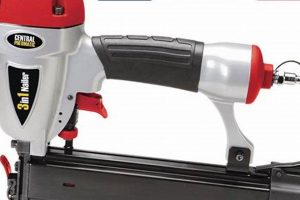
These fasteners represent a specific type of nail commonly used in woodworking and finishing applications. Their defining characteristics include a distinct collation angle of 34 degrees and a gauge of 15, indicating their thickness. These nails are frequently employed with pneumatic nailers designed to accommodate the specific collation angle for efficient and consistent driving. The gauge signifies the diameter of the nail, with a 15-gauge nail offering a balance between holding power and minimal visibility in the finished product. As an example, these nails might be used to attach trim to a door frame, providing a secure hold without creating large, unsightly holes that require extensive filling.
The importance of these fasteners stems from their ability to provide a secure and relatively inconspicuous hold in finish carpentry. The angled collation allows for reaching into corners and tight spaces, increasing efficiency. The gauge provides sufficient holding strength for lighter materials, reducing the likelihood of splitting delicate wood. Historically, finish carpenters relied on hand-driven nails, which required more time and skill. The introduction of pneumatic nailers and corresponding fasteners like these significantly increased productivity and consistency, leading to improved efficiency in construction and woodworking.
Understanding the specifications of these fasteners is crucial for selecting the appropriate nailer and ensuring optimal performance in various woodworking tasks. The subsequent sections will delve deeper into the specific applications, ideal materials, and best practices for utilizing these nails effectively in achieving professional-quality results.
Essential Usage Tips
The following guidance is designed to optimize the use of these fasteners for consistently high-quality finishing work. Adherence to these recommendations will contribute to both structural integrity and aesthetic appeal.
Tip 1: Always ensure the pneumatic nailer is set to the appropriate pressure. Excessive pressure can result in overdriving, damaging the surrounding material and compromising the finish. Insufficient pressure may lead to incomplete nail insertion.
Tip 2: Utilize these fasteners primarily for trim and finish applications. While offering adequate holding power for lighter materials, they are not suitable for structural applications requiring greater shear strength.
Tip 3: When working near edges or with delicate wood species, consider pre-drilling pilot holes. This minimizes the risk of splitting the wood and ensures accurate nail placement.
Tip 4: Select the correct length fastener for the application. The nail should penetrate sufficiently into the substrate to provide a secure hold without protruding through the back.
Tip 5: Maintain the nailer according to the manufacturer’s instructions. Regular cleaning and lubrication will ensure consistent performance and extend the tool’s lifespan.
Tip 6: Be mindful of the collation angle when working in tight spaces. The 34-degree angle allows for access to areas that would be difficult to reach with a straight-collated nailer. Orient the nailer appropriately to maximize this advantage.
Tip 7: Inspect the fasteners before loading them into the nailer. Bent or damaged nails can cause jams and potentially damage the tool.
Employing these techniques maximizes the effectiveness and lifespan of the tools and materials, contributing to a superior final product. The next section will summarize the best practices discussed.
These tips offer a framework for effective and efficient implementation. The subsequent sections will provide a more in-depth analysis of particular uses.
1. Collation Angle

The collation angle is a critical aspect of fastener design, particularly pertinent to angled finish nails. The 34-degree configuration directly relates to the geometry of the nail strips used in compatible pneumatic nailers. It defines the angle at which the nails are joined together in a strip or coil, influencing the nailer’s magazine design, its ability to access confined spaces, and the efficiency of nail delivery.
- Nailer Magazine Design
The collation angle dictates the specific design of the nailer’s magazine. A 34-degree collation necessitates a magazine angled accordingly, allowing the nail strip to feed smoothly into the driving mechanism. Deviation from the specified angle results in improper feeding, potential jams, and unreliable performance. Nailers designed for straight strip nails will not accommodate angled collations and vice versa.
- Accessibility in Confined Spaces
A primary benefit of the 34-degree collation is improved accessibility in tight corners and other restrictive spaces. The angled nail strip allows the nailer to be positioned at a less obstructive angle relative to the work surface, enabling fastening in areas where a straight nailer would be impractical. This is particularly advantageous when installing trim or molding in intricate architectural details.
- Driving Efficiency
The collation angle also influences driving efficiency. The angled collation ensures that each nail is presented to the driving mechanism at the optimal angle for consistent and reliable insertion. This reduces the likelihood of misfires or incomplete drives, contributing to increased productivity and minimizing material waste. The angled delivery path provides direct alignment during nail insertion.
- Nail Strip Material and Construction
The material of the nail strip itself (typically plastic or paper) and its method of construction are also directly related to the collation angle. The strip must be flexible enough to conform to the angled magazine without breaking or jamming, while also maintaining sufficient rigidity to prevent the nails from becoming dislodged during handling and feeding. The strips integrity affects the nailers smooth operation and consistent nail placement.
The selection of fasteners with a specific collation angle, such as 34 degrees, necessitates the use of a compatible nailer designed to accommodate that angle. Employing fasteners with an incorrect collation angle can damage the nailer, compromise fastening quality, and potentially cause injury. Understanding and adhering to the specified collation angle is therefore paramount for safe, efficient, and effective utilization of these angled finish nails.
2. Material Compatibility

Material compatibility is a paramount consideration when utilizing 34-degree 15-gauge finish nails. The selection of appropriate nail material and type relative to the substrate directly impacts the strength, durability, and aesthetic quality of the finished product. Incompatibility can lead to premature failure, corrosion, or unsightly blemishes.
- Wood Species Density
Different wood species exhibit varying densities, directly affecting nail penetration and holding power. Softer woods, such as pine or cedar, require careful nail selection to prevent over-driving and splitting. Harder woods, like oak or maple, may necessitate pre-drilling pilot holes to facilitate nail insertion and minimize the risk of bending or breaking the fastener. A 15-gauge nail is generally suitable for medium-density woods; however, adjustments in nail length and driving force are often necessary to compensate for density variations.
- Environmental Conditions
Exposure to moisture, humidity, or corrosive substances demands the use of corrosion-resistant finish nails. Standard steel nails are prone to rust and degradation, potentially weakening the joint and staining the surrounding wood. Galvanized or stainless-steel nails offer superior protection against corrosion, making them ideal for outdoor applications or environments with high humidity. For instance, when installing trim in a bathroom or near a coastal region, stainless steel is the preferred material choice.
- Adhesive Interactions
When using adhesives in conjunction with finish nails, potential chemical interactions must be considered. Certain adhesives can react with nail coatings or metals, leading to discoloration or reduced bonding strength. It is advisable to select adhesives that are compatible with the chosen nail material and to perform a small test application to verify compatibility before proceeding with the entire project. Polyurethane adhesives, for example, are generally compatible with a wide range of nail types.
- Aesthetic Considerations
The nail’s finish and color should complement the surrounding material to achieve a visually appealing result. Uncoated steel nails may leave visible marks or discoloration, particularly on light-colored woods. Color-matched or coated finish nails can minimize visibility and blend seamlessly with the surrounding surface. When installing painted trim, using finish nails with a paintable coating simplifies the finishing process and ensures a uniform appearance.
The careful consideration of these material compatibility factors ensures that 34-degree 15-gauge finish nails provide a secure, durable, and aesthetically pleasing fastening solution. Selecting the appropriate nail type and material based on the specific application and environmental conditions is essential for achieving long-lasting and professional-quality results. Furthermore, knowledge in application and material interaction increases the value of the craft and the longevity of the project.
3. Gauge Thickness

Gauge thickness, specifically in the context of 34-degree 15-gauge finish nails, refers to the diameter of the nail shaft. This measurement is a critical determinant of the nail’s holding power, its visibility in the finished product, and its suitability for various applications. The “15 gauge” designation signifies a specific diameter, influencing the nail’s overall performance and intended use.
- Holding Power and Shear Strength
The gauge thickness directly correlates with the nail’s ability to resist withdrawal and shear forces. A thicker gauge, such as a 15-gauge nail, provides greater holding power compared to a higher gauge number (thinner nail). However, increased thickness also corresponds to a larger hole in the material. Therefore, the 15-gauge nail represents a balance between adequate holding strength for trim and finish work while minimizing visible imperfections. For instance, securing door casings often requires the balance offered by a 15-gauge nail to prevent movement without creating large, easily noticeable holes that need filling.
- Material Splitting and Damage
The thickness of the nail directly impacts the likelihood of splitting the wood, particularly in delicate trim or hardwoods. Thicker gauges exert greater force during insertion, increasing the risk of material separation. The 15-gauge dimension is generally considered a good compromise for many types of trim, offering sufficient strength while reducing the chance of splitting, compared to larger gauges. Pre-drilling is still recommended in dense materials to prevent splitting even with a 15-gauge nail.
- Aesthetic Considerations and Visibility
The gauge thickness directly affects the nail’s visibility in the finished product. Thinner gauges create smaller entry holes, minimizing the need for filling and touch-up work. The 15-gauge size allows the fastener to be less obtrusive while still providing robust attachment. For applications where aesthetics are critical, such as installing decorative molding or fine trim, the relatively small hole left by a 15-gauge nail is highly desirable.
- Nailer Compatibility and Performance
The gauge thickness determines the required specifications for the pneumatic nailer used to drive the nails. A nailer designed for 15-gauge nails will not function correctly with other gauges. Attempting to use the wrong gauge can cause jams, misfires, and potential damage to the tool. Ensuring the correct nailer-to-nail match is critical for efficient and reliable fastening. The 34-degree angled collation of these nails further necessitates a nailer specifically designed for this configuration.
In summary, gauge thickness is a fundamental parameter defining the characteristics and applications of 34-degree 15-gauge finish nails. The selection of this specific gauge represents a deliberate engineering choice to optimize holding power, minimize material damage, enhance aesthetics, and ensure compatibility with appropriate pneumatic nailers. Its utility stems from its balance in strength and finish.
4. Holding Strength

The term “holding strength,” when associated with 34-degree 15-gauge finish nails, refers to the fastener’s ability to resist withdrawal from the material into which it is driven. This characteristic is critical for ensuring the long-term integrity and stability of any construction or finishing project. The dimensions and design of these nails are engineered to optimize holding strength while minimizing aesthetic impact. Several factors contribute to this capacity, including the nail’s shank design, material composition, and driving depth. Insufficient holding strength can lead to trim detachment, structural instability in furniture, and ultimately, a compromised finished product. For example, if these nails are used to secure crown molding to a wall, inadequate holding strength will result in the molding separating from the wall over time, creating gaps and detracting from the overall appearance.
The 15-gauge designation balances holding strength with the desire for a relatively small entry hole, often mitigating the necessity for extensive filling and finishing. The 34-degree angle, while primarily affecting collated nailer functionality, indirectly influences holding strength by facilitating access to confined spaces where proper nail placement might otherwise be compromised. The angle does not inherently increase or decrease holding strength; rather, it allows for more accurate and effective fastening in difficult-to-reach areas, maximizing the potential of the nail’s design. Correct pneumatic nailer pressure also becomes essential; it ensures that the nail is driven to an optimal depth, maximizing its grip without damaging the surrounding material, a key aspect impacting the connection’s overall durability and stability.
In summary, holding strength represents a core functional requirement of 34-degree 15-gauge finish nails. Its effectiveness depends not only on the nail’s inherent properties but also on proper application techniques and suitable material selection. The balance between holding strength and minimal aesthetic disruption defines the utility of this specific type of fastener. Challenges include ensuring consistent driving depth across varied material densities and maintaining proper nailer calibration for reliable performance.
5. Application Precision
Application precision, in the context of 34-degree 15-gauge finish nails, signifies the degree of accuracy and control required during their deployment to achieve optimal fastening performance and aesthetic results. This precision encompasses various elements, from accurate nail placement to appropriate driving depth, directly influencing the stability, appearance, and longevity of the finished product. Deviations from the intended placement or driving depth can result in structural weaknesses, unsightly blemishes, or material damage, underscoring the importance of meticulous execution.
- Nail Placement Accuracy
Nail placement accuracy refers to the precise positioning of each nail within the material. This is crucial for ensuring that the nail effectively secures the components being joined, distributing the holding force evenly and preventing stress concentrations. For instance, when attaching trim around a window, precise nail placement along the frame is necessary to maintain a consistent reveal and prevent gaps from forming over time. Misplaced nails may require removal, resulting in visible holes and necessitating additional filling and finishing work. The 34-degree angle of the nail collation facilitates access to tight corners and intricate profiles, enhancing the potential for accurate nail placement in challenging areas.
- Driving Depth Control
Driving depth control pertains to the precise depth to which the nail is driven into the material. Overdriving, where the nail head sinks too deeply below the surface, can damage the surrounding material and compromise the holding power of the fastener. Conversely, underdriving, where the nail head protrudes above the surface, creates an unsightly appearance and presents a potential safety hazard. Maintaining consistent driving depth is essential for achieving a flush, professional finish. Many pneumatic nailers designed for 34-degree 15-gauge finish nails incorporate depth adjustment mechanisms that enable precise control over the driving depth, mitigating the risk of overdriving or underdriving.
- Angle of Nail Insertion
While the 34-degree angle refers to the collation angle, the angle at which the nail enters the material also affects application precision. Ideally, the nail should be driven perpendicular to the surface to maximize holding strength and minimize the risk of bending or skewing. Deviations from this perpendicular angle can reduce the nail’s effectiveness and create visible blemishes. Maintaining a steady hand and ensuring the nailer is firmly seated against the work surface are essential for achieving consistent and accurate nail insertion angles. The design of the nailer, including its nosepiece and depth adjustment features, plays a role in facilitating consistent nail insertion angles.
- Material Considerations and Adjustments
The material being fastened significantly impacts the requirements for application precision. Softer woods may require lower driving pressures to prevent overdriving, while harder woods may necessitate pre-drilling to facilitate nail insertion and minimize the risk of splitting. Experienced users of 34-degree 15-gauge finish nailers develop a sense of how to adjust the nailer’s settings and technique to accommodate variations in material density and hardness. This adaptability is a key aspect of application precision and contributes to a consistently high-quality finished product.
These facets of application precision underscore the importance of operator skill, proper tool setup, and careful attention to detail when working with 34-degree 15-gauge finish nails. The combination of the nail’s design characteristics and the user’s expertise determines the final outcome, demonstrating that fastener selection is only one component of achieving a successful and aesthetically pleasing result. Failing to consider any or all of these aspects when utilizing the given nail will compromise the entire build.
Frequently Asked Questions
This section addresses common inquiries regarding the selection, application, and performance of these fasteners, providing clarity on their appropriate use and limitations.
Question 1: Are these nails suitable for structural applications?
No, these fasteners are designed primarily for trim and finish applications. Their relatively small gauge and limited holding power make them unsuitable for structural framing or load-bearing connections. Heavier gauge nails or screws should be used for those purposes.
Question 2: Can these nails be used with any pneumatic nailer?
No, these fasteners require a nailer specifically designed for 34-degree collated nails. Attempting to use them in a nailer with a different collation angle will result in jams and potential damage to the tool. The manufacturer’s specifications should always be consulted to ensure compatibility.
Question 3: What is the appropriate air pressure for driving these nails?
The optimal air pressure depends on the density of the material being fastened. Consult the nailer’s manual for recommended pressure settings. It is advisable to start with a lower pressure and gradually increase it until the nails are driven flush without overdriving.
Question 4: Can these nails be used in outdoor applications?
Standard steel finish nails are prone to corrosion in outdoor environments. Galvanized or stainless-steel finish nails should be used for outdoor applications to prevent rust and ensure long-term durability. The specific requirements of the environment will dictate the most appropriate material.
Question 5: How can splitting be prevented when using these nails in delicate wood?
Pre-drilling pilot holes is the most effective method for preventing splitting in delicate wood. The diameter of the pilot hole should be slightly smaller than the diameter of the nail shank. Care should be taken to avoid overdriving the nails, as this can also contribute to splitting.
Question 6: What is the best way to conceal the nail holes after installation?
Nail holes can be concealed with wood filler or putty that matches the color of the surrounding material. Apply the filler sparingly and allow it to dry completely before sanding it flush with the surface. Touch-up paint or stain can then be applied to blend the filled area with the surrounding finish.
Understanding these key aspects ensures optimal performance and longevity when utilizing these specialized fasteners. Selection in the build is a crucial point.
The next section will delve into comparative analysis, highlighting differences between these and alternative fastener types.
Conclusion
The preceding exploration has detailed the characteristics, applications, and critical considerations pertaining to 34 degree 15 gauge finish nails. Their design optimizes a balance between holding power, minimal visibility, and compatibility with angled pneumatic nailers, making them well-suited for specific finish carpentry tasks. Proper selection, installation techniques, and material compatibility are paramount for realizing their intended performance. Furthermore, strict adherence to safety guidelines and manufacturer specifications is essential for efficient and reliable use.
The informed application of 34 degree 15 gauge finish nails contributes significantly to the quality and longevity of finished woodworking projects. Continued advancements in fastener technology and material science may yield future improvements. However, a thorough understanding of their current capabilities and limitations remains essential for any professional or serious enthusiast seeking to achieve optimal results. The onus remains on the user to apply this knowledge judiciously to ensure safe, effective, and enduring craftsmanship.