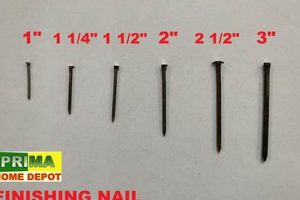
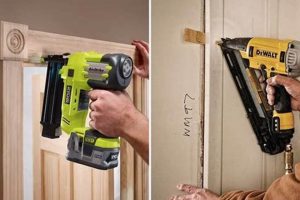
A slender fastener commonly employed in woodworking, it features a small, nearly invisible head designed to be sunk beneath the surface of the wood. An example of its use is in attaching delicate trim work where a prominent head would detract from the aesthetic appeal.
Its significance lies in its ability to provide a secure hold without significantly marring the surrounding material. Historically, these types of fasteners have allowed for more refined and aesthetically pleasing finished products, particularly in applications where minimal visibility of the fixing point is desired. This characteristic has contributed to its widespread adoption in cabinetry, furniture making, and decorative molding applications.
Understanding the specifications, optimal usage scenarios, and appropriate tools for driving it is essential for achieving professional results. The following sections will delve into these aspects, providing a detailed guide for effective and efficient utilization of this versatile fastener.
Tips for Effective Use
The following recommendations promote optimal performance and minimize potential complications when working with this type of fastener.
Tip 1: Select the Appropriate Length: Choose a length that penetrates deeply enough into the substrate for a secure hold, but avoids protruding through the back of the material. A general rule is to select a length that is at least twice the thickness of the material being fastened.
Tip 2: Utilize a Consistent Driving Force: Employ a pneumatic finish nailer with adjustable depth settings. This ensures that the fastener is consistently set to the desired depth, preventing over-driving or under-driving, both of which can compromise the finished appearance.
Tip 3: Angle the Fastener Strategically: In situations where maximum holding power is crucial, consider angling the entry point slightly. This creates a mechanical interlock that enhances resistance to pull-out forces.
Tip 4: Pre-Drill Hardwoods: When working with dense hardwoods, pre-drilling a pilot hole that is slightly smaller than the shank diameter can prevent splitting and facilitate easier insertion.
Tip 5: Handle with Care: When loading the nailer, avoid bending or damaging the collation. Damaged collation can cause jams and misfires, increasing the risk of injury and delaying the work process.
Tip 6: Consider the Material: Galvanized or stainless-steel versions are recommended for exterior applications to prevent corrosion and ensure long-term durability.
Adhering to these guidelines contributes to a professional and durable finished product, minimizing the risk of fastener failure and aesthetic imperfections.
The subsequent sections will explore advanced techniques and troubleshooting common issues encountered during its application.
1. Gauge Consistency
Gauge consistency is a fundamental characteristic of a 16 gauge finish nail, directly affecting its performance and compatibility with pneumatic driving tools. A deviation from the specified 16 gauge standard (approximately 0.0625 inches in diameter) can lead to misfires, jams, and inconsistent setting depths when used in a compatible nailer. This stems from the nailer’s internal mechanisms being precisely calibrated for this specific diameter. For example, if the nail is slightly oversized, it may bind within the nailer’s magazine or driving channel, preventing proper advancement. Conversely, an undersized nail might not receive sufficient force from the driver, resulting in an incomplete set and protruding head. The precise dimensions are therefore not merely a specification, but a critical functional component.
The significance of consistent gauge extends to the aesthetic outcome of the finished product. Inconsistent gauge nails, even if driven successfully, can exhibit variations in head protrusion, requiring manual adjustment or resulting in a less uniform appearance. In applications like installing fine trim or cabinet facing, where a flush, seamless finish is paramount, variations due to gauge inconsistencies are unacceptable. Furthermore, relying on nails that deviate from the standard can damage the nailer itself over time, leading to costly repairs and downtime. Professionals and hobbyists alike therefore rely on recognized manufacturers who adhere to strict gauge tolerances during production, ensuring reliable and predictable performance.
In summary, gauge consistency is not merely a dimensional characteristic; it is a performance-defining attribute of the 16 gauge finish nail. Deviations from the standard introduce a cascade of potential issues, ranging from functional impairment of the driving tool to aesthetic compromises in the finished product. Adherence to gauge specifications is therefore non-negotiable for achieving reliable and professional results. The challenge for manufacturers lies in maintaining tight tolerances throughout the production process, while the responsibility for users involves selecting reputable suppliers who prioritize quality and consistency.
2. Head Size

The head size of a 16 gauge finish nail directly dictates its visibility and holding power in a finished application. Due to the relatively small diameter of the shank (16 gauge), the head is intentionally manufactured to be as minimal as possible, facilitating countersinking and subsequent concealment with wood filler or paint. This is a critical design feature, as a larger head would detract from the aesthetic appeal of fine woodworking projects. The trade-off, however, is a reduced bearing surface, which impacts the nail’s ability to resist pull-through, especially in softer materials. For instance, when attaching thin trim to a cabinet frame, a 16 gauge finish nail with a properly sized head can provide sufficient holding power without being overly visible, preserving the clean lines of the design. Conversely, using a nail with a larger, incompatible head would necessitate more extensive filling and sanding to achieve a similar level of finish.
The connection between head size and application extends beyond mere aesthetics. In situations where shear strength is a primary concern, supplemental adhesives are often employed alongside the fastener to compensate for the limited holding power inherent in the small head. Another consideration is the type of finish nailer used. Most 16 gauge finish nailers are designed to set the nail head slightly below the surface, allowing for a smooth fill. However, variations in nailer settings or material density can result in the head either protruding above or being driven too far below the surface. Both scenarios require corrective action, either tapping the nail further in or filling a larger void. This highlights the importance of understanding the interaction between the tool, the fastener, and the substrate material.
In conclusion, the head size of a 16 gauge finish nail represents a deliberate compromise between concealment and holding power. Its minimal design is essential for achieving a professional finish in applications where aesthetics are paramount. The effectiveness of this design, however, is contingent on careful selection of nail length, proper setting technique, and, in some cases, the use of supplemental adhesives to ensure adequate holding strength. Challenges arise when dealing with dense materials or when precise setting depths are difficult to achieve, necessitating a thorough understanding of the fastener’s limitations and appropriate mitigation strategies. These parameters collectively define the operational envelope for this type of fastener.
3. Shank Type

The shank type of a 16 gauge finish nail significantly influences its holding power and suitability for various applications. The design of the shank, the main body of the nail, directly impacts how effectively it grips the surrounding material. Different shank types are engineered to optimize performance in specific contexts.
- Smooth Shank
Smooth shank finish nails rely on friction for holding power. They are the most common type due to their ease of manufacturing and lower cost. However, their holding strength is limited, particularly in softer woods or applications subject to vibration. An example is their use in attaching lightweight trim where minimal holding power is required and aesthetics are prioritized.
- Barbed Shank
Barbed shank nails feature small, angled protrusions along the shank that resist withdrawal. These barbs create a mechanical interlock with the wood fibers, increasing holding power compared to smooth shank nails. They are often used in applications where greater resistance to pull-out is needed, such as attaching door or window casings.
- Twisted Shank
Twisted shank nails, also known as spiral shank nails, have a helical or screw-like thread. This design allows the nail to rotate as it is driven, effectively threading into the wood fibers and providing significantly enhanced holding power. They are particularly effective in denser materials and applications subject to shear forces, such as securing cabinet frames.
- Ring Shank
Ring shank nails feature a series of concentric rings along the shank. Similar to barbs, these rings provide increased surface area and create a mechanical interlock with the wood, resisting withdrawal. They are often specified for applications requiring high holding power in engineered wood products or when fastening materials subject to expansion and contraction.
The selection of the appropriate shank type for a 16 gauge finish nail hinges on a careful assessment of the material properties, the anticipated load, and the environmental conditions. While smooth shank nails offer cost-effectiveness and ease of use, barbed, twisted, and ring shank nails provide progressively enhanced holding power for demanding applications. Ultimately, choosing the correct shank type contributes to the long-term performance and structural integrity of the finished product.
4. Material Composition

The material composition of a 16 gauge finish nail dictates its strength, durability, and resistance to corrosion, directly impacting its suitability for diverse applications and environmental conditions. Understanding the various materials employed is essential for selecting the appropriate fastener for a given task.
- Carbon Steel
Carbon steel represents a common and economical choice for manufacturing these fasteners. While offering adequate strength for many interior applications, it is susceptible to corrosion in humid or exterior environments. Carbon steel nails typically require a protective coating to mitigate this vulnerability. A frequent application involves interior trim work where moisture exposure is minimal.
- Galvanized Steel
Galvanization, a process involving the application of a zinc coating, significantly enhances the corrosion resistance of steel nails. This treatment makes them suitable for exterior applications or environments with moderate moisture exposure. Galvanized 16 gauge finish nails find use in outdoor projects like fence construction or siding installation where protection against rust is crucial.
- Stainless Steel
Stainless steel offers superior corrosion resistance due to its inherent chromium content. While more expensive than carbon or galvanized steel, stainless steel nails are essential for applications involving exposure to harsh chemicals, saltwater, or prolonged moisture. They are often utilized in marine environments or in projects requiring long-term durability without degradation.
- Copper
Copper nails exhibit excellent corrosion resistance and possess an aesthetic appeal that makes them suitable for decorative applications. Although less strong than steel, copper nails offer a unique visual characteristic and are often employed in projects where appearance is a key consideration. Examples include use in fine woodworking projects or securing copper flashing.
In summary, the selection of material composition for a 16 gauge finish nail must align with the specific demands of the application. Factors such as environmental exposure, required strength, and aesthetic considerations dictate the optimal choice. By carefully evaluating these variables, a durable and aesthetically pleasing result can be achieved. Furthermore, the cost implications associated with each material must also be factored into the decision-making process.
5. Fastener Length

Fastener length represents a critical parameter in the effective application of a 16 gauge finish nail. The selected length directly influences the holding power of the nail and the structural integrity of the assembled components. Inadequate length compromises joint strength, while excessive length can lead to protrusion or splitting of the material.
- Material Thickness and Penetration
The length of the nail must correspond to the thickness of the materials being joined. As a general rule, the nail should penetrate at least two-thirds of the thickness of the substrate material to ensure a secure hold. For example, when attaching a 1/2-inch thick trim piece to a 3/4-inch thick cabinet frame, a 1 1/4-inch or 1 1/2-inch nail is typically appropriate to provide sufficient penetration without protruding through the back of the frame.
- Wood Density and Holding Power
Denser woods offer greater resistance to nail withdrawal, allowing for shorter nail lengths to achieve adequate holding power. Conversely, softer woods require longer nails to compensate for their lower density. When fastening into a soft wood like pine, a longer nail is necessary compared to fastening the same thickness of oak to prevent the joint from loosening over time. Ignoring this can affect the durability.
- Avoiding Protrusion and Splitting
Selecting an excessively long nail risks protrusion through the back of the workpiece, creating an unsightly and potentially hazardous situation. Furthermore, in thin or brittle materials, an overlong nail can cause splitting, compromising the structural integrity of the assembly. Proper length selection minimizes these risks and ensures a clean, professional finish.
- Head Exposure and Countersinking
The nail head needs to be flush with or slightly countersunk below the surface of the material for aesthetic and functional reasons. The nail length influences the ability to countersink effectively without weakening the joint. If a shorter nail is used, the head might not be able to be recessed sufficiently. It could be necessary to switch to screws. For longer nail, it risks over-driving.
Therefore, fastener length, in relation to a 16 gauge finish nail, requires careful consideration of material properties, desired holding power, and potential risks associated with both inadequate and excessive lengths. Optimal length selection ensures a secure, aesthetically pleasing, and structurally sound finished product. Neglecting this aspect compromises quality and durability.
6. Applications

The versatility of the 16 gauge finish nail renders it suitable for a diverse range of applications within woodworking and construction. Its balance of holding power and minimal head size makes it a staple in scenarios demanding both structural integrity and aesthetic refinement. The following details specific use cases, highlighting the attributes that make it the preferred fastener in each situation.
- Interior Trim Work
A primary application involves securing interior trim such as baseboards, door casings, and window moldings. The relatively small head allows for easy concealment with wood filler or paint, resulting in a seamless transition between the trim and the wall surface. It is essential to choose a length appropriate for the combined thickness of the trim and the wall material to prevent protrusion. The nails’ ability to be set inconspicuously makes them ideal for high visibility areas.
- Cabinetry and Furniture Assembly
In cabinet and furniture construction, the 16 gauge finish nail serves to attach face frames, drawer fronts, and other non-structural components. Its holding power is sufficient for these applications, and the small head minimizes the need for extensive filling and sanding. Consider pre-drilling hardwoods to prevent splitting, particularly near the edges of the workpiece. The precise, clean connections they enable are crucial for the structural integrity of the final piece.
- Decorative Molding Installation
The installation of decorative moldings, such as crown molding and picture rails, benefits from the use of this fastener. The ability to set the nail head flush with the surface or slightly below allows for a professional-looking finish. When working with complex molding profiles, careful nail placement is essential to ensure that the molding sits securely against the wall or ceiling. The resulting aesthetic is critical for high-end and custom homes.
- Paneling and Wainscoting
Securing paneling and wainscoting to walls is another common application. The 16 gauge finish nail provides adequate holding power for attaching these relatively lightweight materials. Proper nail spacing is crucial to prevent warping or buckling of the panels. A consistent nailing pattern ensures a uniform and visually appealing surface. This use highlights its capability in large-scale interior design.
These applications represent a subset of the scenarios where this type of nail proves invaluable. Its versatility stems from its balanced attributes, enabling secure fastening with minimal aesthetic disruption. Considerations such as material type, environmental exposure, and structural requirements must inform the selection of the appropriate nail length and material composition to ensure optimal performance and longevity.
Frequently Asked Questions
This section addresses common inquiries and misconceptions regarding the utilization and characteristics of this specific type of fastener. Information provided is intended to clarify best practices and ensure optimal performance.
Question 1: What distinguishes a 16 gauge finish nail from other nail types?
The defining characteristic is its gauge (diameter), approximately 0.0625 inches, coupled with a small head designed for countersinking and minimal visibility after installation. This contrasts with framing nails, which are thicker and have larger heads for structural applications.
Question 2: What is the ideal nail length for attaching 1/2-inch trim?
A length of 1 1/4 inch to 1 1/2 inch is generally recommended to ensure sufficient penetration into the substrate for secure holding power, while minimizing the risk of protrusion through the back. Consider the density of the substrate; softer materials may require slightly longer nails.
Question 3: When should galvanized finish nails be preferred over non-galvanized?
Galvanized nails are recommended for exterior applications or in environments with high humidity or moisture exposure. The zinc coating provides corrosion resistance, prolonging the lifespan of the fastener and preventing rust stains.
Question 4: Is it necessary to pre-drill pilot holes before using these fasteners?
Pre-drilling is advisable when working with hardwoods or when fastening near the edges of materials to prevent splitting. The pilot hole should be slightly smaller than the nail shank diameter.
Question 5: Can a standard pneumatic nailer be used for driving 16 gauge finish nails?
No. A dedicated 16 gauge finish nailer is required. Standard framing nailers use larger gauge nails and are incompatible. Attempting to use an incorrect nailer can damage the tool and result in unsafe operation.
Question 6: What is the best method for concealing the nail head after installation?
Countersinking the nail head slightly below the surface allows for the application of wood filler or putty. After the filler has dried, sand it flush with the surrounding surface and apply a finish to match the surrounding material.
Key takeaways include understanding the specific dimensions, appropriate applications based on material and environment, and the importance of using the correct driving tools and techniques.
The subsequent section will delve into potential challenges and provide troubleshooting guidance.
Concluding Remarks on 16 Gauge Finish Nail Applications
This exploration has elucidated the multifaceted nature of the 16 gauge finish nail, emphasizing its critical role in woodworking and finishing applications. Discussions encompassed its dimensional specifications, material composition options, shank type variations, and application-specific considerations. Understanding these factors is paramount for selecting and utilizing the fastener effectively, thereby achieving optimal results and ensuring the longevity of finished projects.
The judicious application of knowledge concerning the 16 gauge finish nail empowers practitioners to execute projects with precision and confidence. Proper utilization enhances structural integrity, aesthetic appeal, and overall project durability. Continued adherence to best practices and informed decision-making regarding fastener selection remain essential for upholding professional standards and achieving lasting quality in the craft.