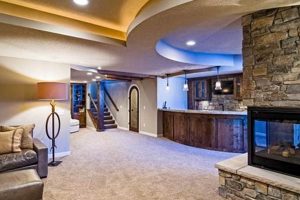
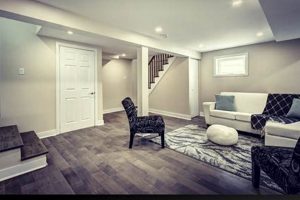
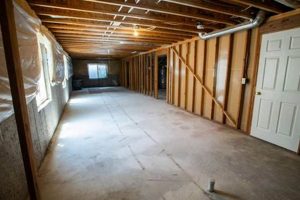
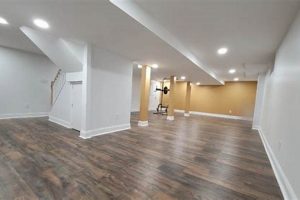
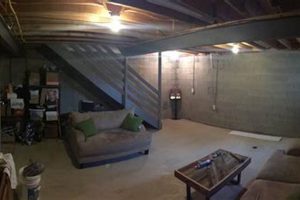
The extent to which a completed lower level impacts a property’s worth is a complex calculation, influenced by several factors. It is not a fixed percentage or monetary value. The degree of enhancement depends on the quality of the finish, the functionality of the added space, and the prevailing market conditions within the property’s locale. For instance, a high-end renovation with a full bathroom and egress windows in a sought-after neighborhood will likely contribute more to the overall appraisal than a basic finish in a less desirable area.
Enhancing a home with a finished lower level can provide significant advantages, including increased living space, potential rental income (where permitted), and improved marketability. Historically, the appeal of such upgrades has fluctuated with economic cycles and changing homeowner preferences. During periods of economic growth, homeowners are more inclined to invest in such projects, anticipating a solid return on investment. Conversely, during downturns, the focus shifts towards more essential home improvements. The benefit of added recreational space or a home office, features often included in finished lower levels, is undeniable, expanding a home’s utility and appeal to potential buyers.
The following sections will delve into the specific elements that determine the contribution of a finished lower level to the total value of a residence, including regional variations, cost considerations, and the appraisal process.
Maximizing Value
Optimizing a lower level finish requires strategic planning to ensure the greatest impact on a property’s assessed worth. Careful consideration of design, materials, and local market demands is paramount.
Tip 1: Prioritize Functionality: A well-designed lower level maximizes usable space. Consider layouts that accommodate multiple functions, such as a combined recreation and exercise area, or a guest suite with a separate living space. Functional design increases the appeal to a wider range of potential buyers.
Tip 2: Ensure Code Compliance: All work must adhere to local building codes. Specifically, egress windows are vital for safety and often legally required for a bedroom to be considered a legal bedroom. Non-compliance can negatively affect the appraisal and potentially lead to costly remediation.
Tip 3: Focus on Moisture Control: Address any existing moisture issues before commencing the finish. Waterproofing measures such as a sump pump and vapor barrier are essential to prevent future problems. Moisture damage can significantly diminish the value and necessitate expensive repairs.
Tip 4: Invest in Quality Materials: Opt for durable, water-resistant materials suitable for below-grade environments. High-quality flooring, drywall, and insulation will enhance the longevity and perceived value of the finished space.
Tip 5: Match the Style to the Home: The lower level finish should complement the existing aesthetic of the house. A cohesive design throughout the property enhances its overall appeal and perceived value.
Tip 6: Optimize Lighting: Adequate and well-placed lighting can transform a dark lower level into a bright and inviting space. Incorporate a combination of natural light (where possible), recessed lighting, and accent lighting to create a comfortable ambiance.
Tip 7: Consider Soundproofing: If the lower level is intended for use as a home theater or recreation room, soundproofing measures can be a valuable addition. Sound insulation can reduce noise transmission to other parts of the house, increasing its usability and appeal.
Strategic planning and careful execution of a lower level finish can significantly improve a property’s worth. Attention to detail, code compliance, and quality materials are vital to maximizing the return on investment.
The subsequent sections will explore the intricacies of the appraisal process and its effect on establishing a property’s market value following a lower level renovation.
1. Location

The geographical location of a property significantly influences the potential appreciation resulting from a finished basement. Regional variations in housing markets, buyer preferences, and cost of living dictate the demand for and perceived value of additional living space.
- Market Demand and Buyer Preferences
Urban centers and areas with high population density often exhibit increased demand for finished basements due to limited above-grade living space. Buyers in these locations may be willing to pay a premium for the additional functionality a finished basement provides. Conversely, in rural areas with larger lot sizes, the impact on value may be less significant, as buyers may prioritize outdoor space or perceive less of a need for additional indoor living areas.
- Regional Building Codes and Regulations
Local building codes and regulations pertaining to basement finishing can affect the cost and feasibility of such projects. Regions with stringent requirements for egress windows, ceiling heights, or waterproofing may increase the initial investment, potentially impacting the return on investment. Furthermore, differences in property tax assessments based on finished square footage can vary by location, influencing the overall economic benefit.
- Comparable Sales Data
Real estate appraisals rely heavily on comparable sales data from similar properties within the same geographic area. The presence and quality of finished basements in comparable sales directly impact the estimated value of a subject property. A higher concentration of homes with finished basements in a given location suggests a stronger market demand and potentially a greater increase in value. However, differences in construction quality, design, and amenities must be carefully considered to accurately assess the impact.
- Neighborhood Characteristics and Demographics
The socio-economic characteristics and demographics of a neighborhood can influence the desirability of finished basements. For example, neighborhoods with a high proportion of families may value the additional living space for recreation, playrooms, or guest accommodations. In contrast, areas with a larger population of older residents may prioritize other home improvements, such as accessibility features or energy efficiency upgrades. The perceived value of a finished basement aligns closely with the needs and preferences of the local demographic.
The interplay between location-specific factors, including market dynamics, regulatory frameworks, and demographic trends, shapes the contribution of a finished basement to a property’s overall value. A comprehensive assessment of these variables is essential to estimate the potential return on investment and make informed decisions regarding basement finishing projects.
2. Square footage

The area, or ‘square footage’, of a finished basement directly influences its contribution to a home’s total appraised value. This is because usable space is a primary determinant in property valuation; a larger, well-finished basement provides increased utility and, therefore, a potentially greater return.
- Usable Living Area Expansion
Additional square footage from a completed lower level enhances the overall livable area of a property. Potential buyers often consider this increased space as adding bedrooms, living areas, or recreational facilities. For instance, a 700-square-foot finished basement could effectively add a bedroom, bathroom, and small living area, transforming a two-bedroom house into a three-bedroom property. This enlargement of usable space is commonly reflected in higher appraised value.
- Impact on Price Per Square Foot
Although the per-square-foot valuation of a basement is often less than that of above-grade space, it nevertheless contributes to the overall value. The added square footage, even at a discounted rate, raises the total appraised amount. A detailed comparison of similar properties with and without finished basements reveals the effect of this additional area on market value. For example, if homes in an area typically sell for \$200 per square foot above grade, the finished basement might be valued at \$100-\$150 per square foot, still adding significantly to the property’s overall price.
- Functional Space Considerations
The utility and planned utilization of the basement space play a crucial role. Square footage allocated to essential functionalities, such as an additional bedroom or bathroom, tends to hold greater value than space used primarily for storage. For instance, a basement with a legal bedroom (with egress window) and a full bathroom adds considerably more to the property’s value than unfinished storage space of comparable area.
- Building Code Compliance
Proper compliance with local construction regulations is essential when calculating the value of finished basement square footage. Areas with ceiling heights below the permitted minimum or without appropriate egress may not be considered legal living space, thus affecting its appraisable worth. An area that is considered non-conforming may not be included in the total square footage when calculating property value. Failure to adhere to these codes can result in a lower assessment.
In summary, the square footage of a finished basement is a significant contributor to the valuation of a property. However, its impact relies on various elements, including the quality of the finish, functionality of the space, compliance with codes, and market conditions.
3. Quality of finish

The level of refinement in a completed lower level is a critical determinant of its impact on the overall property valuation. Superior craftsmanship and premium materials contribute significantly to the perceived value and marketability of the home.
- Material Selection and Durability
The types of materials employed in the finishing process directly influence the long-term appeal and value of the space. High-quality flooring, moisture-resistant drywall, and durable trim enhance the longevity of the finish and reduce the likelihood of future repairs. Premium materials present a favorable impression to potential buyers, signifying a sound investment. Conversely, inexpensive or low-grade materials can detract from the perceived value and potentially lead to costly maintenance, thereby limiting the overall impact on property valuation.
- Craftsmanship and Attention to Detail
The meticulousness and expertise demonstrated in the execution of the finishing work play a significant role in the perceived value of the lower level. Flawless drywall installation, precise trim work, and professional painting contribute to a refined aesthetic that resonates with discerning buyers. Conversely, visible imperfections, such as uneven surfaces or poorly executed finishes, can diminish the overall appeal and detract from the perceived value. Attention to detail signals a commitment to quality, influencing the potential return on investment.
- Design Cohesion and Aesthetic Appeal
The extent to which the lower level finish harmonizes with the existing style and architectural character of the home impacts its contribution to the overall property value. A cohesive design scheme that seamlessly integrates the lower level with the rest of the house enhances its desirability and appeal to potential buyers. Conversely, a disjointed or mismatched design can create a sense of incongruity, diminishing the perceived value. Thoughtful design choices that align with the prevailing market trends and buyer preferences contribute positively to the valuation process.
- Integration of Amenities and Features
The inclusion of desirable amenities and features, such as a wet bar, home theater, or exercise room, further enhances the value of a finished basement. Premium appliances, custom cabinetry, and specialized lighting systems contribute to a luxurious and functional space that appeals to a broad range of buyers. Conversely, a lack of amenities or outdated features can limit the appeal and reduce the potential return on investment. Strategic incorporation of high-demand features can significantly elevate the perceived value and marketability of the property.
The quality of finish in a completed lower level directly correlates with its potential to increase home value. Superior materials, skilled craftsmanship, cohesive design, and strategic integration of amenities collectively contribute to a favorable impression and increased marketability, thereby enhancing the overall property valuation.
4. Comparable sales

The assessment of similar property sales, or “comparable sales,” represents a cornerstone in determining the impact of a finished basement on a property’s market valuation. These “comps,” as they are often termed, provide concrete evidence of how the market values such improvements, establishing a benchmark against which to measure the subject property. The presence or absence of finished lower levels, along with the quality and features thereof, within these comparable properties directly influences the adjustment applied to the subject property’s valuation. For example, if three similar homes recently sold in the same neighborhood, each with comparable above-grade features to the subject property, but only two possessed finished basements, the difference in sale prices between those with and without finished basements indicates the market’s perceived value of that improvement. This differential provides a data-driven basis for calculating the contribution of a finished basement to the subject property’s value.
Adjustments made based on comparable sales must account for variations in size, quality, and features of the finished spaces. A significantly larger or more luxuriously appointed lower level in a comparable property warrants a more substantial adjustment than a smaller or more basic finish. Furthermore, locational factors also play a key role. Comps should ideally be situated within the same neighborhood or a similar market area to accurately reflect local buyer preferences and real estate trends. Examining appraisal reports from the relevant area can offer insights into the typical adjustments made for finished basements, based on sales data. Appraisers will typically make positive adjustments to the subject property’s value if the comparable properties possess smaller or less well-appointed finished basements. The opposite is also true.
The reliance on comparable sales presents challenges, particularly in areas with limited sales data or significant heterogeneity among properties. In such cases, careful consideration of qualitative factors and expert judgment becomes crucial. Nonetheless, “comps” remain an indispensable tool in estimating the value added by a finished basement, offering a tangible link between market transactions and property valuation. Understanding this connection equips homeowners and real estate professionals with a more accurate framework for evaluating investment decisions and property appraisals.
5. Permits

The acquisition of permits for a finished basement significantly impacts a property’s valuation. Completion of basement finishing work without proper authorization can lead to a decrease in the perceived and actual worth of the home. This results from potential code violations, safety concerns, and legal liabilities. Permitted work ensures adherence to building regulations concerning structural integrity, egress, fire safety, and electrical and plumbing systems. A finished basement completed without these safeguards raises questions for potential buyers regarding the quality and safety of the construction, making the property less desirable. For example, the absence of proper egress windows in a basement bedroom, a code violation often revealed during a home inspection, can render the room legally unusable as a bedroom and necessitate costly remediation to achieve compliance. This expense and uncertainty reduce the property’s value.
Furthermore, obtaining permits creates a documented record of the work performed, increasing transparency for future buyers. This record provides assurance that the construction meets acceptable standards and diminishes the risk of latent defects. Conversely, the absence of permits creates ambiguity and may prompt buyers to suspect shortcuts or substandard work. Real estate transactions frequently involve title searches and disclosure requirements, which can uncover unpermitted work. Unpermitted work may require retroactive permits, or even removal of the non-compliant structures, before a sale can close. This uncertainty and potential cost burden deter buyers and can lead to lower offers or canceled sales. Therefore, compliance with permitting regulations fosters confidence in the quality and legality of the finished space, strengthening the overall value proposition.
In summary, the procurement of permits is integral to maximizing the value a finished basement adds to a home. It assures adherence to safety and building codes, increases buyer confidence, and avoids potential legal and financial complications. The added cost and effort of obtaining the appropriate permits are outweighed by the enhanced valuation, reduced liability, and increased marketability of the property. The permit serves not only as a legal requirement but also as a testament to quality and responsible construction, contributing positively to the overall value of the property.
6. Functionality
The utility of a completed lower level is a critical factor in determining its impact on property worth. A well-designed and functional space enhances the overall appeal and value of a home, offering potential buyers tangible benefits and increased livability.
- Adaptability and Multi-Purpose Design
A flexible layout capable of serving various purposes increases the attractiveness of a finished basement. A space that can function as a recreation room, home office, or guest suite offers greater value than a single-purpose area. Adaptability ensures that the space meets the evolving needs of potential buyers. For example, a basement designed with modular furniture and convertible layouts can appeal to families, remote workers, or those seeking entertainment spaces.
- Practical Amenities and Features
The presence of practical amenities such as a full bathroom, kitchenette, or laundry room significantly enhances the functionality of the finished basement. These features allow the space to operate as a self-contained living area, increasing its value. A basement with a bathroom and kitchenette could serve as an in-law suite or rental unit (where permitted), adding versatility and revenue potential to the property.
- Storage Solutions and Organization
Incorporating efficient storage solutions and organization systems maximizes the utility of a finished basement. Built-in shelving, closets, and storage rooms help keep the space uncluttered and functional. Organized storage ensures that the basement remains a usable living area rather than becoming a repository for unused items. A well-organized basement indicates that the space is designed for practical living, improving its overall value.
- Accessibility and Egress Considerations
Safe and convenient access to the finished basement is essential for its functionality. A wide staircase, well-lit pathway, and easy access to utilities enhance the usability of the space. Egress windows or a walk-out entrance provide emergency exits and natural light, ensuring code compliance and increasing the desirability of the basement. Proper accessibility and egress not only meet safety standards but also contribute to the comfort and convenience of the living area, positively impacting its assessed worth.
The degree to which a completed lower level provides usable and adaptable living space directly influences its impact on property value. A functional design, practical amenities, efficient storage, and safe access contribute to the overall appeal and utility of the finished basement, enhancing its contribution to the assessed worth of the home.
7. Market demand
The degree to which a completed lower level enhances property valuation is intrinsically linked to prevailing market demand. Buyer preferences within a specific geographic location exert a considerable influence on the perceived and actual worth of such improvements. Increased market demand for homes with finished basements directly translates to a higher return on investment for homeowners considering such renovations. The causal relationship is clear: as more buyers seek properties with these features, the value attributed to a finished lower level increases, reflecting its enhanced desirability in the marketplace. For instance, in densely populated urban areas where above-grade living space is limited and expensive, completed lower levels offering additional recreational areas or living quarters become highly sought after, significantly boosting the overall property valuation. This stands in contrast to rural areas where larger lot sizes may diminish the relative importance of finished basement space, thus limiting its impact on value.
The importance of market demand as a component of assessing the value added by a finished basement is underscored by fluctuations in real estate trends. During periods of economic expansion and increased consumer confidence, demand for upgraded homes, including those with finished basements, typically rises. Conversely, economic downturns may shift buyer priorities towards more affordable properties, potentially reducing the premium associated with finished lower levels. This dynamic illustrates the practical significance of understanding local market conditions before undertaking basement finishing projects. A real-life example of this principle can be observed in areas experiencing a surge in remote work arrangements. The demand for homes with dedicated home office spaces has increased, making finished basements an attractive option for creating such environments, and correspondingly increasing the value homeowners can expect.
The ability to accurately gauge market demand allows homeowners and real estate professionals to make informed decisions regarding investment in finished basements. Challenges arise when assessing niche markets or predicting future trends. However, analyzing local sales data, demographic shifts, and economic indicators provides valuable insights. Ultimately, the connection between market demand and the incremental value conferred by a finished basement underscores the importance of aligning renovation projects with the prevailing preferences of prospective buyers. This strategic alignment maximizes the potential return on investment and enhances the property’s overall marketability.
Frequently Asked Questions
The following addresses common inquiries regarding the influence of a completed lower level on the assessed value of a residence.
Question 1: Does finishing a basement automatically increase home value?
Not automatically. The degree to which a finished basement contributes to the total value depends on a variety of factors, including location, quality of the finish, adherence to building codes, and prevailing market demand. It is not a guaranteed increase.
Question 2: How does square footage of the finished basement impact value?
The square footage adds to the overall usable living space, contributing to the home’s appraised worth. However, the value per square foot of a basement is typically lower than that of above-grade space. Larger, well-designed basements generally contribute more value.
Question 3: Are building permits necessary for finishing a basement and how do they affect value?
Building permits are essential. Finishing a basement without permits can result in code violations and safety concerns, decreasing the property’s value. Permitted work ensures compliance with building regulations and increases buyer confidence.
Question 4: What role do comparable sales play in determining the value of a finished basement?
Comparable sales of similar properties with finished basements provide a benchmark for valuation. Appraisers use these “comps” to determine the market’s perceived value of such improvements, adjusting for variations in size, quality, and location.
Question 5: How does the quality of the basement finish affect its impact on home value?
Superior craftsmanship, high-quality materials, and thoughtful design contribute significantly to the perceived value. Durable materials, precise workmanship, and cohesive design enhance the appeal and marketability of the home.
Question 6: Does market demand influence how much a finished basement increases home value?
Yes. Buyer preferences within a specific location exert considerable influence. Increased market demand for homes with finished basements directly translates to a higher return on investment. Economic trends also affect buyer preferences.
In summary, the value added by a finished basement is a nuanced calculation influenced by multiple factors. Careful consideration of these elements is essential to maximize the return on investment.
The subsequent sections will delve into the practical steps homeowners can take to maximize the value of their finished basement project.
Estimating the Contribution of Finished Basements
The preceding analysis elucidates the intricate factors determining the value a completed lower level adds to a residence. Location, square footage, quality of finish, comparable sales, permits, functionality, and market demand collectively shape the financial impact. The confluence of these variables dictates the degree to which a finished basement contributes to the overall property valuation.
A prudent assessment of these determinants facilitates informed decision-making regarding basement finishing projects. Understanding local market dynamics and adherence to regulatory requirements are paramount to maximizing the potential return on investment. Homeowners should carefully weigh these considerations to align renovation plans with market realities and ensure a financially sound outcome.