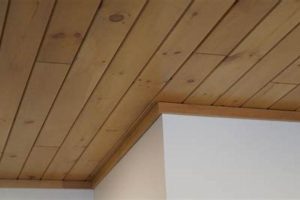
A manufactured wood panel product, constructed of multiple layers of wood veneer, features a top layer of birch veneer selected for its smooth surface and light color. This surface is pre-finished, meaning it has been treated with a coating like varnish or polyurethane to enhance its appearance and provide protection. For example, such a panel could be used in cabinet making, where a paint-ready or stain-ready surface is desired.
The utilization of this type of panel offers several advantages. Its stable core reduces warping and twisting compared to solid wood. The pre-finished surface minimizes the need for extensive sanding and preparation, leading to time and cost savings in production. Historically, these panels have been favored in applications where aesthetics and dimensional stability are both important, evolving from basic construction materials to more refined elements in furniture and interior design.
The subsequent sections of this article will delve into specific grades and applications, examining the varying thicknesses available and their suitability for different projects. Furthermore, surface treatment options and best practices for cutting and fastening will be discussed, ensuring optimal results when working with this versatile material.
Working with Birch Finish Plywood
The following guidelines are designed to optimize the utilization of birch finish plywood, ensuring professional results and longevity in finished projects.
Tip 1: Acclimation is Critical: Prior to cutting, allow panels to acclimate to the environment in which they will be used. This minimizes expansion or contraction after installation, reducing the likelihood of joint gaps or surface distortions.
Tip 2: Sharp Blades are Essential: Employ fine-toothed saw blades specifically designed for plywood. This minimizes splintering and tear-out along the cut edges, preserving the smooth surface.
Tip 3: Proper Support During Cutting: Ensure the panel is fully supported during cutting operations. This prevents sagging and vibration, contributing to cleaner, more accurate cuts.
Tip 4: Pre-Drilling Screw Holes: Pre-drilling pilot holes for screws is highly recommended. This avoids splitting the veneer layers, especially when working near edges or corners.
Tip 5: Careful Edge Treatment: Exposed edges require careful attention. Apply edge banding or filler to protect the core and provide a finished appearance. Sanding smooth prior finishing enhances the appearance.
Tip 6: Appropriate Fasteners: Select fasteners that are appropriate for the thickness and application. Fine-thread screws or nails are preferred for their holding power and reduced risk of splitting.
Tip 7: Consider Sealing Before Painting: Depending on the intended finish, sealing the birch finish plywood before painting can improve adhesion and prevent excessive paint absorption.
Adhering to these guidelines will maximize the potential of this versatile material, resulting in projects that are both aesthetically pleasing and structurally sound.
The subsequent conclusion will summarize the key benefits and common applications discussed throughout this article.
1. Smooth, Paintable Surface

The characteristic of a “Smooth, Paintable Surface” is a defining feature that significantly contributes to the widespread adoption and utility of birch finish plywood. This surface quality enables a broad range of finishing options and is integral to the material’s aesthetic and functional appeal.
- Enhanced Paint Adhesion
The tight grain structure of the birch veneer provides an ideal surface for paint adhesion. This reduces the likelihood of paint peeling or flaking, resulting in a more durable and professional finish. For example, when painting kitchen cabinets made of birch finish plywood, the paint bonds more effectively, ensuring a longer-lasting and aesthetically pleasing result.
- Minimized Surface Preparation
Compared to other wood substrates, the pre-sanded smooth surface reduces the amount of preparation needed before painting or staining. This saves time and labor costs in projects. Examples of application can be seen on interior paneling.
- Uniform Color Absorption
The consistent density of the birch veneer allows for uniform color absorption when staining or painting. This ensures a consistent, even color across the entire surface, avoiding blotchiness or uneven tones, thus improve aesthetic impact.
- Aesthetic Versatility
The neutral tone and smooth surface offer aesthetic versatility, allowing the material to be finished in a wide variety of colors and styles. It lends itself well to both modern and traditional designs, making it a versatile choice for diverse interior applications.
These facets of the “Smooth, Paintable Surface” directly enhance the value and usability of birch finish plywood. The combination of its inherent properties and the ease with which it accepts finishes contributes significantly to its popularity in cabinetry, furniture making, and interior design, allowing for diverse aesthetic expressions and durable, long-lasting results.
2. Dimensional Stability

Dimensional stability, defined as the ability of a material to maintain its original size and shape despite environmental changes, is a critical attribute of birch finish plywood. The multi-layered construction inherent to plywood, where thin sheets of wood veneer are glued together with alternating grain directions, significantly enhances this stability compared to solid wood. This cross-graining process minimizes the effects of moisture absorption and temperature fluctuations, factors that typically cause solid wood to expand, contract, warp, or crack. Consequently, structures built with birch finish plywood are less prone to developing gaps, uneven surfaces, or structural weaknesses over time. A practical example is its widespread use in kitchen cabinetry, where consistent dimensions are crucial for proper door and drawer alignment, even under varying humidity levels.
The finish applied to the birch veneer further contributes to dimensional stability by providing a protective barrier against moisture. This barrier slows down the rate at which the wood absorbs or releases moisture, reducing dimensional changes. Moreover, the rigidity of the adhesive used in the lamination process also plays a role, preventing individual layers from shifting independently. For instance, birch finish plywood is used in environments with elevated humidity, because the lamination and coating give to plywood an advantage to not change dimensions as simple wood.
In conclusion, the inherent layered structure combined with the protective finish makes dimensional stability a key characteristic of birch finish plywood. This stability ensures long-term performance in demanding applications. Addressing the need for reliable building materials to have minimal dimension change is one of the many advantages of using this type of plywood material, contributing to its selection in quality furniture making.
3. Layered Construction
Layered construction is a fundamental aspect of birch finish plywood, directly influencing its strength, stability, and overall suitability for a wide array of applications. The specific configuration of these layers dictates the panel’s performance characteristics, making it a critical design consideration.
- Veneer Orientation and Strength
In birch finish plywood, layers of birch veneer are stacked with alternating grain directions. This cross-graining technique dramatically increases the panel’s resistance to bending and splitting compared to solid wood. For example, this arrangement is crucial for shelving, where it prevents sagging under load.
- Core Material Impact
The core layers, sandwiched between the birch face veneers, significantly impact the panel’s thickness, weight, and screw-holding ability. Options range from veneer core (all birch veneers) to composite cores (particleboard or MDF). A veneer core provides superior screw holding and is lighter, while a composite core offers cost savings and increased thickness. Consider the core composition to guarantee that screws and other binding methods will have enough support, for example the support of screw while making birch finish plywood kitchen cabinet is an important consideration.
- Adhesive Selection and Durability
The type of adhesive used to bond the veneer layers is essential for the panel’s structural integrity and resistance to moisture. Exterior-grade adhesives create waterproof panels suitable for outdoor use, while interior-grade adhesives are adequate for indoor applications. When used in furniture pieces, the durability and strength of adhesion between layers are prime concerns.
- Surface Veneer Grade and Appearance
The quality of the birch veneer used on the face impacts the panel’s aesthetic appeal and its ability to accept finishes. Higher grades are free of knots and imperfections, providing a smooth, paintable surface. Lower grades may have visible defects but are more economical for concealed applications. It’s important to consider which surface qualities will impact the end design, like when choosing between grades of this plywood while designing kitchen cabinets or other interior furniture projects.
By understanding the nuances of layered construction, informed decisions can be made regarding the selection of birch finish plywood for specific projects. The interplay of veneer orientation, core material, adhesive type, and face veneer grade directly determines the panel’s performance, longevity, and aesthetic suitability, solidifying its position as a versatile building material.
4. Pre-Finished Options
The availability of pre-finished options significantly enhances the utility and efficiency of birch finish plywood. The application of a factory finish, such as a clear coat, stain, or paint, prior to purchase and installation provides immediate aesthetic value and protection. This pre-finishing process eliminates the need for on-site finishing, reducing labor costs and project completion time. For instance, cabinetry manufacturers often utilize pre-finished birch plywood to streamline production, ensuring consistent finish quality and minimizing volatile organic compound (VOC) emissions associated with traditional finishing methods. The consistent finish of a factory-applied coating is frequently more durable and uniform than what can be achieved on-site, due to controlled environmental conditions and specialized equipment.
Beyond the immediate benefits of time and labor savings, pre-finished birch plywood offers advantages in terms of environmental control and waste reduction. Factory finishing processes often incorporate systems to capture and recycle excess finish materials, minimizing environmental impact. Additionally, the precision application of the finish in a controlled environment reduces the likelihood of imperfections, leading to less waste compared to on-site finishing. A practical example is the use of pre-finished panels in modular construction, where precision and speed are paramount, and the reduction of on-site waste contributes to sustainability goals.
In summary, the pre-finished options associated with birch finish plywood represent a significant advancement in material processing, offering tangible benefits in terms of cost savings, time efficiency, environmental responsibility, and finish quality. The widespread adoption of pre-finished panels across various industries underscores the practical significance of this approach. The availability of consistent, high-quality finishes enhances the versatility of birch finish plywood, solidifying its position as a preferred material in both residential and commercial applications.
5. Versatile Applications

The broad applicability of birch finish plywood stems from its combination of aesthetic appeal and structural properties. Its smooth, paintable surface makes it suitable for visible components, while its layered construction provides dimensional stability and strength, making it ideal for load-bearing elements. The effect is a material adaptable to diverse functional requirements. For example, in furniture manufacturing, it serves as both a structural base and a paint-ready surface, reducing the need for separate materials and processes. This versatility is not merely a desirable attribute but a core characteristic that influences its selection across many industries.
Further extending its utility are the varied grades and thicknesses available. Thinner sheets are utilized in crafting curved surfaces or intricate designs, while thicker panels provide the robustness necessary for structural components in cabinetry or shelving. Pre-finished options, with clear coats or paint-ready surfaces, further streamline production in applications such as interior paneling, where uniformity and quick installation are prioritized. This flexibility in specifications allows manufacturers and builders to tailor its use to the precise demands of the project, maximizing efficiency and minimizing waste. The fact that this plywood can be manufactured at various thicknesses and grades enables manufacturers to have the suitable raw material for various needs of their end applications.
Ultimately, the “Versatile Applications” aspect of birch finish plywood represents a convergence of its inherent properties and the diverse needs of modern manufacturing and construction. While challenges may arise in selecting the appropriate grade and thickness for specific uses, understanding the material’s capabilities enables informed decision-making and optimal results. Its adaptability, therefore, positions it as a consistently relevant and valuable resource in numerous industries, illustrating the practical significance of its multifaceted nature.
Frequently Asked Questions About Birch Finish Plywood
The following section addresses common inquiries regarding the properties, applications, and handling of birch finish plywood. The information provided is intended to offer clarity and assist in informed decision-making.
Question 1: What distinguishes birch finish plywood from other types of plywood?
Birch finish plywood is characterized by its top veneer layer, which is made of birch wood. Birch offers a smooth, light-colored surface ideal for painting or staining. While other plywood types may use different face veneers (e.g., oak, maple), birch is specifically chosen for its aesthetic qualities and workability.
Question 2: What are the typical applications of birch finish plywood?
This material is commonly used in cabinetry, furniture making, interior paneling, and woodworking projects where a smooth, paintable or stainable surface is desired. Its dimensional stability also makes it suitable for applications requiring minimal warping or twisting.
Question 3: What factors influence the price of birch finish plywood?
Price is affected by several factors, including the grade of the birch veneer, the thickness of the panel, the type of core material (e.g., veneer core, MDF core), and whether the panel is pre-finished. Higher-grade veneers, greater thicknesses, and pre-finished options generally increase the cost.
Question 4: How should birch finish plywood be cut to minimize splintering?
To minimize splintering, employ a fine-toothed saw blade specifically designed for plywood. Ensure the panel is well-supported during cutting and use a scoring cut to sever the surface fibers before making the primary cut.
Question 5: What is the recommended method for fastening birch finish plywood?
Pre-drilling pilot holes is advisable to prevent splitting, especially near edges. Screws with fine threads provide secure fastening. Adhesive can also be used in conjunction with mechanical fasteners to enhance joint strength.
Question 6: How should birch finish plywood be stored to prevent damage?
Store panels flat in a dry, well-ventilated area. Avoid direct sunlight and extreme temperature fluctuations. Proper storage minimizes warping and prevents moisture absorption, preserving the panel’s integrity.
Understanding these frequently asked questions allows for more effective utilization and management of birch finish plywood in various projects. Awareness of the material’s properties and best practices contributes to successful outcomes.
The following section will delve into more specialized considerations for working with birch finish plywood in advanced applications.
Conclusion
This exposition has detailed the characteristics, advantages, and practical considerations surrounding birch finish plywood. The material’s smooth surface, dimensional stability, and layered construction contribute to its versatility across diverse applications. Pre-finished options offer efficiencies in manufacturing and construction, while an understanding of its nuances enhances its performance in various projects.
The informed selection and proper handling of birch finish plywood will yield optimal results. As material science continues to evolve, ongoing research and development will likely enhance the properties and expand the applications of this valuable engineered wood product. Continued adherence to best practices will ensure its sustained performance and contribution to quality construction and design.