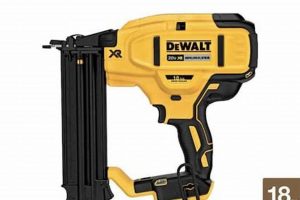
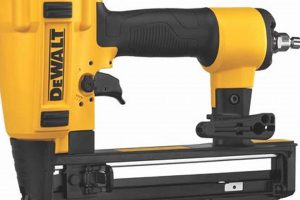
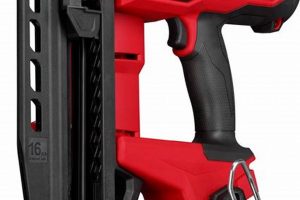
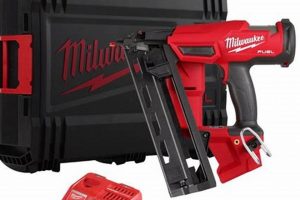
The central consideration involves selecting the appropriate pneumatic tool for trim and finish work, focusing on the magazine configuration. One style features a magazine oriented at an angle relative to the nailer body, while the other presents a straight, inline design. For example, an angled tool can prove useful in tight corners where a straight magazine might not fit.
The selection impacts accessibility and maneuverability in varied applications. The angled configuration offers improved access in constrained spaces, facilitating more precise nail placement. Conversely, the straight design can provide a more streamlined profile for general use and potentially improved balance. The historical development of these tools reflects an ongoing effort to optimize usability and address diverse job site requirements.
The subsequent sections will delve into the specific advantages and disadvantages of each design, examining performance characteristics, typical applications, and factors influencing the choice between the two configurations for optimal project outcomes.
Considerations for Choosing a Finish Nailer
Selecting the appropriate tool for finish carpentry requires careful evaluation of project needs and workspace characteristics. Understanding the distinctions between magazine orientations is crucial for optimal performance.
Tip 1: Access in Confined Spaces: Angled magazines are advantageous when working in tight corners or along intricate trim details. The offset design allows for nail placement in areas where a straight magazine would be obstructed.
Tip 2: Maneuverability and Balance: Straight magazines typically offer a more balanced feel, particularly during prolonged use. This can contribute to reduced operator fatigue and improved accuracy on large projects.
Tip 3: Nail Strip Compatibility: Confirm that the selected tool accepts readily available nail strips. Angled tools often require specifically angled nail strips, which may limit purchasing options.
Tip 4: Line of Sight: Evaluate the line of sight to the work surface. Some users find that the angled magazine obstructs the view of the nail placement point, potentially impacting precision.
Tip 5: Project Scope: For general-purpose finish work on open surfaces, a straight magazine often proves sufficient. Angled magazines are best reserved for tasks demanding superior access.
Tip 6: Maintenance Considerations: The complexity of the angled mechanism might require more specialized maintenance and repair compared to the simpler straight magazine design.
Tip 7: Storage and Transport: The overall dimensions, including magazine orientation, should be considered for convenient storage and transport within a toolbox or vehicle.
Understanding the functional differences related to magazine design will ensure the selected tool best suits the demands of the specific application. This will result in more efficient and higher-quality finish work.
The subsequent discussion will summarize these key factors and offer recommendations based on common scenarios.
1. Access

The configuration of the magazine directly impacts access when employing a finish nailer. The angled magazine design inherently provides improved accessibility in confined spaces. The angular offset allows the tool to reach into corners and tight areas where a straight magazine would be physically obstructed. This increased access facilitates precise nail placement in areas traditionally difficult to reach with conventional tools.
The enhanced access afforded by the angled magazine design translates into more efficient workflow, especially during projects involving intricate trim work or complex architectural details. For instance, installing crown molding in a room with limited clearance between the ceiling and upper walls benefits significantly from the angled magazine. Without this feature, the user might struggle to position the nailer correctly, potentially compromising the quality of the finish. Conversely, a straight magazine design is not able to offer this amount of flexibility.
In summary, magazine configuration significantly determines tool access, affecting nail placement precision, operational efficiency, and overall project quality. The choice between an angled and straight magazine is a pragmatic decision based on project characteristics and accessibility requirements. Ignoring the access factor during tool selection can lead to increased operational difficulties and potentially compromise the final outcome.
2. Balance

The physical equilibrium of a finish nailer, or balance, is a critical ergonomic factor directly influenced by the tool’s design, particularly concerning the magazine configuration. The distribution of weight affects the operator’s control and fatigue levels during prolonged use. The position of the nailer’s center of gravity determines how easily it can be manipulated and held steady, impacting nail placement accuracy.
- Center of Gravity Shift
An angled magazine typically shifts the center of gravity away from the tool’s handle. This offset can create a less stable feel, requiring more effort to maintain precise positioning. The operator may exert additional force to counteract the imbalance, potentially leading to muscle strain over extended periods. The effects become more pronounced with heavier nailers and when working in awkward positions.
- Operator Fatigue
Poor balance contributes to increased operator fatigue. The body compensates for the tool’s imbalance through continuous muscle engagement, accelerating fatigue onset. Tasks that demand prolonged overhead or horizontal nailing are particularly susceptible to this effect. A well-balanced tool minimizes the strain on the operator’s wrist, arm, and shoulder, improving endurance and productivity.
- Nail Placement Accuracy
The stability of the nailer directly affects nail placement accuracy. A well-balanced tool allows for more controlled movement and reduces the likelihood of unintentional shifts during the nailing process. This is especially crucial when working on delicate or visible surfaces where precise nail placement is paramount. Imbalance can lead to misfires or skewed nails, compromising the quality of the finished work.
- Tool Maneuverability
Balance influences the overall maneuverability of the tool. A nailer with a well-positioned center of gravity is easier to rotate, angle, and position in tight spaces. This enhanced maneuverability simplifies complex nailing tasks and allows the operator to work more efficiently. An imbalanced tool can feel cumbersome and difficult to manipulate, hindering productivity and potentially increasing the risk of errors.
In summary, the balance of a finish nailer is intrinsically linked to its ergonomic design and the positioning of its components, notably the magazine configuration. The selection between an angled and straight magazine can significantly impact the tool’s center of gravity, operator fatigue, nail placement accuracy, and overall maneuverability. Choosing a well-balanced tool, tailored to the specific demands of the project, is crucial for maximizing efficiency, minimizing fatigue, and achieving high-quality results.
3. Visibility

Clear line of sight to the work surface is a crucial factor in achieving accurate and consistent nail placement with any finish nailer. The magazine configuration, whether angled or straight, significantly influences this visual access, impacting precision and overall efficiency.
- Magazine Obstruction
Angled magazines, by their offset nature, can potentially obstruct the user’s direct line of sight to the point of nail entry. The bulk of the angled magazine and the attached nail strip can create a visual barrier, especially when working in tight spaces or at acute angles. This obstruction may necessitate adjustments in posture or head position to maintain a clear view, potentially compromising stability and accuracy.
- Nosepiece Design
Nosepiece design can either mitigate or exacerbate the visibility challenges posed by the magazine configuration. A slim, streamlined nosepiece allows for a clearer view of the nailing point, regardless of magazine orientation. Conversely, a bulky or poorly designed nosepiece can further obscure vision, increasing the risk of misfires or inaccurate nail placement. The nosepiece should ideally allow for precise positioning without obstructing the user’s line of sight.
- Work Surface Lighting
Adequate lighting is essential for optimal visibility, regardless of the finish nailer’s magazine configuration. Insufficient lighting casts shadows and reduces the clarity of the work surface, making it difficult to pinpoint the desired nailing location. Proper lighting, either ambient or task-specific, enhances visual acuity and allows the user to compensate for any potential obstruction caused by the magazine.
- User Adaptation and Technique
With practice and experience, users can adapt their technique to compensate for any visibility limitations imposed by the magazine configuration. Adjusting the angle of approach, utilizing visual cues, and developing a tactile sense for nail placement can mitigate the impact of magazine obstruction. Experienced users often develop strategies to maintain accuracy despite visual challenges.
The influence of magazine configuration on visibility is a critical consideration when selecting a finish nailer. While angled magazines may present potential obstructions, nosepiece design, lighting conditions, and user adaptation can all play a role in mitigating these challenges. The optimal choice depends on a careful assessment of the specific work environment, project requirements, and user preferences.
4. Nail Type

The selection of finish nails is intrinsically linked to the magazine configuration of the nailer. Angled magazine designs necessitate the use of collated nails specifically manufactured with an appropriate angle to match the magazine. Straight magazine nailers, on the other hand, utilize straight collated nail strips. This fundamental difference dictates the types of fasteners that can be used, directly affecting project suitability and cost considerations. Utilizing the incorrect nail type can cause tool malfunction, damage to the work piece, or even pose a safety hazard to the operator. For instance, attempting to load a straight nail strip into an angled magazine will result in jamming, rendering the tool inoperable.
The availability and cost of specific nail types must be factored into the overall project budget and tool selection process. Angled nails, owing to their specialized design, may be less readily available at local suppliers or may command a higher price point compared to standard straight finish nails. This price differential becomes particularly relevant for larger-scale projects requiring substantial fastener quantities. A contractor consistently working on intricate trim details, where angled nailers provide superior access, must account for the ongoing cost and procurement logistics associated with angled nail strips. Conversely, if the majority of work involves general finishing tasks, the wider availability and lower cost of straight nails may justify choosing a straight magazine nailer, even if it compromises access in occasional tight corners.
In summary, the relationship between magazine design and nail type is a critical element of finish nailer selection. Choosing a tool requires considering the practical implications of fastener compatibility, availability, and cost. Understanding the specialized nail requirements of angled magazine nailers, compared to the more standardized nail options for straight magazine nailers, enables informed decision-making, leading to optimized project outcomes and cost-effective tool utilization. Failing to adequately address nail type considerations can result in operational inefficiencies, increased project expenses, and potentially compromised workmanship.
5. Maneuverability

The maneuverability of a finish nailer is directly affected by its magazine configuration, specifically whether it is angled or straight. The angle of the magazine relative to the tool body influences the nailer’s ability to access and operate within confined or complex spaces. An angled magazine generally improves maneuverability in situations where a straight magazine would be obstructed by surrounding structures or materials. For instance, installing baseboards in a room with tight corners or around existing cabinetry benefits from the improved maneuverability of an angled nailer. The offset allows the tool to maintain a perpendicular nailing angle without requiring excessive repositioning or contortion of the operator’s body.
A straight magazine, while potentially more streamlined in open areas, can present challenges when navigating obstacles or working in close proximity to other surfaces. While providing balanced feel, straight designs frequently require the operator to create more clearance or to adopt awkward positions to achieve the desired nail placement. The trade-off between balance and accessibility inherent in these designs underscores the need to consider the specific application when selecting a tool. For example, installing door casings where minimal clearance exists between the casing and the adjacent wall becomes significantly more difficult with a straight magazine nailer. This decreased maneuverability increases task completion time and the potential for damaging surrounding surfaces.
In summary, the correlation between maneuverability and magazine configuration in finish nailers is a function of spatial accessibility. Angled magazines offer enhanced maneuverability in confined spaces, improving work efficiency and minimizing potential damage. Straight magazines, although potentially providing better balance and a more streamlined profile, can limit maneuverability in tight areas. Choosing the appropriate tool necessitates careful consideration of the project’s spatial constraints and the operator’s comfort and dexterity.
6. Applications

The suitability of angled versus straight finish nailers is significantly determined by the specific applications for which they are intended. The choice between these two configurations directly impacts efficiency, accuracy, and the overall quality of the finished product across various woodworking and trim carpentry tasks.
- Crown Molding Installation
Angled finish nailers often excel in crown molding installation due to their ability to access tight corners and awkward angles where a straight nailer cannot easily reach. The angled magazine allows for precise nail placement into the molding’s profile without requiring excessive maneuvering or potential damage to surrounding surfaces. Straight nailers can be used, but the process may be more cumbersome and require additional tools or techniques.
- Baseboard and Door Casing Work
Both angled and straight finish nailers find application in baseboard and door casing installation. Straight nailers are generally preferred for long, straight runs of baseboard where ease of use and consistent nail depth are paramount. However, angled nailers prove advantageous when navigating tight corners or when fastening casing in areas with limited clearance. The choice depends on the complexity and spatial constraints of the specific job site.
- Cabinetry and Furniture Assembly
Within cabinetry and furniture assembly, both angled and straight nailers can be utilized. Angled nailers provide increased access for fastening components in confined spaces within cabinets or furniture frames. This allows for secure joins in areas difficult to reach with a straight magazine. Straight nailers are often suitable for larger, more accessible surfaces where speed and ease of operation are prioritized.
- Trim and Decorative Detailing
For intricate trim and decorative detailing, the maneuverability of an angled finish nailer offers a distinct advantage. Its angled magazine allows for precise nail placement in complex shapes and profiles, minimizing the risk of splitting or damaging delicate materials. Straight nailers can be used for simpler trim work, but the increased access afforded by the angled design is often crucial for achieving a professional finish on detailed projects.
In conclusion, the selection between angled and straight finish nailers depends significantly on the intended application. Angled nailers provide increased access and maneuverability in tight spaces and complex geometries, making them ideal for tasks like crown molding and detailed trim work. Straight nailers offer ease of use and efficiency for long, straight runs and more accessible surfaces. Considering the specific requirements of each project is essential for maximizing the benefits of each nailer configuration.
7. Maintenance
The long-term operational reliability of finish nailers hinges on adherence to proper maintenance protocols. The complexity of the magazine configuration, whether angled or straight, has direct implications for the scope and frequency of required maintenance procedures.
- Component Accessibility
The design of angled magazine nailers often presents challenges in accessing internal components for cleaning, lubrication, and repair. The angled mechanism can obstruct direct access, requiring disassembly of multiple parts to reach critical areas. Straight magazine nailers, with their simpler design, generally offer more straightforward access to internal components, simplifying routine maintenance tasks. For instance, clearing a jammed nail in an angled magazine might necessitate a more involved disassembly process compared to a straight magazine design.
- O-Ring and Seal Integrity
Pneumatic nailers rely on O-rings and seals to maintain airtight connections and ensure efficient operation. The angled configuration of some nailers places additional stress on these components due to the more complex air pathways. Increased stress can accelerate wear and tear, necessitating more frequent replacement of O-rings and seals. Straight magazine nailers typically exhibit less stress on these components, potentially extending their service life. Regular lubrication is crucial for both designs but assumes greater importance for angled models.
- Jam Clearing Mechanisms
Nail jams are a common occurrence in finish nailers, regardless of magazine orientation. However, the design of the jam clearing mechanism can vary significantly between angled and straight models. Angled nailers may require more specialized tools or techniques to clear jams due to the complexity of the angled pathway. Straight nailers often feature simpler jam clearing mechanisms that can be operated quickly and easily. The efficiency of the jam clearing process directly impacts productivity and downtime on the job site.
- Preventative Maintenance Schedules
The complexity of the angled magazine mechanism may warrant a more rigorous preventative maintenance schedule compared to a straight magazine design. Regular cleaning, lubrication, and inspection are crucial for maintaining optimal performance and preventing premature component failure. Neglecting maintenance can lead to decreased efficiency, increased repair costs, and potential safety hazards. Implementing a consistent maintenance schedule tailored to the specific nailer model is essential for ensuring long-term reliability.
The considerations regarding maintenance highlight the subtle but significant differences between angled and straight finish nailers. While straight models are usually easier to maintain, it’s also true that the benefits gained by angle designs outweight the cons if you choose the right model. Ultimately, understanding the intricacies of both configurations is crucial for making informed decisions that promote both operational efficiency and longevity.
Frequently Asked Questions
The following section addresses common inquiries regarding the selection between angled and straight magazine configurations for finish nailers.
Question 1: What primary advantage does an angled magazine offer over a straight magazine?
The principal advantage of an angled magazine lies in its enhanced access to confined spaces. The offset design permits nail placement in corners and other restricted areas where a straight magazine would be obstructed.
Question 2: Does the magazine configuration affect nail capacity?
Nail capacity is generally independent of magazine angle. Both angled and straight magazine nailers can accommodate comparable quantities of fasteners, although specific models may vary.
Question 3: Are angled finish nails universally compatible across all angled nailers?
No, angled finish nails are not universally compatible. The precise angle and collation style of the nail strip must match the specifications of the nailer model. Consult the manufacturer’s documentation for compatible fastener types.
Question 4: Is one configuration inherently more durable than the other?
Neither configuration is inherently more durable. Durability depends on the quality of materials and construction, as well as adherence to proper maintenance practices. However, the increased mechanical complexity of certain angled magazine designs could, potentially, introduce more points of failure.
Question 5: Does an angled magazine increase the risk of nail jams?
The risk of nail jams is not solely determined by the magazine angle. Factors such as nail quality, proper tool maintenance, and adherence to recommended operating procedures are equally significant. A well-maintained angled nailer should not exhibit a higher incidence of jams compared to a straight nailer.
Question 6: How does the magazine orientation affect the overall weight and balance of the tool?
An angled magazine typically shifts the center of gravity away from the handle, which might alter the tool’s balance. Straight magazine nailers often exhibit a more balanced feel, particularly during extended use. However, the actual impact on weight and balance depends on the specific model and its overall design.
In summary, the optimal choice between angled and straight magazine configurations hinges on a careful evaluation of project requirements, spatial constraints, and user preferences.
The subsequent section offers concluding remarks and recommendations.
Finish Nailer Angled vs Straight
This exploration of finish nailer angled vs straight configurations has revealed critical distinctions impacting performance, accessibility, and overall suitability for varied applications. The angled magazine design affords enhanced access in confined spaces, while the straight magazine often provides improved balance and ease of use in open areas. The choice necessitates careful consideration of project-specific demands, nail type availability, maintenance requirements, and operator preferences. Each design presents inherent advantages and limitations that must be weighed against the specific context of the task at hand.
The informed selection of a finish nailer, predicated on a thorough understanding of magazine configuration attributes, directly influences the efficiency and quality of finish carpentry endeavors. Further research into specific models and comparative testing under representative working conditions are encouraged to optimize tool selection for long-term performance and project success.