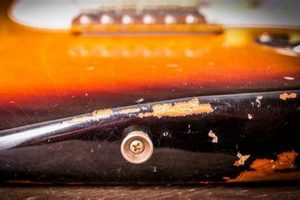
The act of rectifying imperfections in the protective coating applied to a guitar is a specialized process. This coating, typically a lacquer, polyurethane, or polyester substance, safeguards the wood from environmental factors and enhances its aesthetic appeal. Damage can manifest as scratches, dents, cracks (checking), clouding, or chemical reactions. Corrective measures can range from simple buffing and polishing to more complex procedures involving filling, spot finishing, and complete refinishing. An example of such work includes addressing a surface scratch on a glossy, poly finish with progressively finer abrasives, followed by polishing compounds to restore the original sheen.
Maintaining the integrity of a guitar’s surface protection is paramount for several reasons. It prevents moisture absorption and warping of the wood, preserving the instrument’s structural stability and tonal qualities. Furthermore, it directly influences the resale value and overall visual attractiveness of the instrument. Historically, finishes were primarily shellac or varnish, requiring frequent maintenance. Modern synthetic finishes offer improved durability and resistance to wear, yet are still susceptible to damage and may require professional attention to preserve the instrument’s condition.
This discussion will explore various techniques employed to address common imperfections, detail the materials and tools required, and outline preventative measures to minimize future damage. Furthermore, it will differentiate between minor cosmetic enhancements and more extensive structural restorations. Subsequent sections will delve into specific finish types and their respective repair methodologies.
Tips for Maintaining and Addressing Damage
Adhering to proper handling and storage procedures is crucial in minimizing potential harm to a guitar’s protective coating. Early detection and careful mitigation of minor issues can prevent more extensive and costly interventions.
Tip 1: Implement Proper Storage Protocols: Keep instruments in a controlled environment with stable temperature and humidity levels. Extreme fluctuations can cause finish cracking (checking) and wood warping. A hard-shell case provides optimal protection during storage and transport.
Tip 2: Employ Gentle Cleaning Techniques: Utilize a soft, lint-free cloth and a finish-safe cleaner specifically designed for guitars. Avoid abrasive materials or harsh chemicals, as these can dull or scratch the surface. Wipe down the instrument after each use to remove fingerprints and debris.
Tip 3: Address Minor Scratches Promptly: Superficial scratches can often be remedied with polishing compounds formulated for guitar finishes. Apply the compound sparingly with a soft cloth, using circular motions. Always test in an inconspicuous area first to ensure compatibility.
Tip 4: Prevent Belt Buckle Rash: The back of a guitar is particularly susceptible to scratches from belt buckles. Consider using a protective film or pad to shield this area from contact with abrasive materials.
Tip 5: Exercise Caution with Solvents and Chemicals: Avoid exposing the finish to solvents, alcohol, or other harsh chemicals, as they can cause discoloration, softening, or dissolving of the coating. Clean spills immediately with a damp cloth.
Tip 6: Protect from Prolonged Sunlight Exposure: Direct sunlight can cause fading, yellowing, and cracking, particularly in nitrocellulose lacquer finishes. Store instruments away from direct sunlight or use a UV-resistant case cover.
Tip 7: Consider Professional Evaluation for Significant Damage: Deep scratches, cracks, or areas of significant finish loss are best addressed by a qualified luthier or guitar technician. Attempting complex repairs without the necessary skills and equipment can lead to further damage.
Following these recommendations will contribute significantly to the longevity and aesthetic appeal of the instrument. Consistent preventative measures are more effective and economical than extensive restorative work.
These maintenance strategies provide a foundation for understanding the value of preserving the surface of stringed instruments. This information will now shift toward exploring repair approaches for various common issues.
1. Adhesion
Adhesion, in the context of guitar finish repair, is the crucial bond formed between the existing finish and any newly applied material, be it filler, color coat, or clear coat. The strength and durability of this bond directly determine the longevity and quality of the repair. Insufficient adhesion can lead to premature failure, manifesting as peeling, cracking, or bubbling, ultimately compromising the instrument’s appearance and protection.
- Surface Preparation: The Foundation of Adhesion
Proper surface preparation is paramount for achieving adequate adhesion. This involves removing contaminants like wax, grease, and dirt, which can impede bonding. Additionally, the surface may require abrasion to create a mechanical key for the new finish to grip. Techniques such as sanding or scuffing provide the necessary texture. The specific preparation method depends on the type of existing finish and the repair materials being used.
- Chemical Compatibility: Ensuring a Strong Bond
Chemical compatibility between the existing finish and repair materials is essential. Applying incompatible substances can result in poor adhesion or even chemical reactions that degrade the finish. For instance, applying lacquer over a polyurethane finish without proper isolation layers can lead to cracking and lifting. Selecting appropriate primers and sealers is critical for bridging dissimilar finish types and promoting adhesion.
- Environmental Factors: Influencing Bond Formation
Environmental conditions, such as temperature and humidity, play a significant role in adhesion. Extreme temperatures or high humidity can hinder the curing process and weaken the bond. Manufacturers typically specify ideal temperature and humidity ranges for their products. Maintaining these conditions during application and curing is crucial for optimal adhesion.
- Application Technique: Optimizing Bond Strength
The application technique significantly impacts adhesion. Applying the finish too thinly or too thickly can result in uneven drying and reduced bond strength. Proper spray gun settings, consistent application speed, and appropriate overlap are essential for achieving a uniform and well-adhered finish. Additionally, following the manufacturer’s recommended drying times between coats is crucial for allowing each layer to properly bond to the previous one.
Ultimately, the successful execution of finish work hinges on mastering the factors influencing adhesion. Neglecting any of these elements can compromise the repair, leading to costly rework and potentially damaging the instrument. A thorough understanding of surface preparation, chemical compatibility, environmental factors, and application techniques is indispensable for achieving a durable and aesthetically pleasing result.
2. Color Matching

In guitar finish repair, precise color matching is paramount for achieving a seamless and aesthetically pleasing restoration. Discrepancies in color between the repaired area and the original finish can be glaringly obvious, diminishing the instrument’s value and visual appeal. Accurate color matching requires a combination of skill, experience, and specialized techniques.
- Understanding Finish Coloration and Aging
Guitar finishes are susceptible to color changes over time due to exposure to ultraviolet light and environmental factors. Nitrocellulose lacquer, for example, tends to amber with age. Repairing a vintage instrument necessitates accounting for this aged hue, rather than simply matching the original factory color. Failure to do so will result in a patch that appears too bright or unnatural.
- Utilizing Color Theory and Pigment Blending
Achieving accurate color matches often requires blending multiple pigments to replicate the desired hue. Color theory principles, such as understanding complementary colors and their interactions, are essential. For instance, adding a small amount of green to a red finish can create a more muted, vintage appearance. Precise measurement and incremental adjustments are crucial to avoid overshooting the target color.
- Employing Color Matching Tools and Techniques
Various tools can aid in the color matching process. Spectrophotometers can measure the precise color values of the existing finish, providing a numerical reference for replication. Color charts and swatches offer a visual guide for selecting appropriate pigments. Spray-out cards, which are sample panels sprayed with the blended color, allow for comparison under different lighting conditions.
- Considering Lighting Conditions and Viewing Angles
The perceived color of a finish can vary depending on the lighting conditions and viewing angle. Metallic or pearlescent finishes, in particular, exhibit significant color shifts. Color matching should be performed under consistent lighting conditions, and the repaired area should be viewed from multiple angles to ensure a uniform appearance.
The complexities involved in color matching underscore its importance in achieving a high-quality guitar finish repair. A successful repair seamlessly integrates with the original finish, preserving the instrument’s value and aesthetic integrity. Mastering the principles of color theory, employing appropriate tools, and accounting for environmental factors are crucial for achieving accurate and undetectable results. The integration of “Color matching” with skillful execution is essential in these guitar’s restotation.
3. Leveling Techniques
Leveling techniques are integral to guitar finish repair, addressing imperfections and ensuring a smooth, uniform surface. Deviations in planarity, such as orange peel texture, runs, or embedded debris, detract from the instrument’s appearance and tactile feel. Effective leveling restores the surface to its intended condition, ready for subsequent polishing or buffing.
- Wet Sanding: Abrasive Material Application
Wet sanding involves using abrasive papers, typically silicon carbide, lubricated with water or specialized leveling solutions. The liquid minimizes friction, prevents clogging of the abrasive, and carries away removed material. This process systematically removes imperfections by gradually flattening the finish. Grits ranging from coarse to ultra-fine are employed in sequence, progressively refining the surface. For example, removing deep scratches might commence with 400-grit paper, followed by 600, 800, 1000, 1200, and ultimately finer grits to eliminate the scratches created by the preceding, coarser abrasives. Proper execution minimizes swirl marks and ensures a consistent matte finish before polishing.
- Scraping: Controlled Material Removal
Scraping utilizes specialized tools, such as razor blades or hardened steel scrapers, to precisely remove material from the finish. This technique is particularly effective for addressing localized imperfections, such as sags or runs. The scraper is held at a low angle to the surface and drawn across the defect, shaving off thin layers of finish. Successful scraping requires a sharp tool and a controlled hand to avoid gouging or uneven removal. Scraping is often preferred for sensitive areas or when preserving the surrounding finish is critical.
- Card Sanding: Flexible Abrasive Support
Card sanding involves wrapping abrasive paper around a rigid but flexible backing, such as a piece of stiff cardboard or plastic. This provides a flat and even sanding surface, preventing the abrasive from conforming to small surface irregularities and creating uneven leveling. Card sanding is useful for maintaining flatness over larger areas and for refining surfaces after wet sanding or scraping. The backing material distributes pressure evenly, reducing the risk of localized scratching.
- Buffing and Polishing: Final Surface Refinement
Buffing and polishing are the final stages of leveling, restoring the finish to its intended gloss level. These processes employ rotating buffing wheels and polishing compounds, which contain progressively finer abrasives. The compounds remove the microscopic scratches left by the previous leveling steps, creating a smooth and reflective surface. Buffing requires careful control of speed and pressure to avoid burning or damaging the finish. Multiple buffing stages, using different compounds and wheels, are often necessary to achieve the desired level of clarity and gloss.
The selection and execution of appropriate leveling techniques are crucial for achieving a professional-quality guitar finish repair. Inadequate leveling compromises the aesthetic appeal and protective function of the finish. The integration of carefully chosen techniques enhances instrument preservation and restoration.
4. Curing Conditions

Curing conditions exert a profound influence on the success and longevity of guitar finish repair. The term encompasses temperature, humidity, airflow, and light exposure during the drying and hardening phases of the applied coating. Deviation from optimal conditions can compromise the physical and chemical properties of the finish, leading to defects and premature failure. Therefore, precise control of the curing environment is an indispensable element of quality restoration.
- Temperature: Impact on Polymerization and Solvent Evaporation
Temperature directly affects the rate of polymerization and solvent evaporation in many guitar finishes. Insufficient temperature can slow down these processes, resulting in a soft, uncured finish that is prone to scratching and marring. Excessively high temperatures can cause rapid solvent evaporation, leading to blistering, pinholing, or cracking. For instance, a nitrocellulose lacquer finish requires a moderate temperature range (typically 70-75F) to ensure proper crosslinking and solvent release. Variations outside this range necessitate adjustments to application techniques and drying times. Professional finishing environments often incorporate temperature-controlled booths to maintain consistent conditions.
- Humidity: Influence on Moisture Absorption and Coating Integrity
Humidity levels impact the moisture content of both the wood substrate and the applied finish. High humidity can hinder solvent evaporation and promote moisture absorption into the finish, resulting in clouding, blushing, or reduced adhesion. Low humidity can cause rapid solvent evaporation and shrinkage of the finish, leading to cracking or checking. Maintaining a relative humidity range of 45-55% is generally recommended for most guitar finishes. Dehumidifiers or humidifiers may be necessary to achieve this range in different climates or seasons. Proper humidity control minimizes stress on the finish and promotes long-term stability.
- Airflow: Affecting Solvent Removal and Finish Uniformity
Adequate airflow is crucial for removing evaporated solvents from the finishing environment. Stagnant air can lead to solvent build-up, slowing down the curing process and increasing the risk of solvent entrapment within the finish. Solvent entrapment can cause swelling, softening, or discoloration of the finish over time. Forced air circulation, using fans or ventilation systems, promotes even drying and prevents solvent accumulation. Proper airflow also helps to maintain a consistent temperature and humidity level throughout the finishing area, contributing to uniform finish curing.
- Light Exposure: Impact on UV-Cured Finishes and Color Stability
Certain guitar finishes, such as UV-cured coatings, require exposure to specific wavelengths of ultraviolet light to initiate polymerization. The intensity and duration of UV exposure directly affect the curing rate and the final properties of the finish. Insufficient UV exposure can result in an under-cured finish, while excessive exposure can cause discoloration or embrittlement. For traditional finishes, prolonged exposure to direct sunlight can cause fading, yellowing, or cracking, particularly in nitrocellulose lacquer. Proper storage and handling procedures, including the use of UV-resistant cases or covers, can minimize the adverse effects of light exposure.
The interplay of temperature, humidity, airflow, and light exposure during the curing process significantly affects the ultimate quality and durability of guitar finish repairs. Optimizing these conditions is essential for achieving a flawless, long-lasting finish that enhances both the aesthetic appeal and structural integrity of the instrument. Consistent monitoring and adjustment of the curing environment are critical for successful restoration outcomes. The integration of “Curing Conditions” within these repairs help the guitar’s appearance and preservation.
5. Material compatibility

In the realm of guitar finish repair, material compatibility denotes the capacity of disparate substances, such as fillers, sealers, color coats, and clear coats, to coexist without adverse chemical or physical interactions. A failure to observe material compatibility precipitates a cascade of detrimental effects, ranging from compromised adhesion and discoloration to finish cracking and delamination. This principle is not merely an ancillary consideration; rather, it forms a cornerstone of successful restoration, directly influencing the longevity and aesthetic integrity of the repaired area. For instance, the application of a lacquer-based topcoat over an improperly sealed silicone-containing contaminant invariably results in “fish-eye,” a cratering effect that necessitates complete finish removal and reapplication. Similarly, the use of incompatible solvents can soften or dissolve the existing finish, rendering any subsequent repair futile.
Practical applications of material compatibility principles are widespread throughout guitar finish repair procedures. When addressing finish cracks in a vintage instrument finished with nitrocellulose lacquer, the selection of a compatible nitrocellulose-based filler is critical. Conversely, attempting to fill these cracks with an epoxy-based filler, while structurally sound, would create an inflexible barrier that could inhibit the natural expansion and contraction of the surrounding lacquer, ultimately leading to new cracks along the interface. Moreover, color matching often necessitates the use of toners and dyes. These must be carefully selected to ensure their compatibility with the carrier solvent and the existing finish. The introduction of incompatible dyes can result in color bleeding, fading, or even a chemical reaction that alters the overall finish appearance.
In summary, material compatibility stands as an indispensable consideration in guitar finish repair. Its proper understanding and application directly correlate with the quality and durability of the restoration. While challenges may arise in identifying compatible materials, particularly when dealing with aged or unknown finishes, meticulous research, careful product selection, and adherence to manufacturers’ guidelines are essential. By prioritizing material compatibility, repair professionals can effectively mitigate the risk of finish failures and ensure the preservation of these valuable instruments.
Frequently Asked Questions
This section addresses common inquiries concerning the restoration and maintenance of guitar finishes, offering clarity on prevalent concerns and misconceptions.
Question 1: Is it possible to fully restore a heavily damaged guitar finish to its original factory condition?
While significant improvements are often achievable, a complete return to original factory condition is frequently unattainable. Factors such as finish aging, environmental exposure, and the unavailability of original materials can limit the extent of restoration. Ethical considerations also dictate preserving aspects of the instrument’s history, rather than pursuing a flawless, but potentially inauthentic, result.
Question 2: What are the risks associated with attempting to undertake finish repairs without professional experience?
Inexperienced individuals may inadvertently cause further damage through improper techniques, incompatible materials, or inadequate preparation. Common errors include sanding through the finish, creating swirl marks, or inducing chemical reactions that compromise the finish’s structural integrity. Such mistakes can necessitate costly and complex corrective measures.
Question 3: How does the type of finish (e.g., nitrocellulose lacquer, polyurethane) affect the repair process?
Different finish types necessitate distinct repair methodologies and materials. Nitrocellulose lacquer, for example, requires specialized solvents and application techniques due to its volatile nature. Polyurethane finishes, known for their durability, often demand more aggressive sanding and leveling procedures. Matching the appropriate repair materials to the existing finish is critical for ensuring adhesion and preventing incompatibility issues.
Question 4: Can minor surface scratches be repaired without refinishing the entire instrument?
Yes, superficial scratches can often be addressed through spot repairs using polishing compounds and buffing techniques. However, the success of this approach depends on the severity and depth of the scratches, as well as the type of finish. Deeper scratches may necessitate filling, spot finishing, or even localized refinishing.
Question 5: What preventative measures can be taken to minimize damage to a guitar finish?
Implementing proper storage protocols, such as maintaining consistent temperature and humidity levels, is crucial. Regular cleaning with finish-safe products, avoiding exposure to harsh chemicals, and protecting the instrument from direct sunlight can also significantly reduce the risk of damage. Additionally, using a protective case during transport and storage is highly recommended.
Question 6: Does repairing the finish of a vintage guitar negatively affect its value?
Whether a finish repair impacts value depends on the extent and quality of the work. Poorly executed repairs can diminish the instrument’s value. However, professional-grade repairs, performed with appropriate techniques and materials, can preserve or even enhance the instrument’s value, particularly if the original finish was severely damaged or deteriorated.
In summary, guitar finish repair presents both opportunities for restoration and potential pitfalls. Informed decision-making, guided by expert advice and a clear understanding of the process, is essential for achieving successful outcomes.
The following section will explore the tools and equipment essential for effective repair.
Conclusion
This exploration has illuminated the intricacies inherent in guitar finish repair. From adhesion challenges to color matching complexities, and the critical importance of leveling and controlled curing conditions, the process demands precision and expertise. Material compatibility stands as a central tenet, governing the long-term integrity of any restorative endeavor. The information provided serves to underscore the necessity for informed decision-making when addressing imperfections in an instrument’s protective coating.
The decision to undertake repair work should be weighed carefully, considering the potential impact on the instrument’s value and structural stability. Whether engaging professional services or attempting minor repairs, a thorough understanding of the processes involved is paramount. Preserving the aesthetic and functional qualities of these instruments requires a commitment to best practices and a recognition of the nuanced skills required for successful guitar finish repair.