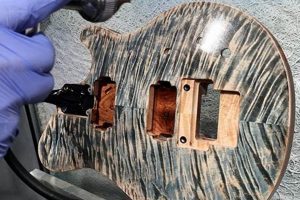
A specific type of coating, historically prevalent in instrument making, involves the application of a cellulose-based lacquer. This material, known for its thinness and ability to age gracefully, allows the tonewood of guitars to resonate freely. Examples of instruments utilizing this type of coating are often found in vintage and high-end models, prized for their sonic qualities and visual appeal.
The advantages of this finish include its contribution to the instrument’s tonal characteristics and its capacity to develop a desirable patina over time. Furthermore, its relatively soft nature allows for easier repair and restoration compared to more modern, rigid coatings. Historically, its use was favored due to its availability and the perception that it enhanced the instrument’s sound projection and overall quality.
The following discussion will delve into the application process, maintenance considerations, and potential drawbacks associated with this classic instrument coating technique. This exploration will further clarify its role in guitar construction and its enduring appeal to musicians and luthiers alike.
Tips for Applying Nitrocellulose Lacquer to Guitars
The application of nitrocellulose lacquer to guitars requires precision and careful attention to detail. Following these guidelines will assist in achieving a professional and durable finish.
Tip 1: Preparation is Paramount: Ensure the wood surface is meticulously sanded and free of any imperfections, dust, or contaminants. Grain filling may be necessary for open-pored woods to achieve a smooth, level surface prior to lacquer application.
Tip 2: Thin Coats are Crucial: Apply multiple thin coats rather than a few thick coats. Thin coats promote proper drying and prevent runs, sags, and solvent entrapment, leading to a more durable and visually appealing final finish.
Tip 3: Proper Spray Technique is Essential: Maintain a consistent distance and spray pattern with the spray gun. Overlapping each pass by approximately 50% ensures even coverage and minimizes the risk of dry spots or uneven build-up.
Tip 4: Environmental Control is Key: Apply the lacquer in a well-ventilated environment with controlled temperature and humidity. Elevated humidity can cause blushing or clouding in the finish, while extreme temperatures can affect the lacquer’s drying and leveling properties.
Tip 5: Sanding Between Coats Enhances Adhesion: Lightly sand each coat with fine-grit sandpaper (e.g., 400-grit or higher) to provide a mechanical key for subsequent coats. This promotes optimal adhesion and minimizes the risk of delamination.
Tip 6: Adequate Drying Time is Non-Negotiable: Allow sufficient drying time between coats, as specified by the manufacturer’s instructions. Rushing the drying process can lead to solvent entrapment, resulting in a soft or unstable finish.
Tip 7: Buffing and Polishing for a Professional Shine: After the final coat has fully cured, use a series of progressively finer grits of polishing compounds and buffing pads to achieve a high-gloss, mirror-like finish. Patience and attention to detail are vital during this stage.
These tips emphasize the importance of preparation, technique, and environmental control for successfully applying nitrocellulose lacquer. Adhering to these guidelines will result in a superior finish that enhances the instrument’s appearance and protects its tonewood.
The subsequent sections will address troubleshooting common issues and providing recommendations for maintenance and care of the finished instrument.
1. Thinness

The characteristic thinness of nitrocellulose lacquer is a primary factor influencing its use in instrument finishing. This property directly impacts the guitar’s acoustic behavior. A thinner finish layer allows the wood to vibrate more freely compared to thicker, more rigid coatings. This unrestricted vibration is believed to contribute to a richer, more resonant tone. For instance, vintage guitars finished with nitrocellulose are often lauded for their complex sonic qualities, a characteristic frequently attributed, in part, to the finish’s minimal dampening effect. The application process, requiring multiple thin coats, further emphasizes this attribute, contrasting with single-application, thick film finishes.
Achieving this thinness necessitates meticulous application. Over-application or improper spraying techniques can negate the tonal benefits by creating a thicker, less flexible layer. Lutherie practices often involve carefully sanding between coats to maintain the desired minimal thickness while ensuring adequate protection. Furthermore, the composition of the lacquer itself is formulated to minimize film build, further emphasizing its thinness. The practical significance lies in the direct influence on the instrument’s sonic output, a factor highly valued by musicians and luthiers who prioritize tonal nuance.
In summary, the thinness of nitrocellulose lacquer is not merely a physical attribute but a critical component of its functionality in guitar finishing. It facilitates optimal wood vibration, contributing to a desirable tonal response. Maintaining this thinness requires skilled application and careful monitoring of film build throughout the finishing process. The challenges of achieving and preserving this attribute underscore the importance of understanding the relationship between the finish and the instrument’s acoustic properties, reaffirming its significance in guitar manufacturing and restoration.
2. Resonance

The application of nitrocellulose lacquer directly influences the resonance of a guitar. This influence stems from the lacquer’s impact on the instrument’s overall mass and vibrational characteristics. A finish that is too thick or inflexible can dampen the natural vibrations of the tonewood, reducing sustain and altering the guitar’s tonal response. Nitrocellulose, when applied correctly in thin, even coats, is understood to minimize this dampening effect, allowing the wood to vibrate more freely. This enhanced vibration is a critical component of the instrument’s resonance, contributing to its perceived volume, sustain, and tonal complexity. For example, a solid-body electric guitar finished with a heavy polyurethane coating might exhibit a noticeably different sustain and overall resonance compared to an identical guitar finished with a thinner nitrocellulose lacquer. The practical significance of this understanding lies in the luthier’s ability to manipulate the finish type and application to achieve desired tonal characteristics.
The relationship between finish thickness and resonance is not linear. While a thinner finish generally allows for greater wood vibration, the type of wood, its density, and the overall construction of the instrument also play significant roles. The finish acts as a membrane, and its properties impact how the sound waves are transmitted and reflected within the instrument. The aging process of nitrocellulose further affects resonance. Over time, the lacquer becomes harder and more brittle, potentially altering the way the guitar resonates. Some players and builders believe that this aging process contributes to the tonal character of vintage instruments. Real-world applications show a preference for thinner finishes in instruments intended for acoustic playing, where maximizing natural resonance is paramount. Conversely, thicker finishes might be favored in instruments where durability and protection are prioritized over subtle tonal nuances.
In conclusion, the effect of nitrocellulose lacquer on guitar resonance is a nuanced and critical consideration in instrument construction. The finish, when applied strategically, contributes to the instrument’s vibrational properties. Understanding the interplay between finish thickness, wood type, and construction techniques allows luthiers to tailor the instrument’s resonance to meet specific tonal goals. The primary challenges in this process involve achieving a balance between finish durability, aesthetic appeal, and optimal vibrational characteristics. This nuanced understanding continues to inform both the construction of new instruments and the restoration of vintage ones.
3. Aging (Patina)

The aging process, specifically the development of a patina, is intrinsically linked to nitrocellulose lacquer finishes on guitars. This aging manifests as a gradual change in the finish’s appearance, characterized by subtle discoloration, checking (fine cracks in the surface), and a softening of the gloss. These changes are primarily caused by the lacquer’s sensitivity to ultraviolet light, temperature fluctuations, and environmental pollutants. The result is a unique, aged aesthetic that is often highly valued by musicians and collectors. The importance of this aging effect lies in its contribution to the instrument’s perceived vintage character and, arguably, its tonal qualities, as the hardening of the finish over time may subtly alter the instrument’s resonance. For example, a 1950s Fender Stratocaster with its original nitrocellulose finish will typically exhibit a pronounced patina, lending it a visual authenticity and a perceived sonic maturity that is difficult to replicate.
The practical significance of understanding this aging process extends to both instrument preservation and restoration. Recognizing the factors that contribute to patina formation allows for informed decisions regarding instrument storage and maintenance. Strategies to minimize environmental exposure, such as controlled humidity and UV-protective cases, can slow the aging process. Conversely, restoration efforts may aim to replicate or enhance the existing patina to maintain the instrument’s vintage aesthetic. Techniques include careful application of tinted lacquers or controlled exposure to UV light. However, it’s crucial to approach such restoration with caution, as improper techniques can damage the finish or detract from the instrument’s originality. The effect of aging and patina on the value of vintage guitars is also a key element to keep in mind.
In conclusion, the aging and subsequent patina of nitrocellulose guitar finishes are complex phenomena, driven by environmental factors and the inherent properties of the lacquer. The resulting aesthetic is not merely superficial; it contributes to the instrument’s perceived value, sonic character, and historical significance. The challenges lie in balancing the desire to preserve the instrument’s original condition with the inevitability of aging and the potential for informed restoration. A comprehensive understanding of these processes is essential for both instrument owners and luthiers alike, highlighting the enduring connection between finish type and the instrument’s long-term evolution.
4. Repairability

The characteristic repairability of nitrocellulose lacquer finishes is a significant factor in its continued use on guitars. This attribute stems from the lacquer’s ability to chemically bond to itself, even after significant curing. This cohesive bonding allows for seamless blending of new lacquer with existing finish during repairs, a process that is considerably more difficult with modern, catalyzed finishes such as polyurethane or polyester. Consequently, scratches, dents, and other blemishes on a nitrocellulose finish can be addressed with relative ease, often without requiring a complete refinishing of the instrument. An example is the spot repair of a surface scratch on a vintage guitar; a skilled luthier can blend new lacquer into the affected area, making the repair virtually undetectable. The importance of this repairability is amplified in the context of vintage instruments, where preserving the original finish, even with repairs, maintains the instrument’s value and historical integrity.
The practical applications of this repairability extend beyond aesthetic considerations. Damage to the finish can expose the underlying wood to environmental factors, such as moisture, potentially leading to structural problems. The ability to easily repair the finish provides a crucial line of defense against such damage. Furthermore, the relatively soft nature of nitrocellulose makes it easier to level and polish repaired areas, achieving a smooth and consistent surface. The process typically involves careful sanding, application of new lacquer in thin coats, and subsequent buffing to blend the repair with the surrounding finish. This stands in stark contrast to the more complex and often irreversible repairs required for finishes that do not readily bond to themselves. Due to nitrocellulose lacquer bonding to itself in the repair process, older guitars can maintain originality longer, which is more desired than a complete new spray job.
In summary, the inherent repairability of nitrocellulose lacquer finishes provides both practical and aesthetic benefits for guitar owners and luthiers. This attribute facilitates the preservation of vintage instruments, enables efficient repair of surface damage, and protects the underlying wood from environmental harm. The challenges associated with nitrocellulose repair lie primarily in matching the existing finish color and sheen, a skill that requires experience and expertise. Nevertheless, the relative ease of repair contributes to the enduring appeal of nitrocellulose finishes, ensuring their continued use in guitar construction and restoration.
5. Tonewood Protection

Tonewood protection is a primary function of any guitar finish, and the attributes of nitrocellulose lacquer coatings influence their effectiveness in safeguarding the instrument’s structural integrity and tonal properties. The application of this finish creates a barrier against environmental factors that can negatively impact the wood.
- Moisture Barrier
Nitrocellulose lacquer, when properly applied, acts as a moisture barrier, preventing excessive absorption or release of moisture by the tonewood. Fluctuations in humidity can cause wood to swell or shrink, leading to warping, cracking, or changes in the instrument’s setup and intonation. The finish slows down the rate of moisture exchange, stabilizing the wood and minimizing these adverse effects. For instance, a guitar stored in a humid environment without adequate finish protection is more susceptible to developing issues such as a raised action or fret sprout.
- UV Protection
Exposure to ultraviolet (UV) radiation can degrade the lignin in wood, causing it to become brittle and discolored. Nitrocellulose lacquer offers a degree of UV protection, although it is not as effective as some modern finishes with UV inhibitors. The finish filters out some of the harmful UV rays, slowing down the degradation process and preserving the wood’s structural integrity and original appearance. A guitar left in direct sunlight will exhibit accelerated fading and potentially structural weakening if not adequately protected by a finish.
- Scratch and Dent Resistance (Limited)
While not exceptionally hard, nitrocellulose lacquer provides a degree of protection against minor scratches and dents. The finish acts as a sacrificial layer, absorbing some of the impact and preventing damage to the underlying wood. However, due to its relative softness, nitrocellulose is more prone to scratching and checking compared to harder finishes like polyurethane. Despite this, the finish still shields the wood from everyday wear and tear. For example, the finish protects the tonewood from scratches caused by guitar picks.
- Chemical Resistance (Limited)
Nitrocellulose lacquer offers limited resistance to certain chemicals, such as solvents or cleaning agents. Exposure to harsh chemicals can dissolve or damage the finish, compromising its protective function. While it provides some barrier against accidental spills, care must be taken to avoid prolonged contact with damaging substances. The tonewood is thus protected from chemicals in this way.
The protective qualities of nitrocellulose lacquer, while not as robust as some modern alternatives, contribute to the long-term preservation of the tonewood and the overall longevity of the instrument. Understanding the limitations and proper care techniques associated with this finish is essential for maintaining the instrument’s structural integrity and tonal characteristics over time. Even though the level of protection given may not be as intense as more durable finishes, it’s still important to understand that the tonewood is being protected.
6. Application Technique

The application technique employed in nitro guitar finishing is paramount in determining the quality, durability, and aesthetic appeal of the final product. Improper application can negate the inherent advantages of nitrocellulose lacquer, while meticulous technique can enhance its desirable properties. The skill of the applicator is therefore crucial in realizing the full potential of this finishing method.
- Surface Preparation
Thorough surface preparation is an indispensable first step. This includes meticulous sanding to achieve a smooth, level substrate, free of imperfections that would be magnified by the finish. Grain filling may be necessary for open-pored woods to prevent the lacquer from sinking into the grain, resulting in an uneven surface. Inadequate preparation leads to a finish that reflects underlying flaws, compromising both its appearance and protective qualities. An example is neglecting to properly sand a guitar body, resulting in visible sanding marks beneath the lacquer layers.
- Spraying Consistency
Maintaining a consistent spray pattern and distance is essential for achieving uniform coverage. Overlapping each pass by approximately 50% minimizes the risk of dry spots and ensures even build-up of the finish. The gun speed and fluid delivery must be carefully calibrated to avoid runs, sags, or orange peel texture. An inconsistent spray pattern can result in variations in gloss level and thickness across the instrument’s surface, detracting from its visual appeal and potentially affecting its acoustic properties.
- Environmental Control
Applying nitrocellulose lacquer requires a controlled environment to prevent issues such as blushing or solvent pop. Optimal temperature and humidity levels promote proper drying and leveling of the finish. Elevated humidity can trap moisture within the lacquer film, leading to a cloudy or hazy appearance. Insufficient ventilation can result in solvent build-up, causing bubbles or blisters in the finish. An uncontrolled environment can cause an otherwise perfect application to fail.
- Curing and Buffing
Allowing sufficient curing time is crucial for the lacquer to fully harden and develop its optimal properties. Rushing the curing process can result in a soft or unstable finish that is susceptible to damage. After curing, careful buffing and polishing are necessary to achieve a high-gloss, mirror-like finish. The choice of buffing compounds and techniques influences the final appearance and smoothness of the surface. Inadequate curing or improper buffing can ruin the final result.
These facets of application technique collectively determine the success of the nitro guitar finishing process. The quality of the finish is directly proportional to the skill and attention to detail of the applicator, underscoring the importance of proper training and experience in achieving a professional and durable result. The overall result is a professional and quality finish that lasts for a long time and is aesthetically pleasing.
Frequently Asked Questions About Nitro Guitar Finishing
The following questions address common concerns and misconceptions regarding nitrocellulose lacquer finishes on guitars. The answers provide factual information to aid in informed decision-making.
Question 1: Is nitrocellulose lacquer inherently superior to modern finishes in terms of tone?
The assertion that nitrocellulose lacquer unequivocally enhances tonal qualities compared to modern finishes lacks definitive scientific consensus. While some musicians and luthiers report subjective differences, objective measurements of acoustic properties often yield inconclusive results. The perceived tonal impact is influenced by numerous factors, including wood selection, construction methods, and individual playing styles. There are too many varying factors to consider.
Question 2: What are the primary drawbacks of nitrocellulose lacquer?
Nitrocellulose lacquer exhibits lower durability and chemical resistance compared to modern finishes. It is more prone to scratching, checking, and damage from solvents or cleaning agents. The application process also poses environmental and health risks due to the emission of volatile organic compounds (VOCs). Appropriate ventilation and safety precautions are thus mandatory.
Question 3: How does the aging process affect a nitrocellulose lacquer finish?
Over time, nitrocellulose lacquer undergoes a process of aging, characterized by gradual discoloration, the development of a patina, and potential checking (fine cracks in the surface). This aging process is primarily caused by exposure to ultraviolet (UV) light, temperature fluctuations, and environmental pollutants. While some appreciate the aesthetic qualities of an aged finish, others may seek to minimize these effects through careful storage and maintenance. It truly comes down to preference.
Question 4: Is nitrocellulose lacquer more difficult to repair than modern finishes?
While nitrocellulose lacquer is readily repairable due to its ability to chemically bond to itself, achieving a seamless repair requires skill and experience. Matching the existing color and sheen can be challenging, particularly on aged finishes. The repair process typically involves careful sanding, application of new lacquer, and subsequent buffing. Improper techniques can result in visible repairs that detract from the instrument’s value.
Question 5: Are there specific precautions to take when cleaning a nitrocellulose lacquer finish?
Avoid using harsh chemicals or abrasive cleaners on nitrocellulose lacquer finishes. Use a soft, lint-free cloth dampened with a mild guitar polish specifically formulated for nitrocellulose. Avoid prolonged contact with water or other liquids, and promptly wipe away any spills. Regular cleaning helps to remove dirt, fingerprints, and other contaminants that can dull the finish over time. Follow the product’s recommendation.
Question 6: Does the thickness of the nitrocellulose lacquer finish significantly impact the guitar’s tone?
Excessively thick finish layers can dampen the natural vibrations of the tonewood, potentially affecting the guitar’s resonance and sustain. However, the relationship between finish thickness and tone is complex and influenced by other factors, such as the type of wood and the instrument’s construction. Applying nitrocellulose lacquer in thin, even coats minimizes the risk of negatively impacting the guitar’s acoustic properties. As previously mentioned, the wood density is crucial.
These FAQs provide a concise overview of key considerations regarding nitrocellulose lacquer finishes. Informed decisions require weighing the advantages and disadvantages in the context of individual preferences and priorities.
The subsequent sections will provide best practices for maintaining and storing guitars with nitrocellulose lacquer finishes.
Nitro Guitar Finishing
This exploration has elucidated the multifaceted characteristics of nitro guitar finishing. From its influence on resonance and aging properties to its repairability and role in tonewood protection, the nuances of this traditional technique have been thoroughly examined. The importance of proper application, coupled with an understanding of its limitations, has been consistently emphasized.
As instrument builders and enthusiasts navigate the options available in guitar finishing, a comprehensive understanding of nitrocellulose lacquer empowers informed decisions. Consideration of both its unique attributes and inherent challenges remains paramount in preserving the legacy and optimizing the performance of stringed instruments. Further research and evolving application techniques will continue to shape the future of nitro guitar finishing.


![Best Nouveau Moisturizing Finishing Lotion [Review] | Best Final Touch: Elevate Your Projects with Professional Finishing](https://bestfinaltouch.com/wp-content/uploads/2026/05/th-338-300x200.jpg "Best Nouveau Moisturizing Finishing Lotion [Review] Best Final Touch: Elevate Your Projects with Professional Finishing")