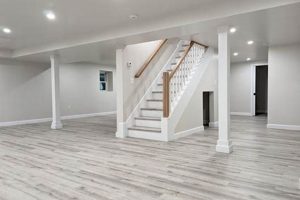
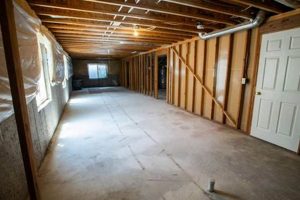
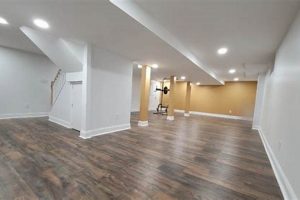
The presence of a colorless, odorless, radioactive gas in a lower-level living space poses a significant health concern. Remedial actions in a completed below-grade area address elevated levels of this naturally occurring element through techniques designed to reduce its concentration. This commonly involves sealing cracks and pathways and establishing a sub-slab depressurization system to vent the gas safely outdoors.
Addressing the issue effectively in such a space protects the health and well-being of occupants, specifically reducing the risk of lung cancer associated with prolonged exposure. Historically, awareness of this problem grew as scientific studies demonstrated the link between indoor air quality and respiratory health. Taking these measures can also increase property value and ensure compliance with local building codes and regulations.
The following sections will detail common methods employed to lower the concentration of this gas, explore the steps involved in testing existing levels, and provide guidance on selecting qualified professionals to implement appropriate solutions within a completed below-grade residential environment.
Considerations for Radon Reduction in Finished Basements
This section presents key considerations when addressing the presence of a radioactive gas in a completed lower-level living area. Employing these strategies contributes to a safer and healthier indoor environment.
Tip 1: Comprehensive Initial Assessment: Prior to commencing any remedial work, conduct a thorough radon test using an approved testing method. This establishes a baseline measurement to determine the extent of the problem. Long-term testing, spanning several months, offers a more accurate reflection of average levels.
Tip 2: Sealing Obvious Entry Points: Identify and seal all visible cracks and openings in the foundation walls and floor. Utilize appropriate sealant materials designed for concrete to prevent the gas from entering the living space through these pathways.
Tip 3: Sub-Slab Depressurization System Installation: The most effective mitigation technique involves creating a sub-slab depressurization system. This entails drilling a hole through the concrete slab and inserting a PVC pipe connected to a fan. The fan draws the gas from beneath the slab and vents it safely above the roofline.
Tip 4: Proper Ventilation Strategies: Improve ventilation within the finished basement to dilute indoor air contaminants. This can be achieved through natural ventilation, such as opening windows, or by installing a mechanical ventilation system. Ensure adequate airflow to reduce the concentration of the gas.
Tip 5: Professional System Maintenance: Regularly inspect the sub-slab depressurization system to ensure it is operating correctly. Check the fan and vent pipe for any signs of damage or blockage. Schedule professional maintenance as recommended by the installer.
Tip 6: Post-Mitigation Testing and Verification: After completing the mitigation measures, conduct a follow-up radon test to verify the effectiveness of the system. Ensure that radon levels have been reduced to an acceptable range, typically below 4 picocuries per liter (pCi/L) as recommended by health organizations.
Implementing these actions minimizes exposure and contributes significantly to a safer, more habitable completed basement environment. Consistent adherence to these protocols is essential for maintaining long-term protection.
The following section delves into selecting qualified contractors and the importance of adhering to established safety standards during the mitigation process.
1. Foundation Sealing

Foundation sealing constitutes a crucial element in the overall strategy for mitigating the presence of a naturally occurring radioactive gas in a completed below-grade residential area. By addressing potential entry points, this process minimizes the ingress of the gas into the living space, thus reducing the risk of prolonged exposure.
- Crack and Penetration Identification
A thorough assessment of the foundation walls and floor is paramount for identifying all cracks, joints, and service penetrations. These discontinuities often serve as pathways for the gas to enter the structure. Examples include cracks caused by settling, expansion joints, and openings around pipes or wiring. Ignoring these vulnerabilities compromises the effectiveness of other mitigation efforts.
- Appropriate Sealant Selection
The choice of sealant material directly impacts the long-term performance of the sealing process. The selected sealant must be compatible with concrete, possess excellent adhesion properties, and maintain its integrity over time despite fluctuations in temperature and humidity. Polyurethane-based sealants and epoxy-based crack injection systems are frequently employed due to their durability and resistance to degradation.
- Proper Application Techniques
Effective sealing requires meticulous application techniques. Cracks should be properly cleaned and prepared before applying the sealant. For wider cracks, backer rod may be necessary to control the depth of the sealant and prevent three-sided adhesion. Proper curing time, as specified by the sealant manufacturer, is also crucial for achieving a durable and effective seal. Inadequate preparation or application compromises the integrity of the seal and may necessitate repeat applications.
- Integration with Other Mitigation Strategies
Foundation sealing is most effective when implemented in conjunction with other mitigation techniques, such as sub-slab depressurization. While sealing reduces the amount of gas entering the structure, a sub-slab depressurization system actively removes the gas from beneath the foundation, preventing it from accumulating within the living space. A comprehensive approach that combines sealing with depressurization provides the most robust solution for lowering the concentration of the gas to acceptable levels.
In summation, diligent foundation sealing, employing appropriate materials and techniques, forms a vital component in the comprehensive mitigation strategy for completed below-grade areas. It minimizes the gas’s entry, working in concert with other methods to ensure a safer indoor environment. Regular inspection and maintenance of sealed areas are essential to sustain long-term effectiveness.
2. Sub-Slab Depressurization

Sub-slab depressurization (SSD) represents a primary method for reducing the concentration of a naturally occurring radioactive gas within completed below-grade living spaces. Its implementation directly addresses the root cause of elevated levels by preventing the gas from entering the habitable area. This technique is particularly relevant in finished basements, where occupants spend significant time, increasing their potential exposure.
- System Design and Installation
SSD systems typically involve drilling a hole through the concrete slab and inserting a PVC pipe connected to a continuously operating fan. The fan creates a negative pressure zone beneath the slab, drawing the gas away from the foundation. The extracted gas is then vented safely above the roofline, away from windows and ventilation intakes. Proper system design is crucial, considering soil permeability, foundation characteristics, and building layout. Incorrect installation can lead to reduced effectiveness or increased energy consumption.
- Impact on Indoor Air Quality
A properly functioning SSD system significantly lowers the concentration of the radioactive gas in the indoor air. The system interrupts the gas’s pathway into the living space, preventing it from accumulating to dangerous levels. Regular monitoring of the system’s performance and periodic indoor air testing are essential to verify its continued effectiveness. These measures ensure that the living environment remains safe for occupants, minimizing the risk of long-term health consequences associated with exposure.
- Integration with Building Codes and Standards
Many jurisdictions have incorporated regulations regarding the testing and mitigation of this naturally occurring radioactive gas into their building codes. SSD systems must comply with these codes and adhere to established industry standards for design, installation, and performance. Compliance ensures that systems are installed safely and effectively, providing a consistent level of protection across different properties. Professional contractors specializing in mitigation are trained to meet these requirements and can provide documentation verifying compliance.
- Long-Term System Maintenance and Monitoring
SSD systems require regular maintenance to ensure their continued optimal performance. This includes periodic inspection of the fan, vent pipe, and system components for damage or blockage. The fan’s power consumption should be monitored to detect any changes that may indicate a malfunction. Regular indoor air testing should be conducted to verify that the system is maintaining acceptable levels. Proactive maintenance and monitoring prolong the system’s lifespan and prevent potential health risks.
The facets of SSD demonstrate its vital role in mitigating risk within completed basements. Effective system design, adherence to building codes, and ongoing maintenance are all necessary to ensure a safe and healthy living environment. By preventing entry into the finished space, SSD significantly reduces the risk of prolonged exposure, contributing to the overall well-being of occupants.
3. Ventilation Improvement

Ventilation improvement, as a component of mitigating risk in completed lower-level living spaces, plays a crucial role in reducing indoor concentrations of a naturally occurring radioactive gas. While not a standalone solution in most cases, enhanced airflow complements primary mitigation techniques like sub-slab depressurization by diluting existing concentrations and improving overall air quality. Insufficient ventilation allows the gas to accumulate, increasing exposure risk, whereas improved air exchange reduces this potential.
Consider a finished basement where sub-slab depressurization is already in place. Introducing a heat recovery ventilator (HRV) or energy recovery ventilator (ERV) increases the rate at which stale air is exhausted and fresh air is introduced. This process further lowers the concentration of the gas, creating a healthier environment. In situations where the initial concentration is only marginally above acceptable levels, improved ventilation, combined with careful sealing of cracks and openings, may be sufficient to achieve the desired reduction. However, in areas with significantly elevated levels, ventilation alone is unlikely to provide adequate protection and must be used in conjunction with other remediation strategies.
In conclusion, ventilation improvement offers a valuable supplementary measure to reduce concentrations within finished basements. Its effectiveness is dependent on the initial concentration, the building’s construction characteristics, and its integration with primary mitigation strategies. While enhanced airflow alone may not always suffice, it contributes significantly to improved indoor air quality and reduces the overall risk associated with prolonged exposure, particularly when integrated into a comprehensive remediation plan.
4. Regular Monitoring

In completed below-grade spaces where mitigation systems have been implemented, ongoing assessment of levels is paramount. Initial reduction efforts, such as sub-slab depressurization or enhanced ventilation, necessitate subsequent verification to ensure sustained effectiveness. Fluctuations in soil moisture, seasonal temperature variations, and alterations to the building’s structure can affect the performance of mitigation systems over time, potentially leading to a resurgence of elevated concentrations. Therefore, periodic measurement serves as a critical safeguard, confirming that the implemented strategies continue to provide the intended level of protection. For example, a home in a region with heavy rainfall might experience increased levels during wet seasons due to increased soil saturation impeding the gas’s natural dispersion, requiring adjustments to the mitigation system.
Continued assessment can involve active or passive testing methods. Active monitoring employs electronic devices that continuously measure and record concentrations, providing real-time data on the system’s performance. Passive monitoring, conversely, uses collection devices that are analyzed in a laboratory after a specified period. Both methods offer valuable insights, though active monitoring allows for immediate detection of system failures or performance declines. Furthermore, regular monitoring helps identify potential problems early, enabling proactive maintenance and preventing prolonged exposure. A homeowner who consistently monitors their system can detect a failing fan motor before levels rise significantly, avoiding a potentially hazardous situation.
In summary, consistent assessment of levels represents an indispensable aspect of maintaining a safe and healthy environment in finished basements. It provides crucial validation of mitigation system effectiveness, facilitates timely detection of performance issues, and ultimately safeguards the health and well-being of occupants. The integration of regular monitoring protocols into the overall mitigation strategy ensures long-term protection and peace of mind. The absence of such monitoring constitutes a critical oversight, potentially negating the benefits of initial remediation efforts and leaving occupants vulnerable to continued exposure.
5. Professional Expertise
The successful remediation of elevated concentrations in completed below-grade environments hinges on the involvement of qualified professionals. This is not a task suitable for amateur endeavors due to the complexities involved and the potential health risks. Certified mitigation specialists possess the requisite knowledge, training, and experience to accurately assess the situation, design an appropriate remediation plan, and implement the solution effectively. The presence of unforeseen structural conditions, variations in soil composition, or improper system installation can all compromise the outcome, underscoring the necessity for professional competence. For instance, a homeowner attempting a DIY solution might improperly seal cracks, inadvertently diverting the gas into other areas of the house, or select an inadequate ventilation system, failing to achieve the required air exchange rate. Such errors can lead to continued exposure and potentially exacerbate the problem.
Professional expertise extends beyond the installation of mitigation equipment. It encompasses a thorough understanding of building codes, regulatory requirements, and best practices within the industry. Certified specialists are equipped to conduct comprehensive testing, interpret the results accurately, and provide informed recommendations based on the specific characteristics of the property. This includes proper system design, ensuring that the chosen mitigation method is suitable for the unique conditions of the finished basement, such as the type of foundation, the presence of sump pumps, and the overall ventilation characteristics. Furthermore, qualified contractors are familiar with the proper techniques for sealing cracks and penetrations in the foundation, preventing the gas from entering the living space through these pathways. The choice of appropriate materials and application methods ensures the longevity and effectiveness of the sealing process.
In conclusion, engaging skilled experts for the mitigation of in completed below-grade spaces is an investment in the health and safety of the occupants. It guarantees that the remediation efforts are conducted effectively, efficiently, and in compliance with relevant standards. The potential consequences of inadequate mitigation, including prolonged exposure and increased health risks, far outweigh the cost of professional services. Furthermore, utilizing certified professionals often provides peace of mind, knowing that the problem has been addressed thoroughly and that ongoing monitoring can ensure continued protection. The complexities inherent in this issue make professional expertise not merely advisable, but essential for achieving lasting success.
Frequently Asked Questions
This section addresses common inquiries regarding addressing the presence of a naturally occurring radioactive gas in completed below-grade living spaces. The information provided aims to clarify the process and dispel potential misconceptions.
Question 1: Is testing necessary even if the basement is finished and occupied?
Yes. Regardless of whether the basement is used as a living space, testing is crucial. Completed spaces often have higher occupancy rates, increasing exposure risk if levels are elevated.
Question 2: How does mitigation in a finished basement differ from an unfinished one?
Mitigation in completed spaces necessitates careful consideration of aesthetics. Routing of vent pipes and placement of system components must minimize disruption to the finished appearance while maintaining effectiveness.
Question 3: Can simply sealing cracks adequately address the problem?
Sealing cracks alone is rarely sufficient. While it can reduce entry points, the underlying source remains. Sub-slab depressurization is generally required for effective mitigation.
Question 4: Will a mitigation system impact heating and cooling costs?
Mitigation systems typically have minimal impact on heating and cooling costs. The fan used in sub-slab depressurization consumes a relatively small amount of electricity.
Question 5: How long does the mitigation process typically take in a finished basement?
The installation of a mitigation system usually takes one to two days. However, the duration can vary depending on the size of the basement and the complexity of the installation.
Question 6: Can levels return to unsafe concentrations after mitigation?
Yes, which is why post-mitigation testing and regular monitoring are essential. Changes in soil conditions or system malfunctions can lead to elevated concentrations over time.
Understanding the necessity of testing, the nuances of finished basement mitigation, and the importance of ongoing monitoring ensures effective and lasting protection.
The following section provides a glossary of key terms related to mitigation for better understanding.
Conclusion
The preceding discussion has provided a comprehensive overview of the critical considerations surrounding radon mitigation finished basement environments. Effective strategies, including foundation sealing, sub-slab depressurization, and ventilation improvements, are essential to safeguarding occupant health. Regular monitoring and the engagement of qualified professionals remain indispensable components of a successful and sustainable mitigation plan.
Given the potential health risks associated with prolonged exposure, property owners must prioritize proactive assessment and remediation. Continued research and adherence to evolving best practices will further enhance the effectiveness of these measures. The long-term well-being of those inhabiting completed below-grade spaces depends upon diligent implementation of recommended mitigation protocols.