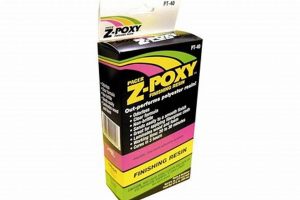
A durable, synthetic coating often applied to wood, metal, and other surfaces to provide protection and enhance appearance. This type of coating is known for its resistance to abrasion, chemicals, and moisture. An example includes its application on hardwood floors to shield them from daily wear and tear.
Its significance lies in its ability to prolong the lifespan of treated materials while minimizing maintenance requirements. The benefits include a tough, long-lasting barrier against damage, and it can come in various sheen levels, from matte to high gloss, providing aesthetic versatility. Historically, similar coatings have been used for centuries, but advancements in synthetic chemistry have led to the creation of products with superior performance characteristics.
The following sections will delve into the specific properties of this protective layer, examine the different types available, detail the application process, and address potential challenges and solutions associated with its use.
Application & Maintenance Tips
Achieving optimal results requires careful surface preparation and adherence to application guidelines. Proper maintenance ensures its longevity and continued protection.
Tip 1: Surface Preparation is Paramount: Ensure the substrate is clean, dry, and free from contaminants. Sanding may be required to create a suitable profile for adhesion. Inadequate preparation diminishes the coatings ability to bond effectively, potentially leading to premature failure.
Tip 2: Apply Thin, Even Coats: Multiple thin coats are preferable to a single thick coat. This minimizes the risk of runs, sags, and bubbles. Each coat should be allowed to dry completely before applying the subsequent layer.
Tip 3: Control Environmental Conditions: Temperature and humidity levels significantly impact drying time and finish quality. Avoid application in extreme conditions; ideal conditions are typically between 65-75F (18-24C) with moderate humidity.
Tip 4: Use Appropriate Application Tools: The selection of brushes, rollers, or spray equipment should be based on the type being used and the desired finish. High-quality brushes and rollers minimize imperfections and ensure a uniform application.
Tip 5: Sand Between Coats (if Required): Lightly sanding between coats can improve adhesion and create a smoother final surface. Use fine-grit sandpaper and ensure thorough dust removal before applying the next coat.
Tip 6: Allow Adequate Drying and Curing Time: Follow the manufacturer’s recommendations for drying and curing times. Rushing this process can compromise the coating’s integrity and durability. Full curing typically requires several days or even weeks.
Tip 7: Regular Cleaning and Maintenance: Routine cleaning with mild soap and water helps to maintain its appearance and prevent the buildup of dirt and grime. Avoid harsh chemicals and abrasive cleaners, which can damage the surface.
By following these tips, you can maximize its protective qualities, ensuring lasting beauty and resilience for the treated surface.
The concluding section will summarize the key aspects discussed and offer a final perspective on its utility in various applications.
1. Durability

Durability represents a critical performance characteristic when considering coatings. It dictates the lifespan and resistance to degradation under various environmental and mechanical stresses. The inherent level of durability dictates its suitability for a multitude of applications.
- Abrasion Resistance
Abrasion resistance directly impacts its long-term aesthetic and protective function. As surfaces undergo wear and tear, such as foot traffic on a wood floor, this coating must withstand the forces without scratching or wearing away. This maintains both visual appeal and the initial protective barrier.
- Impact Resistance
Impact resistance describes the capacity to absorb sudden force without cracking or chipping. A kitchen countertop treated with this material should withstand accidental impacts from dropped objects, maintaining its integrity and preventing damage to the underlying substrate.
- Chemical Resistance
Exposure to various chemicals, from household cleaners to industrial solvents, can degrade a coating over time. A durable substance maintains its integrity upon contact with these substances, preventing staining, softening, or dissolution, ensuring long-term protection. For example, laboratory surfaces and industrial worktops.
- UV Stability
Prolonged exposure to ultraviolet radiation can cause fading, discoloration, and even structural degradation in some coatings. UV stability is paramount for exterior applications, ensuring the coating maintains its color and protective qualities under constant sunlight. This applies to outdoor furniture and marine applications.
The durability conferred by these coatings is not merely a matter of aesthetics. It directly translates to reduced maintenance costs, extended service life of coated items, and sustained protection of valuable assets. It stands as a key differentiator in the coating selection process, informing decisions based on application-specific demands and environmental factors.
2. Abrasion Resistance

Abrasion resistance stands as a critical performance attribute that directly influences the suitability of coatings across diverse applications. In the context of materials finishing, this characteristic determines the coating’s ability to withstand mechanical wear, friction, and erosion, ensuring long-term surface protection and aesthetic appeal. Its connection to durability establishes the coatings overall lifespan, dictating its ability to perform.
- The Role of Polymer Structure
The inherent polymer structure of a determines the magnitude of its abrasion resistance. Cross-linked polymers typically exhibit superior resistance compared to linear polymers, because the interconnected network provides enhanced structural integrity. For example, formulations employing aliphatic isocyanates generally provide better exterior durability. The composition and structure of the polymer directly influence its capacity to withstand abrasive forces.
- Surface Hardness and Coating Thickness
Surface hardness correlates with its resistance to scratching and indentation. Thicker coatings, within optimal limits, often provide enhanced abrasion protection by increasing the material volume that must be eroded before substrate damage occurs. The measurement of film thickness using a precise instrument determines how well that finish will perform in the future. The thickness and hardness of the finished product works as a team to ensure durability.
- Additives and Fillers
The incorporation of specific additives and fillers can significantly enhance its abrasion resistance. For example, adding ceramic microspheres can increase the coating’s hardness and resistance to wear. Similarly, the inclusion of UV absorbers helps to protect the coating from degradation caused by sunlight, maintaining its structural integrity and preventing premature failure. The chemical makeup directly impacts how the finish handles long term wear and tear.
- Application Techniques
Proper application techniques play a crucial role in maximizing abrasion resistance. Achieving a uniform film thickness, avoiding air entrapment, and ensuring adequate curing are essential for optimizing the coating’s protective qualities. Improper application can lead to weak spots, increased vulnerability to abrasion, and reduced overall lifespan. Expert application is essential to ensure durability.
The interplay between polymer structure, surface hardness, additives, and application techniques collectively determines the abrasion resistance . This performance aspect dictates the coating’s ability to protect substrates from wear and tear, thereby ensuring long-term durability and maintaining aesthetic integrity in diverse applications.
3. Moisture Barrier

Coatings frequently serve as a crucial moisture barrier, protecting underlying substrates from water damage. This characteristic is particularly important in applications where exposure to humidity, spills, or direct water contact is expected. The composition inherently provides a resistance to water permeation, preventing moisture from reaching vulnerable materials like wood or metal.
The effectiveness as a moisture barrier stems from its hydrophobic properties and film-forming characteristics. When properly applied, the coating creates a continuous, non-porous layer that inhibits water absorption. For instance, wood floors coated with this finish are shielded from everyday spills and humidity fluctuations, preventing warping, swelling, and rot. In marine applications, they can protect metal components from corrosion caused by saltwater exposure. Conversely, a poorly applied coating, or one with imperfections, may allow moisture penetration, negating its protective benefits. For example, inadequate edge sealing on wood furniture allows moisture entry, leading to swelling and finish delamination.
In conclusion, the moisture barrier properties of such coatings are vital for preserving the integrity and longevity of various materials. Understanding the relationship between application techniques, coating formulation, and environmental conditions is essential for maximizing its effectiveness as a moisture barrier and ensuring durable protection in diverse settings. Selecting a appropriate topcoat or using proper sealants could also play a factor into long term durability.
4. Chemical Resistance
Chemical resistance is a critical attribute of coatings, dictating its ability to withstand degradation upon exposure to various substances. For finishes, this characteristic determines its suitability for applications where contact with solvents, acids, alkalis, or other aggressive chemicals is anticipated. The integrity of the coating directly correlates with the protection it provides to the underlying substrate. For example, the application of this on laboratory countertops necessitates robust resistance to spills and reagents to maintain a sterile and functional workspace. Failure to resist chemical attack results in surface damage, compromising both aesthetic appeal and protective function.
The chemical resistance of a coating is influenced by its formulation, particularly the crosslinking density and the types of resins used. Highly crosslinked polymer networks generally offer superior resistance, forming a tighter barrier against chemical permeation. Epoxies and catalyzed materials are frequently incorporated into to enhance their resistance to specific chemicals. For instance, in industrial flooring applications, coatings are formulated to withstand exposure to hydraulic fluids, lubricating oils, and cleaning agents, ensuring long-term performance in harsh environments. The specific chemical environment dictates the selection of an appropriate coating to ensure compatibility and prevent premature failure.
In summary, chemical resistance is an essential consideration in the selection and application . Its ability to withstand chemical attack dictates its longevity and protective capabilities in diverse settings. Formulations must be carefully tailored to the anticipated exposure conditions, and quality control measures are necessary to ensure consistent performance. By understanding the interplay between chemical resistance, formulation, and application, we maximize the potential to create durable, long-lasting coatings suitable for a wide array of applications.
5. UV Protection

Ultraviolet (UV) radiation poses a significant threat to coatings, causing degradation, discoloration, and reduced performance. The inclusion of UV protection within coatings, particularly those containing polymeric structures, is therefore critical for exterior applications and items exposed to sunlight. Without adequate UV protection, the polymer chains can break down, leading to a brittle or chalky surface, a loss of gloss, and ultimately, failure of the coating. The significance of UV protection cannot be overstated when considering the long-term durability and aesthetic appeal of these finished surfaces.
Certain formulations incorporate UV absorbers or stabilizers to mitigate the damaging effects of UV radiation. These additives function by absorbing the harmful UV rays and converting them into less harmful forms of energy, or by scavenging free radicals generated by UV exposure. For example, marine applications such as boat hulls require to maintain their appearance and protective qualities against constant sun exposure. Coatings lacking these additives will experience premature degradation, requiring more frequent maintenance or replacement. Exterior wood finishes benefit significantly from UV protection, preventing graying and cracking caused by sunlight.
In conclusion, UV protection is an indispensable component of coatings intended for outdoor use. By incorporating UV absorbers and stabilizers, these finishes can maintain their appearance, structural integrity, and protective function under prolonged exposure to sunlight. The practical significance of understanding this lies in selecting the appropriate type for specific applications, thereby maximizing longevity and minimizing maintenance costs. Failure to address UV degradation risks compromising the performance and value of the coated item.
6. Application Methods
The method of application significantly influences the performance and appearance of coatings. Selecting the appropriate technique is critical to achieving optimal results, ensuring proper adhesion, film thickness, and a uniform finish.
- Spraying
Spraying, utilizing equipment such as airless or HVLP (High Volume Low Pressure) sprayers, allows for the application of a thin, even coat over large or intricate surfaces. This method minimizes brush marks and provides a professional-looking finish. For instance, spraying is commonly used to apply to furniture and automotive parts, achieving a smooth, consistent layer.
- Brushing
Brushing is a traditional application method suitable for smaller projects or areas where precision is required. The choice of brush (natural or synthetic) depends on the type being applied. Brushing is often used for trim work and smaller woodworking projects, allowing for controlled application and detailed work.
- Rolling
Rolling is effective for applying to flat surfaces, such as floors or doors. The use of different roller covers (foam, microfiber, etc.) affects the texture and thickness of the coating. Rolling provides a cost-effective way to cover large areas quickly, ensuring a consistent film build.
- Dipping
Dipping involves submerging an object into a tank of finish, ensuring complete coverage. This method is often used for smaller parts or components that require a uniform coating on all surfaces. Dipping is suitable for high-volume production, providing efficient and consistent coverage.
The selection of an application method depends on factors such as the size and shape of the object, the desired finish quality, and the equipment available. Proper surface preparation, environmental conditions, and the skill of the applicator also contribute to the overall success of the application process. Choosing the appropriate technique is crucial for maximizing the benefits of coatings, including durability, aesthetics, and protection.
7. Sheen Options

Sheen options, ranging from matte to high gloss, represent a critical aesthetic and functional component of coatings. The choice of sheen significantly impacts the appearance of a finished surface and its resistance to wear and tear. Lower sheen coatings, such as matte or satin, diffuse light, minimizing the visibility of imperfections and offering a softer, more subdued look. Conversely, higher sheen coatings, like gloss or semi-gloss, reflect light, enhancing vibrancy and providing a polished, reflective surface. For instance, matte formulations are often selected for residential flooring to conceal scratches and reduce glare, while high-gloss finishes are utilized in commercial settings where durability and ease of cleaning are paramount.
The selection of a particular sheen level also influences its maintenance requirements. High-gloss coatings, while visually appealing, tend to reveal fingerprints, smudges, and other surface imperfections more readily than lower-sheen alternatives. Therefore, higher-sheen surfaces often necessitate more frequent cleaning to maintain their desired appearance. This practical consideration is particularly relevant in high-traffic areas. Furthermore, the application process can be affected by sheen choice; certain application techniques are better suited to achieving specific levels of gloss. For example, spraying generally provides a smoother, more consistent finish for high-gloss applications than brushing.
In conclusion, sheen options are an integral aspect of , allowing for customization to meet both aesthetic and functional requirements. The interplay between appearance, durability, maintenance, and application techniques dictates the selection of a specific sheen level. Understanding the characteristics and implications of each sheen option is essential for achieving the desired results and maximizing the long-term performance of surfaces coated with this material.
Frequently Asked Questions About Finishes
The following questions address common concerns and misconceptions regarding this type of coating, offering clarity and insight for informed decision-making.
Question 1: Is finish suitable for outdoor use?
Certain formulations are designed for exterior applications, containing UV absorbers and stabilizers to resist degradation from sunlight. However, interior-grade finishes will degrade more rapidly when exposed to UV radiation.
Question 2: How does affect the color of wood?
Some finishes impart a subtle amber tone to wood, while others remain clear. Water-based typically offer a clearer finish compared to oil-based formulations. Always test in an inconspicuous area.
Question 3: What is the difference between water-based and oil-based ?
Water-based options are low in VOCs, dry quickly, and offer excellent clarity. Oil-based ones provide a more durable finish, amber hue, and longer drying times.
Question 4: Can be applied over existing finishes?
Yes, provided the existing finish is properly prepared (cleaned, sanded, and compatible). However, testing for adhesion is crucial to prevent peeling or delamination.
Question 5: How long does take to fully cure?
Full curing typically takes several days to weeks, depending on the specific formulation, ambient temperature, and humidity levels. Refer to the manufacturer’s instructions for precise curing times.
Question 6: What maintenance is required for surfaces finished with ?
Regular cleaning with mild soap and water is typically sufficient. Avoid harsh chemicals, abrasive cleaners, and excessive moisture. Re-coating may be necessary after several years of wear.
In summary, careful consideration of the application, environmental conditions, and type are essential for achieving optimal results and ensuring the long-term performance. Failure to properly choose these options could result in damage to the project in the future.
The concluding section will offer a comprehensive overview of the applications and considerations. Make sure to read thoroughly.
Conclusion
This exploration has underscored the versatile properties of the keyword term, from its inherent durability and chemical resistance to the nuanced selection of sheen and application methods. A comprehensive understanding of these facets is paramount for achieving optimal performance and longevity. The information presented herein serves as a foundation for informed decision-making, enabling the selection and application that align with specific performance requirements and aesthetic goals.
The sustained effectiveness of coated surfaces hinges upon informed selection and diligent maintenance practices. Further research and adherence to manufacturer guidelines remain critical for maximizing the benefits. The future of this protective layer lies in continued innovation and adaptation to evolving needs, ensuring its enduring relevance across diverse industries and applications. Proper execution will ensure durability long term.