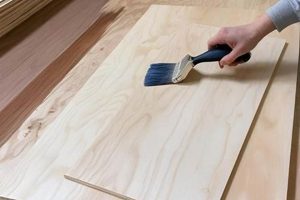
A coating cured by ultraviolet radiation provides a durable and often glossy surface. This process rapidly hardens specially formulated liquids when exposed to specific wavelengths of ultraviolet light. As an example, furniture manufacturers might apply it to tabletops to enhance scratch resistance.
The application of this method offers several advantages, including increased resistance to abrasion, chemicals, and moisture. Furthermore, the rapid curing time improves production efficiency and reduces volatile organic compound (VOC) emissions compared to traditional methods. Its use has grown substantially due to increased demand for durable and environmentally conscious products.
The subsequent sections will delve into specific applications, various types available, application techniques, and considerations for selecting the optimal option for particular needs. A detailed discussion of safety measures and environmental impact is also included.
Guidance on Implementation
The following recommendations are intended to optimize the results and longevity of surfaces treated with this method. Proper application and maintenance are crucial for achieving desired outcomes.
Tip 1: Substrate Preparation: Prior to application, ensure the substrate is clean, dry, and free of contaminants. Inadequate preparation can lead to adhesion failures and compromised performance.
Tip 2: Application Thickness Control: Adhere to manufacturer-recommended application thicknesses. Excessive thickness can result in incomplete curing and surface defects, while insufficient thickness may compromise durability.
Tip 3: Wavelength Matching: Verify that the UV curing equipment emits the appropriate wavelength for the coating being used. Incorrect wavelength exposure can lead to improper cross-linking and reduced effectiveness.
Tip 4: Controlled Exposure Time: Maintain consistent exposure times during the curing process. Insufficient exposure will result in a soft, uncured surface, while excessive exposure can cause discoloration or embrittlement.
Tip 5: Environmental Considerations: Control the ambient temperature and humidity during application and curing. Extreme environmental conditions can negatively impact the curing process and the final finish.
Tip 6: Proper Equipment Maintenance: Regularly inspect and maintain UV curing equipment to ensure consistent and reliable performance. Malfunctioning equipment can lead to inconsistent curing and substandard results.
Tip 7: Protective Measures: Implement appropriate safety protocols, including eye and skin protection, when working with UV curing equipment and coatings. Prolonged exposure to UV radiation can be harmful.
Adhering to these guidelines promotes the successful utilization of this specialized surface treatment, resulting in enhanced product performance and longevity.
The subsequent section provides a detailed analysis of the environmental considerations associated with this technology, including potential benefits and mitigation strategies.
1. Durability

Ultraviolet-cured coatings exhibit enhanced durability primarily due to the rapid cross-linking of polymers during the curing process. This process creates a dense, highly interconnected network that resists scratching, abrasion, and chemical attack. The causative link is the intense energy from UV radiation that initiates polymerization, leading to superior hardness compared to air-dried or heat-cured finishes. For instance, hardwood flooring treated with this method demonstrates significantly improved resistance to wear from foot traffic, pet claws, and dropped objects.
The durability afforded is an essential component in various industrial applications. In the automotive industry, components coated with it withstand prolonged exposure to environmental elements such as UV radiation from sunlight, acid rain, and road salts. The practical significance lies in extending the lifespan of products and reducing the need for frequent replacement or refinishing, contributing to cost savings and resource conservation. Furthermore, in the manufacturing of consumer electronics, its application safeguards device screens from everyday wear and tear, maintaining their aesthetic appeal and functionality over time.
In summation, the durability afforded by ultraviolet-cured finishes stems directly from the robust polymer network created during the curing process. This characteristic is crucial for applications demanding resistance to physical and chemical stresses, providing a tangible benefit in terms of product longevity and reduced maintenance. While formulation challenges exist in balancing hardness with flexibility to prevent cracking, the overall advantages for durability make it a valuable option across a spectrum of industries.
2. Adhesion

Adhesion is a critical factor influencing the long-term performance of ultraviolet-cured (UV) coatings. It refers to the ability of the coating to bond securely to the substrate. Insufficient adhesion results in premature failure, manifesting as peeling, blistering, or delamination. The effectiveness of this bond hinges upon several elements, including surface preparation of the substrate, the chemical compatibility between the coating and substrate, and the precise application parameters of the UV curing process. For instance, applying this finish to improperly cleaned metal surfaces frequently leads to compromised adhesion, as residual oils or contaminants impede the formation of strong interfacial bonds.
Surface pretreatments such as chemical etching or plasma cleaning play a vital role in enhancing adhesion by increasing the surface energy of the substrate and promoting mechanical interlocking. Selecting the appropriate coating formulation, containing functional groups that can chemically react with the substrate, is similarly essential. Furthermore, controlling the application thickness and UV curing parameters, such as intensity and duration, ensures complete cross-linking and optimal interfacial bonding. In the wood finishing industry, the selection of UV coatings with specific adhesion promoters allows for direct application onto various wood species, minimizing the need for extensive sanding or priming. The success of this coating hinges on the ability to create a strong, lasting bond with the wood fibers.
In summary, achieving robust adhesion in UV coatings requires careful consideration of substrate preparation, coating chemistry, and curing process control. Deficiencies in any of these areas can compromise the integrity and durability of the resulting finish. Further investigation into advanced adhesion-promoting techniques and novel coating formulations remains crucial for expanding the application range and improving the reliability in demanding environments. The integration of these elements forms the cornerstone of successful implementation.
3. Gloss Level

Gloss level, a measure of a surface’s ability to reflect light specularly, is a critical characteristic directly influenced by the nature of the ultraviolet (UV) finish applied. The smoothness of the cured surface, achieved through precise formulation and application techniques, dictates the degree of reflectivity. Higher gloss levels denote a smoother, more mirror-like surface, while lower gloss levels indicate a more diffuse reflection. Manufacturers employ specialized UV coatings to attain a specific gloss level tailored to the products aesthetic and functional requirements. For instance, high-end furniture often utilizes a high-gloss finish to accentuate the wood grain and impart a luxurious appearance, while instrument panels in automobiles might employ a low-gloss finish to minimize glare and improve visibility.
Achieving the desired gloss level necessitates careful control over several variables during the UV curing process. These factors include the coating’s viscosity, surface tension, and leveling characteristics, as well as the intensity and wavelength of the UV radiation employed. An uneven or insufficiently cured surface will exhibit a lower gloss level due to light scattering from microscopic imperfections. Furthermore, the presence of additives, such as matting agents, intentionally reduces gloss by creating surface roughness at a microscopic scale. In the printing industry, it is common to use a high gloss to highlight images and text in brochures or catalogs. Conversely, point-of-sale signage may be treated with a matte option to prevent excessive glare in brightly lit retail environments.
The selection of the appropriate gloss level is essential for both aesthetic and functional reasons. A properly chosen gloss level enhances the visual appeal of the product and contributes to its overall performance. Understanding the relationship between the UV finish, the curing process, and the resulting gloss level is crucial for manufacturers seeking to optimize their products’ quality and marketability. Continual advancements in UV coating technology are providing greater control over gloss levels, expanding design possibilities and improving product performance across diverse applications.
4. Curing Speed

The curing speed of a ultraviolet (UV) finish represents a fundamental advantage over traditional coating methods. It refers to the time required for the liquid coating to transform into a hardened, durable film upon exposure to UV radiation. This rapid transformation, often occurring within seconds, directly contributes to increased production efficiency and reduced processing times. The underlying mechanism involves the initiation of polymerization by UV light, which rapidly cross-links the coating’s monomers and oligomers, creating a solid, robust network. For example, in the high-volume manufacturing of smartphone cases, a fast curing speed allows for continuous processing, where cases move along a conveyor belt, receive the UV coating, pass under a UV lamp, and emerge fully cured in a matter of seconds.
The practical significance of rapid curing extends beyond simple time savings. It minimizes the potential for dust or other contaminants to settle on the surface during the drying process, resulting in a higher-quality finish with fewer defects. Furthermore, the accelerated throughput enabled by the rapid curing speed translates to lower energy consumption compared to thermal curing methods, as less heat is required. This aspect aligns with environmentally conscious manufacturing practices. Within the automotive industry, the implementation of it in the coating of interior components enables just-in-time production, reducing inventory holding costs and minimizing lead times for vehicle assembly. The efficacy of the curing process greatly determines the quality of the end product.
In conclusion, the curing speed of a UV finish is an inherent and vital component that contributes directly to its efficiency and performance benefits. Its fast-curing nature facilitates increased production speed, reduces energy consumption, minimizes defects, and supports leaner manufacturing processes. While formulation adjustments may be necessary to optimize the balance between curing speed and other coating properties, the overall advantages associated with rapid curing position this finish as a superior alternative in many industrial applications. Any deficiencies in the curing process are directly reflected in the quality and lifespan of the end product.
5. Chemical Resistance

Chemical resistance, a paramount attribute of surface coatings, directly influences the longevity and applicability of ultraviolet (UV) finishes across diverse industries. The ability of a UV-cured coating to withstand exposure to various chemicals without degradation is critical for maintaining its protective and aesthetic properties.
- Cross-linking Density and Permeability
The degree of cross-linking within the UV-cured polymer network directly impacts its chemical resistance. Higher cross-linking density reduces permeability, limiting the diffusion of chemical substances into the coating matrix. For instance, a UV finish with a high cross-link density exhibits superior resistance to solvents like acetone or toluene, commonly used in industrial cleaning processes. Conversely, a coating with lower cross-link density is more susceptible to swelling, softening, or dissolution upon chemical exposure.
- Chemical Nature of the Coating
The specific chemical composition of the UV coating plays a critical role in determining its compatibility with different chemical environments. Certain polymers exhibit inherent resistance to acids, while others are more resistant to bases. For example, fluoropolymers offer exceptional resistance to a broad range of aggressive chemicals due to the strong carbon-fluorine bonds within their structure. The selection of the appropriate UV coating chemistry is, therefore, crucial for applications involving exposure to specific chemical substances, such as in laboratory equipment or chemical storage tanks.
- Exposure Time and Concentration
The duration and concentration of chemical exposure are critical determinants of coating performance. Even inherently resistant UV finishes can exhibit degradation over extended exposure to highly concentrated chemicals. Short-term exposure to dilute cleaning agents may have minimal impact, while prolonged contact with concentrated acids or bases can lead to irreversible damage. Accelerated aging tests, involving prolonged chemical immersion or vapor exposure, are typically employed to evaluate the long-term chemical resistance of UV finishes under simulated service conditions.
- Surface Defects and Imperfections
The presence of surface defects, such as pinholes or micro-cracks, can significantly compromise the chemical resistance of ultraviolet (UV) coatings. These imperfections act as pathways for chemical penetration, accelerating degradation and undermining the overall protective barrier. Manufacturing and application processes must therefore be strictly controlled to minimize surface defects and ensure a continuous, impervious finish. Quality control measures, including microscopic inspection and non-destructive testing, are essential for identifying and rectifying surface imperfections that could impair chemical resistance.
In summary, the chemical resistance of ultraviolet (UV) finishes is a multifaceted characteristic, influenced by cross-linking density, chemical composition, exposure parameters, and surface integrity. Understanding and controlling these factors are critical for selecting the optimal coating for specific applications and ensuring long-term performance in chemically demanding environments. Continuous research and development efforts are focused on formulating novel UV coatings with enhanced chemical resistance to meet the ever-increasing demands of modern industrial processes.
6. Scratch Resistance

Scratch resistance is a crucial property imparted by ultraviolet (UV) finishes, significantly enhancing the durability and aesthetic appeal of coated products. The application of a UV finish creates a hard, cross-linked surface layer that resists abrasion and minor surface damage. This resistance stems from the rapid polymerization process induced by UV radiation, which forms a dense, interconnected network of polymer chains. The direct effect is a surface more resilient to everyday wear and tear. For instance, furniture treated with this process maintains its appearance longer by resisting scratches from keys, utensils, and other common household objects. This characteristic is particularly vital in high-traffic areas and for items subject to frequent handling.
The importance of scratch resistance extends to various industrial applications. Automotive clear coats benefit significantly, maintaining a glossy appearance despite exposure to road debris and automated car washes. Similarly, electronic devices, such as smartphones and tablets, utilize this specialized coating to protect screens from scratches caused by contact with rough surfaces or abrasive particles. In each case, the scratch-resistant properties of the UV finish preserve the product’s aesthetic value and prolong its lifespan, reducing the need for frequent replacements or repairs. The practical benefit is improved customer satisfaction and reduced warranty claims for manufacturers.
In summary, scratch resistance is a key attribute of UV finishes, contributing significantly to the enhanced durability and longevity of various products. The improved surface hardness achieved through UV curing provides tangible benefits across industries, from furniture to electronics, by minimizing surface damage and maintaining aesthetic appeal. Ongoing advancements in UV coating technology are continuously improving scratch resistance, further solidifying its importance in modern manufacturing processes. The challenge lies in balancing scratch resistance with other desirable properties, such as flexibility and chemical resistance, to optimize overall coating performance.
7. Environmental Impact

The environmental impact associated with ultraviolet (UV) finishes presents a complex balance of advantages and disadvantages compared to traditional coating methods. On one hand, UV-curable coatings often contain significantly lower levels of volatile organic compounds (VOCs). The elimination or reduction of VOCs is a crucial factor in mitigating air pollution and improving worker safety, especially in enclosed manufacturing environments. The reduction in VOC emissions stems from the nature of the UV curing process, which relies on photochemical reactions rather than solvent evaporation for hardening. For example, furniture manufacturers transitioning from solvent-based lacquers to water-based UV coatings have observed substantial decreases in their overall VOC emissions, contributing to compliance with stringent environmental regulations. However, the production and disposal of UV curing equipment, including lamps and related components, also carries its own environmental footprint that must be taken into consideration.
Conversely, the UV curing process necessitates the use of specialized equipment and chemicals, which themselves have environmental implications. UV lamps, while energy-efficient compared to thermal curing ovens, require careful disposal to prevent mercury contamination. Moreover, the raw materials used in UV-curable formulations, such as photoinitiators and reactive monomers, can pose environmental risks if not handled and disposed of responsibly. Recycling and waste management programs designed for UV coatings can reduce the environmental burden. A real-world example involves the development of bio-based UV coatings derived from renewable resources, such as plant oils and sugars. These coatings offer a lower carbon footprint and reduced reliance on petroleum-based raw materials.
In summary, the environmental impact of ultraviolet (UV) finishes is a nuanced issue that requires careful assessment and management. While they offer clear advantages in terms of reduced VOC emissions, the production, use, and disposal of UV curing equipment and materials must be addressed to minimize potential environmental harm. Future advancements in UV coating technology, including the development of bio-based formulations and improved waste management strategies, are crucial for further reducing the environmental footprint and promoting sustainable manufacturing practices. Comprehensive lifecycle assessments provide a holistic view of the environmental consequences, from raw material extraction to end-of-life disposal, thereby informing responsible decision-making.
Frequently Asked Questions About UV Finish
The following questions address common concerns and misconceptions surrounding surfaces cured using ultraviolet (UV) light. These answers provide clarity on the characteristics, applications, and limitations.
Question 1: How does a UV finish differ from traditional lacquer or varnish?
Ultraviolet (UV) finishes differ significantly from traditional lacquers and varnishes in their curing mechanism. Traditional coatings dry through solvent evaporation or chemical reactions with atmospheric oxygen, a process that can take hours or even days. It cures rapidly upon exposure to ultraviolet (UV) radiation, solidifying in seconds. This rapid curing minimizes dust contamination, lowers volatile organic compound (VOC) emissions, and produces a more durable finish.
Question 2: What types of materials can receive a UV finish?
It is applicable to a wide range of materials, including wood, metal, plastic, and paper. The suitability of a material depends on its ability to withstand the curing process and its compatibility with the coating formulation. Careful consideration should be given to the substrate’s porosity, surface energy, and thermal stability.
Question 3: Are surfaces finished with UV light more resistant to scratches and chemicals?
Surfaces treated with this method generally exhibit enhanced resistance to scratches and chemicals due to the high degree of cross-linking achieved during curing. The resulting dense polymer network creates a durable barrier that protects the underlying substrate. However, the specific level of resistance depends on the formulation of the coating and the nature of the chemical or abrasive agent.
Question 4: What safety precautions are necessary when working with UV curing equipment?
Working with ultraviolet (UV) curing equipment necessitates adherence to strict safety protocols. Direct exposure to UV radiation can cause skin and eye damage. Protective eyewear and clothing are essential to mitigate these risks. Additionally, adequate ventilation is necessary to minimize inhalation of any vapors released during the curing process.
Question 5: Is it environmentally friendly?
The environmental impact of it is multifaceted. While it often contains lower volatile organic compound (VOC) levels compared to traditional coatings, the production and disposal of UV curing equipment and materials raise environmental concerns. Responsible manufacturing practices, including the use of renewable resources and proper waste management, can help minimize the environmental footprint.
Question 6: How can I maintain a UV finish to ensure its longevity?
Maintaining the appearance and durability requires regular cleaning with mild, non-abrasive cleaners. Avoid prolonged exposure to harsh chemicals or extreme temperatures. Periodic inspections for scratches or other damage are recommended, and repairs should be performed promptly to prevent further deterioration. Application of a protective wax or polish can enhance the finish’s resistance to wear and tear.
In summary, this coating represents a versatile finishing solution characterized by rapid curing, enhanced durability, and reduced environmental impact compared to traditional methods. Proper understanding of its properties, applications, and maintenance requirements is critical for maximizing its benefits.
The subsequent section details the different types of UV finish and their specific applications.
Conclusion
This examination of the properties, applications, and considerations surrounding uv finish reveals its significance as a modern surface treatment technology. Key points established include its superior durability and its role in environmentally conscious manufacturing, as well as the potential challenges associated with the process. This detailed exploration highlights the importance of informed decision-making when selecting coating solutions for various applications.
Moving forward, continued research and development in UV-curable materials and processes will be crucial. These advancements promise to further minimize environmental impact while maximizing performance across a broad spectrum of industrial and consumer goods. The implementation of this technology presents a pathway toward enhanced product quality and sustainability, but its successful integration depends on a comprehensive understanding of its capabilities and limitations.