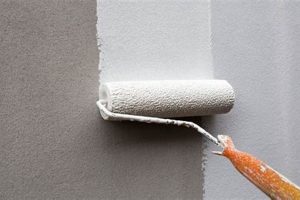
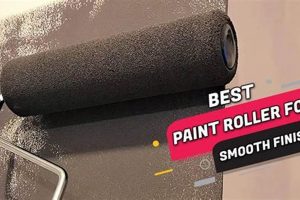
A coating that adds both color and tactile dimension to surfaces, creating visual interest through varied patterns. This application provides a durable and aesthetically pleasing alternative to smooth, uniformly colored walls. Consider, for instance, the transformation of a plain interior space into one with depth and character achieved by its implementation.
The use of such a coating enhances the visual appeal of a room while offering practical advantages. Imperfections on underlying surfaces are effectively concealed, reducing the need for extensive preparation. Historically, variations of this technique have been employed to mimic more expensive materials or add architectural detail where none existed. Its lasting popularity stems from its combination of decorative effect and functional utility.
The following sections will delve into the various types available, the application methods best suited for achieving different results, and the considerations necessary for selecting the ideal product for specific project needs. Furthermore, we will explore the maintenance requirements and potential challenges associated with its use.
Application Guidance
Achieving optimal results requires careful attention to detail and adherence to recommended practices. The following guidelines ensure a professional and long-lasting outcome.
Tip 1: Surface Preparation is Paramount. Ensure the surface is clean, dry, and free of loose debris. Repair any imperfections before application to prevent them from being accentuated by the texture.
Tip 2: Priming Enhances Adhesion. A suitable primer, selected based on the substrate material, promotes optimal bonding and uniformity in the final appearance. Failure to prime may result in uneven coverage or premature peeling.
Tip 3: Consistent Mixing is Crucial. Thoroughly mix the product before and during application. This ensures even distribution of the texturing agents and prevents inconsistencies in the final finish.
Tip 4: Application Technique Impacts Texture. Experiment with different rollers, brushes, or spray equipment to achieve the desired texture. Practice on a sample area to determine the optimal method.
Tip 5: Maintain Wet Edge to Prevent Lapping. When applying, work in small, manageable sections and maintain a wet edge to avoid visible seams or overlap marks. This technique ensures a seamless appearance.
Tip 6: Consider Environmental Conditions. Avoid application in extreme temperatures or high humidity, as these conditions can affect drying time and adhesion. Follow the manufacturer’s recommendations regarding suitable environmental parameters.
Tip 7: Allow Adequate Drying Time. Ensure the product is completely dry before applying subsequent coats or exposing the surface to traffic. Insufficient drying can compromise the integrity of the finish.
Following these guidelines contributes significantly to a successful application, yielding a durable, aesthetically pleasing surface. Careful planning and execution are essential for achieving the desired result.
The subsequent sections will address specific application techniques and maintenance considerations in greater detail.
1. Aesthetic Appeal
The visual characteristics imparted by surface treatments are integral to the overall ambiance of an interior or exterior space. The selection of a “white textured paint finish” directly influences the perceived style, depth, and character of the environment.
- Light Reflectance and Diffusion
The interplay of light and texture significantly alters the perceived brightness and spatial dimensions of a room. A surface with a coarse texture diffuses light more effectively than a smooth surface, minimizing glare and creating a softer, more inviting atmosphere. The specific degree of light reflectance is determined by the chosen texture and the inherent properties of the white pigment employed in the coating.
- Depth and Dimensionality
Textured finishes introduce visual depth, transforming flat surfaces into dynamic planes. This three-dimensional effect enhances architectural details and can compensate for the lack of inherent character in minimalist designs. The amplitude and frequency of the texture dictate the level of perceived depth; higher amplitude textures create bolder visual statements, while finer textures offer subtle enhancements.
- Style and Period Authenticity
The selection of a specific texture can evoke stylistic associations with particular historical periods or design movements. For instance, stucco textures often suggest Mediterranean or Southwestern influences, while orange-peel textures are commonly found in mid-century modern homes. Choosing a texture that complements the architectural style and intended aesthetic of the space is crucial for achieving a cohesive design.
- Subtlety and Visual Interest
While color is a primary element of visual design, texture adds a layer of complexity that can elevate a simple color palette. A “white textured paint finish” offers a nuanced alternative to plain white walls, providing visual interest without overwhelming the space. The subtle variations in light and shadow created by the texture engage the eye and prevent the surface from appearing flat or monotonous.
These facets collectively contribute to the aesthetic impact of a “white textured paint finish.” The choice of texture must be carefully considered in relation to the desired style, lighting conditions, and overall design goals. Successful integration of these elements results in a visually appealing and harmonious environment.
2. Surface Imperfection Masking

The ability of a “white textured paint finish” to conceal underlying flaws represents a significant advantage in various applications. This characteristic reduces the need for extensive surface preparation, thereby saving time and resources. Its effectiveness stems from the interplay of light and shadow created by the texture itself.
- Texture Depth and Shadow Creation
Deeper textures, characterized by pronounced variations in surface height, cast more noticeable shadows. These shadows effectively distract the eye from minor imperfections such as hairline cracks, nail holes, or uneven patches. In contrast, smoother surfaces accentuate even the smallest flaws, requiring meticulous preparation to achieve a uniform appearance. For instance, a heavily textured stucco finish can completely obscure minor surface irregularities that would be readily visible under a smooth coat of paint.
- Light Diffusion and Softening
Textured surfaces diffuse light more effectively than smooth surfaces. This diffusion softens harsh reflections and minimizes the visibility of imperfections. The uneven surface scatters light in multiple directions, reducing the contrast between the flaw and the surrounding area. Imagine a wall with slight undulations; a smooth paint reflects light directly, highlighting each bump and valley. Conversely, a textured finish scatters the light, making the undulations less noticeable.
- Visual Diversion and Pattern Complexity
Intricate textures draw the eye away from localized imperfections by creating a visually stimulating pattern. The complexity of the texture serves as a form of camouflage, diverting attention from minor flaws that might otherwise be conspicuous. Consider a wall with a trowel-applied texture; the irregular patterns and swirls naturally obscure small imperfections within the surface.
- Cost and Time Efficiency
The masking capabilities of “white textured paint finish” translate directly into cost and time savings. By minimizing the need for extensive filling, sanding, and patching, the overall project duration and labor expenses are significantly reduced. In situations where perfect surface preparation is impractical or cost-prohibitive, a textured finish offers a viable and aesthetically pleasing alternative.
The facets discussed highlight the practical benefits of employing a “white textured paint finish” in situations where surface imperfections are a concern. By leveraging the properties of texture to diffuse light, create shadows, and divert attention, a more forgiving and efficient solution is achieved, resulting in both aesthetic improvements and reduced project costs.
3. Application Complexity

The process of applying a “white textured paint finish” involves a range of techniques and considerations that directly influence the success and overall quality of the final result. The complexity varies depending on the chosen texture, application method, and surface conditions. Understanding these variables is crucial for achieving a professional and durable finish.
- Material Viscosity and Spread Rate
The thickness and flow characteristics of the coating dictate the ease of application and the resulting texture. High-viscosity materials require specialized equipment and techniques to achieve uniform coverage, potentially increasing the complexity. The spread rate, or the area covered per unit of material, impacts the consistency of the texture and the overall efficiency of the process. An inexperienced applicator may struggle with materials that have inconsistent viscosity or spread rates, leading to uneven results.
- Equipment Selection and Proficiency
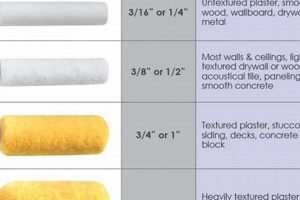
Different textures require specific tools, such as textured rollers, spray hoppers, or trowels. Mastering the use of these tools demands practice and skill. Improper equipment selection or lack of proficiency can lead to undesirable patterns, inconsistent texture depth, or material waste. For example, achieving a consistent “orange peel” texture requires precise control of spray pressure and nozzle settings, factors that demand experience and technical knowledge.
- Multi-Step Processes and Timing
Certain textured finishes involve multiple application steps, such as applying a base coat, texturing agent, and topcoat. Each step requires careful timing and technique to ensure proper adhesion and a cohesive final product. Premature application of subsequent coats can lead to bubbling, cracking, or delamination. The complexity increases with each additional step, demanding meticulous attention to detail and adherence to manufacturer instructions.
- Surface Preparation and Environmental Control
While textured finishes can mask minor imperfections, proper surface preparation is still essential for optimal adhesion and a long-lasting result. Cleaning, priming, and repairing significant flaws are crucial steps that add to the overall complexity of the application. Furthermore, environmental conditions, such as temperature and humidity, can affect drying time and the final texture. Failure to account for these factors can lead to cracking, peeling, or inconsistent texture formation.
These factors collectively contribute to the “Application Complexity” associated with “white textured paint finish.” The successful execution relies not only on selecting the appropriate materials and equipment but also on possessing the requisite skills and understanding of the underlying principles. The level of complexity ultimately dictates the time, cost, and expertise required to achieve the desired outcome.
4. Durability Expectations

The longevity and resilience of a “white textured paint finish” are directly proportional to the “Durability Expectations” established prior to its selection and application. These expectations encompass the anticipated wear and tear, environmental exposure, and maintenance demands that the finish will endure. The selection of an inappropriate product or application method can lead to premature failure, necessitating costly repairs or replacement. For example, a high-traffic commercial space demands a more robust coating than a low-impact residential area, dictating the choice of a more durable product and application technique. Failing to account for this differential leads to increased maintenance and a shortened lifespan of the finish.
Consider the impact of environmental factors on the coating’s performance. Exterior applications are exposed to ultraviolet radiation, temperature fluctuations, and moisture, each contributing to degradation over time. Consequently, formulations designed for exterior use incorporate additives to enhance UV resistance, flexibility, and water repellency. Similarly, interior applications in kitchens and bathrooms require coatings that are resistant to moisture, grease, and cleaning chemicals. The use of an inadequate product in these environments results in staining, peeling, or blistering. Understanding the specific demands of the environment is crucial for selecting a “white textured paint finish” that meets the “Durability Expectations.”
In summary, aligning “Durability Expectations” with the appropriate product and application method is paramount for ensuring the long-term performance and aesthetic appeal of a “white textured paint finish.” Careful consideration of anticipated wear and tear, environmental exposure, and maintenance requirements enables informed decision-making, minimizing the risk of premature failure and maximizing the return on investment. A failure to properly assess these factors will likely result in increased maintenance costs and a reduced lifespan of the coating.
5. Lighting Interaction

The interplay between light and surface texture is a critical determinant of the overall visual effect of a “white textured paint finish.” The angle, intensity, and color temperature of illumination profoundly influence the perception of depth, shadow, and even the apparent color of the finish.
- Specular Reflection and Glare
Smooth surfaces exhibit specular reflection, resulting in a high degree of glare when light is reflected directly. “White textured paint finish,” due to its uneven surface, diffuses light, reducing specular reflection and minimizing glare. The extent of diffusion is directly related to the depth and complexity of the texture. For instance, a heavily textured stucco finish scatters light more effectively than a subtle “orange peel” texture, thus minimizing glare more significantly. This characteristic is particularly relevant in spaces with abundant natural light or strong artificial lighting sources.
- Shadow Formation and Depth Perception
The variations in height and depth inherent in a textured surface create shadows, enhancing the perceived depth and dimensionality. The angle of incident light dictates the size and intensity of these shadows, influencing the visual impact of the texture. Side lighting, for example, accentuates the texture by casting elongated shadows, while direct frontal lighting tends to flatten the surface. The interplay of light and shadow adds visual interest and can compensate for a lack of architectural detail in a room. Understanding the effects of lighting direction is crucial for optimizing the aesthetic appeal of “white textured paint finish.”
- Color Perception and Light Absorption
The color perceived from a “white textured paint finish” is influenced by the surface’s ability to absorb and reflect light across the visible spectrum. Textured surfaces, due to their increased surface area, tend to absorb more light than smooth surfaces. This increased absorption can subtly alter the perceived hue of the white paint, making it appear slightly darker or warmer, depending on the light source. Additionally, the texture can create micro-shadows that locally darken the surface, contributing to the overall depth and complexity of the color perception. The impact of light absorption on color is especially noticeable in situations with low or indirect lighting.
- Light Source Color Temperature
The color temperature of the light source, measured in Kelvin, significantly affects the appearance of a “white textured paint finish.” Warm light sources (lower Kelvin values) tend to enhance the yellow undertones in the white paint, creating a warmer, more inviting atmosphere. Cool light sources (higher Kelvin values), on the other hand, accentuate the blue undertones, resulting in a brighter, more contemporary look. Choosing the appropriate light source color temperature is crucial for achieving the desired aesthetic and ensuring that the “white textured paint finish” complements the overall design scheme.
The aforementioned facets underscore the critical connection between illumination and surface characteristics. Consequently, the selection of “white textured paint finish” requires careful consideration of existing and planned lighting conditions. Understanding how lighting interacts with the texture allows for optimizing visual impact and creating a harmonious, well-balanced environment. The interplay of texture and light is integral to transforming a space from merely functional to visually captivating.
Frequently Asked Questions
The following addresses common inquiries concerning the application, properties, and maintenance of textured coatings. Understanding these aspects is crucial for making informed decisions and achieving optimal results.
Question 1: Is surface preparation truly necessary before applying a textured coating?
While textured finishes can mask minor imperfections, proper surface preparation remains essential. Cleaning, priming, and repairing significant flaws ensure optimal adhesion and longevity. Neglecting these steps can lead to premature peeling or uneven texture application.
Question 2: Can any type of paint be used to create a textured finish?
No. Specialized paints formulated with texturing additives are required. Standard paints lack the necessary viscosity and solids content to create a durable and visually appealing texture. Using inappropriate paints can result in a substandard finish with poor adhesion and durability.
Question 3: How does a textured coating affect the acoustic properties of a room?
Textured surfaces can improve acoustic absorption, reducing echo and reverberation. The degree of improvement depends on the texture depth and surface area. However, textured coatings are not a substitute for dedicated acoustic treatments.
Question 4: What is the best method for cleaning a textured painted surface?
Gentle cleaning methods are recommended. Avoid abrasive cleaners or vigorous scrubbing, as these can damage the texture. A soft brush or sponge with mild soap and water is generally sufficient. Always test cleaning solutions in an inconspicuous area first.
Question 5: Are textured paint finishes suitable for high-moisture environments like bathrooms?
Certain formulations are designed for high-moisture environments and contain mildew-resistant additives. Selecting a product specifically labeled for bathroom or kitchen use is crucial. Proper ventilation is also essential to prevent moisture accumulation and mildew growth.
Question 6: Can textured paint be applied over existing wallpaper?
It is generally not recommended to apply textured paint directly over wallpaper. The wallpaper may delaminate, causing the textured coating to fail. Removing the wallpaper and properly preparing the underlying surface is the preferred approach.
In conclusion, careful consideration of surface preparation, material selection, and maintenance procedures are paramount for maximizing the benefits and longevity of textured coatings.
The subsequent section will provide guidance on selecting the appropriate type of product for various applications.
Conclusion
This exploration has illuminated the multifaceted nature of white textured paint finish, encompassing its aesthetic contributions, practical advantages in surface masking, application complexities, durability considerations, and interactions with lighting. From selecting the appropriate texture to understanding the environmental factors that impact its longevity, a comprehensive understanding is paramount for successful implementation. The material represents a design choice demanding informed decisions and careful execution.
Therefore, meticulous planning and adherence to best practices are crucial for realizing the full potential of a white textured paint finish. Its value extends beyond mere aesthetic enhancement, offering a solution for addressing surface imperfections and enhancing the perceived depth and character of a space. Future advancements in material science may further refine its properties and expand its applications, solidifying its position as a versatile and enduring element in architectural design.