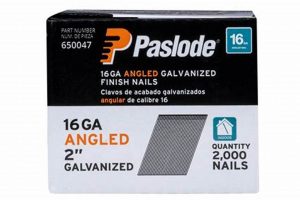
The gauge of a finish nail denotes its thickness; a higher number indicates a thinner nail. Consequently, a 16-gauge nail is finer than a 15-gauge nail. These slender fasteners are primarily utilized in woodworking for trim work, cabinetry, and other applications where minimizing visible nail holes is essential. The selection between these two sizes hinges on the specific project requirements and desired aesthetic outcome.
Employing the appropriate gauge of finish nail offers several advantages. Thinner nails reduce the likelihood of splitting delicate wood, preserving the integrity of the material. They also result in smaller entry points, leading to a cleaner, more professional finish that requires less filling and sanding. Historically, the development of varied nail gauges allowed woodworkers greater flexibility and control over the final appearance of their projects.
The subsequent discussion will delve into the comparative strengths, holding power, and optimal applications for each size, providing a detailed analysis to assist in making an informed decision for various woodworking tasks. Factors such as wood density, joint strength, and desired finish will be considered.
Guidance on Selecting Finish Nail Gauges
The selection of the appropriate finish nail gauge is crucial for achieving optimal results in woodworking projects. The following guidelines offer practical advice for informed decision-making.
Tip 1: Consider Material Density: For hardwoods, the increased holding power of a 15-gauge nail may be preferable. Softwoods, however, may be adequately secured with the finer 16-gauge nail, reducing the risk of splitting.
Tip 2: Evaluate Joint Strength Requirements: If the joint requires substantial strength, such as in structural cabinetry elements, the 15-gauge nail offers a more robust solution. Decorative trim, which experiences less stress, may be effectively attached using 16-gauge nails.
Tip 3: Assess Visibility of Nail Holes: When a nearly invisible finish is paramount, the smaller diameter of the 16-gauge nail minimizes the size of the entry point, simplifying filling and finishing processes.
Tip 4: Test on Scrap Material: Before commencing the primary project, test both gauges on scrap pieces of the same wood to assess the potential for splitting and the visual impact of the nail holes.
Tip 5: Account for Nailer Compatibility: Ensure that the selected nail gauge is compatible with the available nail gun. Using the incorrect gauge can damage the tool and compromise the quality of the fastening.
Tip 6: Factor in Wood Thickness: For thinner materials, a 16-gauge nail is generally recommended to prevent breakthrough and minimize the risk of visible nail protrusions on the opposite side.
Tip 7: Consider the Need for Concealment: If the nail heads will be intentionally exposed as a design element, the slightly larger head of a 15-gauge nail may be visually preferable. However, if concealment is the goal, a 16-gauge option is often better.
Proper selection based on material properties, joint requirements, and aesthetic considerations leads to stronger, cleaner, and more professional-looking results in woodworking. Understanding these nuances allows for greater control over the final product.
The subsequent sections will provide comparative analyses of specific applications, detailing scenarios where one gauge is demonstrably superior to the other.
1. Thickness difference

The fundamental distinction between 15-gauge and 16-gauge finish nails lies in their diameter. A 15-gauge nail, being of a lower gauge number, possesses a greater thickness than its 16-gauge counterpart. This seemingly minute variation in diameter has significant implications for the nail’s performance and suitability for various applications. The difference in thickness directly influences factors such as holding power, the likelihood of wood splitting, and the visibility of the nail head upon completion of the project. For instance, when securing dense hardwoods, the increased thickness of the 15-gauge nail provides superior grip, reducing the risk of the joint failing under stress. Conversely, using a thicker nail on delicate trim work increases the probability of splitting the wood, compromising the aesthetic quality of the piece.
The practical consequences of this thickness difference extend to the finishing process. The larger diameter of the 15-gauge nail creates a more prominent entry hole, necessitating more filling and sanding to achieve a seamless finish. In contrast, the finer 16-gauge nail leaves a smaller, less noticeable hole, simplifying the finishing work and minimizing the potential for surface imperfections. Cabinetmakers, for example, often opt for 16-gauge nails when attaching face frames to cabinet boxes because the smaller nail holes are easier to conceal. Conversely, construction crews might choose 15-gauge nails for heavier trim work on door frames, where the increased holding strength outweighs the concern about minor imperfections.
In summary, the thickness difference is a critical element in determining the appropriate choice between these two nail sizes. The decision hinges on a balance between the required holding strength, the susceptibility of the material to splitting, and the desired level of finish. While 15-gauge nails provide superior grip in demanding applications, 16-gauge nails offer a more refined finish in delicate projects. Careful consideration of these factors is essential for achieving optimal results in woodworking and construction. Improper selection can lead to structural weakness or aesthetic flaws, underscoring the importance of understanding the nuances of nail gauge.
2. Holding Strength

Holding strength is a primary consideration when choosing between 15-gauge and 16-gauge finish nails. The ability of a nail to resist withdrawal from the material into which it is driven directly impacts the integrity and longevity of the assembled piece. The thicker the nail, the greater its potential holding force.
- Diameter and Surface Area
The increased diameter of a 15-gauge nail provides a larger surface area in contact with the surrounding wood fibers. This greater contact area generates more friction, enhancing resistance to pulling forces. For example, when attaching a solid wood door casing, the additional holding power of the 15-gauge nail helps prevent separation over time, especially in environments with fluctuating humidity.
- Material Density and Embedment
Harder, denser materials require greater force to penetrate, but also provide more resistance to nail withdrawal. A 15-gauge nail, due to its strength, can be driven more effectively into dense hardwoods like oak or maple, achieving a secure embedment that a thinner 16-gauge nail may struggle to match. Consider cabinetry construction where face frames are attached to hardwood boxes; the 15-gauge nail provides a more reliable hold in these demanding applications.
- Nail Length and Shank Design
While gauge is critical, nail length also contributes to holding strength. Longer nails, regardless of gauge, penetrate deeper and thus offer more resistance to withdrawal. Furthermore, the shank design, whether smooth, barbed, or twisted, affects the nail’s grip within the wood. A barbed 15-gauge nail driven into a softwood like pine can offer exceptional holding power, comparable to a smooth-shank 16-gauge nail in a denser wood.
- Joint Stress and Load Bearing
The anticipated stress on a joint dictates the necessary holding strength of the fasteners. In applications subject to significant loads, such as structural elements in furniture or heavy trim work, the superior holding strength of 15-gauge nails is generally preferable. However, for purely decorative trim with minimal load bearing requirements, the sufficient holding power of 16-gauge nails may be adequate and offer a less conspicuous finish.
The relationship between nail gauge and holding strength is therefore nuanced, dependent on material properties, nail design, and the specific application. While 15-gauge nails generally offer greater holding power due to their increased diameter, factors such as wood density, nail length, and shank design must also be considered to ensure an appropriate and secure fastening solution. The choice of finish nail should be carefully evaluated to balance the necessary holding strength with the desired aesthetic and the risk of splitting the material.
3. Splitting risk
The potential for splitting wood is a critical consideration when selecting between 15-gauge and 16-gauge finish nails. The driving of a nail exerts force on the wood fibers, and exceeding the material’s tensile strength results in a split, compromising both structural integrity and aesthetic appeal. Therefore, understanding how nail gauge influences splitting is paramount for achieving successful woodworking outcomes.
- Nail Diameter and Fiber Displacement
The fundamental principle is that a larger nail diameter necessitates greater displacement of wood fibers. A 15-gauge nail, being thicker, exerts more lateral pressure during insertion compared to a 16-gauge nail. This increased pressure escalates the likelihood of splitting, particularly in brittle or thin materials. A practical example is attaching delicate molding: the use of a 15-gauge nail almost guarantees splits, while a 16-gauge nail significantly reduces this risk.
- Wood Species and Density
The inherent properties of wood species dictate their susceptibility to splitting. Dense hardwoods like oak, while strong, are often more prone to splitting due to their tight grain structure. Softwoods, such as pine, are generally more forgiving, but can still split if a nail of excessive diameter is used. Consequently, a 16-gauge nail might be suitable for pine, whereas a 15-gauge could lead to splitting in oak, especially near the ends of boards.
- Proximity to Edges and Ends
Nailing near the edge or end of a board concentrates stress, making the wood more vulnerable to splitting. The closer the nail is placed to the edge, the less support the wood fibers have, and the greater the risk of separation. In such situations, a finer gauge, like 16-gauge, is imperative to minimize the outward pressure. Pre-drilling pilot holes, regardless of nail gauge, is also beneficial when nailing close to edges.
- Nail Angle and Grain Direction
The angle at which a nail is driven relative to the wood grain also impacts splitting risk. Driving a nail parallel to the grain is generally less prone to splitting than driving it perpendicular. Angled nailing, or toenailing, can introduce significant stress. Moreover, driving a nail against the natural direction of the grain exacerbates the splitting potential. Consequently, adjusting the nailing angle and selecting the appropriate gauge are crucial for minimizing splitting in these scenarios.
In summary, the splitting risk is inextricably linked to the interplay between nail gauge, wood properties, and nailing technique. While 15-gauge nails offer greater holding power, their increased diameter elevates the risk of splitting, especially in hardwoods, near edges, or with improper nailing techniques. 16-gauge nails, with their finer diameter, mitigate this risk, making them a more suitable choice for delicate materials and applications where splitting is a primary concern. Careful consideration of these factors is essential for achieving structurally sound and aesthetically pleasing results in woodworking projects.
4. Cosmetic finish

The selection of finish nail gauge directly influences the final aesthetic outcome of woodworking projects. The size of the nail head and the resulting entry point impact the visibility and overall quality of the finished surface, thus making cosmetic finish a crucial consideration when choosing between 15-gauge and 16-gauge nails.
- Nail Hole Size and Visibility
16-gauge nails produce smaller entry holes than 15-gauge nails. This reduction in size translates to less conspicuous nail marks, minimizing the need for extensive filling and sanding. For projects where a pristine, seamless finish is paramount, such as high-end cabinetry or fine furniture, the use of 16-gauge nails is often preferred.
- Filling and Sanding Requirements
The larger diameter of 15-gauge nails necessitates more substantial filling to conceal the nail holes effectively. This increased filling translates to more sanding to achieve a smooth, uniform surface. In contrast, the smaller holes created by 16-gauge nails require less filler and sanding, reducing labor and the potential for uneven finishes. This is particularly advantageous in intricate trim work with complex profiles.
- Finishing Product Compatibility
The choice of finish nail gauge can also influence the selection of finishing products. The larger nail holes produced by 15-gauge nails may require specialized fillers designed to adhere well and resist shrinking. 16-gauge nail holes, being smaller, offer greater flexibility in filler selection and may be adequately concealed with standard wood fillers or putties. Consider the application of a clear coat; smaller nail holes are less likely to telegraph through the finish.
- Head Styles and Concealment
Both 15-gauge and 16-gauge finish nails are available with various head styles, including straight, brad, and angled. These different head types impact the ease and effectiveness of concealment. Brad heads, for example, are designed to sink flush with the surface, minimizing the need for extensive filling. Angled heads, often found on 15-gauge nails, allow for easier toenailing in tight spaces. Selecting the appropriate head style in conjunction with the nail gauge can optimize the cosmetic finish.
The interplay between nail gauge and cosmetic finish is nuanced, requiring careful consideration of the desired aesthetic and the specific project requirements. While 15-gauge nails offer increased holding power, they necessitate more effort to achieve a seamless finish. 16-gauge nails, conversely, prioritize cosmetic appearance, reducing the need for extensive filling and sanding. The optimal choice depends on balancing structural needs with the pursuit of a visually appealing final product.
5. Material density

Material density, a measure of mass per unit volume, exerts a significant influence on the performance and selection of finish nail gauges. The density of the wood directly impacts the nail’s holding power, the risk of splitting, and the overall integrity of the fastened joint. Choosing between 15-gauge and 16-gauge finish nails requires careful consideration of the material’s density to optimize results.
- Hardwood Applications
Hardwoods, characterized by their high density, offer substantial resistance to nail penetration and withdrawal. Species like oak, maple, and cherry necessitate fasteners with sufficient strength to ensure secure and lasting connections. In these applications, 15-gauge finish nails are often favored due to their increased diameter, providing superior holding power compared to 16-gauge nails. For instance, when constructing hardwood cabinetry, 15-gauge nails offer a more robust solution for attaching face frames and assembling structural components, mitigating the risk of joint failure over time.
- Softwood Applications
Softwoods, distinguished by their lower density, exhibit less resistance to nail penetration but are also more prone to splitting. Species like pine, fir, and cedar require a more delicate approach to fastening. In these scenarios, 16-gauge finish nails are generally preferred due to their finer diameter, which minimizes the risk of splitting the wood. For example, when installing softwood trim or molding, 16-gauge nails provide adequate holding power while preserving the integrity of the material.
- Nail Holding Power and Density Correlation
The holding power of a finish nail is directly proportional to the density of the material into which it is driven. Denser materials offer greater resistance to nail withdrawal, resulting in a stronger and more durable connection. However, this increased resistance also necessitates greater driving force, potentially increasing the risk of splitting. Therefore, selecting the appropriate nail gauge requires balancing holding power with the material’s susceptibility to splitting. In dense hardwoods, the enhanced holding power of 15-gauge nails outweighs the slightly increased risk of splitting, while in softwoods, the reduced splitting risk of 16-gauge nails outweighs the slightly reduced holding power.
- Pre-Drilling and Density Mitigation
Pre-drilling pilot holes can mitigate the risk of splitting in dense materials, allowing for the use of larger gauge nails without compromising the integrity of the wood. By creating a channel for the nail to follow, pre-drilling reduces the lateral pressure exerted on the wood fibers during insertion. This technique is particularly useful when working with hardwoods prone to splitting, enabling the use of 15-gauge nails for enhanced holding power without the associated risk. For instance, pre-drilling before attaching hardwood trim allows for the use of 15-gauge nails, providing a stronger and more durable connection than would be possible with 16-gauge nails alone.
The relationship between material density and finish nail gauge is a critical factor in achieving successful woodworking outcomes. Consideration of wood density ensures that the selected nail provides adequate holding power without causing splitting or compromising the aesthetic quality of the finished product. Whether working with dense hardwoods or delicate softwoods, understanding this correlation is essential for making informed decisions and achieving lasting results.
6. Application specificity

The selection between 15-gauge and 16-gauge finish nails is heavily influenced by the specific application for which they are intended. Different projects demand varying levels of holding power, aesthetic considerations, and material compatibility, making application specificity a critical determinant in the choice process.
- Trim and Molding Installation
For delicate trim and molding work, particularly when using softwoods or intricate profiles, 16-gauge nails are generally preferred. Their smaller diameter reduces the risk of splitting the wood, preserving the aesthetic integrity of the finished product. In contrast, 15-gauge nails may be too aggressive, leading to visible damage and requiring extensive repairs. An example is installing crown molding, where a clean, unblemished finish is paramount.
- Cabinetry Construction
In cabinetry construction, the choice depends on the specific component and material. For attaching face frames to cabinet boxes made of hardwood, 15-gauge nails offer superior holding power, ensuring long-term structural integrity. However, for assembling smaller or less stressed components, or when working with softer woods, 16-gauge nails may provide sufficient strength while minimizing the risk of splitting. Consider attaching a cabinet back panel; a 16-gauge nail may suffice due to lower stress.
- Furniture Assembly
Furniture assembly presents a diverse range of applications. For structural joints that bear significant weight or stress, such as leg attachments or frame construction, 15-gauge nails provide enhanced holding power. However, for attaching decorative elements or panels, where aesthetics are more critical than strength, 16-gauge nails offer a cleaner finish with less visible nail holes. Think about attaching a drawer bottom; 16-gauge may be adequate to prevent visual distraction.
- Hardwood Flooring Installation
While finish nails are not typically the primary fastener for hardwood flooring, they can be used to secure the initial rows or to address isolated areas where adhesive is insufficient. In these cases, the choice of nail gauge must consider the density and thickness of the flooring material. 15-gauge nails may be necessary for thicker, denser hardwoods, while 16-gauge nails are better suited for thinner or softer wood species. A key consideration is avoiding splitting during installation.
These examples illustrate the importance of application specificity when selecting between 15-gauge and 16-gauge finish nails. The optimal choice depends on a careful assessment of the material properties, structural requirements, and aesthetic goals of the project. A thorough understanding of these factors ensures a successful and durable outcome.
7. Nailer compatibility

Nailer compatibility represents a fundamental aspect in the effective utilization of finish nails. The operational principle of pneumatic or cordless nailers relies on precise alignment between the nail gauge and the nailer’s magazine and driving mechanism. An incompatible nail gauge will result in tool malfunction, potential damage to the nailer, and compromised fastening quality. For instance, attempting to load 15-gauge nails into a nailer designed exclusively for 16-gauge nails will invariably jam the mechanism, preventing proper firing and potentially damaging the internal components.
The importance of this compatibility extends beyond preventing immediate malfunctions. Repeated attempts to use incorrect nail gauges can cause wear and tear on the nailer’s internal parts, shortening its lifespan and diminishing its performance. Moreover, even if a nailer appears to function with a slightly mismatched gauge, the driving force may be uneven, leading to inconsistent nail penetration and reduced holding power. A real-world example involves construction crews facing delays due to tool downtime and inconsistent fastening when using incorrectly specified nails for a large-scale trim installation. The resulting rework increases costs and extends project timelines.
Therefore, adherence to the manufacturer’s specifications regarding compatible nail gauges is paramount. This adherence ensures optimal nailer performance, minimizes the risk of damage, and guarantees consistent, high-quality fastening. The cost of neglecting nailer compatibility extends beyond tool repairs; it encompasses compromised project quality, increased labor costs, and potential safety hazards. Therefore, verification of nail gauge compatibility must be an integral step in any woodworking or construction project involving finish nailers.
Frequently Asked Questions
This section addresses common inquiries regarding the selection and application of finish nails, specifically concerning 15-gauge and 16-gauge options. These questions aim to clarify distinctions and provide guidance for optimal usage.
Question 1: What constitutes the primary difference between 15-gauge and 16-gauge finish nails?
The primary difference resides in their diameter. A 15-gauge nail is thicker than a 16-gauge nail. This seemingly small difference significantly impacts holding power, splitting potential, and the visibility of the nail head.
Question 2: In what scenarios is a 15-gauge finish nail most appropriate?
A 15-gauge nail is generally more suitable for applications demanding higher holding power, such as attaching hardwood trim or assembling robust cabinetry components. Its increased thickness provides a stronger grip, mitigating the risk of joint failure.
Question 3: When should a 16-gauge finish nail be preferred over a 15-gauge option?
A 16-gauge nail is preferable for delicate materials or applications where minimizing visible nail holes is crucial. Its finer diameter reduces the likelihood of splitting, resulting in a cleaner, more professional finish, often employed in softwood trim and intricate woodworking.
Question 4: Does the length of the finish nail affect its holding power, irrespective of the gauge?
Yes, nail length significantly influences holding power. Longer nails, regardless of gauge, penetrate deeper into the material, offering greater resistance to withdrawal. Nail length and gauge should be considered in conjunction for optimal fastening.
Question 5: What role does wood density play in selecting the appropriate finish nail gauge?
Wood density is a critical factor. Hardwoods, being denser, typically benefit from the increased holding power of 15-gauge nails. Softwoods, more prone to splitting, are often better suited to the finer diameter of 16-gauge nails.
Question 6: Is it possible to use 15-gauge nails in a nailer designed for 16-gauge nails, and vice versa?
No, finish nailers are designed for specific nail gauges. Attempting to use an incompatible gauge will result in tool malfunction, potential damage to the nailer, and compromised fastening quality. Always adhere to the manufacturer’s specifications.
Selecting the proper finish nail gauge requires careful consideration of material properties, structural requirements, and aesthetic goals. Understanding the nuances between 15-gauge and 16-gauge options empowers informed decision-making.
The subsequent section will delve into advanced techniques and best practices for finish nail applications.
Conclusion
This exploration of “15ga vs 16ga finish nails” has illuminated critical distinctions impacting woodworking outcomes. The diameter difference dictates holding power, splitting risk, and aesthetic finish. Application specificity and material density further influence optimal gauge selection. Nailer compatibility remains paramount for safe and effective operation.
Mastery of finish nail selection empowers informed decisions, fostering durable and visually appealing results. Continued adherence to best practices and evolving material science will refine fastening techniques, promoting excellence in woodworking and construction. Diligence in these considerations ensures project success and enduring structural integrity.