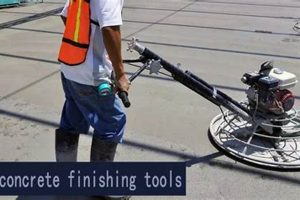
Equipment utilized in the construction industry to create smooth, level surfaces on freshly placed concrete is a crucial element of many projects. These devices, available in various configurations, automate the process of leveling, smoothing, and compacting concrete, ultimately enhancing the final product’s quality and durability. A common example includes a walk-behind or ride-on machine that uses rotating blades or pans to refine the concrete surface.
The importance of employing such technology lies in its ability to significantly reduce labor costs and increase efficiency on job sites. The enhanced precision achieved through mechanical means leads to flatter, more uniform surfaces, minimizing imperfections and improving the overall structural integrity. Historically, these tasks were performed manually, a labor-intensive and time-consuming endeavor, but the advent of mechanization has transformed concrete finishing practices.
The following sections will delve into the different types of these machines, their operational principles, factors to consider when selecting the appropriate equipment, and best practices for achieving optimal results on various concrete projects. Considerations for maintenance and troubleshooting will also be addressed.
Concrete Finishing Machine
Maximizing the efficiency and quality of concrete finishing requires adherence to specific techniques and operational considerations. The following tips offer guidance on optimizing the use of concrete finishing machines.
Tip 1: Pre-Operational Inspection: Prior to each use, a thorough inspection of the machine is essential. This includes checking blade condition, oil levels, and belt tension. Addressing any issues before operation prevents equipment failure and ensures consistent performance.
Tip 2: Proper Blade Selection: The type of blade employed significantly impacts the finished surface. Float blades are suited for initial passes, while finish blades are used for achieving a smooth, polished surface. Selecting the appropriate blade for each stage is critical.
Tip 3: Appropriate Machine Speed: The speed at which the machine operates directly affects the concrete finish. Starting with lower speeds during the initial pass and gradually increasing speed as the concrete sets minimizes surface imperfections.
Tip 4: Consistent Overlap: Maintaining a consistent overlap between each pass of the machine ensures uniform coverage and prevents noticeable lines or variations in the finished surface.
Tip 5: Concrete Moisture Management: The moisture content of the concrete is a key factor. Operating the machine on overly wet or dry concrete can lead to surface defects. Monitoring moisture levels and adjusting operational parameters accordingly is necessary.
Tip 6: Regular Cleaning: Concrete buildup on the machine can affect its performance and lifespan. Regular cleaning, especially after each use, is crucial for maintaining optimal operating condition.
Tip 7: Safety Protocol Adherence: Implementing comprehensive safety protocols is paramount. This includes wearing appropriate personal protective equipment (PPE) and ensuring the machine is operated by trained personnel.
Following these guidelines will result in improved concrete finishing, reduced rework, and extended equipment lifespan.
The subsequent sections will provide further details regarding maintenance procedures and troubleshooting common issues encountered during operation.
1. Surface Smoothness

Achieving the desired surface smoothness in concrete construction is intrinsically linked to the proper selection and operation of a concrete finisher machine. The machine’s function is to eliminate surface irregularities, create a uniform texture, and compact the concrete, directly influencing the final smoothness. Improper operation or a malfunctioning machine can lead to uneven surfaces, waves, or aggregate exposure, compromising both aesthetic appeal and structural integrity. For example, using an incorrectly angled float blade can result in a wavy surface, while worn finish blades may produce a coarse, sandpaper-like texture. The intended use of the concrete surface whether it’s a warehouse floor requiring a high degree of flatness or a sidewalk needing slip resistance dictates the required smoothness level and, consequently, the appropriate finishing techniques.
The relationship between the machine and surface smoothness extends beyond simple operation. Concrete mix design, ambient temperature, and curing processes also play significant roles. A concrete mix that is too wet can lead to segregation and surface defects during finishing, even with a properly functioning machine. Similarly, rapid drying due to high temperatures can cause surface cracking and reduce smoothness. Therefore, effective concrete finishing involves not only mastering the operation of the machine but also understanding and controlling these related variables. Skilled operators adjust machine settings and techniques based on the specific conditions of each project.
Ultimately, achieving the required surface smoothness with a concrete finisher machine relies on a combination of factors: proper equipment maintenance, correct blade selection, skilled operation, and a thorough understanding of concrete properties and environmental conditions. Failure to address any of these aspects can compromise the final result. The practical significance of understanding this connection lies in the ability to produce durable, aesthetically pleasing, and fit-for-purpose concrete surfaces, contributing to the overall success of construction projects.
2. Blade types

The performance and ultimate surface finish achieved by a concrete finisher machine are directly dependent on the type of blade employed. Different blade designs are engineered for specific phases of the concrete finishing process, ranging from initial leveling to final polishing. Failure to select the appropriate blade type can lead to substandard results, increased labor costs, and compromised structural integrity. For example, using a finishing blade during the initial floating stage can cause the blade to dig into the wet concrete, creating an uneven surface and potentially damaging the blade itself. Conversely, using a float blade for final finishing will not produce the smooth, dense surface required for many applications. The relationship between blade type and the machine’s function is therefore a crucial consideration for any concrete finishing project.
Several common blade types exist, each with distinct characteristics and applications. Float blades, typically larger and designed with a wider surface area, are used to consolidate the concrete, remove imperfections, and establish a level plane. Finish blades, in contrast, are smaller and often made of a more flexible material, allowing them to polish the surface and create a smooth, dense finish. Combination blades offer a compromise between these two functionalities, suitable for smaller projects or where a single-pass finishing process is desired. Additionally, specialty blades exist for specific applications, such as edging or creating textured surfaces. The selection process must consider factors such as the concrete mix design, environmental conditions, and the desired final finish.
In summary, blade type is not merely an accessory but a fundamental component that dictates the capability and effectiveness of concrete finishing machines. Understanding the characteristics of different blade designs and their appropriate applications is essential for achieving optimal results. Improper blade selection leads to inefficiencies, increased costs, and a compromised final product. A concrete finisher machine’s potential is only fully realized when paired with the correct blade type, operated by a skilled technician who understands the nuances of the process.
3. Operational efficiency

Operational efficiency, in the context of concrete finisher machines, denotes the ratio of output achieved to resources consumed. Maximizing this ratio is critical for reducing project costs, minimizing completion times, and ensuring consistent quality in concrete surfaces. Several interconnected factors influence the operational efficiency of these machines.
- Machine Uptime and Reliability
A key component of operational efficiency is the continuous availability of the machine for productive work. Frequent breakdowns or maintenance requirements significantly reduce the time spent on actual concrete finishing. Implementing preventative maintenance schedules, using high-quality parts, and ensuring operators are properly trained to identify and address minor issues contribute to increased uptime. For example, a machine requiring daily belt adjustments due to poor design will inherently be less efficient than a machine with a robust, self-tensioning belt system.
- Operator Skill and Training
The proficiency of the machine operator directly impacts the quality and speed of the finishing process. A skilled operator can optimize machine settings for various concrete mixes and environmental conditions, minimizing the need for rework and maximizing coverage per pass. Investing in comprehensive training programs that cover machine operation, maintenance, and troubleshooting is essential. An inexperienced operator may, for instance, use an incorrect blade angle, leading to an uneven surface that requires additional finishing passes, thereby reducing efficiency.
- Proper Site Preparation and Logistics
Operational efficiency is not solely dependent on the machine itself but also on the surrounding environment. Adequate site preparation, including level ground and unobstructed access, allows the machine to operate at its optimal speed and maneuverability. Efficient logistics for concrete delivery and placement minimize idle time for the finishing machine. A project site with poor access, for instance, might require the machine to be transported over rough terrain, increasing the risk of damage and delaying the finishing process.
- Matching Machine to Project Scale and Complexity
Selecting the appropriate machine size and type for the project’s specific requirements is crucial. Using an oversized machine on a small project wastes resources and may lead to difficulties in maneuvering within confined spaces. Conversely, using an undersized machine on a large project results in extended completion times and increased labor costs. A large-scale commercial project, for instance, would benefit from a ride-on power trowel, while a smaller residential project might be more efficiently handled by a walk-behind model.
The facets above illustrates that achieving optimal operational efficiency with concrete finisher machines requires a holistic approach that considers machine reliability, operator competence, site logistics, and appropriate equipment selection. Neglecting any of these elements diminishes the overall efficiency of the finishing process, leading to increased costs and project delays. These areas must be considered for a successful operation.
4. Maintenance protocols

The operational lifespan and performance consistency of a concrete finisher machine are inextricably linked to adherence to rigorous maintenance protocols. These protocols, encompassing scheduled inspections, lubrication, component replacement, and cleaning, are not merely recommended practices but essential requirements for minimizing downtime, preventing equipment failure, and ensuring the quality of finished concrete surfaces. For example, neglecting to regularly check and replace worn blades results in uneven finishing, increased machine strain, and ultimately, premature component degradation. Such neglect necessitates costly repairs and project delays, directly impacting profitability and client satisfaction. Therefore, maintenance protocols constitute an integral component of effective concrete finishing operations, affecting both the tangible output and the overall cost efficiency of a project.
The practical implementation of maintenance protocols requires a structured approach, tailored to the specific machine model and operating conditions. A detailed maintenance schedule, incorporating manufacturer recommendations and site-specific factors (e.g., dust levels, operating hours), should be established and consistently followed. This schedule should include tasks such as daily lubrication of moving parts, weekly inspection of belts and pulleys, and monthly replacement of air filters. Furthermore, operators must be trained to recognize early signs of equipment malfunction, such as unusual noises or vibrations, and to report these issues promptly for corrective action. Consider a scenario where a clogged air filter leads to engine overheating, resulting in irreversible damage if left unaddressed. Proper maintenance practices can often prevent such costly incidents.
In conclusion, the efficacy of a concrete finisher machine is contingent upon the consistent and thorough execution of maintenance protocols. These protocols serve as a preventative measure against equipment failure, ensuring sustained performance, and ultimately, the consistent production of high-quality concrete surfaces. Challenges in implementing these protocols often stem from time constraints or a perceived lack of immediate return on investment. However, the long-term benefits, including reduced repair costs, extended equipment lifespan, and improved project outcomes, far outweigh the initial investment in establishing and adhering to a comprehensive maintenance program.
5. Concrete properties

The effectiveness of a concrete finisher machine is intrinsically linked to the properties of the concrete being worked. These properties, including slump, air content, water-cement ratio, and aggregate size, directly influence the machine’s ability to achieve the desired surface finish and structural integrity. For example, a concrete mix with a high slump (indicating high water content) may be easily workable but can lead to surface bleeding and segregation during finishing, requiring adjustments to machine settings or delaying finishing operations. Similarly, the presence of excessive air content can create surface voids, necessitating additional passes with the machine to achieve a smooth, dense finish. The practical implication is that an understanding of these concrete properties is essential for optimal machine operation and quality control.
Different concrete properties demand specific adjustments in the finishing process. A concrete mix with large aggregates may require more aggressive floating and finishing techniques to ensure that the aggregates are adequately embedded and do not protrude from the surface. Concrete mixes with a low water-cement ratio, while beneficial for long-term durability, can be more challenging to work with due to their reduced plasticity, requiring increased machine speed and pressure to achieve the desired smoothness. Furthermore, environmental factors, such as temperature and humidity, influence the rate of hydration and setting, impacting the timing of finishing operations. A contractor finishing concrete in hot, dry conditions must be prepared to accelerate the finishing process or implement measures to prevent rapid surface drying, which can lead to cracking and surface defects. The successful application of a concrete finisher machine, therefore, requires a dynamic adaptation to the changing properties of the concrete as it sets.
In summary, concrete properties serve as a critical input variable for any concrete finishing operation utilizing a concrete finisher machine. A mismatch between concrete properties and finishing techniques inevitably leads to compromised results, increased labor costs, and potential structural weaknesses. Addressing this challenge requires thorough mix design, accurate on-site adjustments, and a skilled operator capable of adapting machine settings to the specific characteristics of the concrete. Recognizing the interdependence between concrete properties and finishing techniques is paramount for achieving durable, aesthetically pleasing, and structurally sound concrete surfaces.
Frequently Asked Questions Regarding Concrete Finisher Machines
This section addresses common inquiries and misconceptions pertaining to concrete finisher machines, offering insights into their operation, maintenance, and application.
Question 1: What is the primary function of a concrete finisher machine?
A concrete finisher machine serves to level, smooth, and compact freshly poured concrete surfaces, enhancing their aesthetic appeal and structural integrity. The mechanical operation ensures a more uniform and consistent finish compared to manual methods.
Question 2: What are the different types of blades used with a concrete finisher machine, and what is their purpose?
Common blade types include float blades, used for initial leveling and consolidation, and finish blades, designed for creating a smooth, polished surface. Specialty blades also exist for edging and texturing applications. The selection depends on the desired finish and stage of the concrete setting process.
Question 3: How does the moisture content of concrete impact the operation of a concrete finisher machine?
Excessive or insufficient moisture content can lead to surface defects during finishing. Overly wet concrete may cause bleeding and segregation, while dry concrete can result in cracking and dusting. Monitoring moisture levels and adjusting machine settings are crucial for optimal results.
Question 4: What are the key maintenance procedures required for a concrete finisher machine?
Essential maintenance includes regular lubrication of moving parts, inspection of belts and blades, cleaning of concrete buildup, and timely replacement of worn components. Adherence to a structured maintenance schedule minimizes downtime and extends the machine’s lifespan.
Question 5: How does operator skill level influence the effectiveness of a concrete finisher machine?
A skilled operator can optimize machine settings, blade angles, and operating speed to achieve the desired finish under varying conditions. Proper training and experience are essential for minimizing rework and maximizing efficiency.
Question 6: What safety precautions should be observed when operating a concrete finisher machine?
Safety measures include wearing appropriate personal protective equipment (PPE), ensuring the machine is operated in a well-ventilated area, and adhering to manufacturer’s guidelines regarding safe operation and handling. Regular safety inspections and training are also critical.
The key takeaway from these FAQs is that the successful utilization of a concrete finisher machine requires a combination of proper equipment selection, skilled operation, and a thorough understanding of concrete properties and maintenance procedures.
The following section will explore case studies illustrating the application of concrete finisher machines in diverse construction projects.
Conclusion
This exploration has elucidated the multifaceted role of the concrete finisher machine in modern construction. From enhancing surface smoothness and optimizing operational efficiency to requiring strict adherence to maintenance protocols and careful consideration of concrete properties, the utilization of this equipment directly impacts project success. The variety of blade types and the skill required for their effective application highlight the complexities involved in achieving desired outcomes.
Therefore, stakeholders in the construction industry should prioritize informed decision-making regarding the selection, operation, and maintenance of the concrete finisher machine. Investment in operator training, adherence to scheduled maintenance, and a thorough understanding of concrete characteristics are essential for maximizing the return on investment and ensuring the delivery of durable, aesthetically pleasing, and structurally sound concrete surfaces. Future advancements in machine technology and concrete mix designs will likely further refine the finishing process, underscoring the need for continuous learning and adaptation.