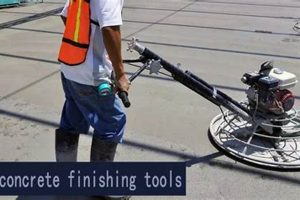
Tools and machinery employed to refine and enhance the surface of freshly placed concrete are essential for achieving desired aesthetic and functional qualities. These implements range from simple hand tools used for small-scale projects to large, power-operated machines designed for extensive surfaces. An example of their use includes achieving a smooth, level surface on a concrete floor using a power trowel.
Their proper application is paramount to ensure durability, prevent cracking, and achieve desired textures and finishes. Historically, manual labor was the sole method, but advancements in technology have significantly improved efficiency and precision. The utilization of specialized tools contributes to the longevity and visual appeal of concrete structures, enhancing their value and performance.
A detailed examination of specific categories such as screeds, floats, trowels, and texturing tools will provide a thorough understanding of how different apparatus impact the final result. Furthermore, the maintenance and safe operation of these items are crucial for prolonged usability and operator safety.
Essential Guidance for Concrete Surface Refinement
The attainment of optimal concrete surface quality hinges on proficient employment of specific implements and techniques. The following guidelines outline essential considerations for achieving durable and aesthetically pleasing results.
Tip 1: Selection of Appropriate Implements: The selection process must prioritize the specific requirements of the project. For instance, large slabs benefit from ride-on power trowels, while smaller areas are more effectively finished with hand trowels. Matching the tool to the scale and nature of the work is paramount.
Tip 2: Precise Timing of Operations: The progression from initial screeding to final finishing must be meticulously timed. Commencing finishing operations too early can lead to water bleed and surface defects. Delaying too long may result in a surface that is too hard to work effectively. Conduct the thumb-print test to ensure proper consistence.
Tip 3: Consistent Surface Preparation: Before initiating any finishing steps, guarantee a level and uniformly consolidated concrete surface. Correct any imperfections such as air pockets or aggregate segregation through diligent vibration and screeding techniques.
Tip 4: Controlled Moisture Levels: The moisture content of the concrete significantly influences the final surface characteristics. Implement moisture control measures like evaporation retardants in hot or windy conditions to prevent premature drying and cracking.
Tip 5: Gradual Progression of Finishing: Avoid aggressive techniques during initial finishing stages. Instead, opt for gradual passes, progressively increasing pressure to achieve the desired smoothness and compaction. Implement bull floats to bring surface even.
Tip 6: Proper Maintenance and Cleaning: Regular cleaning and maintenance of these tools are essential for preserving their performance and extending their service life. Clean blades with mineral spirits or similar solvents. Sharpen when required.
Tip 7: Adherence to Safety Protocols: Operation of power-operated tools requires strict adherence to safety protocols, including wearing appropriate personal protective equipment (PPE) such as safety glasses, gloves, and hearing protection. Ensure all guards and safety devices are in place and functioning correctly.
Effective employment of these techniques yields enhanced concrete surfaces, exhibiting heightened durability, increased resistance to wear, and improved aesthetic properties.
The successful application of these guidelines ensures the creation of high-quality concrete surfaces suitable for a wide array of applications.
1. Surface preparation tools

The effective use of implements designed to prepare a concrete surface before final finishing significantly impacts the quality and longevity of the completed work. Proper preparation ensures the subsequent finishing processes yield a uniform, durable, and aesthetically pleasing outcome. These tools are integral to the entire process, preventing defects and maximizing the performance of the finished surface.
- Screeds
Screeds are utilized to level freshly placed concrete, establishing a consistent plane for subsequent finishing operations. Both manual and powered screeds are employed, depending on the scale of the project. An example is the use of a laser screed on large commercial slabs, providing a highly accurate and level surface. The accuracy of the screed directly influences the uniformity and levelness of the final finish.
- Concrete Vibrators
Concrete vibrators consolidate the concrete mix, removing air pockets and ensuring uniform density throughout the slab. This process is crucial for preventing voids and weaknesses that can compromise the structural integrity of the finished surface. An immersion vibrator, for instance, is used during the pouring process to ensure that the concrete flows evenly and fully fills the formwork. Improper vibration can lead to segregation and surface defects.
- Edgers and Groovers
Edgers and groovers are specialized hand tools that create smooth, rounded edges and control joints in the concrete slab. Edgers prevent chipping and spalling along the edges, while groovers create intentional weaknesses in the concrete to control cracking. An example would be using an edger along a sidewalk to provide a finished edge or a groover to create expansion joints. The strategic placement of control joints minimizes random cracking and enhances long-term durability.
- Surface Grinders
Surface grinders remove imperfections and irregularities from the concrete surface prior to finishing. These tools are used to smooth rough areas, remove coatings, or prepare the surface for specialized finishes. A walk-behind concrete grinder, for instance, may be used to level a slab with uneven sections or to remove old epoxy coatings. The effectiveness of surface grinding directly impacts the smoothness and uniformity of the final finish.
These tools play a vital role in the overall concrete finishing process. They prepare the surface for subsequent finishing steps, ensuring a high-quality, durable, and aesthetically pleasing result. Without adequate preparation, the benefits of advanced finishing techniques may be diminished or negated, leading to a compromised final product.
2. Equipment Maintenance Schedules

The longevity and consistent performance of tools hinges directly upon the implementation of well-structured upkeep programs. These schedules encompass routine inspections, lubrication, cleaning, and timely component replacement. Failure to adhere to a rigorous maintenance plan inevitably leads to diminished operational efficiency, increased downtime, and potentially hazardous working conditions. For example, neglecting to regularly inspect and replace worn trowel blades results in uneven finishes and increased operator fatigue. A proactive maintenance strategy mitigates these risks, ensuring that concrete placement, surface leveling, and texture application proceed without interruption or compromise to quality.
Furthermore, customized maintenance routines are essential, adapted to the specific demands placed on each piece of machinery. High-frequency tools, such as power trowels used extensively on large commercial projects, demand more frequent inspections and servicing than tools used intermittently on smaller residential tasks. Detailed maintenance logs, recording all inspections, repairs, and component replacements, provide a valuable historical record. This data facilitates accurate forecasting of future maintenance requirements and aids in identifying potential equipment weaknesses or design flaws. Regularly scheduled hydraulic fluid replacement in power screeds, for example, prevents premature pump failure and maintains consistent screeding force across the entire slab surface.
In conclusion, the establishment and meticulous execution of equipment maintenance schedules are not merely procedural formalities but are fundamentally integral to the successful application of technology. Ignoring this crucial aspect of concrete work results in avoidable equipment failures, subpar finishes, and compromised project timelines. A comprehensive understanding of the cause-and-effect relationship between systematic maintenance and tool performance contributes directly to enhanced jobsite safety, improved project outcomes, and extended equipment lifespan, ultimately increasing overall operational efficiency and profitability.
3. Operational Safety Protocols

Adherence to operational safety protocols is paramount when utilizing machinery. These protocols mitigate risks associated with concrete placement, surface leveling, and finishing. The potential for injury necessitates a structured approach to hazard identification and risk mitigation.
- Personal Protective Equipment (PPE) Compliance
Mandatory use of PPE, including safety glasses, gloves, and hearing protection, is essential. Eye protection shields against concrete splatter and dust particles. Gloves protect against chemical burns from cement and abrasion injuries. Hearing protection mitigates noise-induced hearing loss from power tools. Consistent PPE enforcement reduces the likelihood of preventable injuries on site.
- Lockout/Tagout Procedures
Lockout/tagout protocols prevent accidental startup of tools during maintenance or repair. Disconnecting power sources and applying locks and tags ensures machinery remains inoperable. Strict adherence to these procedures prevents serious injuries, such as amputations, during servicing.
- Equipment-Specific Training
Comprehensive training on each tool’s operation, safety features, and potential hazards is crucial. Operators must demonstrate proficiency before using machinery unsupervised. Proper training minimizes misuse, reduces accidents, and enhances overall operational efficiency.
- Hazard Communication and Awareness
Clear communication of potential hazards and implementation of safety signage is essential. Workers must be informed about potential risks, such as electrical hazards, pinch points, and chemical exposures. Visible signage reinforces safety awareness and encourages proactive hazard mitigation.
These protocols are integral to a safe working environment. Effective implementation reduces accidents, enhances productivity, and fosters a culture of safety within the concrete finishing industry. Consistent enforcement and ongoing training are critical for sustained success.
4. Finishing technique variety

The diversity of concrete finishing techniques necessitates a correspondingly diverse array of machinery. The desired aesthetic and functional properties of the finished surface directly dictate the selection and application of specific tools. For example, achieving a smooth, polished surface requires the use of power trowels equipped with progressively finer blades and diamond polishing pads. In contrast, a textured surface suitable for exterior applications may be achieved through the use of brooms, stamping tools, or specialized texturing rollers. Each technique leverages distinct properties of the tools, making the choice of machinery an integral factor in achieving the desired outcome.
The relationship between technique and is evident in various construction scenarios. Stamped concrete, often employed for decorative driveways and patios, utilizes specialized stamping mats and release agents in conjunction with hand tools to create intricate patterns. Similarly, exposed aggregate finishes require the use of surface retarders, washing equipment, and potentially abrasive blasting to reveal the aggregate beneath the surface. Power floats are suited for leveling surface, while roller screeds create flat surface for large spaces, each machine directly supporting the chosen finishing methodology. The selection and application of the appropriate tools are paramount for efficient and high-quality execution.
Therefore, understanding the interplay between various processes and the associated implements is crucial for achieving optimal results. Challenges arise when the incorrect device is selected for a particular method, leading to inefficiencies, substandard finishes, or potential damage to the concrete surface. Investing in a comprehensive range of devices and providing operators with adequate training on their proper application are essential for realizing the full potential of each finishing technique. Mastering this connection is foundational to success in concrete construction and design.
5. Texture application methods
The creation of textured surfaces on concrete structures is intrinsically linked to the strategic use of specialized tools. Surface treatments alter the appearance and functionality of concrete, influencing properties such as slip resistance and aesthetic appeal. The selection and application of appropriate methodologies are vital for achieving desired outcomes.
- Broom Finishing
Broom finishing is a common method employed to create a non-slip surface, particularly on exterior concrete slabs. A broom, typically a stiff-bristled push broom, is dragged across the surface of the freshly finished concrete. The resulting texture provides increased traction, making it suitable for sidewalks, driveways, and patios. The effectiveness depends on the timing of the brooming and the consistency of the strokes.
- Stamped Concrete
Stamped concrete involves imprinting patterns onto the surface of freshly placed concrete using specialized stamping mats. These mats come in a variety of designs, replicating natural stone, brick, or tile. Release agents are used to prevent the stamps from sticking to the concrete. This method allows for the creation of aesthetically pleasing and durable surfaces, often used for decorative pavements and landscape features. The quality of the impression depends on proper concrete preparation, timing, and the application of adequate pressure.
- Exposed Aggregate
Exposed aggregate involves removing the surface layer of cement paste to reveal the decorative aggregate beneath. This can be achieved through chemical retarders applied during the concrete placement, followed by washing the surface at the appropriate time. Alternatively, abrasive blasting techniques can be employed. The resulting surface is textured and visually appealing, often used for architectural applications. Proper aggregate selection and timing of the exposure process are crucial for achieving the desired aesthetic.
- Swirl Finishing
Swirl finishes are created by using a trowel or float in a circular or arcing motion while the concrete is still plastic. This method results in a visually interesting pattern that can add character to concrete surfaces. The depth and consistency of the swirls depend on the tool used and the technique of the finisher. Swirl finishes are often used for patios, walkways, and other decorative applications.
Each method employs specific tools and techniques to achieve unique textural results. The selection depends on factors such as desired aesthetic, functional requirements, and budget constraints. Competent application is essential for maximizing the visual and performance characteristics of concrete surfaces.
Frequently Asked Questions
The following addresses common inquiries regarding machinery utilized in the refinement of concrete surfaces. The information presented aims to provide clarity on aspects of selection, usage, and maintenance.
Question 1: What constitutes essential upkeep for power trowels?
Essential upkeep includes regular inspection of blades for wear or damage, lubrication of moving parts according to manufacturer specifications, and timely replacement of air filters. These actions prolong the life of the and ensure consistent performance.
Question 2: How does the selection of blade type impact the final concrete surface?
Blade selection significantly influences the surface finish. Floating blades are used for initial leveling, while finishing blades are employed to achieve a smooth, hard surface. Using the incorrect blade type can result in unevenness or surface defects.
Question 3: What safety precautions should be observed when operating a concrete saw?
Operators must wear appropriate personal protective equipment, including safety glasses, hearing protection, and respiratory protection. Ensuring proper blade guarding and adherence to lockout/tagout procedures during maintenance are also critical for preventing injuries.
Question 4: How often should screeds be calibrated to ensure accuracy?
Screeds should be calibrated regularly, ideally before each use, to maintain accuracy. Factors such as temperature fluctuations and handling can affect calibration. Regular verification ensures a level and consistent concrete surface.
Question 5: What are the consequences of neglecting proper cleaning procedures?
Neglecting cleaning procedures can lead to reduced efficiency, increased wear and tear, and potential equipment failure. Concrete residue can harden and obstruct moving parts, impairing performance and shortening the lifespan.
Question 6: How does the type of power source affect the selection of machinery?
The type of power sourceelectric, gasoline, or pneumaticinfluences portability, power output, and suitability for different job site conditions. Electric tools are often preferred for indoor use due to lower emissions, while gasoline-powered equipment offers greater mobility on large outdoor projects.
The preceding inquiries represent common concerns regarding usage. Proper implementation of these guidelines facilitates efficient and safe concrete finishing operations.
A detailed examination of the operational benefits across diverse applications will be presented in the following section.
Conclusion
The preceding discussion has addressed the vital role of apparatus in achieving desired outcomes in concrete construction. The selection, maintenance, and safe operation of these tools are fundamental to ensuring structural integrity, surface durability, and aesthetic appeal. Varied techniques and procedures dictate the specific types of devices required for optimal results.
Continued advancements in technology will inevitably lead to further innovation in the field. Staying informed about best practices and investing in high-quality apparatus are essential for professionals seeking to enhance their capabilities and meet the evolving demands of the construction industry. A commitment to excellence in concrete finishing ensures lasting infrastructure and aesthetically pleasing environments.