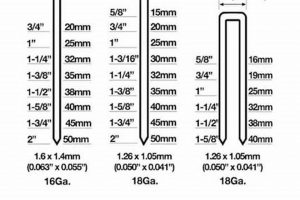
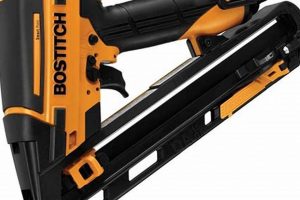
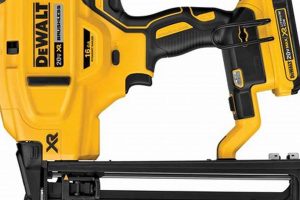
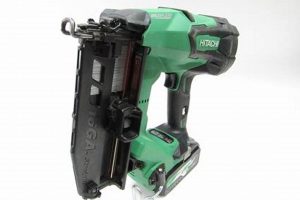
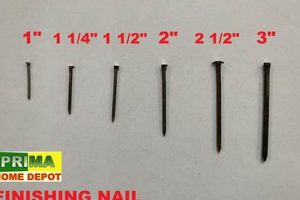
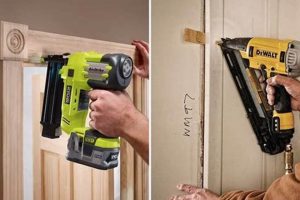
This pneumatic tool drives slender fasteners into wood for trim and finishing applications. An example of its use includes attaching baseboards, crown molding, and door casings. The gauge refers to the thickness of the nails it utilizes; in this case, the tool is designed for 16-gauge nails.
The utility of this type of device lies in its ability to provide a secure and nearly invisible hold, which enhances the aesthetic appeal of finished carpentry projects. Its adoption has streamlined many woodworking tasks, replacing manual hammering in numerous professional settings. Its evolution reflects advancements in power tool technology and the demand for precision in construction and remodeling.
Further exploration of pneumatic fastening systems reveals variations in nail size and power, highlighting the adaptability of these tools across different applications. The subsequent discussion will address specific operational techniques, safety protocols, and maintenance procedures relevant to its effective use and longevity.
Operational Tips for 16-Gauge Finish Nailers
Optimal performance and lifespan of the equipment require adherence to specific operational guidelines. The following tips provide insights into maximizing utility and ensuring safety.
Tip 1: Air Pressure Regulation: Proper air pressure is critical. Consult the manufacturer’s specifications for the recommended PSI range. Insufficient pressure may result in incomplete nail sets, while excessive pressure can damage the workpiece or the tool itself. Use a regulator to maintain consistent pressure.
Tip 2: Selecting the Correct Nail Length: Employ nail lengths appropriate for the combined thickness of the materials being joined. Using excessively long nails can cause them to protrude from the back of the workpiece, requiring additional finishing. Shorter nails may not provide adequate holding power.
Tip 3: Maintaining a Consistent Angle: When fastening trim, maintain a consistent angle of the tool relative to the workpiece. Variations in angle can lead to inconsistent nail placement and weaken the joint. Use a steady hand and visualize the desired nail trajectory.
Tip 4: Utilizing Sequential or Contact Actuation: Understand the difference between sequential and contact actuation modes. Sequential actuation requires the safety tip to be depressed against the workpiece before the trigger is pulled, reducing the risk of accidental firing. Contact actuation allows for faster nailing but demands greater caution.
Tip 5: Performing Regular Maintenance: Regularly lubricate the tool with air tool oil as specified by the manufacturer. Clean the nail magazine and remove any debris to prevent jams. Inspect the O-rings and seals for wear and replace as necessary to maintain proper air pressure and prevent leaks.
Tip 6: Adjusting Depth of Drive: Utilize the depth-of-drive adjustment feature to control the nail set depth. This prevents nails from being driven too deeply or protruding from the surface. Experiment on scrap material to determine the optimal setting for different wood densities.
Tip 7: Storing Properly When Not in Use: Disconnect the air hose and empty the nail magazine before storing. Store the tool in a clean, dry environment to prevent corrosion and damage to internal components. A dedicated carrying case can provide added protection.
Adherence to these operational tips will contribute to improved precision, reduced material waste, and extended tool longevity. These best practices translate directly into cost savings and enhanced efficiency on any finishing project.
The subsequent section will explore common troubleshooting scenarios and provide solutions for resolving operational issues that may arise during use.
1. Fastener Gauge Compatibility

Fastener gauge compatibility is a defining characteristic of any nailer, directly dictating the types of nails the tool can accommodate and, consequently, the applications for which it is suited. In the context of a 16-gauge finish nailer, this parameter is paramount as it establishes the tool’s utility for precision woodworking and trim work.
- Designated Nail Size
A 16-gauge finish nailer is specifically engineered to accept 16-gauge nails. These nails possess a standardized diameter, ensuring consistent performance and preventing jams or misfires. Deviation from the designated gauge will render the tool inoperable or potentially cause damage. The standardization ensures that any brand of 16-gauge nail meeting industry specifications will function correctly within the device.
- Impact on Joint Strength
The 16-gauge nail diameter provides a balance between holding power and minimal visibility. Thicker nails offer greater tensile strength, but leave more noticeable entry points requiring filling and finishing. A 16-gauge nail offers adequate strength for securing trim, molding, and cabinet components without compromising the aesthetic appeal of the finished product. The resulting joint offers resistance to separation under normal stress, contributing to the longevity of the assembly.
- Application Limitations
The use of 16-gauge nails inherently limits the tool’s suitability for heavy-duty framing or structural applications requiring larger fasteners. While effective for joining lighter materials, it is not designed to withstand the shear forces encountered in structural construction. Attempting to use the tool in these inappropriate applications can lead to fastener failure, project instability, or tool damage.
- Compatibility with Consumables
Ensuring compatibility extends beyond just the gauge; the nailer must also be compatible with the nail collation type (e.g., strip or coil) and the nail material (e.g., steel, stainless steel). The physical arrangement of nails within the magazine must align with the tool’s feeding mechanism. Similarly, the nail material must be strong enough to withstand the driving force of the tool without bending or breaking. Failure to adhere to these compatibility factors will result in operational inefficiencies and potentially hazardous situations.
The stringent gauge compatibility requirements of a 16-gauge finish nailer underscore its specialization in delicate finishing tasks. This specialization enables precision and minimizes visible imperfections in the final product. By understanding these constraints, users can optimize the tool’s performance and ensure its safe and effective operation within its intended range of applications. While versatile within its designed scope, it is crucial to recognize its limitations and select appropriate tools for tasks demanding larger or more robust fasteners.
2. Pneumatic Power Source
The operational functionality of a 16-gauge finish nailer depends critically on a pneumatic power source. This compressed air system provides the force necessary to drive fasteners into various materials. The design and characteristics of this system directly impact the tool’s performance, efficiency, and application range.
- Compressor Requirements
Operation of a 16-gauge finish nailer mandates a suitable air compressor. The compressor’s capacity, measured in cubic feet per minute (CFM) and pressure (PSI), must meet or exceed the tool’s specifications. Inadequate CFM results in reduced nailing speed and potential misfires. Sustained operation requires a compressor with sufficient tank volume to maintain consistent pressure. Selection of an appropriately sized compressor is therefore essential for optimal tool performance.
- Air Hose Specifications
The air hose connecting the nailer to the compressor plays a vital role in pressure delivery. Hose diameter impacts air flow; narrower hoses can restrict air supply, leading to performance degradation. Hose length also affects pressure; excessively long hoses can cause pressure drop. Durable materials, such as reinforced rubber or polyurethane, are preferred to withstand repeated use and prevent leaks. Correct hose selection ensures consistent air pressure delivery to the tool.
- Pressure Regulation and Control
Precise pressure regulation is paramount for consistent nail depth and preventing damage to the workpiece. An adjustable regulator, typically located near the compressor outlet, allows users to fine-tune the air pressure according to material density and fastener length. Over-pressurization can cause nails to sink too deep, while under-pressurization may result in incomplete sets. Proper pressure adjustment ensures clean, flush nail placement without surface marring.
- Maintenance and Leak Prevention
The pneumatic system requires regular maintenance to ensure efficient operation and prevent air leaks. Draining moisture from the compressor tank is crucial to prevent corrosion and internal damage. Inspecting hoses and fittings for wear or damage is essential for leak prevention. Applying thread sealant to connections can further minimize air loss. Consistent maintenance prolongs the lifespan of both the compressor and the nailer, maintaining optimal performance and minimizing downtime.
The pneumatic power source is an integral element of the 16-gauge finish nailer, directly influencing its performance characteristics. Proper selection, maintenance, and operation of the compressed air system are crucial for achieving consistent, high-quality results in finishing applications. A well-maintained pneumatic system ensures the reliable delivery of power needed for precise and efficient fastening, contributing to the overall effectiveness of the tool.
3. Finishing Applications
The operational domain of a 16-gauge finish nailer is intrinsically linked to a set of specific finishing applications within carpentry and construction. These applications necessitate a balance between fastener holding power and minimal visual impact, a compromise facilitated by the tool’s design and the gauge of nails it employs. Failure to recognize this connection leads to improper tool selection and potentially compromised project outcomes.
Examples of suitable finishing applications include the installation of interior trim such as baseboards, crown molding, door casings, and window moldings. These elements contribute significantly to the aesthetic appeal of a room, requiring fasteners that provide adequate security without leaving conspicuous marks. Another application is the assembly of cabinets and furniture, where the 16-gauge nail provides sufficient strength for joining components while minimizing the risk of splitting delicate wood. The tool’s ability to drive nails at a consistent depth also prevents surface damage, further enhancing the quality of the finished product. Conversely, applications requiring greater structural strength, such as framing or sheathing, are beyond the capabilities of this type of nailer. Attempting to use it in such contexts would compromise the integrity of the structure.
In summary, the 16-gauge finish nailer’s value lies in its specialized role within a defined set of finishing tasks. Understanding the limitations and appropriate uses of the tool, and its connection to these finishing applications, is critical for achieving professional-quality results and ensuring the longevity of the completed project. The challenge remains in educating users to accurately assess project needs and select the appropriate fastening system accordingly, optimizing both efficiency and structural integrity.
4. Depth Adjustment Control

Precise regulation of nail penetration is crucial for achieving optimal results in finishing applications. Depth adjustment control, a feature integrated into tools such as the paslode 16 gauge finish nailer, facilitates this regulation, enhancing both the aesthetic and structural integrity of finished work.
- Mechanism and Operation
Depth adjustment mechanisms typically involve a dial or screw that alters the distance the nailer’s driver blade travels. Rotating the dial or screw adjusts the point at which the driver blade stops, thereby controlling how deeply the nail is embedded into the material. This adjustment occurs without necessitating changes to the air pressure, allowing for fine-tuning based on material density.
- Material Density Considerations
Different wood species exhibit varying densities, directly impacting nail penetration. Softer woods, such as pine, require shallower nail sets to prevent over-driving, which can damage the surface. Conversely, denser hardwoods, like oak or maple, necessitate deeper nail sets to ensure adequate holding power. Depth adjustment control enables the user to adapt to these differences, maintaining consistent results across diverse materials.
- Preventing Surface Damage
Over-driving nails not only mars the surface but can also weaken the joint. By precisely controlling nail depth, the feature minimizes the risk of creating unsightly indentations around the nail head. In applications such as installing delicate trim or moldings, this control is essential for achieving a professional finish that requires minimal filling or patching.
- Optimizing Holding Power
Insufficient nail penetration compromises the joint’s structural integrity. If nails are not driven deeply enough, they may not fully engage with the substrate, leading to weakened connections and potential failures. Depth adjustment allows users to optimize nail penetration, ensuring that nails are driven deep enough to provide secure fastening without causing damage.
The depth adjustment control on a paslode 16 gauge finish nailer is a critical feature for achieving consistent and professional results. By understanding and utilizing this feature effectively, users can optimize both the aesthetic appeal and structural integrity of their projects. The correct application of this control is fundamental to maximizing the tool’s utility in a wide range of finishing tasks.
5. Magazine Capacity
Magazine capacity, in the context of the paslode 16 gauge finish nailer, fundamentally impacts workflow efficiency and overall productivity. This parameter dictates the number of fasteners the tool can hold, influencing the frequency of reloading and subsequent interruptions during operation.
- Nail Quantity and Operational Rhythm
The magazine’s capacity determines the intervals between reloads. A higher capacity allows for extended periods of continuous operation, reducing downtime and improving the overall speed of project completion. Conversely, a smaller magazine requires more frequent interruptions to replenish the nail supply, potentially disrupting the user’s rhythm and extending project timelines. The practical effect is measured in minutes saved per task, accumulating significantly across larger projects.
- Ergonomic Considerations and Weight Balance
Magazine capacity is intrinsically linked to the tool’s weight and balance. Larger magazines, while offering increased nail capacity, can add to the tool’s overall weight, potentially causing user fatigue during prolonged use. The distribution of weight can also affect handling and maneuverability, impacting precision and control. Design compromises are often necessary to balance the benefits of increased capacity with the ergonomic needs of the user, particularly in overhead or intricate applications.
- Nail Strip Configuration and Loading Mechanisms
Magazine design dictates the type of nail strips that can be accommodated and the method of loading. Some models utilize straight strips, while others employ coiled or angled configurations. The loading mechanism, whether top-loading, side-loading, or rear-loading, affects the speed and ease of reloading. User preference and application requirements often influence the selection of a nailer based on its magazine configuration and loading convenience. Misalignment can lead to jamming and operational delays.
- Material and Environmental Considerations
Magazine construction materials impact durability and resistance to environmental factors. Magazines constructed from high-impact polymers or reinforced metals are more resistant to damage from drops, impacts, or exposure to moisture and dust. The magazine’s design may also incorporate features to protect nails from contamination or corrosion, ensuring reliable feeding and consistent performance in various working conditions. The longevity of the tool is indirectly but significantly dependent on the robustness of the magazine construction.
The interplay between magazine capacity, ergonomic design, loading mechanisms, and material considerations collectively defines the operational efficiency and user experience associated with a paslode 16 gauge finish nailer. These factors, while often overlooked, contribute substantially to the overall productivity and effectiveness of the tool in diverse finishing applications.
6. Tool Weight

The weight of a power tool, such as a paslode 16 gauge finish nailer, is a critical factor influencing user experience, particularly during prolonged operation. Tool weight affects maneuverability, precision, and user fatigue, directly impacting the quality and efficiency of finishing tasks.
- Impact on User Fatigue
The cumulative effect of holding a relatively heavy tool over extended periods contributes to user fatigue. A heavier nailer requires more physical exertion to control and maneuver, accelerating the onset of muscle strain and reduced precision. This is especially pertinent in overhead or awkward-angle applications, where maintaining stability demands significant effort. The implications include decreased productivity, increased error rates, and potential long-term musculoskeletal issues for the operator.
- Influence on Maneuverability and Control
A lighter nailer generally offers superior maneuverability and control, allowing for more precise nail placement in intricate or confined spaces. The ability to easily adjust the tool’s position is crucial for achieving clean, consistent results in delicate finishing tasks. Conversely, a heavier tool may feel cumbersome and less responsive, making it challenging to maintain accuracy, particularly when working on complex or detailed trim work. The trade-off often involves balancing power and features with ease of handling.
- Material Composition and Weight Trade-offs
The materials used in the construction of a paslode 16 gauge finish nailer directly influence its overall weight. Lighter materials, such as aluminum or high-strength polymers, can reduce weight but may compromise durability. Heavier materials, like steel, enhance robustness but increase the tool’s heft. Manufacturers must carefully consider these trade-offs to achieve an optimal balance between weight, durability, and performance. The selection of materials reflects a design choice that prioritizes either ease of use or long-term resilience based on the intended application scenarios.
- Power Source and Weight Distribution
The type of power source also contributes to the overall weight of the nailer. Pneumatic nailers, like the paslode 16 gauge model, require an external air compressor and hose, which, while not directly adding to the tool’s weight, can affect maneuverability. Cordless battery-powered nailers eliminate the need for a hose but introduce the weight of the battery pack. The distribution of weight is equally important; a well-balanced tool feels lighter and is easier to control than one with an uneven weight distribution. Ergonomic design aims to distribute the weight optimally to minimize strain on the user’s hand and wrist.
In conclusion, tool weight is a significant ergonomic factor influencing the usability and efficiency of a paslode 16 gauge finish nailer. The interplay between weight, maneuverability, user fatigue, and material composition necessitates careful consideration to optimize tool selection for specific finishing applications, ultimately contributing to improved project outcomes and reduced operator strain.
7. Actuation Method

The actuation method is a core functional element of a Paslode 16 gauge finish nailer, determining how the device delivers fasteners. This method directly influences the speed, precision, and safety of nail delivery. Variations in actuation methods offer distinct advantages and disadvantages depending on the specific application and user preferences. The two primary actuation types found in these nailers are contact actuation (bump fire) and sequential actuation. Each type presents unique operational characteristics, directly affecting the workflow and safety profile of the tool. The selection of an appropriate actuation method is crucial for optimizing performance and minimizing the risk of unintended nail discharge.
Contact actuation, also known as bump fire, allows for rapid nail placement. The user keeps the trigger depressed and “bumps” the safety contact element against the work surface to fire a nail. This method is advantageous for high-speed applications, such as installing large quantities of trim. However, it demands a high degree of user control and awareness to prevent accidental firing. Sequential actuation, on the other hand, requires the safety contact to be engaged before the trigger can be pulled. This method significantly reduces the risk of unintentional nail discharge, making it a safer option, particularly for novice users or in situations where precision and control are paramount. An example would be delicate trim work where accuracy outweighs speed.
In summary, the choice of actuation method fundamentally shapes the operational characteristics of a Paslode 16 gauge finish nailer. While contact actuation offers increased speed, sequential actuation prioritizes safety and precision. Understanding the implications of each method allows users to select the appropriate mode for the task at hand, thereby maximizing efficiency while minimizing the risk of accidents. The integration of these distinct actuation mechanisms reflects a balance between performance demands and safety considerations in the design of the Paslode 16 gauge finish nailer.
Frequently Asked Questions
This section addresses common inquiries regarding the operation, maintenance, and application of the Paslode 16 Gauge Finish Nailer. The information presented aims to provide clarity and enhance user understanding of this specialized tool.
Question 1: What type of air compressor is required for operating the Paslode 16 Gauge Finish Nailer?
The Paslode 16 Gauge Finish Nailer requires an air compressor capable of delivering a consistent air pressure within the tool’s specified operating range, typically between 70 and 120 PSI. The compressor’s CFM (cubic feet per minute) rating should also be sufficient to maintain consistent pressure during sustained use, preventing performance degradation. Consult the tool’s manual for precise compressor specifications.
Question 2: Can the Paslode 16 Gauge Finish Nailer be used for framing applications?
The Paslode 16 Gauge Finish Nailer is designed primarily for finishing and trim work. It is not suitable for framing applications, which require larger gauge nails and greater fastener holding power. Attempting to use this tool for framing could compromise structural integrity.
Question 3: What is the purpose of the depth adjustment feature on the Paslode 16 Gauge Finish Nailer?
The depth adjustment feature allows the user to control the depth to which the nails are driven into the workpiece. This is crucial for preventing over-driving nails in soft materials or under-driving them in dense materials, ensuring a clean and secure finish without damaging the surface.
Question 4: How frequently should the Paslode 16 Gauge Finish Nailer be lubricated?
The Paslode 16 Gauge Finish Nailer should be lubricated daily or before each use with air tool oil. Applying a few drops of oil into the air inlet helps maintain internal components, preventing wear and ensuring optimal performance. Refer to the tool’s manual for specific lubrication instructions.
Question 5: What types of safety precautions should be observed when using the Paslode 16 Gauge Finish Nailer?
Safety precautions include wearing appropriate eye and ear protection, disconnecting the air supply when not in use or performing maintenance, and never pointing the tool at oneself or others. The safety contact element must always be engaged with the workpiece before firing to prevent accidental nail discharge.
Question 6: What causes the Paslode 16 Gauge Finish Nailer to jam, and how can this be prevented?
Jams can occur due to incorrect nail collation, debris in the nail magazine, or damaged internal components. Prevention involves using the correct type of nails, regularly cleaning the magazine, and inspecting the tool for wear or damage. Proper lubrication also contributes to smooth nail feeding and reduces the likelihood of jams.
This information provides a foundational understanding of key aspects related to the Paslode 16 Gauge Finish Nailer. Adhering to recommended practices ensures safe and efficient operation.
The next section will delve into potential accessories and complementary tools that enhance the versatility and effectiveness of the Paslode 16 Gauge Finish Nailer in various applications.
Conclusion
This exploration has detailed various facets of the paslode 16 gauge finish nailer, encompassing its operational characteristics, application domain, and maintenance requirements. The discussion has underscored the tool’s specialized role in finishing applications, emphasizing the importance of appropriate usage to ensure both aesthetic quality and structural integrity. Consideration has been given to crucial factors such as air pressure regulation, nail selection, and actuation methods, all of which directly influence the tool’s performance and the outcome of the project.
The paslode 16 gauge finish nailer represents a balance between power and precision, demanding a nuanced understanding for optimal application. Continued adherence to best practices and a commitment to safety protocols will maximize the tool’s lifespan and its effectiveness in achieving professional-grade results. The future of finishing technology will likely bring further refinements in efficiency and ergonomics, continuing to elevate the standards of craftsmanship.