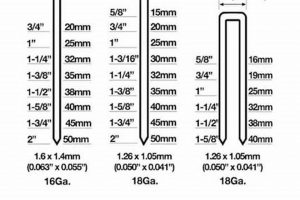
Selecting fasteners of the appropriate size is crucial for securely attaching baseboard trim to walls. The chosen fastener must be long enough to penetrate both the baseboard and the wall studs behind the drywall or plaster, ensuring a firm hold. For example, if a baseboard is 1/2 inch thick and the drywall is also 1/2 inch thick, the fastener must extend at least an inch or more into the stud to provide adequate holding power.
Correctly sized fasteners prevent the baseboard from detaching over time due to movement or impact. Using fasteners that are too short will result in a weak connection, leading to unsightly gaps and potential damage. Conversely, fasteners that are excessively long can pierce through the wall and potentially damage wiring or plumbing, adding unnecessary risk and cost to the installation process. The practice of carefully selecting fasteners has been a cornerstone of carpentry for centuries, evolving from simple pegs to the modern, specialized options available today.
Therefore, factors such as baseboard thickness, wall material, and stud depth are critical considerations when determining appropriate fastener dimensions. Understanding these elements will ensure a professional and lasting installation. The following sections will delve into these factors and provide specific guidelines for selecting the correct size and type of fasteners.
Selecting Appropriate Fastener Dimensions for Baseboard Installation
This section provides essential guidance for choosing the correct fastener size, ensuring a secure and professional baseboard installation.
Tip 1: Measure Baseboard Thickness: Precisely measure the thickness of the baseboard material. This measurement is a fundamental factor in determining the required fastener length.
Tip 2: Assess Wall Material: Identify the wall construction material (drywall, plaster, wood paneling). Account for its thickness when calculating fastener penetration depth.
Tip 3: Target Stud Depth: Ensure the fastener penetrates at least one inch into the wall stud. This provides adequate holding power and prevents loosening over time.
Tip 4: Avoid Over-Penetration: Select a fastener length that prevents it from protruding through the back of the wall. Over-penetration can damage wiring or plumbing and create an unsightly appearance.
Tip 5: Consider Fastener Gauge: Choose a suitable gauge for the fastener. A thinner gauge minimizes splitting, particularly when working with hardwoods.
Tip 6: Pre-Drilling Option: For hardwoods or denser materials, pre-drilling pilot holes reduces the risk of splitting and ensures straighter fastener placement.
Tip 7: Test Fastener Placement: Before final installation, test the selected fastener in an inconspicuous area to assess its holding power and prevent unforeseen issues.
Adhering to these guidelines ensures a secure and aesthetically pleasing baseboard installation. Proper fastener dimension selection is a cornerstone of quality carpentry.
The subsequent section will address advanced techniques and troubleshooting methods for complex baseboard installations.
1. Baseboard Thickness

Baseboard thickness is a primary determinant in the selection of appropriate fastener length. The dimension dictates the minimum length required to securely attach the baseboard to the wall structure.
- Minimum Nail Penetration
The chosen fastener must penetrate the baseboard entirely and extend sufficiently into the wall stud for adequate holding power. A thicker baseboard necessitates a longer fastener to achieve this minimum penetration depth into the stud, usually at least one inch.
- Wall Material Considerations
While baseboard thickness dictates the initial fastener length requirement, the wall material to which it’s being attached must also be considered. Drywall or plaster adds to the overall thickness that the fastener must traverse before reaching the stud. Baseboard plus wall material measurements, therefore, need to be accounted for.
- Avoiding Protrusion
It is critical that the selected fastener is not so long as to protrude through the back of the wall. Baseboard thickness, wall material depth, and stud depth must be summed up to ensure the chosen fastener isn’t excessively long, which could damage hidden wiring or plumbing or simply create an unsightly bump.
- Material Properties
The density and hardness of the baseboard material itself may also influence fastener selection. For example, hardwood baseboards may require pre-drilling to prevent splitting, and the fastener length must be chosen to minimize stress on the wood fibers.
Therefore, baseboard thickness is a foundational measurement influencing fastener selection. The dimension directly affects the minimum length required for adequate stud penetration and overall secure attachment, while also informing decisions related to pre-drilling and material properties.
2. Wall Material

The composition of the wall to which baseboard is being affixed critically impacts the appropriate fastener length. Different materials offer varying degrees of resistance and require differing penetration depths to achieve a secure hold. Choosing an incorrect length, without considering wall material, can result in either a weak attachment or damage to the wall structure.
- Drywall Composition and Thickness
Drywall, typically 1/2 inch or 5/8 inch thick, is a common wall covering. Fasteners must penetrate this layer to reach the underlying stud. The fastener length should accommodate the drywall’s thickness and allow sufficient penetration into the stud itself. Failing to account for drywall thickness can lead to the fastener only anchoring in the drywall, resulting in a weak connection prone to failure. Using too long of a fastener, conversely, can penetrate beyond the stud, creating an unsightly and potentially hazardous protrusion on the opposite side of the wall.
- Plaster Characteristics
Plaster walls, often found in older homes, present a different set of considerations. Plaster can be significantly harder and thicker than drywall, demanding a more robust fastener and potentially requiring pre-drilling to prevent cracking. The required fastener length will necessarily increase to traverse the plaster layer and engage the stud effectively. A fastener designed for drywall may prove inadequate for plaster, resulting in a loose or ineffective attachment.
- Wood Paneling and Substrates
When attaching baseboard to walls with wood paneling, the thickness and density of the paneling must be factored into the fastener length calculation. Furthermore, it’s crucial to determine the material behind the paneling. If the paneling is applied directly to studs, the fastener length needs to ensure proper penetration into the stud, similar to drywall applications. However, if there’s drywall or another substrate behind the paneling, the overall thickness must be considered to achieve a secure anchor.
- Stud Material and Spacing
The material of the wall studs themselves (wood or metal) influences the holding power of the fastener. Wood studs provide a more forgiving surface for fasteners, whereas metal studs may require specialized fasteners designed for metal framing. Additionally, stud spacing can affect fastener placement. If studs are widely spaced, the fastener may need to be angled slightly to ensure it enters the stud effectively.
The selection of appropriate fastener length hinges directly on a thorough understanding of the wall’s composition. Failure to accurately assess and account for the properties of drywall, plaster, wood paneling, and stud material can compromise the integrity of the baseboard installation, leading to premature failure and potential damage to the surrounding structure. Precise measurement and informed fastener selection are, therefore, paramount.
3. Stud Depth

Stud depth, representing the distance from the wall surface to the back of the stud, is a critical factor when determining appropriate fastener length. Insufficient penetration into the stud compromises the holding power, while excessive length can lead to unwanted protrusion or damage.
- Minimum Penetration Requirement
The industry standard typically mandates a minimum fastener penetration of one inch into the stud. This ensures a secure grip capable of withstanding normal stresses and preventing the baseboard from loosening over time. Less than one inch of penetration can lead to a weak connection and eventual failure.
- Stud Material and Density
The composition of the stud itself, whether softwood, hardwood, or metal, affects the necessary fastener length. Softer woods offer less resistance, necessitating a slightly longer fastener to achieve adequate grip. Metal studs require specialized fasteners designed for metal framing.
- Accounting for Wall Coverings
The combined thickness of drywall, plaster, or other wall coverings must be added to the stud depth when calculating fastener length. These materials reduce the effective penetration into the stud, demanding longer fasteners to compensate.
- Risk of Over-Penetration
Using a fastener that is too long, exceeding the stud depth, carries the risk of protruding through the back of the stud, potentially damaging electrical wiring, plumbing, or creating an unsightly bump on the opposite side of the wall. Careful calculation is paramount.
The selection of the proper fastener length necessitates a comprehensive understanding of stud depth in conjunction with wall covering thickness and stud material. Accurate measurement and informed fastener selection are essential for a secure and professional baseboard installation.
4. Nail Gauge

Nail gauge, a measure of nail diameter, profoundly influences the selection of appropriate length fasteners for baseboard installation. Its significance extends beyond mere size, impacting holding power, aesthetic considerations, and the risk of material damage.
- Splitting Mitigation
A thinner nail gauge reduces the risk of splitting the baseboard material, particularly when working with hardwoods or brittle composites. This is especially important near the edges of the baseboard or when nailing close to knots or other imperfections. Smaller gauge nails require less force to penetrate the material, minimizing stress concentrations that lead to splitting. Using a thicker gauge nail in these situations may necessitate pre-drilling, adding time and complexity to the installation process.
- Holding Power Trade-offs
While a smaller gauge nail reduces the risk of splitting, it generally offers less holding power compared to a larger gauge nail of the same length. Therefore, selecting an appropriate length to compensate for the reduced diameter is crucial. Longer, thinner gauge nails may be required to achieve the same level of grip as shorter, thicker gauge nails. Consideration must be given to the type of wall stud (wood vs. metal) and the material of the baseboard itself when balancing gauge and length for optimal holding power.
- Cosmetic Finish Considerations
Nail gauge impacts the visibility of the nail head after installation. Thinner gauge nails leave smaller holes, requiring less filler and creating a smoother, more professional finish. This is particularly important for painted baseboards where nail holes are more noticeable. The chosen length should be sufficient to allow for countersinking without compromising holding power, allowing for effective filling and sanding to achieve a seamless surface.
- Fastener Compatibility
The nail gun or fastening tool being used also affects the gauge and length of nails that can be employed. Different tools accept different gauge and length ranges. Before selecting the appropriate length nail, it’s imperative to verify that the chosen gauge and length are compatible with the available fastening equipment. Attempting to use incompatible fasteners can damage the tool or result in improper nail installation.
In conclusion, nail gauge and fastener length for baseboard installation are inextricably linked. A judicious balance must be struck between mitigating splitting, maximizing holding power, achieving a seamless finish, and ensuring compatibility with available tools. The appropriate fastener length is therefore determined not solely by baseboard and wall thickness but also by the chosen gauge, necessitating a holistic approach to material selection.
5. Holding Power
The holding power of finish nails is directly correlated to the length of the fastener selected for baseboard installation. Insufficient length compromises the ability of the nail to resist withdrawal forces, leading to potential detachment and instability. The effectiveness of the connection relies on adequate penetration into both the baseboard material and the underlying wall stud. For instance, if a baseboard is installed using nails that only penetrate the drywall layer and fail to reach the stud, the holding power is negligible, resulting in a loose and easily dislodged trim piece. Conversely, nails of appropriate length, driven securely into the stud, establish a robust mechanical bond, effectively resisting movement and maintaining the baseboard’s position over time. Therefore, considering the combined thickness of the baseboard and wall material to ensure sufficient stud penetration is crucial for maximizing holding power.
Holding power is also influenced by factors beyond mere length, including the type of wood, the presence of knots, and the nail’s shank design. Denser woods offer greater resistance, requiring less penetration depth than softer woods to achieve comparable holding power. Knots, being denser and harder than surrounding wood, can deflect nails, reducing penetration depth and potentially compromising the connection. Ring-shank nails, with their spiraled design, offer superior holding power compared to smooth-shank nails, as the rings interlock with the wood fibers, resisting withdrawal. An example would be in installing a solid oak baseboard; if smooth nails were to be use, the oak will work against the smooth nail, causing it to become loose over time.
In summary, holding power is a paramount consideration when determining appropriate fastener dimensions for baseboard installation. Sufficient nail length, coupled with informed material selection and proper installation techniques, ensures a secure and long-lasting attachment. Understanding the interplay between nail length, wood density, and nail design is essential for achieving optimal holding power and preventing premature baseboard failure. Ignoring these factors can result in costly repairs and aesthetic imperfections, highlighting the practical significance of informed fastener selection.
6. Wood Splitting
The propensity of wood to split is a critical consideration when determining fastener dimensions for baseboard installation. An inappropriately sized fastener, particularly one with excessive diameter relative to its length, can induce splitting, compromising the integrity of both the baseboard and the connection. For instance, driving a thick nail too close to the edge of a hardwood baseboard without pre-drilling frequently results in a crack extending along the grain. This phenomenon directly influences fastener length selection; shorter fasteners, combined with pre-drilling, can mitigate this risk. Understanding this relationship is crucial for preserving the aesthetic appeal and structural soundness of the installation.
Furthermore, the angle of nail entry also plays a role in wood splitting. Angling the nail excessively, while sometimes necessary for securing baseboards in tight corners, increases the stress on the wood fibers, potentially leading to splitting along the grain. In such scenarios, a longer fastener, driven at a shallower angle, may distribute the force more evenly, reducing the risk. Alternatively, selecting a thinner gauge nail, even if it necessitates a slight increase in length to maintain holding power, can further minimize the potential for splitting. Proper technique, including the use of a nail set to countersink the nail head, also contributes to preventing surface splitting.
In conclusion, mitigating wood splitting is an integral aspect of appropriate fastener length determination for baseboard installation. The selection process must consider wood species, fastener diameter, angle of entry, and pre-drilling practices to ensure a durable and aesthetically pleasing result. A thorough understanding of these variables allows for informed decisions that minimize the risk of wood splitting, thereby preserving the long-term integrity of the installed baseboard. Failure to adequately address this aspect can lead to unsightly cracks, weakened connections, and ultimately, the premature failure of the installation.
7. Cosmetic Finish
The ultimate appearance of a baseboard installation is intrinsically linked to the selection of appropriate fasteners. The fastener’s size, particularly its length, directly influences the ease and effectiveness of achieving a seamless and visually appealing finish.
- Nail Hole Size and Visibility
Nail length dictates the extent to which the nail head can be effectively countersunk without compromising holding power. Excessively long fasteners may protrude too far beyond the surface, creating deeper, more noticeable holes that require extensive filling and sanding. Conversely, fasteners that are too short may not allow for sufficient countersinking, leaving nail heads exposed and detracting from the overall aesthetic. A balanced length allows for proper countersinking, minimizing the size and visibility of nail holes after filling.
- Filler Application and Sanding
Appropriate fastener length simplifies the process of applying filler to conceal nail holes. Properly countersunk nails create shallow depressions that are easily filled with wood putty or spackle. Overly deep holes, caused by excessive fastener length, require multiple applications of filler and extensive sanding to achieve a smooth, level surface. Inadequate countersinking, due to fasteners being too short, results in raised nail heads that are difficult to conceal effectively, even with filler and sanding. Precise fastener length ensures efficient and effective filler application, streamlining the finishing process.
- Paint and Stain Compatibility
The success of a painted or stained baseboard finish relies on a smooth, uniform surface free from imperfections. Fastener length influences the final appearance by impacting the texture and consistency of the filled nail holes. Overfilled or poorly sanded nail holes, often a consequence of inappropriate fastener length, can create visible patches or uneven surfaces that are particularly noticeable under paint or stain. A well-selected fastener length, coupled with proper filling and sanding techniques, produces a seamless surface that readily accepts paint or stain, resulting in a professional-looking finish.
- Long-Term Aesthetic Integrity
The chosen fastener length affects the long-term aesthetic integrity of the baseboard installation. Inadequate holding power, often a consequence of using fasteners that are too short, can lead to the baseboard detaching from the wall over time, creating gaps and unsightly separations. Excessive fastener length, on the other hand, can increase the risk of splitting or damaging the baseboard material, leading to visible cracks and imperfections. Selecting a fastener length that balances holding power with aesthetic considerations ensures a durable and visually appealing finish that withstands the test of time.
Therefore, careful consideration of fastener length is crucial for achieving a high-quality cosmetic finish in baseboard installation. The optimal length facilitates effective countersinking, simplifies filler application, enhances paint and stain compatibility, and contributes to long-term aesthetic integrity. By prioritizing appropriate fastener length, installers can ensure a seamless and visually pleasing result that enhances the overall appearance of the space.
Frequently Asked Questions
This section addresses common inquiries regarding the selection of appropriate fastener dimensions for baseboard installation, providing clear and concise answers to ensure secure and aesthetically pleasing results.
Question 1: What constitutes the minimum acceptable penetration depth into a wall stud for securing baseboard?
A minimum penetration depth of one inch into the wall stud is generally recommended to ensure adequate holding power and prevent the baseboard from loosening over time. This depth provides a secure anchor capable of resisting normal stresses.
Question 2: How does wall material (drywall vs. plaster) influence the required fastener length?
Wall material thickness must be considered when calculating fastener length. Drywall and plaster add to the overall thickness the fastener must traverse. Account for these material depths to ensure the fastener reaches the stud with sufficient penetration.
Question 3: What are the potential consequences of using fasteners that are too short for baseboard installation?
Using fasteners that are too short results in a weak connection, prone to failure. The baseboard may detach from the wall, creating unsightly gaps and potential damage. Fasteners anchoring only in drywall offer negligible holding power.
Question 4: Is there a risk associated with using fasteners that are excessively long for baseboard installation?
Yes, fasteners that are too long can protrude through the back of the wall, potentially damaging wiring or plumbing. This also creates an unsightly bump on the opposite side of the wall. Over-penetration presents both aesthetic and safety concerns.
Question 5: How does the density of the baseboard material affect the selection of appropriate fastener dimensions?
Denser baseboard materials, such as hardwoods, may require pre-drilling to prevent splitting. While pre-drilling mitigates splitting, it does not eliminate the need to select appropriate fastener length.
Question 6: Should nail gauge be considered when determining appropriate fastener length for baseboard?
Yes, nail gauge influences fastener length selection. Thinner gauge nails reduce splitting risk, but may require increased length to compensate for reduced holding power. A balance between gauge and length is essential for optimal performance.
In summary, selecting the correct fastener length is crucial. Precise measurement of baseboard and wall thickness, coupled with consideration of stud depth and nail gauge, is paramount for successful baseboard installation.
The next section will delve into common mistakes to avoid when selecting fasteners.
Conclusion
The preceding exploration has delineated the critical factors governing fastener length selection for baseboard installation. Baseboard thickness, wall material composition, stud depth, nail gauge, and desired holding power represent interconnected elements that mandate careful consideration. Improper fastener selection risks compromised structural integrity, aesthetic imperfections, and potential damage to underlying infrastructure. The proper approach to selecting “what length finish nails for baseboard” involves diligent measurement, informed material evaluation, and adherence to established best practices.
Mastery of these principles ensures a secure, visually appealing, and enduring baseboard installation. Continued diligence in fastener selection, informed by evolving building materials and construction techniques, will remain paramount for achieving professional-grade results. Prioritizing meticulous planning and execution guarantees the longevity and structural soundness of every baseboard application.