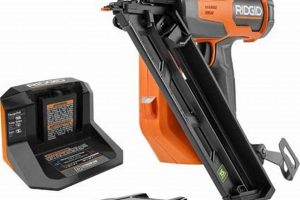
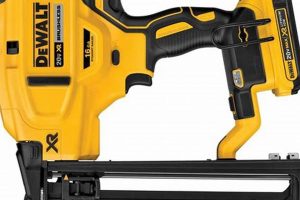
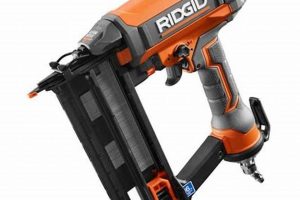
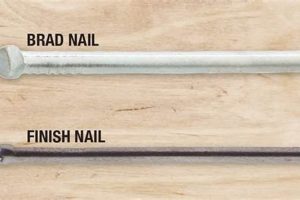
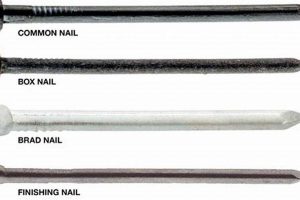
This pneumatic tool, utilizing collated nails of a specific diameter and set at an angle within its magazine, is primarily designed for precise woodworking applications. An example would be securing trim and molding to a wall, leaving a minimal hole requiring less filler.
The importance of this particular type of nailer lies in its ability to access tight corners and provide a cleaner, more professional finish compared to using larger gauge nailers or traditional hand-nailing methods. Its angled magazine allows for greater maneuverability, and the smaller nail diameter reduces the likelihood of splitting delicate wood. Its development reflects advancements in pneumatic tool technology aimed at increasing efficiency and precision in carpentry.
The remainder of this article will delve into specific applications, safety considerations, maintenance procedures, and factors to consider when selecting the optimal model for a given task.
Tips for Optimal Use
The following tips aim to maximize the performance and longevity of the equipment while ensuring user safety and project quality.
Tip 1: Select the Correct Nail Length: Using nails that are too long can result in blow-through, damaging the workpiece or creating a safety hazard. Shorter nails may lack sufficient holding power. Always test nail length on a scrap piece of material before beginning the project.
Tip 2: Adjust Depth of Drive: The depth of drive setting controls how far the nail is driven into the material. Adjusting this setting ensures the nail head is flush with the surface without damaging the surrounding wood fiber.
Tip 3: Maintain Air Pressure: Operating within the recommended air pressure range, typically specified in the tool’s manual, is crucial for consistent nail delivery and preventing damage to the internal components of the tool.
Tip 4: Regularly Lubricate the Tool: Add a few drops of pneumatic tool oil into the air inlet before each use. This lubrication minimizes friction and wear, extending the lifespan of the tool.
Tip 5: Use Eye and Ear Protection: The force of the tool and the potential for flying debris necessitate the use of safety glasses and ear protection to prevent injury.
Tip 6: Inspect the Work Surface: Before firing, verify the work surface is free of knots, splits, or other defects that may cause the material to splinter or the nail to deflect.
Tip 7: Avoid Overdriving Nails Near Edges: Driving nails too close to the edge of the workpiece can cause splitting. Maintain a safe distance from the edge, especially with brittle materials.
Tip 8: Clean and Store Properly: After each use, disconnect the air supply, clean any debris from the tool, and store it in a dry environment to prevent rust and corrosion.
Implementing these strategies will result in enhanced tool performance, improved project outcomes, and a safer working environment.
The next section will examine the common problems encountered, and troubleshooting measures to resolve these.
1. Angled Magazine

The angled magazine is a defining characteristic of certain 16 gauge finish nailers, significantly influencing their usability in specific applications. Its design deviates from traditional straight magazines, offering distinct advantages in maneuverability and access to confined spaces.
- Enhanced Accessibility in Tight Spaces
The primary function of an angled magazine is to facilitate nail placement in corners and other areas where a straight magazine would be impractical. This is particularly relevant when installing crown molding or intricate trim work, allowing the user to maintain a consistent nailing angle without obstruction. For instance, fitting trim around a door frame becomes significantly easier with an angled nailer.
- Improved Maneuverability
The angle reduces the overall length of the tool along the nailing axis, enabling operation in closer proximity to adjacent surfaces. This is especially useful in pre-existing structures where space is limited. An example would be securing baseboards to a wall in a small room, minimizing the need for awkward positioning.
- Ergonomic Considerations
While the angled design improves accessibility, it may also impact the tool’s balance and handling. Some users might find the altered weight distribution less comfortable compared to straight-magazine nailers, particularly during extended use. Therefore, ergonomic design plays a crucial role in mitigating potential fatigue.
- Nail Collation Compatibility
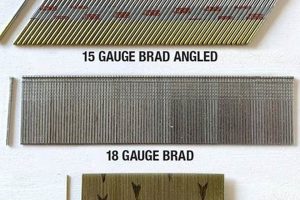
The angled magazine necessitates the use of specifically collated nails designed to accommodate the magazine’s geometry. This limits the interchangeability of nail strips with straight-magazine nailers and requires careful attention to ensure compatibility during nail procurement.
In summary, the angled magazine enhances the versatility of the 16 gauge finish nailer by enabling access to challenging locations. However, potential users should consider the trade-offs related to ergonomics and nail collation when selecting such a tool. The design’s benefits are most pronounced in detailed finish carpentry where precision and accessibility are paramount.
2. Nail Gauge

Nail gauge, a numerical designation indicating nail diameter, is a critical specification influencing the functionality and application of a 16 gauge angled finish nailer. The gauge directly impacts holding power, material compatibility, and the aesthetic outcome of the finished product.
- Holding Power and Material Thickness
A higher gauge number signifies a smaller nail diameter. 16 gauge nails offer a balance between sufficient holding strength for trim and molding and minimal visibility on the finished surface. They are suitable for securing relatively thin materials where excessive splitting is a concern. For example, 16 gauge nails are commonly used to attach quarter-round molding to baseboards.
- Visibility and Finishing Requirements
The relatively small diameter of a 16 gauge nail results in a smaller entry and exit hole, reducing the amount of patching and filling required after installation. This is particularly important in applications where a smooth, seamless finish is desired, such as fine cabinetry or furniture construction. The smaller hole minimizes disruption to the wood grain and reduces the potential for unsightly blemishes.
- Nailer Compatibility and Functionality
The 16 gauge angled finish nailer is specifically designed to accommodate nails of this diameter. Attempting to use nails of a different gauge can result in jams, misfires, and potential damage to the tool. The nailer’s internal mechanisms, including the driver blade and magazine, are calibrated for the precise dimensions of 16 gauge nails.
- Material Splitting and Wood Density
When working with denser hardwoods, a 16 gauge nail may be adequate, but care should be taken to avoid bending or breakage. In softer woods, the small diameter reduces the risk of splitting the material, a common problem when using larger gauge nails. The choice of nail gauge must therefore be carefully considered in relation to the wood species being used.
In conclusion, nail gauge is an integral component of the 16 gauge angled finish nailer system. Its selection should be based on a careful evaluation of the material properties, the desired aesthetic outcome, and the specific requirements of the task at hand. Understanding the relationship between nail gauge and nailer functionality is crucial for achieving optimal results and preventing potential problems.
3. Pneumatic Power

The operational effectiveness of a 16 gauge angled finish nailer is fundamentally linked to its reliance on pneumatic power. Compressed air serves as the energy source, driving the nail consistently and efficiently. Without a suitable compressed air supply, the tool is rendered inoperable. The pressure supplied dictates the driving force of the nail; insufficient pressure results in nails not being fully seated, while excessive pressure can lead to overdriving and material damage. For example, using a compressor set to 70 PSI when the nailer requires 90 PSI will likely result in nails protruding from the workpiece, necessitating manual correction or compromised structural integrity.
The benefits of pneumatic power extend beyond simple operation. It enables rapid, repetitive nail firing, increasing productivity compared to manual methods. The consistency of air pressure provides a uniform driving force, minimizing variations in nail depth and ensuring a professional finish. Furthermore, pneumatic systems generally exhibit higher power-to-weight ratios than electrically powered counterparts, resulting in lighter and more maneuverable tools. The absence of an electric motor directly on the tool also contributes to a reduced risk of electrical hazards, particularly in damp or outdoor environments. As an example, the use of pneumatic nailers significantly reduces the labor required for installing extensive crown molding in large residential projects, shortening project timelines and improving overall efficiency.
However, the dependence on pneumatic power introduces logistical considerations. A compressor unit, air hoses, and appropriate fittings are essential components of the system, adding to the initial equipment cost and requiring space for storage and operation. Furthermore, the noise generated by the compressor can be a nuisance, requiring mitigation measures in noise-sensitive environments. Despite these challenges, pneumatic power remains a cornerstone of modern finish carpentry, offering a balance of power, efficiency, and reliability that is difficult to replicate with alternative technologies. The integration of pneumatic power into 16 gauge angled finish nailers is critical to realizing their full potential in delivering high-quality, consistent results in finish carpentry applications.
4. Finish Applications

The utility of a 16 gauge angled finish nailer is fundamentally defined by its suitability for specific finish applications in carpentry and woodworking. These applications are characterized by the need for precision, minimal surface marring, and secure attachment of lightweight materials. The tool’s design, particularly its angled magazine and smaller nail gauge, directly addresses the requirements of these tasks. Without appropriate finish applications, the specialized features of this nailer would be largely irrelevant. Examples include installing delicate trim, molding, cabinetry facing, and decorative elements, where a larger nail or less maneuverable tool would be detrimental. The significance of understanding this connection lies in selecting the right tool for the job, thereby optimizing efficiency and achieving a high-quality outcome. Mismatching the tool to the application can result in material damage, insecure fastening, and a compromised aesthetic appearance.
Further practical applications include attaching window casings, door frames, and baseboards. In these scenarios, the angled magazine allows for access to tight corners and difficult-to-reach areas, while the 16 gauge nails provide adequate holding power without excessively splitting the wood. When working with hardwoods, pre-drilling pilot holes may still be necessary to prevent splitting, but the smaller nail gauge minimizes the visibility of these holes. In furniture making, the nailer can be used to assemble drawer boxes, secure cabinet backs, and attach decorative elements, providing a cleaner and more professional finish than screws or larger nails. In each of these examples, the inherent characteristics of the finish application directly dictate the selection and appropriate use of the 16 gauge angled finish nailer.
In summary, the success of any project utilizing a 16 gauge angled finish nailer hinges on a clear understanding of its intended finish applications. Challenges arise when attempting to use the tool for tasks outside its design parameters, such as framing or heavy structural work. Recognizing these limitations and adhering to recommended applications ensures optimal performance, minimizes potential damage, and ultimately contributes to the successful completion of finish carpentry projects. The effective utilization of this tool is intrinsically linked to a comprehensive understanding of the nuanced requirements of various finish applications.
5. Depth Adjustment

Depth adjustment is a crucial feature on a 16 gauge angled finish nailer, allowing for precise control over how deeply the nail is driven into the workpiece. This functionality is integral to achieving a professional finish and preventing damage to the material.
- Flush Fastening and Consistent Results
The primary role of depth adjustment is to ensure that nails are driven flush with the surface of the material without either protruding or being driven too deeply, which can mar the surrounding wood. For example, when attaching trim to a cabinet face, an appropriate depth setting prevents the nail head from being visible or from creating an unsightly depression. Consistent depth across multiple nails contributes to a uniform and aesthetically pleasing finish.
- Material Compatibility and Preventing Damage
Different materials possess varying densities and hardness levels. Depth adjustment allows the user to compensate for these differences. When working with softer woods like pine, a shallower depth setting prevents overdriving the nail and splitting the material. Conversely, harder woods like oak may require a deeper setting to ensure the nail is fully seated. Adjusting the depth setting is critical to preventing damage and achieving secure fastening across a range of materials.
- Tool Performance and Longevity
Operating a 16 gauge angled finish nailer with an improperly set depth can negatively impact its performance and lifespan. Overdriving nails can place undue stress on the tool’s internal components, potentially leading to premature wear or failure. Conversely, underdriving nails can cause jams and misfires. Setting the appropriate depth optimizes tool performance and minimizes the risk of mechanical problems.
- User Skill and Application Precision
While depth adjustment provides a valuable degree of control, its effective use relies on the skill and experience of the operator. Achieving optimal results often requires testing different depth settings on scrap material before beginning the actual project. Fine-tuning the depth setting based on material characteristics and the desired outcome is essential for achieving professional-quality results in finish carpentry applications.
In summary, depth adjustment on a 16 gauge angled finish nailer is not merely a convenience feature; it is a fundamental control mechanism that dictates the quality, precision, and longevity of both the tool and the finished product. Mastering this adjustment is key to unlocking the full potential of the tool in a wide range of finish carpentry applications.
6. Collation Type

Collation type, referring to the method by which nails are connected for loading into a nailer, is a critical factor influencing the efficiency and operational characteristics of a 16 gauge angled finish nailer. The collation method determines loading speed, magazine capacity, and compatibility with specific nailer models. Selecting an appropriate collation type is crucial for optimizing productivity and minimizing downtime during finish carpentry tasks.
- Strip Collation
Strip collation, characterized by nails arranged linearly and joined by a thin adhesive or wire, is a common configuration for 16 gauge angled finish nailers. This method offers a balance between ease of loading and magazine capacity. A typical strip might contain between 50 and 100 nails. Strip collation is well-suited for applications where frequent reloading is not a major impediment, such as small to medium-sized trim projects. In practice, a carpenter installing baseboards might prefer strip collation due to its manageable size and simple loading process.
- Coil Collation
Coil collation involves nails wound together in a coil and held by a wire or plastic strip. While less prevalent in angled finish nailers compared to framing nailers, coil collation offers a significantly higher nail capacity, potentially holding several hundred nails. This configuration is advantageous for large-scale projects where minimizing reloading frequency is paramount. For example, a contractor installing siding on a large residential building might opt for a coil-fed nailer to reduce downtime. However, the larger size and weight of coil-fed nailers can sometimes compromise maneuverability in tight spaces.
- Material of Collation
The material used for collation, typically plastic, paper, or wire, impacts the tool’s performance and the work environment. Plastic collation can sometimes leave small fragments behind, requiring cleanup. Paper collation is biodegradable but may be more susceptible to damage from moisture. Wire collation is robust but can pose a safety hazard if not handled carefully. The choice of collation material should consider environmental factors and safety protocols. For instance, a carpenter working indoors might prefer paper collation to minimize plastic waste, while a construction site with exposure to the elements might necessitate wire collation for its durability.
- Angle of Collation
The angle at which nails are collated is crucial for compatibility with angled finish nailers. The collation angle must align with the nailer’s magazine design to ensure proper feeding and firing. Incorrect collation angles can cause jams, misfires, and damage to the tool. It is imperative to verify that the nail collation angle matches the specifications of the 16 gauge angled finish nailer. For example, using a straight-collated nail strip in an angled nailer would invariably lead to malfunctions, whereas using 20 degree collation nails will work.
In summary, collation type is a pivotal consideration when selecting and utilizing a 16 gauge angled finish nailer. Strip collation provides a practical balance for many finish carpentry tasks, while coil collation offers enhanced capacity for large-scale projects. The material and angle of collation directly influence the tool’s performance and compatibility. Therefore, a thorough understanding of these factors is essential for maximizing efficiency and achieving optimal results in various finish carpentry applications.
Frequently Asked Questions
The following questions address common inquiries regarding the operation, maintenance, and application of the 16 gauge angled finish nailer.
Question 1: What distinguishes a 16 gauge angled finish nailer from other types of nailers?
The primary distinction lies in the combination of nail gauge and magazine angle. The 16 gauge refers to the nail diameter, suitable for fine trim work, while the angled magazine allows access to corners and tight spaces inaccessible to straight-magazine nailers.
Question 2: Is lubrication required for a 16 gauge angled finish nailer?
Yes, regular lubrication with pneumatic tool oil is essential for proper operation and longevity. A few drops of oil should be added to the air inlet before each use to minimize friction and prevent premature wear of internal components.
Question 3: What air pressure is recommended for optimal performance?
The recommended air pressure varies by model and manufacturer. Consult the tool’s manual for specific recommendations, typically ranging from 70 to 100 PSI. Operating outside this range can lead to inconsistent nail driving or damage to the tool.
Question 4: What types of projects are best suited for this nailer?
This nailer is best suited for finish carpentry applications such as installing trim, molding, cabinetry, and decorative elements. Its smaller nail diameter and angled magazine make it ideal for tasks requiring precision and minimal surface damage.
Question 5: What safety precautions should be observed when using this tool?
Eye and ear protection are mandatory. Ensure the workpiece is securely supported. Disconnect the air supply before performing maintenance or clearing jams. Never point the tool at oneself or others. Adhere to all safety guidelines outlined in the tool’s manual.
Question 6: How is nail depth adjusted on a 16 gauge angled finish nailer?
Most models feature a depth adjustment mechanism, typically a dial or knob located near the nose of the tool. Adjusting this setting controls how deeply the nail is driven into the material, preventing overdriving or underdriving. Test settings on scrap material before proceeding with the project.
The key takeaways from these FAQs are the importance of understanding the tool’s specific features, adhering to safety guidelines, and performing regular maintenance to ensure optimal performance and longevity.
The next section will explore common problems encountered with the 16 gauge angled finish nailer and provide troubleshooting tips.
Conclusion
This article has presented a comprehensive overview of the 16 gauge angled finish nailer, encompassing its definition, applications, operational considerations, and maintenance requirements. The nuanced examination of nail gauge, magazine angle, pneumatic power, and collation type elucidates the tool’s specific capabilities and limitations within the realm of finish carpentry. Furthermore, the discussion of depth adjustment underscores the importance of precision in achieving professional-quality results. Finally, a review of frequently asked questions has addressed common user concerns and reinforced the necessity of safe and informed operation.
The 16 gauge angled finish nailer remains a valuable asset for professionals and serious hobbyists engaged in detailed woodworking projects. Continued adherence to recommended practices and a commitment to ongoing maintenance will ensure the longevity and optimal performance of this specialized tool. Its proper utilization contributes directly to the quality and durability of finished products, solidifying its significance in the broader context of carpentry and construction.