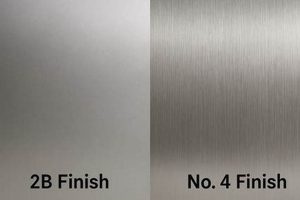
The external texture and appearance of stainless steel, achieved through various manufacturing processes, significantly impacts its functional and aesthetic properties. These processes range from simple mechanical polishing to complex chemical treatments, each resulting in a unique visual and tactile quality. For example, a mirror-like surface is suitable for decorative applications, whereas a rougher, matte texture may be preferred for industrial settings requiring enhanced grip or reduced glare.
The characteristics of the resultant exterior are crucial for corrosion resistance, cleanability, and overall durability. A well-prepared exterior minimizes surface imperfections, reducing the potential for contaminant buildup and corrosion initiation. Furthermore, it plays a vital role in hygiene-sensitive environments such as food processing and healthcare. Historically, the development of specific methods has been driven by the need for increased performance and expanded applications of stainless steel across diverse industries.
The following discussion will delve into specific types of exterior preparation, the methods used to achieve them, and the factors influencing their selection for particular applications. These factors include cost, performance requirements, and aesthetic considerations.
Practical Considerations for Stainless Steel Exteriors
Optimizing the selection and maintenance of stainless steel’s exterior is paramount for ensuring longevity, performance, and aesthetic appeal across various applications.
Tip 1: Specify Application-Appropriate Exteriors: The selection process must align with the intended use environment. A highly polished exterior, while aesthetically pleasing, may not be ideal for high-wear applications. Conversely, a brushed or blasted exterior may offer superior abrasion resistance in industrial settings.
Tip 2: Understand the Impact of Fabrication Processes: Welding, forming, and machining can alter the original exterior. Post-fabrication treatments, such as passivating or re-polishing, may be necessary to restore or enhance the intended properties.
Tip 3: Implement Regular Cleaning Procedures: Routine cleaning removes contaminants that can compromise the protective passive layer of the metal, thus preventing corrosion. Use cleaning agents specifically formulated for stainless steel to avoid damage.
Tip 4: Consider Surface Roughness (Ra) Values: Quantifying the roughness is critical in applications requiring strict hygienic standards, such as food processing or pharmaceutical manufacturing. Lower Ra values indicate smoother exteriors that are easier to clean and sanitize.
Tip 5: Avoid Abrasive Cleaning Methods: Abrasive cleaners or tools can scratch the exterior, creating sites for corrosion initiation. Opt for non-abrasive alternatives and soft cloths or brushes.
Tip 6: Perform Regular Inspections: Regularly inspect stainless steel components for signs of damage, corrosion, or discoloration. Addressing these issues promptly can prevent more significant problems from developing.
Tip 7: Protect Surfaces During Installation and Transport: Safeguarding stainless steel exteriors from scratches and dents during installation and transportation is crucial. Use protective films or padding to minimize potential damage.
Proper consideration of these points will contribute to maximizing the service life and maintaining the desired properties of stainless steel components. This, in turn, optimizes performance and minimizes maintenance costs.
The subsequent section will explore common challenges encountered with stainless steel exteriors and strategies for mitigation.
1. Appearance (aesthetic quality)

The aesthetic quality of stainless steel is directly dictated by the specific preparation applied. The resultant visual properties can range from highly reflective, mirror-like surfaces to matte, textured finishes, each serving distinct design and functional purposes. These appearances are integral to the overall product appeal and influence its suitability for various applications.
- Reflectivity and Specularity
Reflectivity, the measure of light reflected from the exterior, is a key determinant of visual impact. Highly polished exteriors exhibit high specularity, creating a mirror-like appearance desirable in architectural applications or decorative elements. Conversely, matte exteriors diffuse light, minimizing glare and creating a more subtle, understated aesthetic. This is relevant in applications where visual distraction is undesirable.
- Texture and Pattern
The texture imparted to stainless steel impacts its visual appeal and tactile qualities. Brushed exteriors, characterized by fine, parallel lines, offer a directional aesthetic and can conceal minor imperfections. Embossed or patterned exteriors add visual interest and can enhance the material’s structural rigidity. The selection of texture directly influences the perceived quality and sophistication of the finished product.
- Color and Luster
While stainless steel is primarily associated with a metallic silver hue, variations in chemical composition and exterior preparation can influence its color and luster. Anodizing, for example, can create a range of colored exteriors, expanding design possibilities. The luster, or sheen, of stainless steel ranges from bright and reflective to dull and matte, depending on the degree of polishing and the presence of surface oxides.
- Uniformity and Consistency
Uniformity in the exterior is critical for maintaining a consistent aesthetic across a product or project. Variations in color, texture, or reflectivity can detract from the overall visual quality. Strict quality control measures during manufacturing and exterior preparation are essential to ensure a consistent and aesthetically pleasing outcome.
The careful consideration of reflectivity, texture, color, and uniformity is paramount in achieving the desired aesthetic for stainless steel applications. Each preparation technique offers a unique set of visual characteristics, allowing designers and engineers to tailor the appearance of stainless steel to meet specific design requirements and functional needs. The interplay between these elements defines the overall aesthetic quality and contributes to the perceived value and appeal of the finished product.
2. Corrosion resistance

The inherent corrosion resistance of stainless steel is significantly influenced by its exterior characteristics. The relationship between these two factors is pivotal in determining the material’s suitability for various service environments. Exterior treatments modify the passive layer, which is intrinsically linked to the metal’s resistance to degradation.
- Passivation Layer Integrity
The chromium oxide passive layer on stainless steel is the primary defense against corrosion. Certain processes enhance this layer. Proper pickling and passivation treatments, for example, remove surface contaminants and encourage the formation of a uniform, stable passive layer. Conversely, improper grinding or machining can damage the passive layer, creating sites susceptible to corrosion. Surface roughness also plays a role; smoother exteriors reduce the potential for contaminant buildup, thereby limiting corrosion initiation.
- Impact of Exterior Roughness
The degree of roughness directly affects corrosion performance. Rough exteriors provide increased surface area for corrosive agents to interact with the metal. Crevices and pits act as collection points for moisture and chlorides, leading to localized corrosion such as pitting and crevice corrosion. Polished exteriors, on the other hand, minimize these irregularities, providing a smoother, more corrosion-resistant surface.
- Effects of Contamination
Contaminants embedded during manufacturing or use can compromise corrosion resistance. Iron particles from grinding wheels, for example, can initiate rust spots on stainless steel. Similarly, chlorides from marine environments or cleaning agents can attack the passive layer, leading to pitting corrosion. Proper cleaning and handling practices are essential to remove these contaminants and maintain the integrity of the exterior.
- Influence of Specific Treatments
Specific exterior treatments can enhance corrosion resistance in particular environments. Electropolishing, for instance, smooths the exterior at a microscopic level, improving resistance to pitting and crevice corrosion in chloride-rich environments. Nitriding or other surface hardening treatments can improve resistance to wear and erosion, which indirectly contribute to corrosion resistance by minimizing material loss.
The corrosion resistance of stainless steel is not solely determined by its chemical composition but is profoundly influenced by the exterior. Understanding the interplay between the preparation method, exterior roughness, contamination, and specific treatments is critical for selecting the appropriate type for a given application and ensuring long-term performance in corrosive environments. The control of the exterior enables optimization of the material’s inherent resistance to degradation.
3. Cleanability (hygienic properties)

Cleanability, a critical characteristic in applications ranging from food processing to medical equipment, is intrinsically linked to the exterior of stainless steel. The ability to effectively remove contaminants and prevent bacterial adhesion depends largely on the topography of the metal’s exterior.
- Surface Roughness and Bacterial Adhesion
Surface roughness, quantified by the Ra value, is a primary determinant of cleanability. Rough exteriors provide increased surface area and sheltered locations for bacteria to adhere and proliferate. Lower Ra values, indicating smoother exteriors, reduce bacterial adhesion, simplifying cleaning and sanitization procedures. Industries with stringent hygienic requirements often specify maximum Ra values to ensure effective cleaning protocols.
- Effect of Polishing Techniques
Polishing techniques significantly impact the cleanability of stainless steel. Electropolishing, for example, creates an extremely smooth exterior by removing microscopic imperfections, reducing the potential for contaminant entrapment. Mechanical polishing, while effective in creating a visually appealing exterior, may not achieve the same degree of smoothness as electropolishing. The selection of the polishing technique directly influences the effectiveness of cleaning procedures.
- Influence of Passivation
Passivation, the process of forming a chromium oxide layer, enhances both corrosion resistance and cleanability. A properly passivated exterior is less susceptible to corrosion, which can create crevices and pits that harbor bacteria. Passivation also contributes to a smoother, more uniform exterior, facilitating the removal of contaminants during cleaning. The effectiveness of passivation is contingent on proper execution and the absence of contaminants that could inhibit the formation of a complete passive layer.
- Impact of Cleaning Procedures
The effectiveness of cleaning procedures depends on the compatibility between the cleaning agents and the exterior of the stainless steel. Abrasive cleaners can scratch the exterior, creating sites for bacterial adhesion. Harsh chemicals can damage the passive layer, compromising corrosion resistance and cleanability. The selection of appropriate cleaning agents and procedures is essential for maintaining the hygienic properties of stainless steel without damaging its surface.
The hygienic properties of stainless steel are not solely inherent to the material itself but are significantly influenced by its exterior. Optimizing the exterior through appropriate polishing, passivation, and cleaning procedures is critical for ensuring the effectiveness of cleaning and sanitization efforts, thereby minimizing the risk of contamination in hygiene-sensitive environments. The relationship between these elements defines the overall cleanability and contributes to the safety and reliability of stainless steel applications.
4. Manufacturing cost

The preparation of stainless steel’s exterior significantly impacts overall manufacturing costs. The selection of a specific exterior is not solely based on performance or aesthetic requirements; economic considerations are frequently paramount. This intersection of functional needs and budgetary constraints necessitates a thorough understanding of the cost drivers associated with different techniques.
- Material Removal Rate and Labor Intensity
Techniques involving substantial material removal, such as grinding or polishing, are inherently more labor-intensive and time-consuming. These processes necessitate skilled operators and multiple passes to achieve the desired exterior. Furthermore, material loss during processing contributes to increased raw material consumption, impacting overall cost. In contrast, processes like brushing or blasting, which involve minimal material removal, generally exhibit lower labor requirements and reduced material waste.
- Equipment Investment and Operational Expenses
The capital investment required for specific equipment varies substantially. Highly specialized equipment, such as electropolishing systems or automated polishing lines, represents a significant upfront investment. Additionally, operational expenses, including energy consumption, abrasive media, and chemical usage, contribute to the overall cost. Lower-cost options, such as manual brushing or abrasive blasting with simpler equipment, may be more economically feasible for smaller-scale operations or applications with less stringent exterior requirements.
- Quality Control and Defect Rate
The stringency of quality control measures and the acceptable defect rate directly influence manufacturing costs. Techniques requiring tight tolerances or demanding a high degree of exterior uniformity necessitate more rigorous inspection procedures and potentially higher scrap rates. Processes that are more forgiving or less susceptible to defects can reduce quality control costs and minimize material waste, resulting in lower overall manufacturing expenses.
- Pre- and Post-Processing Requirements
Certain methods necessitate additional pre- or post-processing steps, adding to the overall manufacturing cost. For example, components may require cleaning or degreasing prior to the creation of specific exteriors, while post-processing steps like passivation or coating can further enhance performance but also increase expenses. The complexity of the entire manufacturing process chain must be considered when evaluating the cost-effectiveness of different options.
The economic implications of exterior selection are multifaceted. Factors such as labor intensity, equipment investment, quality control requirements, and pre- or post-processing steps all contribute to the overall manufacturing cost. A thorough understanding of these cost drivers is essential for making informed decisions that balance performance requirements with budgetary constraints, ultimately optimizing the value proposition of stainless steel products.
5. Friction coefficient
The friction coefficient of stainless steel is directly influenced by its exterior preparation, playing a critical role in applications involving sliding or contact. The characteristic of stainless steel’s exterior impacts the interaction between surfaces, affecting the force required to initiate or maintain motion. Understanding this relationship is essential for selecting appropriate exterior for diverse engineering applications.
- Impact of Roughness on Static Friction
Rougher exteriors generally exhibit higher static friction coefficients due to increased interlocking of surface asperities. This is advantageous in applications where preventing initial movement is crucial, such as in bolted joints or components requiring secure positioning. Conversely, smoother exteriors offer lower static friction, facilitating easier initial movement and reducing the required starting force. The nature of interlocking is critical for design of application.
- Influence of Lubrication on Kinetic Friction
Lubrication effectively reduces the kinetic friction coefficient, regardless of the exterior. However, the type and effectiveness of the lubricant are significantly influenced by the exterior. Rougher exteriors may retain lubricant more effectively, providing improved lubrication in high-load or high-speed applications. Smoother exteriors may require specialized lubricants to prevent boundary lubrication conditions, where direct contact between surfaces occurs. Selection of lubricant is an integrated part of engineering designs.
- Role of Exterior Treatments in Friction Reduction
Specific exterior treatments can be employed to minimize the friction coefficient. Polishing or electropolishing creates smooth exteriors, reducing the area of contact and minimizing friction. Coatings, such as diamond-like carbon (DLC), offer extremely low friction coefficients and enhanced wear resistance. These treatments are crucial in applications where minimizing energy loss due to friction or reducing wear is paramount.
- Effect of Load and Contact Area
The friction coefficient is typically independent of the apparent contact area but is influenced by the applied load. However, the true area of contact, determined by the exterior, affects the frictional force. Higher loads on rough exteriors can increase the real area of contact, leading to higher frictional forces. Conversely, smoother exteriors distribute the load more evenly, reducing the real area of contact and minimizing friction. Therefore, friction coefficient is important aspect to be considered on these aspects.
The interplay between exterior preparation, lubrication, exterior treatments, and load significantly impacts the friction coefficient of stainless steel. Understanding these interdependencies is essential for optimizing designs requiring specific frictional properties, balancing the need for controlled motion, minimized wear, and energy efficiency. Selection of these depends on the operating condition of specific application.
Frequently Asked Questions
This section addresses common inquiries regarding stainless steel exteriors, focusing on technical aspects and practical considerations.
Question 1: How does exterior roughness affect the corrosion resistance of stainless steel?
Increased exterior roughness provides a larger surface area for corrosive agents to interact with the metal. Crevices and pits can act as collection points for moisture and chlorides, potentially leading to localized corrosion, such as pitting or crevice corrosion. Smoother exteriors minimize these irregularities.
Question 2: What exterior offers the best hygienic properties for food processing equipment?
Exteriors with low surface roughness, typically achieved through polishing or electropolishing, offer optimal hygienic properties. These smooth exteriors minimize bacterial adhesion and facilitate effective cleaning and sanitization, which is essential in food processing environments.
Question 3: Can a mirror exterior be used in high-wear applications?
A mirror exterior, while aesthetically pleasing, is generally not suitable for high-wear applications. The highly polished exterior is susceptible to scratching and damage, which can compromise its appearance and potentially reduce its corrosion resistance. Brushed or blasted exteriors offer superior abrasion resistance.
Question 4: Does the exterior affect the friction coefficient of stainless steel?
Yes, the exterior significantly influences the friction coefficient. Rougher exteriors generally exhibit higher static friction coefficients due to increased interlocking of surface asperities. Smoother exteriors offer lower static friction, facilitating easier movement.
Question 5: What is the role of passivation in maintaining the integrity of stainless steel exterior?
Passivation promotes the formation of a chromium oxide layer, enhancing both corrosion resistance and cleanability. A properly passivated exterior is less susceptible to corrosion, and it creates a smoother, more uniform exterior, facilitating the removal of contaminants during cleaning.
Question 6: How does the choice of stainless steel exterior impact manufacturing costs?
The selection of exterior directly affects manufacturing costs. Techniques involving substantial material removal or requiring specialized equipment are generally more expensive. Furthermore, stringent quality control requirements and pre- or post-processing steps can further increase expenses.
The selection of the appropriate stainless steel exterior requires a comprehensive understanding of the performance requirements, aesthetic considerations, and economic implications.
The following section will present a concise summary of the key insights discussed in this article.
Conclusion
The preceding discussion has elucidated the multifaceted nature of stainless steel surface finish. The preparation dictates aesthetic appeal, corrosion resistance, hygienic properties, manufacturing cost, and friction coefficient. Informed selection requires careful consideration of application-specific demands and a thorough understanding of the trade-offs inherent in each finishing technique.
Effective implementation hinges on recognizing the interplay between desired performance characteristics and economic constraints. Continued research and development in exterior treatments promise further optimization, broadening the application spectrum of stainless steel and enhancing its long-term sustainability. Therefore, diligence in specifying and maintaining appropriate stainless steel surface finish remains paramount for ensuring optimal performance and longevity across diverse industries.