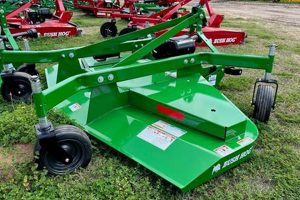
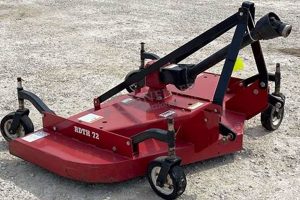
A rear-mounted implement for tractors, designed for achieving a manicured lawn appearance. These units connect to the tractor using a three-point hitch system, allowing for easy lifting and maneuvering. They typically employ multiple blades rotating horizontally beneath a deck, distributing clippings finely across the mowed surface.
The integration of a three-point hitch offers significant advantages in terms of maneuverability and ease of use. This mounting system facilitates quick attachment and detachment, and allows the implement to be raised for transport or obstacle clearance. Historically, such implements represented an evolution from pull-behind mowers, improving efficiency and reducing operator fatigue. Their use contributes to increased productivity in grounds maintenance and landscaping applications by providing consistent and efficient cutting performance.
The following sections will detail specific types, selection criteria, maintenance requirements, and operational best practices associated with these tractor attachments. Considerations such as cutting width, horsepower requirements, and terrain types will also be addressed.
“Finish Mower 3 Point” Tips
This section provides guidance for maximizing the efficiency and lifespan of a rear-mounted implement designed for manicured lawn appearance, utilizing a three-point hitch system.
Tip 1: Proper Hitch Adjustment: Ensure the implement is level relative to the ground by adjusting the three-point hitch. Uneven cutting heights can result from improper leveling.
Tip 2: Blade Sharpening: Regularly sharpen blades to maintain a clean cut and reduce stress on the tractor’s engine. Dull blades tear grass, leading to discoloration and disease susceptibility.
Tip 3: Belt Tension Inspection: Periodically inspect belt tension and replace worn or cracked belts. Insufficient tension leads to slippage and reduced cutting efficiency, while excessive tension can damage bearings.
Tip 4: Deck Cleaning: After each use, clean the underside of the mowing deck to prevent buildup of clippings. Accumulated debris can trap moisture, leading to corrosion and reduced airflow.
Tip 5: Lubrication: Follow the manufacturer’s recommendations for lubricating moving parts, including spindles and bearings. Proper lubrication minimizes friction and extends the life of components.
Tip 6: Overlap Mowing Passes: Overlap each mowing pass slightly to prevent scalping and ensure complete coverage. A 10-15% overlap is generally sufficient.
Tip 7: Adjust Ground Speed to Grass Density: Vary forward speed according to the density and height of the grass being cut. Slower speeds are necessary for thick or tall grass to allow for proper cutting.
Tip 8: Inspect Shear Bolts Regularly: Check shear bolts protecting the gearbox and driveline. Replace any damaged or worn shear bolts with those of the correct specification to prevent more significant damage.
Adhering to these tips will contribute to optimal performance, reduced maintenance costs, and an extended service life. Correct setup and maintenance are crucial for achieving the desired lawn finish and minimizing equipment downtime.
The subsequent sections will delve into troubleshooting common issues and long-term storage strategies for tractor-mounted mowing equipment.
1. Mowing Width

Mowing width, a critical specification of a three-point hitch-mounted finishing implement, directly impacts operational efficiency and suitability for various terrains. The mowing width determines the swath of grass cut in a single pass, influencing the total time required to complete a given area. A wider mowing width translates to fewer passes, thereby reducing fuel consumption and labor costs. Conversely, a narrower mowing width may be necessary for navigating confined spaces or uneven terrain. The choice of mowing width should align with the size and characteristics of the area to be maintained.
The relationship between the mowing width and the tractor’s horsepower is also significant. A wider implement requires more power to operate effectively, particularly when cutting dense or tall grass. Overloading the tractor can lead to reduced cutting performance, increased fuel consumption, and potential damage to the implement or tractor. Therefore, selecting a unit with an appropriate mowing width that matches the tractor’s capabilities is essential for ensuring optimal performance and preventing equipment failure. Examples include residential estates utilizing 60-inch models for large, open lawns, while smaller properties may opt for 48-inch models for improved maneuverability.
In summary, mowing width is an integral factor in the selection and operation of a rear-mounted finishing implement. Careful consideration of the area to be maintained, the tractor’s horsepower, and the terrain characteristics will ensure efficient and effective mowing. Failure to account for these factors can result in suboptimal performance, increased operating costs, and potential equipment damage. Therefore, understanding the practical implications of mowing width is paramount for maximizing the benefits of a tractor-mounted finishing implement.
2. Hitch Compatibility

Hitch compatibility is a foundational element in the effective operation of a rear-mounted finishing implement. Proper alignment and secure attachment of the implement to the tractor’s three-point hitch system are paramount for safe and efficient operation. Incompatibility can lead to equipment damage, reduced performance, and potential safety hazards. Therefore, understanding the nuances of hitch compatibility is essential for selecting and utilizing these implements.
- Hitch Category Standards
Three-point hitches are categorized based on tractor horsepower and size, adhering to industry standards (e.g., Category 0, 1, 2, 3). A Category 1 implement is designed for smaller tractors, while a Category 3 implement is intended for larger, more powerful tractors. Mismatching hitch categories can prevent proper attachment or lead to damage to the hitch components. For example, attempting to connect a Category 2 implement to a Category 1 hitch may result in bent or broken lift arms.
- Top Link and Lift Arm Dimensions
The dimensions of the top link and lift arms on the implement must correspond to the dimensions of the tractor’s hitch. If the top link is too short or too long, the implement may not be level during operation. Similarly, if the lift arms are too narrow or too wide, the implement may not attach securely. Deviations in these dimensions can cause instability, uneven cutting, and potential detachment during operation.
- Quick-Hitch Compatibility
Quick-hitch systems are designed to simplify implement attachment and detachment. However, not all implements are compatible with all quick-hitch systems. Ensuring compatibility between the implement and the quick-hitch is crucial for realizing the benefits of simplified attachment. Attempting to force an incompatible implement into a quick-hitch can damage the hitch or the implement’s attachment points. Some older units may require modification or adapters for quick-hitch usage.
- Clearance and Range of Motion
Sufficient clearance between the implement and the tractor’s tires, fenders, and other components is essential for unrestricted movement. The implement must also have adequate range of motion to follow the contours of the terrain. Insufficient clearance can lead to interference, limiting maneuverability and potentially damaging the tractor or implement. Restricted range of motion can result in scalping or uneven cutting on uneven ground.
In conclusion, hitch compatibility is a multifaceted consideration that extends beyond simply connecting the implement to the tractor. Adherence to hitch category standards, dimensional accuracy, quick-hitch compatibility, and adequate clearance are all critical factors in ensuring safe, efficient, and trouble-free operation of a tractor-mounted finishing implement. Careful attention to these details during selection and setup will contribute to optimal performance and longevity of both the tractor and the implement.
3. Blade Speed

Blade speed, measured in revolutions per minute (RPM), is a critical operational parameter directly influencing the cutting performance and overall effectiveness. Higher blade speeds generally result in a cleaner, more uniform cut, as the increased momentum of the blades allows them to sever grass blades more cleanly. This is particularly important in achieving the manicured appearance desired when using a rear-mounted implement designed for finish mowing. Insufficient blade speed can lead to tearing or shredding of the grass, resulting in an uneven and less aesthetically pleasing cut. An underpowered tractor, or improperly adjusted belt tension, can contribute to reduced blade speed.
The relationship between blade speed and horsepower requirements is also significant. Maintaining optimal blade speed requires sufficient power from the tractor’s engine. Units with wider cutting decks and multiple blades demand more horsepower to maintain the necessary RPMs. For example, operating a 72-inch unit with a tractor that lacks sufficient horsepower will result in a noticeable drop in blade speed, particularly when cutting thick or tall grass. This can manifest as clumps of uncut grass, streaking in the cut, and increased fuel consumption as the engine struggles to maintain the desired speed. Proper matching of the implement size to the tractor’s power output is essential to ensure adequate blade speed.
In summary, blade speed is a key determinant of cutting quality. Maintaining proper blade speed through correct tractor selection, implement maintenance, and appropriate operating practices is crucial for achieving the desired results. Reduced blade speed contributes to poor cutting quality, increased operating costs, and potential damage to the implement. Understanding and managing blade speed within the context of a rear-mounted finish mowing implement is, therefore, vital for successful lawn maintenance. The subsequent analysis will examine deck height and its interplay with blade speed for achieving the desired cut.
4. Deck Height
Deck height, a defining characteristic of a three-point hitch-mounted finishing implement, governs the cutting height and, consequently, the final appearance of the mowed area. The deck houses the rotating blades and dictates the distance between the blades and the ground. Adjustability in deck height allows for customization of the cut to suit different grass types, desired aesthetic preferences, and varying terrain conditions. Improper deck height settings can lead to scalping, uneven cuts, and damage to the turf. For instance, setting the deck height too low on uneven terrain can cause the blades to strike the ground, resulting in scalping and potential damage to the blades and the deck itself. A properly adjusted deck height ensures a consistent and uniform cut, promoting healthy turf growth and an aesthetically pleasing result.
The relationship between deck height and blade speed is also crucial. Lower deck height settings typically require higher blade speeds to effectively cut the grass, especially when dealing with dense or tall grass. Conversely, higher deck height settings may allow for slightly lower blade speeds without sacrificing cutting quality. The combination of deck height and blade speed must be optimized to achieve the desired cut while minimizing stress on the tractor’s engine and the implement’s components. Consider a scenario where the deck height is set very low, but the blade speed is insufficient: the blades will struggle to cut the grass cleanly, resulting in tearing and an uneven finish, even though the deck is positioned close to the ground. Regular monitoring and adjustment of the deck height are, therefore, essential for maintaining optimal cutting performance.
In conclusion, deck height is a critical adjustable parameter that directly impacts the cutting quality, turf health, and overall appearance achieved by a rear-mounted finishing implement. Understanding the relationship between deck height, blade speed, terrain conditions, and grass type is essential for maximizing the effectiveness and longevity of the implement. Challenges in achieving optimal deck height settings often arise from uneven terrain or variations in grass density. However, by carefully considering these factors and making appropriate adjustments, users can ensure a consistent, uniform cut and a healthy, aesthetically pleasing lawn. Subsequent sections will delve into maintenance requirements.
5. Maintenance Schedule

The operational lifespan and cutting performance of a rear-mounted finishing implement designed for manicured lawn appearance are inextricably linked to adherence to a defined maintenance schedule. Neglecting scheduled maintenance leads to a cascade of detrimental effects, culminating in reduced efficiency, increased repair costs, and premature equipment failure. Each component of the implement, from the blades to the belts and bearings, requires periodic inspection, lubrication, and replacement to maintain optimal functionality. A lack of attention to these requirements diminishes cutting quality and increases the likelihood of mechanical breakdown. For example, failure to sharpen blades regularly results in tearing rather than cutting grass, leading to an uneven finish and increased susceptibility to turf diseases.
A comprehensive maintenance schedule encompasses several key elements. Blade sharpening, balancing, and replacement are critical for maintaining a clean cut and preventing vibrations that can damage other components. Belt tension should be regularly inspected and adjusted to ensure efficient power transfer from the tractor to the blades. Lubrication of bearings and spindles minimizes friction, reducing wear and preventing overheating. Periodic inspection of the deck for damage or corrosion is essential for maintaining structural integrity. A documented schedule, outlining the frequency and type of maintenance required, serves as a guide for operators and ensures that all necessary tasks are performed in a timely manner. Consider the case of a commercial landscaping company: implementing a rigorous maintenance schedule for their fleet of rear-mounted finishing implements directly translates to reduced downtime, lower repair costs, and consistently high-quality lawn maintenance services.
In summary, the maintenance schedule is not merely an ancillary consideration, but rather a fundamental component of owning and operating a rear-mounted finishing implement. Its diligent execution directly influences the implement’s performance, longevity, and overall cost-effectiveness. Disregarding the maintenance schedule results in a predictable sequence of negative consequences, ultimately undermining the investment in the equipment. Conversely, a well-defined and consistently followed maintenance schedule ensures that the implement operates at its peak potential, delivering superior results and maximizing its service life. This proactive approach represents a sound operational strategy for both individual homeowners and commercial landscaping professionals.
Frequently Asked Questions
This section addresses common inquiries regarding the selection, operation, and maintenance of tractor-mounted finishing implements, providing concise and informative answers.
Question 1: What is the optimal mowing speed when operating a rear-mounted finishing implement?
Optimal mowing speed depends on factors such as grass density, terrain, and implement cutting width. Generally, a speed of 3-5 miles per hour is recommended, but adjustments may be necessary to maintain consistent cutting quality.
Question 2: How frequently should the blades be sharpened on a rear-mounted finishing implement?
Blade sharpening frequency depends on usage and the type of grass being cut. Inspect blades after each use and sharpen when signs of dullness appear. Sharpening is typically required every 25-50 hours of operation.
Question 3: What type of grease is recommended for lubricating the spindles and bearings of a rear-mounted finishing implement?
A lithium-based grease with an NLGI grade of 2 is generally recommended for lubricating spindles and bearings. Consult the implement’s operator manual for specific recommendations.
Question 4: How should a rear-mounted finishing implement be stored during the off-season?
Before storage, clean the implement thoroughly, lubricate all moving parts, and inspect belts and blades for wear. Store the implement in a dry, covered location to protect it from the elements.
Question 5: What are the common causes of vibration in a rear-mounted finishing implement?
Vibration can result from unbalanced blades, loose hardware, damaged bearings, or a bent spindle. Inspect these components to identify and address the source of the vibration.
Question 6: How can scalping be prevented when using a rear-mounted finishing implement on uneven terrain?
Prevent scalping by raising the cutting height, reducing mowing speed, and using an implement with a floating deck that can follow the contours of the terrain. Consider using smaller width attachments.
In summary, these answers provide valuable insights for effectively managing and maintaining rear-mounted finishing implements. Proper operation and maintenance are crucial for maximizing the implement’s performance and extending its service life.
The subsequent section will provide a concise glossary of terms related to tractor-mounted mowing equipment.
Concluding Remarks
This exposition has detailed various aspects of the finish mower 3 point, including its functionality, advantages, maintenance, and operational considerations. The importance of correct hitch compatibility, blade speed, deck height, and adherence to a rigorous maintenance schedule have been underscored as critical factors influencing performance and longevity. Moreover, common issues and troubleshooting strategies have been addressed to equip operators with the knowledge necessary for effective utilization of the equipment.
Optimal utilization requires careful planning and consistent adherence to established best practices. By prioritizing proper setup, maintenance, and operational techniques, end-users can maximize the potential of this implement, achieving superior results and extending its service life. Future advancements in design and technology will likely further enhance the efficiency and capabilities of tractor-mounted mowing equipment. Continuous vigilance and adaptation to emerging best practices remain essential for realizing the full benefits of such equipment.
![Buy Premium Finishing Mower for Sale - [Brand] Edition | Best Final Touch: Elevate Your Projects with Professional Finishing](https://bestfinaltouch.com/wp-content/uploads/2025/12/th-628-300x200.jpg "Buy Premium Finishing Mower for Sale - [Brand] Edition Best Final Touch: Elevate Your Projects with Professional Finishing")