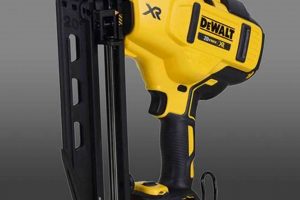
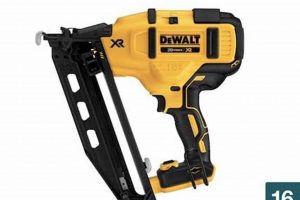
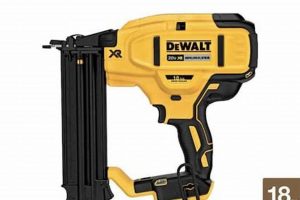
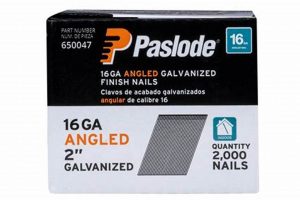
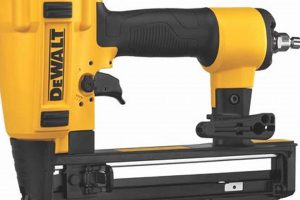
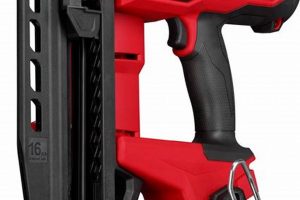
Two distinct pneumatic tools exist for driving nails in woodworking and carpentry: one designed for heavier trim and structural work, and another intended for delicate fastening and minimizing visible nail holes. The former utilizes thicker gauge nails with a larger head, offering superior holding power for applications such as baseboards, crown molding, and door casings. Conversely, the latter employs thinner gauge fasteners with a smaller head, making it suitable for attaching lightweight trim, picture frames, and intricate detailing where aesthetics are paramount.
The choice between these tools significantly impacts the quality and longevity of finished projects. Selecting the appropriate tool ensures secure fastening and reduces the likelihood of splitting or damaging the material being worked on. Historically, carpenters relied on manual hammering, a labor-intensive process prone to inaccuracies. The introduction of pneumatic nailers revolutionized efficiency and precision, leading to improved construction timelines and a higher standard of craftsmanship. These tools contribute to both structural integrity and the overall aesthetic appeal of finished woodworking projects.
The following sections will delve into the specific characteristics of each tool, examining nail size and gauge, application suitability, ideal project types, and the advantages and disadvantages associated with each. Detailed comparisons will provide a comprehensive understanding to aid in selecting the optimal tool for particular woodworking or carpentry needs.
Selection and Usage Tips
Optimal utilization of these pneumatic tools requires careful consideration of project requirements and tool characteristics. Adherence to the following guidelines promotes efficient operation and minimizes potential complications.
Tip 1: Material Compatibility: Prior to initiating any project, assess the density and fragility of the material. Firmer wood species benefit from the increased holding power of a finish nailer, while softer woods necessitate the reduced splitting risk associated with a brad nailer.
Tip 2: Nail Length Determination: Calculate the appropriate nail length by adding the thickness of the material being attached to at least half the thickness of the substrate. Adequate penetration ensures secure fastening and prevents premature failure.
Tip 3: Air Pressure Adjustment: Regulate air compressor pressure to correspond with the tool manufacturer’s specifications. Excessive pressure increases the likelihood of nail over-driving and material damage, while insufficient pressure results in incomplete nail insertion.
Tip 4: Safety Precautions: Always wear appropriate personal protective equipment, including safety glasses, to mitigate the risk of projectile injuries. Disconnect the air supply before performing maintenance or clearing jammed nails.
Tip 5: Nail Selection for Finish Nailer: Utilize finish nails with a gauge appropriate for the tool (typically 15 or 16 gauge). Ensure compatibility with the specific model to prevent malfunctions and maintain consistent performance.
Tip 6: Nail Selection for Brad Nailer: Employ brad nails within the specified gauge range (typically 18 gauge). Incorrect gauge selection can lead to jamming and damage the tool’s internal mechanisms.
Tip 7: Concealment Considerations: Evaluate the necessity for seamless finishing. Brad nailers, with their smaller nail heads, often require minimal filling or patching, streamlining the finishing process.
Implementing these strategies optimizes tool performance, minimizes material waste, and enhances the overall quality of finished woodworking and carpentry projects. Selecting the appropriate tool and adhering to safety protocols are essential for achieving professional results.
The subsequent sections will address potential issues and maintenance practices associated with each tool, ensuring longevity and consistent operational effectiveness.
1. Gauge

Nail gauge, a measurement indicating the thickness of the nail shank, represents a primary differentiating factor between finish nailers and brad nailers. Finish nailers typically utilize 15- or 16-gauge nails. These thicker nails provide substantial holding power, making them suitable for applications demanding structural integrity, such as attaching baseboards or crown molding. The larger diameter necessitates a more visible entry point, potentially requiring filling and finishing for a seamless appearance.
Brad nailers, conversely, employ 18-gauge nails. The reduced diameter of these nails minimizes splitting in delicate materials and leaves a significantly smaller, less conspicuous hole. This characteristic renders brad nailers ideal for attaching lightweight trim, picture frames, or executing intricate woodworking details. However, the thinner gauge inherently limits holding power, precluding their use in load-bearing applications or where robust fastening is essential. For instance, attempting to secure thick hardwood trim with a brad nailer may result in inadequate adhesion and eventual separation.
Therefore, nail gauge dictates the appropriateness of each tool for specific tasks. The selection process necessitates careful consideration of the material’s density, the required holding strength, and the desired aesthetic outcome. Mismatched gauge and application can lead to compromised structural integrity or visually unappealing results. Ultimately, understanding the implications of nail gauge is crucial for effective and efficient woodworking practices. Failure to consider this key aspect will lead to substandard outcomes.
2. Holding power

Holding power, the resistance of a fastener to withdrawal from a substrate, is a critical differentiator between finish nailers and brad nailers. This characteristic directly correlates with the nail’s gauge and length, influencing the suitability of each tool for specific applications. Finish nailers, utilizing thicker gauge nails, inherently provide superior holding power, making them essential for securing substantial materials where long-term stability is paramount. For example, installing door casings or securing thick baseboards demands the robust grip offered by finish nails to prevent movement and maintain structural integrity.
Conversely, brad nailers, with their thinner gauge nails, sacrifice holding power for reduced visibility and minimized splitting in delicate materials. While adequate for lightweight trim or attaching cabinet backs, relying on a brad nailer for applications requiring significant resistance to pulling forces proves inadequate. Attempting to secure heavy crown molding with brad nails will likely result in joint failure and a compromised aesthetic appearance. The trade-off between holding power and cosmetic finish necessitates careful evaluation of project requirements. Prioritizing stability requires the strength of a finish nailer, while prioritizing a clean, unobtrusive finish favors the brad nailer.
Understanding the connection between holding power and tool selection is crucial for achieving professional-grade results and ensuring the longevity of woodworking projects. Failing to match the tool to the demands of the application leads to compromised structural integrity and potential rework. Therefore, an informed decision based on a clear understanding of the forces at play within the finished piece is essential for successful outcomes. In essence, the relationship between required holding power and tool selection is a core principle in effective woodworking practices.
3. Cosmetic finish

The resultant visual appeal of a woodworking project is often paramount. The selection of the appropriate nailer significantly impacts the final cosmetic outcome, influencing the visibility of nail entry points and the need for post-installation finishing processes.
- Nail Head Size
Finish nailers employ nails with larger heads than brad nailers. This increased head size, while contributing to enhanced holding power, creates a more prominent indentation on the surface of the workpiece. Consequently, concealing these indentations typically necessitates filling with wood filler, sanding, and potentially, touch-up painting or staining to achieve a seamless appearance. Brad nailers, on the other hand, utilize nails with significantly smaller heads, creating minimal surface disruption. In many cases, the resulting hole is so small that it requires no additional filling, streamlining the finishing process and preserving the natural aesthetic of the wood. For example, when attaching delicate trim to a cabinet face frame, the minimal nail holes left by a brad nailer are often virtually invisible.
- Splitting Potential
The use of a finish nailer can increase the risk of splitting delicate or thin wood, especially when working near edges. Splitting necessitates extensive repairs, often requiring wood patching, clamping, and re-sanding, severely impacting the final cosmetic result. Brad nailers, with their thinner nails, significantly reduce this risk, allowing for precise fastening in sensitive areas without compromising the material’s integrity. An example of this is attaching thin veneer edging where minimizing splitting is crucial to the final product.
- Nail Hole Concealment Effort
The effort required to conceal nail holes varies significantly between the two nailers. Concealing finish nail holes demands more time and precision. The larger indentations necessitate careful filling, meticulous sanding to avoid creating depressions, and precise color matching to ensure a seamless blend with the surrounding wood. Brad nail holes, being smaller, often require no filling at all, and when filling is needed, the process is significantly less demanding. This difference is especially pronounced in large-scale projects involving numerous nail insertions. The time saved by using a brad nailer on tasks where holding power is not critical contributes to project efficiency and reduces overall labor costs.
- Wood Grain Disruption
Driving a finish nail can sometimes disrupt the surrounding wood grain, creating visible distortions around the nail entry point. These distortions can be particularly noticeable on finely grained woods or when applying transparent finishes. Brad nailers, due to their smaller size, minimize this disruption, preserving the natural beauty of the wood and reducing the need for extensive repairs. This is particularly useful on high-end furniture or musical instruments, where a flawless finish is paramount.
In summary, the desired cosmetic finish should heavily influence the choice. Where minimal visibility and reduced finishing effort are priorities, a brad nailer is the preferred choice. Conversely, when robust holding power outweighs cosmetic concerns, a finish nailer may be more appropriate, with the understanding that additional finishing work will likely be required to achieve the desired aesthetic outcome. The decision involves balancing functionality and aesthetics, aligning the tool with the project’s specific requirements and desired visual impact.
4. Application type
The intended application dictates the appropriate nailer selection. Matching the tool to the task ensures secure fastening and optimal aesthetic results. The specific demands of each project influence the choice between the robust holding power of a finish nailer and the subtle finesse of a brad nailer.
- Trim Installation
Installing trim, such as baseboards, crown molding, or door casings, often necessitates a finish nailer. These applications require substantial holding power to secure the trim to the wall studs or framing members. While a brad nailer may suffice for very lightweight trim, the larger gauge nails of a finish nailer provide a more secure and lasting connection, preventing movement and ensuring a professional finish. The selection hinges on the size, weight, and material of the trim being installed.
- Cabinetry
Cabinetry work presents a mixed bag of applications, requiring both types of nailers. Attaching face frames to cabinet boxes typically benefits from the strength of a finish nailer, ensuring a solid and durable assembly. Conversely, attaching cabinet backs or delicate decorative elements is often best accomplished with a brad nailer, minimizing the risk of splitting the wood and reducing the visibility of nail holes. The specific task within the cabinetry project dictates the optimal tool choice.
- Furniture Assembly
Furniture assembly shares similarities with cabinetry, requiring a nuanced approach to nailer selection. Constructing the main frame of a piece of furniture demands the holding power of a finish nailer to create a structurally sound foundation. Attaching decorative trim, applying thin panels, or securing delicate joints often necessitates the precision and subtlety of a brad nailer. The durability and longevity of the furniture depend on using the appropriate nailer for each specific component.
- Crafting and Hobby Projects
Crafting and hobby projects frequently involve delicate materials and intricate designs. In these scenarios, a brad nailer is often the preferred choice. The smaller gauge nails minimize the risk of splitting thin wood, damaging fragile materials, or creating unsightly nail holes. The focus on aesthetic precision and detail makes the brad nailer an invaluable tool for achieving professional-looking results in crafting endeavors.
Therefore, understanding the demands of the application is crucial for selecting the appropriate nailer. The structural requirements, material characteristics, and desired aesthetic outcome all contribute to the decision-making process. Failing to match the tool to the task can lead to compromised structural integrity, damaged materials, and a less-than-professional final product. The choice between a finish nailer and a brad nailer is not arbitrary but rather a carefully considered decision based on the specific needs of the project at hand.
5. Material thickness

Material thickness exerts a significant influence on the selection between a finish nailer and a brad nailer. The tool’s fastening capability must align with the material’s properties to ensure secure attachment without compromising structural integrity or aesthetic quality. Inadequate consideration of material thickness can lead to splitting, insufficient penetration, or weakened joints.
- Nail Length Requirement
Material thickness directly dictates the necessary nail length. A general rule dictates that the nail should penetrate at least two-thirds of the substrate material for optimal holding power. Attaching thin trim to a thick frame necessitates a longer nail, potentially favoring a finish nailer due to its capacity to handle longer fasteners. Conversely, attaching thin materials to each other may only require the shorter nails typically used in a brad nailer. Failing to account for thickness results in either protruding nails or inadequate penetration, both compromising the project’s stability and appearance.
- Splitting Risk
Thinner materials are inherently more susceptible to splitting when fastened with nails. Finish nailers, employing thicker gauge nails, pose a greater risk of splitting thin boards or delicate trim. Brad nailers, with their finer gauge, minimize this risk, making them the preferred choice for attaching fragile materials. The propensity for splitting is further influenced by wood species, grain orientation, and the proximity of the nail to the material’s edge. Therefore, assessing material thickness in conjunction with these factors is crucial.
- Fastener Protrusion
Selecting the appropriate nailer minimizes the risk of nail protrusion. If the combined thickness of the materials being joined is less than the shortest available nail length for a given tool, the nail will protrude through the back. While protruding nails can be clipped and filed down, this process is time-consuming and may not yield a clean, professional result. Therefore, carefully considering material thickness during tool selection is essential for achieving a flush, seamless finish. In situations where precise nail length is critical, a brad nailer, with its typically shorter nail options, may prove more suitable.
- Joint Strength and Stability
Material thickness influences the overall strength and stability of a joint. Thicker materials generally require stronger fasteners to ensure a lasting bond. While a brad nailer may be sufficient for temporarily holding pieces together during glue-up, a finish nailer is often necessary for providing the long-term structural support required in load-bearing applications. The combination of material thickness and anticipated stress on the joint should guide the selection of the appropriate nailer. For example, constructing a cabinet frame from thick hardwood necessitates the robust fastening capabilities of a finish nailer.
Ultimately, assessing material thickness represents a critical step in selecting the appropriate nailer. Failing to account for this factor can result in compromised structural integrity, aesthetic imperfections, and increased project costs. The decision hinges on a careful evaluation of the material’s properties, the required nail length, the potential for splitting, and the desired level of joint strength. This careful evaluation contributes to a successful outcome, ensuring both structural soundness and visual appeal.
6. Project scale

The size and complexity of a woodworking or carpentry project significantly influence the optimal choice between a finish nailer and a brad nailer. Project scale dictates not only the volume of fastening required but also the balance between speed, holding power, and aesthetic considerations. Larger projects often prioritize efficiency and structural integrity, making the finish nailer a more suitable option, whereas smaller, more intricate projects may necessitate the precision and minimal visibility offered by a brad nailer.
A large-scale trim installation within a residential building, for instance, demands the speed and holding power of a finish nailer. The sheer volume of baseboards, door casings, and crown molding requires a tool capable of rapid and secure fastening to minimize labor time and ensure a lasting, structurally sound result. Conversely, a small-scale crafting project involving delicate wood components, such as building a model airplane or constructing a picture frame, benefits from the brad nailer’s ability to provide precise fastening without splitting the thin material or leaving conspicuous nail holes. Similarly, furniture manufacturing showcases this dichotomy; assembling the main frame of a sofa might call for a finish nailer, while attaching decorative trim could necessitate a brad nailer. Therefore, recognizing the correlation between project dimensions and tool capabilities is essential for efficient resource allocation and achieving the desired outcome.
In summary, project scale acts as a crucial determinant in the selection process. Large projects often necessitate the efficiency and robust fastening of a finish nailer, while smaller, more delicate projects benefit from the precision and subtle finish provided by a brad nailer. Understanding this relationship allows for informed decision-making, optimizing project timelines, minimizing material waste, and ultimately contributing to a higher quality finished product. The practical significance of this understanding lies in the ability to streamline workflows and ensure that the selected tool aligns with the project’s specific demands, leading to both time savings and improved results.
Frequently Asked Questions
This section addresses common inquiries regarding the selection and application of pneumatic nailers, focusing on clarifying distinctions and providing guidance for optimal tool usage.
Question 1: Is a finish nailer suitable for attaching thin trim?
While a finish nailer offers substantial holding power, its use on thin trim presents a significant risk of splitting the material. A brad nailer, designed for finer work, is generally more appropriate for such applications.
Question 2: Can a brad nailer be used for structural applications?
Brad nailers are not designed for structural applications. The thinner gauge nails lack the necessary holding power to withstand significant loads, potentially compromising the integrity of the assembly. A finish nailer or other appropriate fastening method should be employed for structural components.
Question 3: What nail length is appropriate for a given material thickness?
A general guideline dictates that the nail should penetrate at least two-thirds of the substrate material to ensure adequate holding power. Careful consideration of both the material being attached and the underlying structure is essential for selecting the correct nail length.
Question 4: How does nail gauge affect the final appearance of a project?
Nail gauge directly influences the size of the entry point and the subsequent visibility of the fastener. Thicker gauge nails leave larger holes, requiring more extensive filling and finishing. Finer gauge nails minimize visibility, reducing the need for post-installation cosmetic work.
Question 5: Is it necessary to adjust air pressure based on the type of wood being fastened?
Adjusting air pressure is crucial for optimizing performance and preventing damage. Softer woods require lower pressure to avoid over-driving the nails, while harder woods may necessitate higher pressure for proper penetration. Consulting the tool manufacturer’s recommendations is advisable.
Question 6: What safety precautions should be observed when using pneumatic nailers?
Wearing appropriate personal protective equipment, including safety glasses, is essential to mitigate the risk of projectile injuries. Disconnecting the air supply before performing maintenance or clearing jammed nails is also critical for preventing accidental nail discharge.
Understanding the nuances of pneumatic nailer selection, including nail gauge, holding power, and application-specific considerations, is paramount for achieving professional results and ensuring the long-term integrity of woodworking projects.
The following section will provide maintenance guidelines and troubleshooting tips to ensure the continued optimal operation of both finish and brad nailers.
Conclusion
The preceding discussion has explored the distinct characteristics and appropriate applications of finish nailers and brad nailers. The selection between these tools hinges upon a multifaceted assessment encompassing material thickness, required holding power, desired cosmetic finish, and the overall scale of the project. Neglecting to consider these factors can result in compromised structural integrity, aesthetic imperfections, and increased project costs.
Therefore, a comprehensive understanding of the strengths and limitations associated with each type of nailer is essential for informed decision-making. Employing the correct tool for the task at hand ensures both the longevity and visual appeal of woodworking and carpentry endeavors. Continued adherence to best practices and a commitment to ongoing learning will further refine the user’s ability to effectively utilize these indispensable tools within the construction trades.