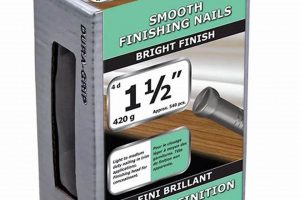
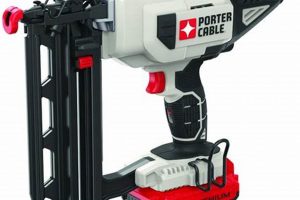
Thin, small-headed fasteners designed to be nearly invisible once installed are commonly employed when affixing decorative molding. These fasteners, when properly set, leave a minimal surface blemish, readily concealed with wood filler, paint, or stain. An example is using a 2-inch, 16-gauge fastener to secure a piece of crown molding to a wall.
The selection of appropriate attachment methods is vital for achieving aesthetically pleasing and durable results in woodworking projects. The small head and setting ability minimize visual disruption, maintaining the intended appearance of the millwork. Historically, these specialized fasteners have allowed craftsmen to conceal attachment points, enhancing the perceived quality and seamlessness of finished carpentry.
Consequently, subsequent discussions will focus on factors to consider when selecting the correct size and type, proper installation techniques, and addressing common challenges encountered during the application of these fasteners in a variety of interior and exterior projects.
Guidance for Optimal Use
The following recommendations outline best practices for utilizing these fasteners to achieve professional-quality trim work.
Tip 1: Select the Appropriate Gauge: Choose a gauge suitable for the trim’s thickness and density. Thicker trim necessitates a lower gauge for greater holding power, whereas thinner trim benefits from a higher gauge to minimize splitting.
Tip 2: Determine Optimal Length: The fastener length should be sufficient to penetrate the trim and underlying substrate, ideally extending at least twice the thickness of the trim into the framing member. A fastener that is too short will lack holding power.
Tip 3: Employ a Nail Set: Utilize a nail set to countersink the fastener head slightly below the surface of the trim. This allows for seamless concealment with wood filler without causing damage to the surrounding wood fibers.
Tip 4: Space Fasteners Consistently: Maintain uniform spacing between fasteners, typically every 8 to 12 inches, to ensure even distribution of holding force and prevent gaps or warping of the trim.
Tip 5: Angle Fasteners Strategically: Angling fasteners slightly when driving them can increase holding power, particularly when attaching trim to a corner or edge.
Tip 6: Pre-Drill Hardwoods: When working with hardwoods, pre-drilling pilot holes prevents splitting and facilitates easier fastener insertion. Select a drill bit slightly smaller than the fastener shank diameter.
Tip 7: Consider the Material: Choose fasteners made from materials compatible with the environment and the trim material. Corrosion-resistant options are essential for exterior applications or when using treated lumber.
Adhering to these guidelines promotes a secure, aesthetically pleasing, and long-lasting trim installation.
The subsequent section will address potential challenges and troubleshooting strategies associated with these fasteners.
1. Gauge Selection

Gauge selection is a crucial determinant in the successful application of small-headed fasteners for decorative molding, influencing both the aesthetic outcome and the structural integrity of the installed trim.
- Holding Power and Material Density
Lower gauge numbers indicate thicker shank diameters, resulting in increased holding power suitable for denser materials like hardwoods. Conversely, higher gauge numbers, denoting thinner shanks, minimize the risk of splitting in softer woods such as pine. Selecting an inappropriate gauge can compromise the security of the trim or damage the substrate.
- Aesthetic Considerations and Visibility
While lower gauge provides greater holding strength, the resulting larger hole may require more extensive filling and finishing to conceal. Higher gauges leave smaller holes, but their reduced holding power necessitates careful consideration of the trim’s weight and exposure to stress. An optimal balance must be achieved to ensure both secure attachment and minimal visual disruption.
- Tool Compatibility and Functionality
Different nail guns and pneumatic nailers are designed to accommodate specific gauge ranges. Selecting a gauge incompatible with the available tools can lead to jamming, misfires, and inefficient installation. Ensuring tool compatibility is essential for streamlined workflow and consistent results.
- Corrosion Resistance and Environmental Factors
The gauge of the fastener can influence its susceptibility to corrosion. Thicker gauges generally offer greater resistance to corrosion due to increased material volume. However, the specific material composition (e.g., stainless steel, galvanized steel) also plays a significant role in determining the fastener’s longevity in various environmental conditions.
Ultimately, the optimal gauge selection requires a careful assessment of the trim material, substrate density, aesthetic requirements, available tools, and environmental conditions. Failure to adequately consider these factors can lead to compromised structural integrity, visual imperfections, and premature failure of the trim installation.
2. Head Concealment

Head concealment is a primary attribute associated with specialized fasteners for securing trim. The small head design allows for recessing the fastener beneath the surface of the wood, a necessary step for achieving a seamless finish. Without this feature, visible fastener heads would detract from the aesthetic quality of the trim. A real-life example is the application of delicate cove molding where a prominent nail head would disrupt the visual flow of the profile. The ability to effectively conceal the head is a direct result of the fastener’s design and the user’s setting technique, making it an integral component of achieving professional-grade results.
The process involves using a nail set and hammer to drive the fastener slightly below the surface. This creates a small indentation that can then be filled with wood filler, sanded smooth, and painted or stained to match the surrounding trim. Poor setting technique, such as overdriving or damaging the wood fibers, can hinder effective head concealment. A common challenge is encountered when working with brittle trim, where excessive force can cause splintering or cracking, compromising the overall finish. Therefore, careful application and appropriate tools are essential for successful head concealment.
In summary, head concealment, facilitated by the design and application of these specialized fasteners, is crucial for maintaining the aesthetic integrity of trim work. Challenges arise from material properties and application techniques; however, understanding these factors allows for effective mitigation. The ability to achieve near-invisibility is a defining characteristic, setting these fasteners apart and contributing significantly to the overall quality of finished carpentry.
3. Holding Strength
Holding strength, in the context of specialized fasteners for decorative molding, refers to the ability of the fastener to resist withdrawal and maintain the secure attachment of trim pieces to a substrate. While aesthetics are paramount, inadequate holding strength compromises the longevity and structural integrity of the installation. The diminutive size of these fasteners, designed for near-invisibility, inherently limits their holding capacity compared to larger fasteners. Therefore, selecting the appropriate type and employing correct installation practices are essential to maximizing holding strength without sacrificing the desired aesthetic outcome. For instance, attaching a heavy crown molding to a ceiling requires careful consideration of fastener length, spacing, and penetration depth to ensure long-term securement and prevent detachment due to gravity or environmental factors.
Several factors influence the effective holding strength achieved. The density and type of wood both the trim and the substrate are critical, as softer woods offer less resistance to withdrawal. Fastener length must be sufficient to penetrate the substrate adequately; a general guideline is to ensure the fastener extends at least twice the thickness of the trim into the framing member. The angle at which the fastener is driven also plays a role, with a slight angle often increasing resistance to pullout. Additionally, environmental conditions, such as humidity fluctuations, can impact the wood’s stability and thus affect the fastener’s holding ability over time. The use of adhesives in conjunction with fasteners can significantly augment holding strength, especially in demanding applications or when working with problematic substrates.
In summary, holding strength is a crucial, albeit often understated, component of successful trim installation. While the primary objective is a visually appealing finish, compromised holding strength can lead to eventual failure. Informed selection of fastener type and size, meticulous installation techniques, and consideration of environmental factors are all necessary to balance aesthetic considerations with the need for a secure and lasting attachment. Failure to address these aspects can result in costly repairs and a diminished overall appearance over time.
4. Material Compatibility

The selection of appropriate attachment hardware necessitates careful consideration of material compatibility. When utilizing small-headed fasteners for decorative molding, electrochemical reactions between dissimilar metals can lead to corrosion, weakening the joint and causing unsightly staining. For example, the installation of trim in a high-humidity environment requires stainless steel or hot-dipped galvanized fasteners to prevent oxidation, particularly when the trim itself is resistant to moisture damage. Failure to account for these factors can result in premature degradation of the installation and necessitate costly repairs. Furthermore, certain wood species, such as cedar or redwood, contain acidic compounds that accelerate corrosion in contact with incompatible metals.
Practical applications of this understanding involve selecting fasteners made from materials that match or exceed the corrosion resistance of the trim. When using pressure-treated lumber, which contains chemical preservatives, specialized fasteners designed for contact with treated wood are mandatory to prevent rapid corrosion. In coastal environments, where salt spray is prevalent, even stainless-steel fasteners may require periodic inspection and maintenance. Moreover, the type of finish applied to the trim can influence material compatibility; certain coatings may react adversely with specific metals, causing discoloration or adhesion problems. Therefore, consulting material compatibility charts and seeking advice from experienced professionals is essential for informed decision-making.
In summary, material compatibility is a critical consideration when employing small-headed fasteners for securing trim. The interaction between fastener materials, trim composition, environmental conditions, and applied finishes dictates the longevity and aesthetic quality of the installation. Neglecting this aspect can lead to avoidable failures, emphasizing the need for careful planning and adherence to established best practices. Understanding material science principles ensures a durable, visually appealing, and structurally sound trim installation.
5. Setting Technique

The effective application of specialized fasteners for trim relies heavily on proper setting technique. This technique dictates the final appearance and long-term performance of the installation, bridging the gap between material selection and a professional finish.
- Proper Depth Control
Achieving consistent depth is paramount. The fastener head must be recessed slightly below the surface to allow for filling without protruding, yet not so deep as to damage the surrounding wood fibers. Overdriving creates an unsightly depression, while underdriving leaves the head exposed. For instance, when installing shoe molding, uneven setting depths highlight imperfections and detract from the overall aesthetic.
- Use of a Nail Set
Employing a nail set is essential for precise and controlled setting. This tool concentrates the force of the hammer, minimizing the risk of glancing blows and surface damage. A nail set with a cupped tip prevents marring the wood. A real-world application is securing delicate trim around a window, where a misplaced hammer strike could easily split the wood, necessitating replacement.
- Angle of Impact
Maintaining a perpendicular angle between the nail set and the fastener is critical for even setting. Angled impacts can cause the fastener to bend or deflect, leading to inconsistent depth and potential damage to the trim. Consider the installation of crown molding along a ceiling; a slight angle during setting can cause the fastener to shear or protrude unevenly.
- Material Considerations
Different wood species require adjusted setting techniques. Softer woods are more susceptible to overdriving, while hardwoods may require pre-drilling to prevent bending or breakage of the fastener. The setting force must be modulated to match the material’s density and resistance. Securing trim made of oak, for instance, demands more deliberate and forceful setting than working with pine.
These facets of setting technique directly influence the quality of the finished trim work. Consistent depth, proper tool usage, perpendicular impact, and material-specific adjustments are all necessary for achieving a professional, seamless appearance. Failure to master these techniques will compromise the aesthetics and longevity of any project involving specialized fasteners.
Frequently Asked Questions
This section addresses common inquiries and dispels misconceptions surrounding the selection and utilization of thin, small-headed fasteners for decorative molding.
Question 1: What is the appropriate gauge for securing hardwood trim?
Lower gauge fasteners (e.g., 15 or 16 gauge) are generally recommended for hardwood trim. The thicker shank provides increased holding power and reduces the likelihood of bending or breaking during installation. Pre-drilling pilot holes is advisable to prevent splitting the wood.
Question 2: How should the fastener be set to ensure proper head concealment?
A nail set is essential for recessing the fastener head slightly below the surface of the trim. The nail set should be positioned directly over the head and struck with a hammer. The depth should be sufficient to allow for filling with wood filler without the head protruding. Avoid overdriving, which can damage the surrounding wood fibers.
Question 3: What fastener length is appropriate for attaching trim to drywall?
Securing trim directly to drywall is not recommended. Fasteners should penetrate the underlying framing member (e.g., stud, furring strip) for adequate holding strength. Select a fastener length that extends at least twice the thickness of the trim into the framing. Consider using construction adhesive in conjunction with fasteners for added security.
Question 4: Are specialized fasteners suitable for exterior trim applications?
Specialized fasteners can be used for exterior trim, provided that corrosion-resistant materials, such as stainless steel or hot-dipped galvanized steel, are selected. The specific environment and exposure to moisture should be considered when choosing the appropriate fastener type.
Question 5: How does wood density influence the choice of fastener?
Denser woods, like oak or maple, require thicker fasteners (lower gauge) to prevent bending and ensure adequate holding power. Softer woods, such as pine or fir, benefit from thinner fasteners (higher gauge) to minimize the risk of splitting. Pre-drilling pilot holes is recommended for hardwoods.
Question 6: Can pneumatic nailers be used for installing trim with small-headed fasteners?
Pneumatic nailers are commonly used for installing trim. Select a nailer that is designed to accommodate the specific gauge and length of fasteners being used. Adjust the air pressure to prevent overdriving or underdriving the fasteners. Practice on scrap material to ensure consistent setting depth.
Correct fastener selection and installation techniques contribute to a professional finish and long-lasting trim work.
The succeeding section will explore advanced techniques and specialized applications.
Conclusion
This exposition has systematically examined the nuances associated with selecting and employing specialized fasteners for decorative molding. Critical parameters, including gauge selection, head concealment, holding strength, material compatibility, and setting technique, have been elucidated. A thorough understanding of these elements is paramount for achieving both aesthetic excellence and structural integrity in trim work.
The diligent application of the principles outlined herein will yield durable and visually appealing results, transforming mere attachment into a refined craft. Continued adherence to best practices and a commitment to meticulous execution will ensure the longevity and enduring beauty of expertly secured trim.