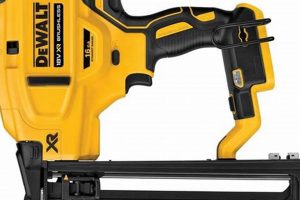
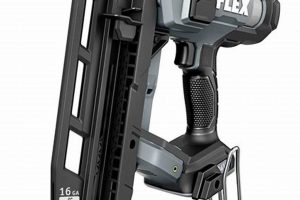
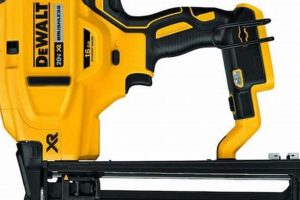
Two common types of pneumatic nail guns exist for different construction and woodworking applications. One tool is designed for heavy-duty structural work, while the other is intended for more delicate, cosmetic tasks. The choice between these tools depends on the specific requirements of the project, considering factors such as the size and type of nails used, the materials being fastened, and the desired finish quality.
The use of specialized nailers streamlines construction processes, increasing efficiency and precision compared to manual hammering. The development of these power tools has significantly impacted both residential and commercial building practices, allowing for faster assembly of structures and improved consistency in fastening. Understanding the distinctions between these tools is essential for professionals and DIY enthusiasts to ensure project success and structural integrity.
The following sections will detail the specific features, applications, and advantages of each type of nailer, providing a clear comparison to assist in selecting the appropriate tool for a given job.
Practical Considerations
Selecting the correct nailer ensures project efficiency and quality. Careful consideration of project requirements is paramount.
Tip 1: Nail Size and Gauge. Determine the appropriate nail size and gauge for the task. Framing nailers typically utilize larger nails (e.g., 0.113″ – 0.131″ diameter) for structural integrity. Finish nailers use smaller gauge nails (e.g., 15-18 gauge) to minimize visible holes.
Tip 2: Application Requirements. Evaluate the specific application. For framing walls, subfloors, and roofs, a framing nailer is essential. For trim work, molding, and cabinetry, a finish nailer is preferable.
Tip 3: Material Compatibility. Consider the materials being fastened. Hardwoods may require a more powerful nailer or pre-drilling, regardless of the tool used. The density and thickness of the material impact nail penetration.
Tip 4: Angle vs. Straight Magazine. Understand the difference between angled and straight magazine nailers. Angled magazines often allow access to tighter spaces, while straight magazines can be more efficient for repetitive tasks.
Tip 5: Power Source. Choose between pneumatic, cordless, or electric models. Pneumatic nailers typically offer more power but require an air compressor. Cordless models provide portability but may have limited runtime. Electric models offer a balance of power and convenience.
Tip 6: Safety Precautions. Always wear safety glasses and hearing protection when operating any nailer. Understand the tool’s operating procedures and safety mechanisms to prevent accidents.
Tip 7: Maintenance. Regularly clean and maintain the nailer according to the manufacturer’s instructions. Proper maintenance extends the tool’s lifespan and ensures consistent performance.
By adhering to these guidelines, users can select the appropriate tool, maximizing efficiency and ensuring the desired outcome for any construction or woodworking endeavor.
The concluding sections will synthesize the information presented, offering a comprehensive overview of these essential tools.
1. Nail Size

Nail size is a defining characteristic differentiating framing nailers from finish nailers. Framing nailers, engineered for structural applications, utilize larger nails with greater diameter and length. These nails, typically ranging from 2 to 3.5 inches in length and with shanks ranging from 0.113 to 0.131 inches in diameter, are designed to provide robust holding power in framing lumber. Conversely, finish nailers employ significantly smaller nails, typically 1 to 2.5 inches in length and with a much smaller gauge (15-18 gauge), intended for finer woodworking tasks. The difference in nail size directly impacts the intended use of each tool and the overall structural integrity of the resulting assembly.
The choice of nail size determines the suitability for specific applications. For example, framing a wall requires the larger nails driven by a framing nailer to ensure the structure can withstand significant loads. Attempting to use finish nails in this application would result in a structurally unsound wall, prone to failure. Conversely, using framing nails for installing trim or molding would cause excessive damage to the material due to their size, splitting the wood and leaving unsightly, large holes. The gauge of the finish nail is designed to be as small as possible while still providing adequate holding power for non-structural elements.
In summary, nail size is a primary determinant in distinguishing these two nailers. The framing nailer’s larger nails are essential for structural integrity in framing applications, while the finish nailer’s smaller nails are necessary for delicate finish work where aesthetics are paramount. Recognizing this fundamental difference is critical for selecting the appropriate tool and achieving the desired result in any construction or woodworking project. The selection also impacts the type of material being used.
2. Application Type
The intended use-case is the primary determinant when selecting between a framing nailer and a finish nailer. The application directly influences the tool choice due to the differing capabilities of each. Framing nailers are specifically designed for structural work, such as assembling walls, floors, and roofs in residential or commercial construction. These applications require the use of larger nails that provide the necessary holding power to withstand significant loads and stresses. The consequence of using an inappropriate tool for framing can be structural instability and potential safety hazards. Finish nailers, conversely, are designed for non-structural applications where aesthetics are paramount. These include installing trim, molding, cabinetry, and other decorative elements. These applications require smaller gauge nails that leave minimal visible holes, preserving the aesthetic appeal of the finished product.
Consider the example of constructing a wooden fence. A framing nailer would be suitable for assembling the fence posts and rails, providing the necessary strength and stability. However, a finish nailer would be the preferred tool for attaching decorative elements to the fence, such as lattice or pickets, where minimizing nail visibility is important. Another illustrative example is the installation of crown molding. A finish nailer, specifically a 15- or 16-gauge model, would be used to securely fasten the molding to the wall or ceiling without causing excessive damage or leaving prominent nail holes. Attempting to use a framing nailer for this task would likely result in splitting the molding and an unsightly finish.
In summary, the application type is a crucial consideration when selecting between these nailers. Understanding the specific demands of the task, in terms of structural requirements and aesthetic considerations, is essential for choosing the appropriate tool. Using the correct tool ensures both structural integrity and a visually appealing result, leading to a successful and professional outcome. The interplay between application and tool selection prevents misapplication and supports efficient project management.
3. Power Output

Power output represents a critical differentiating factor. Framing nailers are engineered to deliver significantly higher power compared to finish nailers. This greater power is necessary to drive larger-diameter and longer nails into dense framing lumber, ensuring a secure and structurally sound connection. Insufficient power results in nails that do not fully penetrate the material, compromising the integrity of the structure. The mechanism relies on pneumatic pressure or, in some cases, high-voltage electrical discharge, to propel the nail with considerable force. The power output of a framing nailer is often measured in impact force, indicating the nailer’s ability to overcome resistance from dense materials. The consequences of insufficient power often involves material failure, requiring rework and the risk of serious accidents.
Finish nailers, conversely, are designed with lower power output. This is a deliberate design choice to prevent damage to more delicate materials such as trim, molding, and cabinetry. The reduced power allows for driving smaller-gauge nails without splitting or marring the surface of the wood. Examples of its use include attaching baseboards, crown molding, or cabinet face frames. The nails, while smaller, still provide adequate holding power for these non-structural applications. The lower power also results in reduced noise and recoil, making finish nailers easier to handle for extended periods. Using a high-powered framing nailer for these applications would result in excessive damage to the workpiece and an unacceptable finished product. Therefore, the nailer’s ability to control its speed and power impacts overall quality.
The relationship between power output and application is thus direct and critical. The choice reflects the fundamental requirement for structural integrity versus aesthetic preservation. High power is necessary for framing to ensure secure connections in load-bearing structures, while lower power is essential for finish work to prevent damage to delicate materials. Understanding this distinction allows for proper tool selection and ultimately contributes to the success and quality of the construction project.
4. Material Thickness

Material thickness is a primary consideration in determining the appropriate nailer for a given task. The ability of a nailer to effectively penetrate and securely fasten materials of varying thicknesses directly influences the choice between a framing nailer and a finish nailer.
- Framing Lumber Thickness
Framing lumber, typically ranging from 2×4 to 2×12 inches in dimensional lumber, requires the substantial power and nail length provided by a framing nailer. The nailer must be capable of driving nails through this thickness to create strong, load-bearing connections. Attempting to use a finish nailer on framing lumber would result in insufficient nail penetration and a compromised structural connection. In residential construction, for example, studs for walls or rafters for roofs necessitate the robust fastening capabilities of a framing nailer.
- Finish Material Thickness
Finish materials, such as trim, molding, and paneling, are generally much thinner than framing lumber. These materials require a nailer that can drive smaller-gauge nails with precision to avoid splitting or damaging the wood. A finish nailer provides the necessary control and finesse for these delicate applications. Installing crown molding, baseboards, or cabinet face frames exemplifies the use of a finish nailer on thinner materials.
- Substrate Density
Material density, in addition to thickness, impacts nailer selection. Dense hardwoods, regardless of their thickness, may require a more powerful nailer or pre-drilling to ensure proper nail penetration. Softer woods, conversely, may be more susceptible to splitting if too much force is applied. The density of the substrate must be considered in conjunction with its thickness to determine the optimal nailer and nail type.
- Fastener Length and Penetration
Optimal fastener length is critical for secure fastening. The nail should penetrate sufficiently into the substrate to provide adequate holding power without protruding through the back side of the material. Using excessively long nails can create a safety hazard and detract from the aesthetic appeal of the finished product. Proper nail length selection, in relation to material thickness, is an essential skill for both framing and finish applications.
In summary, material thickness is a key factor in determining the appropriate nailer. Framing applications involving thicker lumber necessitate the power and nail size of a framing nailer, while finish applications involving thinner materials require the precision and finesse of a finish nailer. The interplay between material thickness, substrate density, and fastener length dictates the optimal tool selection for achieving a secure and aesthetically pleasing result.
5. Visible Fasteners
The visibility of fasteners represents a critical distinction. Framing nailers, designed for structural applications, prioritize holding strength over aesthetic considerations. Consequently, the nails driven by a framing nailer are typically larger and more noticeable. Their presence is accepted, if not entirely disregarded, given the intended use-case where structural integrity supersedes cosmetic concerns. For instance, in framing a wall, the prominent nail heads are subsequently concealed by drywall or other sheathing materials. A focus on cosmetic appearance in structural applications will lead to structural integrity issues and safety hazards.
Finish nailers, conversely, are designed to minimize the visibility of fasteners. The smaller gauge nails driven by finish nailers leave a much smaller hole, which is often easily filled with wood filler or putty. This is particularly important in finish carpentry applications, such as installing trim, molding, or cabinetry, where a clean and seamless appearance is desired. For example, when installing crown molding, the goal is to have the molding appear as a single, continuous piece without any visible nail holes disrupting the aesthetic. This requires a precise application of the finish nailer and careful attention to detail in filling the nail holes.
In summary, the degree of fastener visibility is a key differentiator. While framing nailers prioritize strength over aesthetics, finish nailers prioritize a clean, seamless finish. The appropriate tool must be selected based on the specific requirements of the project, considering the balance between structural integrity and visual appeal. The visibility of the fastener is therefore a deliberate design aspect, impacting the choice between these tools and the overall success of the finished project. A clear understanding will allow the user to avoid time-consuming cosmetic fixes.
6. Structural Integrity

Structural integrity, the ability of a structure to withstand applied loads without failure, is paramount in construction. The selection between a framing nailer and a finish nailer directly impacts the structural integrity of a project. The inappropriate choice can lead to compromised connections and potential structural failure. Understanding the relationship between these tools and structural integrity is thus critical for ensuring safety and longevity of built environments.
- Load-Bearing Capacity
The primary function of a framing nailer is to create strong, load-bearing connections in structural elements such as walls, floors, and roofs. The larger nails used by framing nailers provide the necessary shear and tensile strength to resist forces exerted on the structure. Using a finish nailer in these applications compromises load-bearing capacity, leading to potential collapse under stress. An example is using incorrect nails to connect studs, leading to wall instability and potential collapse during heavy wind or seismic events.
- Fastener Shear Strength
The shear strength of a fastener, its resistance to forces acting parallel to its axis, is directly related to its diameter and material properties. Framing nails, being larger in diameter and often made of hardened steel, exhibit significantly higher shear strength than finish nails. This is essential for resisting lateral loads and preventing structural deformation. In roof construction, shear strength of the fasteners used to connect rafters to the ridge beam is crucial in preventing roof collapse under snow load.
- Pull-Out Resistance
Pull-out resistance refers to a fastener’s ability to resist being pulled out of the material it is embedded in. Framing nails, due to their length, diameter, and often the presence of barbs or rings on their shanks, offer superior pull-out resistance compared to finish nails. This is particularly important in applications where connections are subjected to tension forces. Deck construction requires framing nails or structural screws to resist the pulling forces on the ledger board, preventing detachment from the building.
- Long-Term Durability
Properly selected fasteners contribute to the long-term durability of a structure. Connections made with framing nailers, when used appropriately, maintain their strength and integrity over time, resisting degradation caused by environmental factors such as moisture and temperature changes. Conversely, connections made with finish nailers in structural applications are prone to loosening and failure over time, potentially leading to structural instability. Selecting the wrong tool impacts how long the structure will last.
The preceding facets illustrate the importance of selecting the correct nailer to ensure structural integrity. The choice between a framing nailer and a finish nailer should be based on a thorough understanding of the loads the structure will be subjected to and the required strength of the connections. Compromising on fastener selection to save time or money can have serious consequences, jeopardizing the safety and longevity of the structure. Therefore, integrating structural considerations into the tool selection process enhances overall project success.
7. Tool Weight
Tool weight is a significant factor differentiating framing and finish nailers. The physical mass of each tool influences user fatigue, maneuverability, and overall productivity, particularly during extended use. The weight differences are directly attributable to the design and intended applications of each tool.
- Material Construction and Components
Framing nailers, designed for heavy-duty structural work, incorporate more robust materials and larger internal components, resulting in a heavier tool. These materials, often including steel and reinforced alloys, contribute to the tool’s durability and ability to withstand repeated high-impact operation. Conversely, finish nailers, intended for more delicate tasks, utilize lighter materials and smaller components, reducing their overall weight. The materials used directly impact the physical mass of each device. An example includes using a heavier steel housing on framing nailers and lighter aluminum alloys for housing for finish nailers.
- Ergonomics and User Fatigue
The weight of a nailer directly affects user ergonomics and fatigue. Heavier framing nailers can lead to increased strain on the user’s arms, shoulders, and back, especially during prolonged use or when working overhead. This can reduce productivity and increase the risk of musculoskeletal injuries. Lighter finish nailers are easier to handle and maneuver, reducing user fatigue and allowing for greater precision in delicate applications. A professional framer who uses a tool 8 hours a day versus a hobbyist needs a lighter tool to do the work well.
- Maneuverability and Accessibility
Lighter finish nailers offer greater maneuverability, particularly in tight spaces or awkward angles. This is advantageous when installing trim or molding in confined areas where a heavier framing nailer would be difficult to manage. The reduced weight allows for more precise placement of nails and greater control over the tool. An example can include using a nailer in tight spots or awkward angles.
- Power Source and Weight Distribution
While pneumatic nailers tend to be lighter, cordless framing and finish nailers often include a battery pack, adding to their overall weight. The distribution of weight is crucial for balance and ease of use. A well-balanced tool, regardless of its weight, is generally easier to control and less fatiguing than a poorly balanced tool. Some manufacturers focus on weight distribution to make their nailers less heavy. This means the device itself might be heavy, but feels lighter than other nailers on the market.
In summary, tool weight is a critical consideration when choosing between a framing nailer and a finish nailer. Heavier framing nailers offer the durability and power needed for structural applications, while lighter finish nailers provide greater maneuverability and reduced fatigue for finish work. The choice should reflect the specific demands of the task and the user’s physical capabilities. A correct choice ensures enhanced efficiency and reduces the risks of tool-related injuries.
Frequently Asked Questions
The following section addresses common inquiries regarding the selection and application of pneumatic nail guns, clarifying their distinct functionalities.
Question 1: Is one type universally better than the other?
Neither type inherently surpasses the other in overall quality. The optimal selection is strictly dictated by the intended application. A framing nailer excels in structural tasks, while a finish nailer is better suited for detailed woodworking. Therefore, the ‘better’ tool depends entirely on the task at hand.
Question 2: Can a single nailer be used for all applications?
While some multi-purpose nailers exist, they often represent a compromise. These nailers may lack the specialized power of dedicated framing nailers or the finesse of dedicated finish nailers. For optimal results, the use of specialized tools is recommended.
Question 3: What safety precautions should be observed?
Eye protection is mandatory when operating any pneumatic nail gun. Hearing protection is advisable, particularly during prolonged use. Familiarization with the tool’s safety mechanisms and operating procedures is essential to prevent accidental nail discharge and potential injuries.
Question 4: What factors influence fastener selection beyond nailer type?
Material density, fastener length, and coating all influence fastener selection. Dense hardwoods may require hardened fasteners. Fastener length should be appropriate for material thickness. Coatings, such as galvanized or stainless steel, enhance corrosion resistance in outdoor applications.
Question 5: How does maintenance impact tool performance?
Regular cleaning and lubrication are crucial for maintaining optimal performance. Neglecting maintenance can lead to decreased power, increased jamming, and reduced tool lifespan. Following the manufacturer’s recommended maintenance schedule is essential.
Question 6: Is it possible to substitute screws for nails in all applications?
While screws offer greater holding power and removability, they are not always a suitable substitute. Screws are more brittle than nails and may shear under impact loads. Furthermore, driving screws requires more time and effort than driving nails, impacting efficiency in large-scale projects.
The preceding answers address commonly encountered questions. Proper selection and use, coupled with diligent maintenance, maximizes project success.
The concluding section summarizes the key distinctions and offers final considerations.
Conclusion
The preceding analysis underscores the fundamental differences between framing and finish nailers, illustrating that each tool is purpose-built for distinct construction tasks. The framing nailer’s robust design, larger nail capacity, and higher power output make it indispensable for structural applications where strength and durability are paramount. Conversely, the finish nailer’s lighter weight, smaller nail size, and precision capabilities render it ideal for non-structural, cosmetic applications where aesthetics are a primary concern. This exploration highlights the critical need for informed tool selection based on project-specific requirements. The absence of due diligence may lead to compromised structural integrity or visually unappealing results.
In the broader context of construction and woodworking, the proper utilization of these tools is not merely a matter of convenience but a determinant of project success and long-term structural integrity. Continued advancements in nail gun technology promise further refinements in power, precision, and ergonomics. Thus, a commitment to ongoing education and informed decision-making remains essential for construction professionals and discerning hobbyists alike to harness the full potential of these specialized tools.
![Top Cordless Best Battery Finish Nailer Guide [2024] | Best Final Touch: Elevate Your Projects with Professional Finishing](https://bestfinaltouch.com/wp-content/uploads/2026/05/th-295-300x200.jpg "Top Cordless Best Battery Finish Nailer Guide [2024] Best Final Touch: Elevate Your Projects with Professional Finishing")