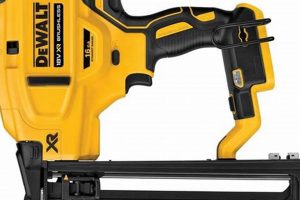
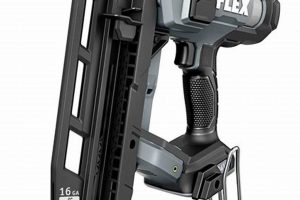
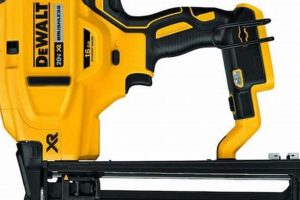
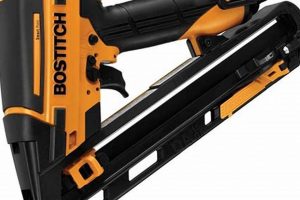
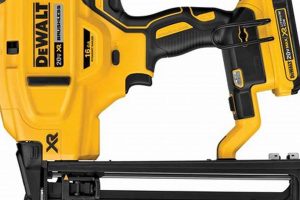
A pneumatic tool, often lightweight and easily maneuverable, is designed to drive slender fasteners into wood for applications demanding minimal visibility of the nail head. These tools employ compressed air to propel fasteners, leaving a small, clean entry point that is readily concealed with wood filler or paint. An example includes installing decorative molding where an unnoticeable nail is desired.
The advantages of employing this type of fastening tool lie in its ability to create nearly invisible joins, contributing to a refined and professional appearance. This characteristic is crucial in applications where aesthetics are paramount. Historically, achieving such results required laborious hand-nailing techniques, making the introduction of these tools a significant advancement in woodworking and construction.
The following sections will delve into specific applications for these tools, examining the types of projects where their characteristics are most beneficial, and providing guidance on selecting the appropriate model for various tasks.
Tips for Optimal Finishing Nailer Application
The following recommendations are intended to enhance the user’s proficiency and safety when employing a finishing nailer. Adherence to these guidelines will contribute to improved project outcomes and minimize potential hazards.
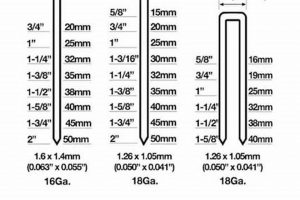
Tip 1: Select the Appropriate Nail Gauge: Different gauges provide varying holding power. 15- or 16-gauge nails are typically used for heavier trim, while 18-gauge brad nails are suited for delicate work. Choosing the correct gauge prevents splitting and ensures adequate fastening.
Tip 2: Adjust Air Pressure Properly: Overly high pressure can cause the nailer to drive fasteners too deep, marring the surface. Insufficient pressure may result in incomplete nail setting. Calibrate the air compressor according to the manufacturer’s recommendations for optimal performance.
Tip 3: Maintain a Consistent Nail Depth: Many models feature depth-of-drive adjustment. Test the setting on scrap material before proceeding with the actual project. Consistency in nail depth creates a professional, uniform appearance.
Tip 4: Employ Correct Angling Techniques: When attaching trim at an angle, position the nailer to drive the fastener perpendicular to the surface being fastened. This technique maximizes holding strength and reduces the likelihood of the trim pulling away from the substrate.
Tip 5: Utilize Safety Glasses and Hearing Protection: Finishing nailers operate at high pressure and generate significant noise. Safety glasses protect against flying debris, and hearing protection mitigates potential auditory damage.
Tip 6: Keep the Nailer Clean and Well-Lubricated: Regular cleaning and lubrication ensure the nailer functions smoothly and prolong its lifespan. Follow the manufacturer’s instructions for maintenance procedures.
Tip 7: Be Aware of Underlying Utilities: Before fastening, confirm the absence of electrical wiring or plumbing within the substrate. Employ a stud finder or other detection device to prevent accidental damage to building systems.
By implementing these strategies, users can enhance their skill and safety, achieving superior results in woodworking and finishing applications.
The subsequent section will provide a comparative analysis of various finishing nailer models, examining their features and capabilities to assist in informed purchasing decisions.
1. Detailed Trim Work

Detailed trim work, encompassing tasks such as installing crown molding, baseboards, door casings, and window sills, demands precision and a refined finish. The execution of these projects hinges on the ability to securely fasten materials while minimizing visible blemishes. The integration of finishing nailers is instrumental in achieving this delicate balance.
- Concealment of Fasteners
The primary advantage of utilizing a finishing nailer in detailed trim work lies in its capacity to drive nails nearly flush with the material surface. This characteristic eliminates the need for extensive filling and sanding, saving time and preserving the integrity of the trim’s profile. Unlike screws or larger nails, the small entry point left by a finishing nail is easily concealed with minimal effort. Example: Installing intricate crown molding in a living room, where a seamless transition between the wall and ceiling is desired.
- Reduced Risk of Splitting
Fine trim often consists of delicate wood susceptible to splitting, particularly when fastened near edges or ends. Finishing nailers, employing smaller gauge nails, significantly reduce the risk of splitting compared to traditional methods. The precision of the tool also minimizes impact on the surrounding material. Example: Attaching delicate quarter-round molding to the base of a cabinet, where a split could compromise the aesthetic appeal of the entire piece.
- Efficient Installation
The speed and efficiency afforded by a finishing nailer streamline the installation process, especially in projects involving extensive trim work. The pneumatic action of the tool allows for rapid and consistent fastener placement, enhancing productivity. Example: Installing baseboards throughout an entire house, a task that can be completed significantly faster with a finishing nailer than with manual nailing.
- Versatility Across Materials
Finishing nailers can be effectively employed with a range of trim materials, including wood, composite, and PVC. This versatility makes them indispensable for projects involving diverse material selections. Example: Using the same tool to install wood door casings and PVC window sills, ensuring a consistent and professional finish throughout the project.
The properties of the finishing nailer — the ability to subtly fasten trim, reduce splitting, accelerate installation, and adapt to various materials — collectively define its utility in detailed trim applications. The tool becomes an indispensable instrument for professionals and hobbyists alike, seeking to achieve refined finishes and enduring joinery.
2. Furniture Assembly

Furniture assembly, whether in mass production or custom creation, relies heavily on methods that ensure structural integrity while maintaining aesthetic appeal. The integration of finishing nailers in this process offers a balance between these requirements, making them a prevalent choice for various stages of furniture construction.
- Joint Reinforcement
Finishing nails serve as a supplemental fastening method, reinforcing glued joints in furniture frames and components. While adhesive provides primary bonding, nails driven with a finishing nailer add mechanical strength and prevent movement during the curing process. Example: Securing the corners of a drawer box after gluing, ensuring a square and durable assembly.
- Panel Attachment
Attaching panels, such as drawer bottoms, cabinet backs, or decorative overlays, benefits from the precise and subtle fastening provided. Finishing nailers allow for secure attachment without unsightly screw heads or the risk of splitting thin materials. Example: Affixing the back panel to a bookcase, creating a rigid structure and a finished appearance.
- Trim and Molding Application
The application of decorative trim and molding is essential in furniture design. The tools ability to drive fasteners nearly flush with the surface allows for a clean, professional finish. Example: Attaching decorative trim to the edges of a table top, enhancing the aesthetic appeal without visible fasteners.
- Temporary Fastening
In complex furniture designs, finishing nails can be used for temporary fastening during assembly. These nails hold components in place while clamps are applied or glue sets, simplifying the construction process. Example: Securing a leg to a table frame temporarily while the adhesive dries, ensuring proper alignment and stability.
These multifaceted applications emphasize the essential role of finishing nailers in furniture assembly. Their precise fastening capabilities, minimal visibility, and versatility across various materials and construction phases contribute to high-quality, aesthetically pleasing, and structurally sound furniture pieces.
3. Cabinetry Creation

Cabinetry creation, encompassing both frameless and face-frame designs, involves intricate assembly processes where precision and aesthetics are paramount. The use of a finishing nailer in this context directly impacts the quality and visual appeal of the final product.
- Drawer Box Assembly
The construction of drawer boxes often necessitates joining thin pieces of wood with minimal visible fasteners. Finishing nailers drive nails that are easily concealed, providing structural support without detracting from the aesthetic. Example: Attaching drawer sides to the front using a finishing nailer, creating a strong joint that is nearly invisible after finishing.
- Face Frame Attachment
In face-frame cabinetry, the face frame is attached to the cabinet box to provide structural rigidity and a decorative front. Finishing nailers allow for this attachment without leaving prominent nail holes, contributing to a clean and professional appearance. Example: Securing a solid wood face frame to a plywood cabinet box with minimal disruption to the surface.
- Panel Installation
Cabinet doors and end panels often incorporate inset or raised panels. Finishing nailers are utilized to secure these panels within the door or cabinet frame, providing a stable connection with minimal visual impact. Example: Attaching a decorative center panel to a cabinet door frame, ensuring it remains securely in place without visible fasteners.
- Molding and Trim Application
Decorative moldings and trim pieces are frequently added to cabinets to enhance their visual appeal. Finishing nailers allow for the precise and secure attachment of these elements, contributing to the overall aesthetic of the cabinetry. Example: Installing crown molding along the top of wall cabinets, adding a decorative element while maintaining a seamless finish.
These applications illustrate the integral role of finishing nailers in various stages of cabinetry creation. The tools capacity to provide subtle yet secure fastening is crucial for achieving both the structural integrity and aesthetic refinement expected in high-quality cabinetry.
4. Molding installation

Molding installation, a critical element of interior design and architectural detailing, necessitates precise and secure attachment of decorative or functional trim. The efficacy and aesthetic outcome of this process are significantly enhanced through the utilization of specialized tools, with the finishing nailer serving a prominent role.
- Precise Placement and Minimal Damage
The finishing nailer enables the precise placement of fasteners, minimizing the risk of splitting or damaging delicate molding materials. This precision is crucial for intricate profiles where inaccuracies can compromise the overall appearance. Example: Installing thin, flexible cove molding along a curved wall, where precise nail placement prevents buckling or cracking.
- Concealed Fastening for a Refined Finish
A key advantage lies in the finishing nailer’s ability to drive nails nearly flush with the surface, leaving a small, easily concealed hole. This ensures a clean, professional look, particularly important for decorative moldings where visible fasteners detract from the aesthetic. Example: Attaching crown molding to a ceiling, where minimizing nail visibility is essential for a seamless transition.
- Efficient Installation on Various Surfaces
Finishing nailers facilitate efficient installation across a range of surfaces, including wood, drywall, and plaster. The ability to adjust driving depth ensures consistent fastener penetration without overdriving or damaging the underlying material. Example: Installing baseboards on uneven drywall, where consistent nail depth is necessary for a secure and uniform attachment.
- Secure Attachment for Functional Moldings
Beyond aesthetics, molding often serves a functional purpose, such as concealing gaps or protecting edges. The finishing nailer provides secure attachment to ensure these moldings remain in place and perform their intended function. Example: Installing shoe molding along the base of a cabinet to cover a gap, requiring a secure and lasting attachment to prevent shifting or displacement.
The integration of the finishing nailer in molding installation underscores its capacity to provide precise, efficient, and aesthetically pleasing results. The tool’s ability to minimize damage, conceal fasteners, accommodate various surfaces, and ensure secure attachment makes it an indispensable asset for professionals and DIY enthusiasts alike.
5. Paneling attachment
Paneling attachment represents a significant application where the capabilities of the finishing nailer become particularly relevant. The need for secure fastening alongside minimal visual disruption makes the finishing nailer a preferred tool in this domain.
- Concealed Fastening for Aesthetic Integrity
The primary requirement in paneling attachment is often to maintain a smooth, unbroken surface. Finishing nailers drive slender fasteners that leave small entry points, easily filled and concealed, thereby preserving the paneling’s aesthetic integrity. Example: Installing wainscoting in a dining room, where visible fasteners would detract from the room’s visual appeal.
- Minimizing Damage to Paneling Materials
Paneling materials, ranging from solid wood to engineered composites, can be susceptible to splitting or surface damage. The controlled driving force and narrow gauge of finishing nails minimize the risk of such damage, ensuring a clean and professional installation. Example: Attaching tongue-and-groove paneling to a wall, where splitting could compromise the interlocking mechanism and overall stability.
- Efficient Installation Across Large Surfaces
Paneling projects often involve covering substantial wall areas, demanding an efficient fastening method. Finishing nailers facilitate rapid and consistent fastener placement, significantly reducing installation time compared to manual methods. Example: Cladding an entire basement wall with paneling, a task that benefits substantially from the speed and consistency of a finishing nailer.
- Versatility with Various Paneling Types
The adaptability of finishing nailers to different paneling materials, thicknesses, and orientations makes them a versatile tool for various applications. The ability to adjust depth-of-drive ensures optimal fastener penetration without overdriving or underdriving. Example: Installing shiplap siding on an interior wall, where the nailer must accommodate varying board thicknesses and orientations.
In conclusion, the benefits derived from utilizing a finishing nailer in paneling attachment extend beyond mere fastening. The combination of concealed fasteners, minimized material damage, efficient installation, and material versatility underscores the critical role of the tool in achieving professional and aesthetically pleasing results.
6. Staircase construction
Staircase construction, encompassing various components from treads and risers to balusters and handrails, necessitates both structural integrity and a refined aesthetic. The selection of appropriate fastening methods directly impacts these dual requirements, establishing a connection to finishing nailer applications. The structural elements typically demand robust fastening, potentially involving screws or framing nails, but the aesthetic detailing relies heavily on concealed or minimally visible fasteners. Finishing nailers address this need, offering a fastening solution that maintains the visual appeal without compromising structural stability, when used appropriately in conjunction with other fastening methods. For example, attaching decorative trim to stair risers or securing balusters to a handrail benefits from the clean finish afforded by a finishing nailer.
The finishing nailer’s utility extends to the attachment of stair treads and risers in certain construction methodologies. When used in conjunction with adhesives and structural fasteners, finishing nails provide temporary or supplemental holding power during the assembly process. This ensures proper alignment and reduces movement while the adhesive cures. Moreover, smaller trim elements, such as quarter-round molding used to cover gaps between the treads and risers, are efficiently and aesthetically attached with finishing nailers. Utilizing this tool minimizes the risk of splitting delicate wood and allows for a seamless, professional finish. A real-world example involves installing pre-finished stair treads where minimal surface disruption is crucial.
The proper application of finishing nailers in staircase construction is essential for achieving both structural soundness and visual appeal. Challenges arise when solely relying on finishing nails for structural connections, which necessitates understanding their limitations and integrating them with other, more robust fastening methods. The judicious employment of these tools contributes to the overall quality and aesthetic finish of the staircase, linking directly to the broader theme of achieving professional results in woodworking and construction.
7. Decorative applications
The realm of decorative applications represents a significant domain where the precision and subtlety afforded by the finishing nailer are invaluable. These applications often demand a seamless integration of fastening methods that do not detract from the aesthetic value of the project.
- Ornamental Trim Installation
Ornamental trim, including delicate moldings, appliques, and carvings, requires a fastening method that is both secure and minimally invasive. Finishing nailers allow for precise placement of fasteners, reducing the risk of splitting or damaging these intricate details. An example is securing delicate carved wooden accents to furniture, where visible fasteners would compromise the design’s integrity.
- Picture Frame Assembly
The assembly of picture frames necessitates a clean and unobtrusive fastening solution. Finishing nailers offer a practical means of joining frame components without leaving prominent nail holes. Securing the mitered corners of a picture frame, ensures structural integrity without detracting from the artwork displayed.
- Signage Creation
The construction of decorative signs, whether for commercial or personal use, often involves attaching lettering, symbols, or embellishments to a backing board. Finishing nailers provide a means of affixing these elements securely while maintaining a smooth and professional surface. Attaching individual wooden letters to a sign board exemplifies this application.
- Decorative Wall Features
Creating decorative wall features, such as shadow boxes, display shelves, or textured wall panels, often requires a fastening method that is both reliable and visually discreet. Finishing nailers enable the secure attachment of these elements without disrupting the intended aesthetic. For instance, constructing a recessed shadow box for displaying collectibles demands a fastening solution that does not detract from the displayed items.
These examples highlight the critical role of the finishing nailer in applications where aesthetic considerations are paramount. The tool’s capacity to provide subtle yet secure fastening contributes significantly to the overall quality and visual appeal of a wide range of decorative projects. The use cases extend beyond those listed here, underscoring the versatility of the tool for professional artisans and DIY enthusiasts alike.
Frequently Asked Questions
This section addresses common inquiries regarding the applications and limitations of finishing nailers, providing clarity on appropriate usage scenarios and best practices.
Question 1: What distinguishes a finishing nailer from a framing nailer?
A finishing nailer employs smaller gauge nails, typically 15-18 gauge, designed for detailed work where minimal visibility is desired. A framing nailer utilizes larger nails for structural applications, such as framing walls and roofs.
Question 2: Can a finishing nailer be used for structural applications?
Finishing nailers are generally unsuitable for structural applications requiring robust fastening. They are primarily designed for attaching trim, molding, and other non-structural elements.
Question 3: What types of materials can be fastened with a finishing nailer?
Finishing nailers can be used with a variety of materials, including wood, plywood, MDF, and some composite materials. However, the specific material and thickness should be considered to ensure adequate holding power.
Question 4: What factors should be considered when selecting a finishing nailer?
Key considerations include nail gauge compatibility, air pressure requirements, depth-of-drive adjustment, and overall tool weight and maneuverability. The specific needs of the project should guide the selection process.
Question 5: How can nail splitting be prevented when using a finishing nailer?
To minimize splitting, employ a nailer with adjustable depth-of-drive, select the appropriate nail gauge for the material, and pre-drill pilot holes in particularly brittle woods.
Question 6: What safety precautions should be observed when operating a finishing nailer?
Essential safety measures include wearing safety glasses and hearing protection, ensuring proper air pressure settings, and being mindful of hand placement to avoid accidental nail discharge.
In summary, the finishing nailer serves as a specialized tool best suited for applications where aesthetics and precision are paramount. Understanding its limitations and adhering to safety guidelines is crucial for optimal performance and user well-being.
The following section will present a concluding overview, summarizing the key advantages and disadvantages of various finishing nailer models.
finishing nailer uses
This exploration has detailed the multifaceted roles of this tool across diverse applications. From intricate trim work to furniture assembly and cabinetry creation, the advantages of minimized visibility and precise fastener placement have been consistently highlighted. The utility in paneling attachment, staircase construction, and various decorative endeavors further underscores its versatility. Safety considerations and material compatibility have been recurring themes, emphasizing the importance of informed application.
The information presented should empower informed decisions regarding its integration into woodworking and construction projects. A proper understanding of the tool’s capabilities and limitations ensures its effective and safe employment, ultimately contributing to superior project outcomes and professional standards.