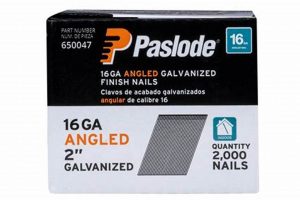
Determining the appropriate fastener size is critical for secure and aesthetically pleasing trim installation. Using nails that are too short may result in inadequate holding power, leading to loose trim over time. Conversely, nails that are excessively long can protrude through the back of the trim or substrate, creating an unsightly finish and potential safety hazard. For instance, when attaching quarter-round to a baseboard, selecting a fastener that penetrates sufficiently into the wall framing is paramount for a lasting connection.
Proper fastener selection provides a clean, professional look while ensuring structural integrity. Historical building practices often relied on specific nail lengths based on the type of wood and the thickness of the materials being joined. This attention to detail contributed to the longevity and beauty of traditional craftsmanship. Modern applications continue to prioritize accurate measurements to maintain the highest standards of quality in both residential and commercial projects.
Key considerations in selecting the correct fastener include the thickness of the trim itself, the density of the material to which it is being attached (e.g., drywall, wood framing), and the desired level of holding power. Factors such as nail gauge and head type also play a role in achieving the desired aesthetic and functionality. The following sections will delve into these specific aspects in greater detail, providing practical guidance for ensuring optimal trim installation results.
Guidance on Fastener Length for Trim Applications
The following recommendations are intended to provide informed guidance when selecting fasteners for trim work, ensuring a secure and aesthetically pleasing result.
Tip 1: Measure the combined thickness of the trim and the substrate it will be attached to. This measurement serves as the baseline for determining the minimum acceptable fastener length. For instance, if the trim is 1/2 inch thick and the drywall is also 1/2 inch thick, the fastener should penetrate at least 1 inch into the framing.
Tip 2: Account for the density of the substrate. Harder materials like oak or maple require longer fasteners to achieve adequate grip compared to softer materials like pine. Increase the fastener length by approximately 1/4 to 1/2 inch when working with dense substrates.
Tip 3: Consider the angle of the fastener. When driving fasteners at an angle, increase the length to compensate for the reduced penetration depth into the substrate. A steeper angle necessitates a longer fastener.
Tip 4: Select fasteners with appropriate gauge. Thicker gauge fasteners provide greater holding power, particularly for heavier trim pieces or areas subject to stress. A 15- or 16-gauge fastener is often preferable to an 18-gauge fastener in these situations.
Tip 5: Test fastener placement in an inconspicuous area. Before committing to a particular fastener length, drive a test fastener into a hidden section of the trim and substrate. This allows for assessment of penetration depth and minimizes the risk of damage or visible imperfections.
Tip 6: When working near edges, minimize the risk of splitting by pre-drilling pilot holes. This ensures that the fastener follows the intended path and reduces stress on the trim material.
Tip 7: For applications requiring enhanced holding power, consider using construction adhesive in conjunction with mechanical fasteners. The adhesive provides additional bond strength, particularly in areas prone to movement or vibration.
Proper fastener selection, informed by these guidelines, will contribute significantly to the stability and longevity of trim installations, while also ensuring a professional and refined appearance.
The subsequent sections will address common challenges encountered during trim installation and offer practical solutions for achieving optimal results.
1. Trim thickness

Trim thickness serves as a fundamental determinant in selecting the appropriate fastener for any trim application. The dimension directly influences the necessary penetration depth into the underlying substrate, ensuring adequate holding power and preventing the trim from becoming dislodged over time. Accurate assessment of this dimension is crucial for a secure and aesthetically pleasing installation.
- Minimum Nail Length Calculation
The trim’s thickness must be accounted for when calculating minimum required nail length. If the trim is too thick relative to the fastener, the nail may not sufficiently penetrate the substrate, resulting in a weak connection. Conversely, neglecting this dimension can lead to the use of excessively long fasteners that protrude through the back of the substrate, creating an undesirable appearance and potential safety hazards. For example, attaching 1/2-inch thick baseboard trim typically requires a minimum fastener length exceeding 1 1/2 inches to ensure adequate penetration into the wall framing.
- Impact on Nail Gauge Selection
Thicker trim may necessitate the selection of a larger gauge nail to provide the required holding strength. A thinner gauge fastener might be prone to bending or breaking when driven through denser trim materials, compromising the integrity of the installation. Furthermore, the head size of the nail should be proportionate to the trim thickness to avoid being overly conspicuous or creating an unsightly depression in the trim’s surface. The trim thickness guides a professional to adjust a correct nail gauge.
- Influence on Nail Head Style Choice
The profile of the trim, coupled with its thickness, influences the suitability of different nail head styles. For example, thicker trim profiles may better conceal larger nail heads, whereas thinner trim may require the use of headless or brad nails for a cleaner, more refined finish. The type of trim profile determines a more suitable nail head for an aesthetic purpose.
- Consideration for Mitered Corners
In applications involving mitered corners, where two pieces of trim meet at an angle, the combined thickness of the two pieces at the joint must be considered. This may necessitate the use of slightly longer fasteners to ensure that both pieces are securely joined and that the corner remains tight and flush over time. When installing, it is important to measure the thickness of where pieces meet to consider its dimension for nail length.
Considering these facets, trim thickness plays a pivotal role in determining the correct fastener, promoting a long-lasting and visually appealing result. Selecting the proper fastener based on the dimensions ensures secure and professional trim installation.
2. Substrate material
The composition of the substrate material significantly influences the selection of appropriate fasteners for trim installation. Different materials possess varying densities and holding capacities, directly affecting the required length and gauge of fasteners to ensure a secure and lasting bond.
- Drywall Composition
Drywall, a common substrate, offers relatively low resistance to fastener penetration and limited holding power. Therefore, when attaching trim to drywall, longer fasteners are typically necessary to reach the underlying framing studs or furring strips. Insufficient penetration may result in the fastener pulling out of the drywall, leading to loose or detached trim. For example, attaching trim to drywall between studs requires specialized anchors in addition to appropriately sized fasteners.
- Solid Wood Substrates
Solid wood substrates, such as pine or oak framing, offer substantially greater holding power compared to drywall. In these cases, shorter fasteners may suffice, provided they penetrate sufficiently into the wood. However, the density of the wood should also be considered; hardwoods like oak require longer fasteners than softwoods like pine to achieve a comparable level of grip. The correct fastener length is based on the type of wood and density.
- Plaster Surfaces
Plaster presents unique challenges due to its brittle nature. Fasteners driven directly into plaster without proper preparation can cause cracking and crumbling, resulting in a weak and unstable connection. When attaching trim to plaster, it is often necessary to pre-drill pilot holes and use specialized fasteners designed for masonry or plaster applications. Pre-drilling helps mitigate damage to the plaster surface. Using a proper pilot hole size ensures a long-lasting hold.
- Metal Framing Considerations
In commercial construction, metal framing is frequently used. Attaching trim to metal studs requires self-tapping screws or other fasteners specifically designed for metal. The gauge and length of these fasteners must be carefully selected to ensure they can effectively penetrate the metal without stripping or damaging the threads. Metal type has different screw-type fastener that works best with the application.
The selection of fastener length must always be considered in direct relationship to the characteristics of the substrate material. Failure to account for substrate density and composition can compromise the integrity of the installation, leading to costly repairs and potential safety hazards. Understanding the properties of the substrate assures selection of the most appropriate fastener to promote a long-lasting finish.
3. Desired holding strength

The requisite holding strength is a critical parameter in determining appropriate fastener size for trim work. The intended function and location of the trim piece, along with anticipated environmental factors, directly influence the necessary holding power and, consequently, the selection of fastener dimensions.
- Load-Bearing Trim Elements
When trim serves a load-bearing function, such as chair rails or substantial crown molding, the demand for holding strength increases substantially. In such scenarios, longer fasteners, penetrating deeply into structural framing members, are imperative. Failure to provide adequate support can lead to sagging, detachment, or even structural failure over time. The nature of the trim itself provides a guide for fastener length and load capacity.
- High-Traffic Areas
Trim installed in high-traffic areas, such as hallways or entryways, is subject to frequent contact and potential impact. Therefore, enhanced holding strength is essential to prevent loosening or damage. In these locations, consider increasing fastener length and using a higher gauge fastener to resist lateral forces. Environmental considerations often add to the holding strength to ensure long-term durability.
- Environmental Exposure
Trim exposed to significant fluctuations in temperature or humidity will experience expansion and contraction, placing additional stress on fasteners. In these environments, longer and potentially thicker fasteners, in conjunction with flexible adhesives, are recommended to accommodate movement and maintain a secure connection. Exterior trim or areas with variable conditions need robust solutions to resist warping and separation.
- Aesthetic Considerations vs. Function
While a clean aesthetic often dictates minimal fastener visibility, it is crucial to prioritize holding strength when functional requirements demand it. Compromising on fastener length for the sake of appearance can lead to premature failure and necessitate costly repairs. In many situations, counter-sinking nails and using wood filler can provide the necessary holding power while maintaining a visually appealing finish. The need to balance appearance with structural needs calls for informed decision-making.
Achieving the desired holding strength represents a balance between functional requirements, environmental factors, and aesthetic considerations. Selecting appropriate fasteners based on these parameters guarantees the longevity and structural integrity of the trim installation, while also contributing to a professional and visually pleasing result. Prioritize function over appearance, as a secure, well-installed trim is more valuable than a purely aesthetic one.
4. Nail gauge selection

Nail gauge selection directly influences the required nail length for trim applications. The gauge, which refers to the diameter of the nail, determines its holding power and resistance to bending. This property is inextricably linked to the overall length necessary to ensure a secure and lasting installation.
- Holding Power and Nail Length Compensation
A lower gauge number indicates a thicker nail, providing greater shear strength and resistance to pull-out forces. When utilizing a higher gauge (thinner) nail, increasing the length becomes necessary to compensate for the reduced diameter and achieve comparable holding power to a thicker, shorter nail. For instance, an 18-gauge brad nail may require a longer length than a 15-gauge finish nail to secure the same trim piece effectively.
- Material Splitting and Length Adjustment
Thicker (lower gauge) nails can increase the risk of splitting delicate trim materials, particularly near edges or in hardwoods. If a lower gauge nail is preferred for its superior holding power, pre-drilling pilot holes becomes essential. Alternatively, selecting a slightly longer, higher gauge nail can mitigate the risk of splitting while still providing adequate retention. Strategic selection is necessary when dealing with vulnerable wood material.
- Head Size and Concealment Requirements
The gauge of the nail correlates with the head size. Lower gauge nails typically have larger heads, offering a greater surface area for holding but potentially requiring more effort to conceal. If a nearly invisible finish is desired, a higher gauge nail with a smaller head is preferable, although the length may need to be increased to offset the reduced holding power of the smaller head. Aesthetic demands impact nail choices.
- Substrate Density and Penetration Depth
The substrate material dictates the required penetration depth for adequate holding. When working with dense materials, a lower gauge nail may be preferred to facilitate easier penetration. However, if a higher gauge nail is used to minimize splitting or improve aesthetic outcomes, the nail length must be increased to ensure sufficient engagement with the substrate. Nail choices should consider material characteristics.
Therefore, appropriate nail gauge selection is not solely a matter of choosing the thickest possible nail for maximum holding power. It involves careful consideration of the trim material, substrate density, aesthetic requirements, and desired level of concealment. Adjusting the nail length in conjunction with the gauge enables a balance between holding power, ease of installation, and the final visual outcome of the trim work.
5. Head style influence

The head style of a finish nail exerts a discernible influence on the optimal length selected for trim work. Different head types are designed to serve distinct purposes, directly impacting the fastener’s holding capacity and its aesthetic integration within the finished product. A larger head, for instance, provides increased surface area for gripping the trim but may necessitate a shorter nail to prevent protrusion and maintain visual appeal. Conversely, a smaller or headless nail necessitates a longer shank to compensate for the reduced head size, ensuring adequate holding power. Examples include the use of brad nails (near-headless) on delicate trim where minimal visibility is paramount; in this instance, the nail length must be sufficient to provide a secure hold despite the minimal head. Ignoring this relationship can lead to either structurally unsound trim or an aesthetically displeasing finish due to overly visible or protruding nail heads.
Considerations surrounding head style also extend to the type of material being fastened. Softer woods may benefit from larger headed nails that distribute pressure more evenly, preventing the nail from sinking too deeply into the material. Harder woods, conversely, might require smaller or countersunk heads to prevent splitting or damage to the trim during installation. Furthermore, the angle at which the nail is driven, often influenced by the head style, plays a role in determining the effective penetration depth and, consequently, the necessary length. For example, angled nailing might necessitate a slightly longer fastener to achieve the same holding power as a straight drive with a larger headed nail.
In conclusion, selecting an appropriate finish nail length is not a singular decision but rather a holistic assessment encompassing head style, material properties, and desired aesthetic outcomes. Understanding the interplay between these factors enables a professional and enduring trim installation. Failure to consider the head style’s influence risks compromising either the structural integrity or the visual appeal of the finished work, highlighting the importance of careful planning and informed decision-making in trim carpentry.
Frequently Asked Questions about Selecting Nail Length for Trim
This section addresses common inquiries regarding the selection of appropriate nail length for trim applications, providing clear and concise answers to ensure proper installation and long-lasting results.
Question 1: What is the general rule for determining nail length when installing trim?
A common guideline involves ensuring the nail penetrates at least twice the thickness of the trim into the substrate material. However, this is a minimum standard and must be adjusted based on the substrate’s density and the desired holding power.
Question 2: Does the type of trim material affect the choice of nail length?
Yes. Softer woods may require longer nails to achieve adequate grip, while harder woods might risk splitting with excessively long nails. Pre-drilling pilot holes may be necessary in dense woods to prevent splitting.
Question 3: How does the substrate material influence nail length selection?
Substrates with low density, such as drywall, necessitate longer nails to reach the underlying framing members. Denser substrates like solid wood allow for shorter nails, provided sufficient penetration is achieved.
Question 4: Is it acceptable to use construction adhesive as a substitute for proper nail length?
Construction adhesive can supplement mechanical fastening, but it is not a substitute for appropriately sized nails. Adhesive provides additional bond strength, but nails are essential for initial holding and long-term stability.
Question 5: What happens if the selected nail length is too short?
Using nails that are too short compromises holding power, leading to loose trim and potential detachment over time. This can also create a safety hazard if the trim becomes dislodged unexpectedly.
Question 6: What are the consequences of using nails that are too long?
Excessively long nails can protrude through the back of the substrate, creating an unsightly finish and posing a safety risk. They can also damage wiring or plumbing concealed within the wall cavity.
Proper nail length selection is a critical aspect of trim installation, requiring consideration of material properties, substrate characteristics, and desired holding power. Adhering to established guidelines and carefully assessing each specific application ensures a secure, professional, and long-lasting result.
The subsequent section will address practical tips and troubleshooting techniques for common trim installation challenges.
Determining Appropriate Fastener Dimensions
Proper fastener selection for trim installation necessitates a thorough evaluation of multiple interrelated factors. The preceding exploration highlights the critical roles of trim thickness, substrate material, desired holding strength, nail gauge selection, and head style influence in determining the appropriate “what length finish nails for trim.” Deviation from informed practices introduces the risk of structural instability, aesthetic compromise, and potential safety hazards.
Therefore, diligent consideration of these parameters remains paramount for achieving durable, visually appealing, and structurally sound trim installations. Implementing the guidelines discussed ensures professional-grade outcomes and contributes to the longevity and overall quality of interior and exterior finishes. Professionals should prioritize this critical step to uphold building standards and client expectations.