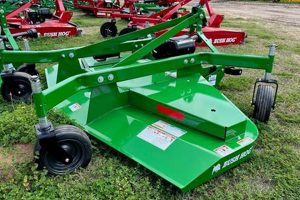
A rotary cutter designed for maintaining lawns and other manicured turf areas differs significantly from one intended for clearing thick brush and overgrown vegetation. The former prioritizes a clean, even cut at a specific height, while the latter focuses on efficiently reducing dense material regardless of the final appearance.
The selection of the appropriate implement hinges on the intended application. Using a device designed for rough cutting on a manicured lawn will result in an undesirable, uneven surface. Conversely, attempting to clear heavy brush with a mower optimized for fine turf will likely damage the equipment and prove ineffective.
Understanding the distinct capabilities of each type of rotary cutting implement is essential for effective land management and equipment longevity. The subsequent sections will delve into the specific design features, applications, and maintenance considerations relevant to each category.
Operational Considerations for Rotary Cutting Implements
Selecting the appropriate equipment and operating it correctly ensures optimal performance and longevity. The following tips offer guidance on maximizing the effectiveness of both types of rotary cutting implements.
Tip 1: Equipment Selection: Prioritize the selection of the correct implement based on the terrain and vegetation. Using a finishing mower in dense brush can lead to damage. A brush hog is unsuitable for fine turf applications.
Tip 2: Blade Maintenance: Regularly inspect blades for sharpness and damage. Dull or damaged blades compromise cutting efficiency and can increase the strain on the implement’s drive system. Sharpen or replace blades as needed.
Tip 3: Cutting Height Adjustment: Adjust the cutting height according to the desired result and the terrain conditions. Lower cutting heights are suitable for lawns, while higher settings are necessary for uneven ground or thick vegetation.
Tip 4: Operating Speed: Maintain a consistent operating speed appropriate for the implement and cutting conditions. Excessive speed can lead to uneven cutting, while insufficient speed can strain the engine and reduce efficiency.
Tip 5: Safety Precautions: Before operating any rotary cutting implement, ensure that all safety shields and guards are in place and functioning correctly. Clear the area of any obstacles or debris that could be ejected during operation.
Tip 6: Implement Maintenance: Regularly lubricate all moving parts according to the manufacturer’s recommendations. Inspect and tighten all bolts and fasteners to prevent loosening or failure during operation.
These operational considerations contribute to safe and efficient land maintenance. Implementing these tips prolongs the lifespan of the equipment and enhances the quality of the finished result.
The next section will compare the specific maintenance requirements for different rotary cutting implements.
1. Cut Quality

Cut quality represents a primary distinction between rotary cutting implements. This attribute directly impacts the suitability of each tool for specific applications, dictating the aesthetic and functional outcome of land maintenance activities.
- Blade Overlap and Tip Speed
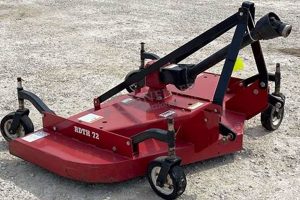
Finishing mowers often feature multiple blades rotating in close proximity with significant overlap. This design, combined with high blade tip speeds, results in a cleaner, more uniform cut. Conversely, brush hogs typically employ fewer blades with less overlap and lower tip speeds, prioritizing power and durability over a pristine finish.
- Discharge Characteristics
Finishing mowers commonly discharge clippings finely and evenly across the cutting width. Some models offer mulching capabilities, further reducing the size of clippings and returning nutrients to the soil. Brush hogs, on the other hand, tend to discharge larger, less processed debris, often leaving a visible layer of chopped material behind.
- Height Consistency
Finishing mowers are engineered to maintain a consistent cutting height, producing a level surface ideal for lawns and other manicured areas. Brush hogs, due to their robust construction and intended use on uneven terrain, may exhibit greater variation in cutting height, resulting in a less uniform appearance.
- Appearance of Cut Stubble
The cut stubble left behind by a finishing mower is generally shorter and less noticeable than that produced by a brush hog. The sharp blades and high tip speeds of a finishing mower create a cleaner severance of grass blades, minimizing the visibility of the cut. Brush hogs, with their thicker blades and lower speeds, may leave a rougher, more pronounced stubble.
The interplay of these factors underscores the fundamental difference in cut quality between the two types of rotary cutting implements. A finishing mower is specifically designed to achieve a visually appealing, well-manicured surface, while a brush hog prioritizes the efficient removal of dense vegetation without regard to aesthetic considerations.
2. Material Density

Material density is a critical determinant in selecting between a rotary finishing implement and a rotary brush cutting implement. The former, designed for low-density materials such as grass and light vegetation, functions optimally when the resistance encountered during cutting is minimal. Introducing high-density material thick brush, small saplings, or dense weeds can overload the system, leading to reduced cutting efficiency, equipment damage, or complete failure. For instance, using a finishing mower in a field containing significant thistle growth or woody shrubs places undue stress on the blades, bearings, and drive components.
In contrast, a rotary brush cutting implement is engineered to handle high-density materials. Its robust construction, heavier blades, and more powerful drive system are designed to withstand the impacts and stresses associated with cutting through thick vegetation. Attempting to process such material with a finishing mower not only risks damage to the mower itself, but it also creates a safety hazard due to the potential for blade breakage or the ejection of debris at high speeds. Farms often utilize rotary brush cutting implements to clear fields of overgrown vegetation prior to planting, or for maintaining the edges of wooded areas to prevent encroachment.
In summation, understanding the density of the material to be cut is paramount in choosing the appropriate rotary cutting implement. The selection directly influences the efficiency of the operation, the lifespan of the equipment, and the overall safety of the procedure. Failing to consider material density can result in equipment damage, increased maintenance costs, and potential injury.
3. Terrain Suitability

Terrain suitability represents a critical factor in determining the appropriate rotary cutting implement. The design and operational characteristics of each type of implement dictate its ability to effectively and safely operate on varying ground conditions, directly impacting performance and equipment longevity.
- Ground Clearance
Finishing mowers generally possess lower ground clearance compared to brush hogs. This design characteristic enhances their ability to maintain a consistent cutting height on smooth, relatively level terrain. However, it also makes them vulnerable to damage when encountering obstacles such as rocks, roots, or uneven ground. Brush hogs, with their higher ground clearance, can navigate rougher terrain with greater ease, minimizing the risk of impact and damage to the implement.
- Wheel Configuration and Stability
The wheel configuration of a rotary cutting implement influences its stability and maneuverability on different terrains. Finishing mowers often utilize multiple wheels or rollers to provide uniform support and minimize scalping on smooth surfaces. Brush hogs, typically equipped with larger, more rugged tires, offer enhanced traction and stability on uneven or sloped terrain. The wider wheelbase of a brush hog also contributes to its stability when operating on inclines.
- Deck Design and Flexibility
The deck design of a rotary cutting implement affects its ability to conform to varying terrain contours. Finishing mowers often feature rigid decks that are optimized for maintaining a consistent cutting height on level ground. Brush hogs, on the other hand, may incorporate flexible decks or floating hitches that allow the implement to follow the contours of uneven terrain, minimizing scalping and ensuring a more uniform cut in challenging conditions.
- Obstacle Avoidance
The ability to avoid obstacles is a key consideration when operating rotary cutting implements on uneven or obstacle-strewn terrain. Finishing mowers, with their lower ground clearance and more delicate construction, require careful operation to avoid collisions with rocks, roots, and other obstructions. Brush hogs, designed for tougher conditions, can often withstand minor impacts without significant damage. However, even with a brush hog, caution is necessary to prevent damage to the blades, spindle, or other components.
The interaction between terrain characteristics and implement design highlights the importance of selecting the appropriate tool for the job. Utilizing a finishing mower on rough terrain can lead to damage and inefficient operation, while attempting to maneuver a brush hog on a manicured lawn may result in scalping and an uneven cut. Matching the implement to the terrain ensures optimal performance, extends equipment life, and promotes operator safety.
4. Blade Design

Blade design is a defining characteristic differentiating rotary cutting implements, directly influencing their cutting performance and suitability for diverse vegetation types. The morphology and construction of the blades are specifically tailored to the intended application, reflecting the distinct demands of maintaining fine turf versus clearing dense brush.
- Blade Thickness and Material
Finishing mower blades are generally thinner and manufactured from lighter-gauge steel. This design minimizes power requirements and allows for higher blade tip speeds, essential for a clean, even cut on grass. Brush hog blades, conversely, are substantially thicker and constructed from high-strength steel to withstand impacts with dense vegetation, rocks, and other debris. Their robust construction prioritizes durability over finesse.
- Blade Shape and Cutting Edge
Finishing mower blades often feature a curved or airfoil shape to generate lift and improve airflow, resulting in a cleaner cut and more efficient discharge of clippings. The cutting edge is typically sharpened to a fine edge to shear grass blades cleanly. Brush hog blades typically have a simpler, straight or slightly curved shape with a less refined cutting edge. Their design emphasizes brute force for chopping through thick vegetation rather than achieving a precise cut.
- Blade Configuration and Number
Finishing mowers commonly employ multiple blades (typically three or more) arranged to provide overlapping cutting paths. This configuration ensures a consistent cut height and minimizes uncut areas. Brush hogs generally utilize fewer blades (often two) attached to a rotating pan or disc. The blades are often hinged or mounted on chains to deflect upon impact with obstacles, reducing the risk of damage to the implement.
- Blade Mounting and Protection
Finishing mower blades are typically mounted directly to the spindle or hub, providing a rigid and precise cutting platform. Brush hog blades are often mounted with a degree of freedom, such as on hinges or chains. This allows them to swing away from obstructions, preventing damage to the blades and the machine’s drivetrain when encountering rocks, stumps, or other solid objects hidden within dense vegetation.
The diverse blade designs reflect the fundamentally different operational requirements of rotary cutting implements. The delicate, high-speed blades of a finishing mower are optimized for producing a manicured lawn, while the robust, impact-resistant blades of a brush hog are engineered for clearing heavy brush and maintaining rough terrain. The correct blade design directly influences the efficiency, effectiveness, and longevity of the equipment.
5. Horsepower Needs

Engine power is a primary determinant in the operational effectiveness of both finishing and brush-cutting implements. The specific horsepower requirements are dictated by the implement’s design, cutting width, and the density of the material being processed. Understanding these requirements is crucial for matching the appropriate implement to the available power source, ensuring optimal performance and preventing equipment strain.
- Cutting Width and Area Coverage
Wider implements inherently require more horsepower to maintain consistent blade speed and cutting efficiency. A larger cutting width translates to a greater volume of material being processed per unit of time, necessitating increased engine power to avoid bogging down or experiencing reduced cutting quality. For instance, a 72-inch finishing mower will demand considerably more horsepower than a 48-inch model to achieve the same level of cut quality. Similarly, a brush hog with a wider cutting path requires more power to effectively clear dense vegetation across a larger area.
- Material Density and Resistance
The density and resistance of the material being cut directly impact the required horsepower. Finishing mowers, designed for light grasses, demand relatively low horsepower. Brush hogs, intended for dense brush and small saplings, necessitate significantly greater engine power to overcome the increased resistance encountered during cutting. Attempting to operate a brush hog in heavy brush with insufficient horsepower will result in reduced cutting speed, incomplete cutting, and potential damage to the implement or the power source.
- Terrain and Slope
Operating on uneven terrain or inclines increases the horsepower demand on rotary cutting implements. The added resistance from navigating slopes and overcoming obstacles requires additional power to maintain consistent blade speed and maneuverability. Therefore, selecting a rotary cutting implement with sufficient horsepower is crucial when operating in hilly or uneven areas. A brush hog used on steep slopes will demand more horsepower than the same implement operating on level ground.
- Implement Design and Drivetrain Efficiency
The design and efficiency of the implement’s drivetrain influence horsepower requirements. Efficient drivetrain systems minimize power loss between the engine and the blades, reducing the overall horsepower demand. Finishing mowers, with their typically simpler drivetrains, may require less horsepower than brush hogs with more complex gearboxes and blade mounting systems. The type of gearbox, blade mounting configuration, and overall design of the implement affect the transfer of power and, consequently, the horsepower needed for optimal operation.
In summary, matching horsepower to the implement and operating conditions is paramount for efficient and effective land management. Understanding the interplay between cutting width, material density, terrain, and implement design ensures that the selected implement is capable of performing the intended tasks without exceeding the limitations of the power source. The choice between a finishing implement and a brush-cutting implement profoundly influences the horsepower requirements, reflecting the contrasting demands of manicuring lawns versus clearing dense vegetation.
6. Maintenance Intensity

The frequency and complexity of maintenance procedures differ significantly between rotary finishing implements and rotary brush-cutting implements. This disparity, directly linked to the operational demands and construction of each implement type, necessitates distinct maintenance schedules and skill sets.
- Blade Sharpening and Replacement
Finishing mower blades, designed for a clean, precise cut, require more frequent sharpening to maintain optimal performance. The thinner blades are also more susceptible to damage from debris, necessitating more frequent replacement. Brush hog blades, built for durability, require less frequent sharpening and replacement, though they may need straightening or repair following impacts with substantial obstacles.
- Gearbox and Driveline Servicing
Brush hogs, designed for heavy-duty applications, typically feature robust gearboxes and drivelines to transmit power to the blades. These components require regular inspection, lubrication, and potential repair due to the high stresses encountered during operation. Finishing mowers, operating under less demanding conditions, generally require less frequent gearbox and driveline servicing.
- Deck Cleaning and Corrosion Prevention
Both types of implements require regular deck cleaning to remove accumulated debris and prevent corrosion. However, the design of finishing mower decks, often featuring intricate baffles and discharge chutes, may make them more difficult to clean thoroughly. Brush hog decks, with their simpler construction, are generally easier to maintain in terms of cleanliness and corrosion prevention.
- Overall Structural Inspection and Repair
Brush hogs, built to withstand rough terrain and dense vegetation, are more prone to structural damage from impacts and stress. Regular inspection for cracks, bends, and other forms of damage is crucial. Finishing mowers, operating on smoother terrain, are less likely to experience structural damage but should still be inspected for signs of wear and tear.
The divergent maintenance intensity reflects the contrasting operational environments of the two rotary cutting implement types. While both require consistent care to ensure optimal performance and longevity, the more demanding applications of the brush hog necessitate a more rigorous and frequent maintenance schedule compared to that of the finishing mower.
Frequently Asked Questions
The following addresses common inquiries regarding the selection and application of rotary cutting implements, clarifying their distinct capabilities and limitations.
Question 1: Can a finishing mower be used to clear light brush?
While a finishing mower may be able to cut some very light brush or weeds, it is not designed for this purpose. Attempting to clear even light brush can damage the mower’s blades, spindle, and drive system, leading to costly repairs and reduced lifespan. A brush hog is the appropriate implement for clearing brush and other dense vegetation.
Question 2: Is it possible to achieve a lawn-quality cut with a brush hog?
No, a brush hog is not designed to produce a lawn-quality cut. Its primary function is to clear dense vegetation, not to create a manicured surface. The blades are thicker and operate at lower speeds than those of a finishing mower, resulting in a rougher, less even cut. Using a brush hog on a lawn will damage the turf and create an undesirable appearance.
Question 3: How often should the blades be sharpened on a rotary cutting implement?
The frequency of blade sharpening depends on the type of implement, the material being cut, and the operating conditions. Finishing mower blades, which require a sharp edge for a clean cut, should be sharpened more frequently than brush hog blades. Inspect blades regularly for dullness, damage, and wear, and sharpen them as needed to maintain optimal performance.
Question 4: What safety precautions should be taken when operating a rotary cutting implement?
Several safety precautions are essential when operating rotary cutting implements. Ensure all safety shields and guards are in place and functioning correctly. Clear the area of any obstacles or debris that could be ejected during operation. Wear appropriate personal protective equipment, including eye protection and hearing protection. Never operate the implement near bystanders or animals.
Question 5: How does the cutting width of a rotary implement affect its performance?
The cutting width of a rotary cutting implement determines the area it can cover in a single pass. Wider implements can clear larger areas more quickly, but they also require more horsepower and may be more difficult to maneuver in tight spaces. Choose a cutting width that is appropriate for the size of the area to be cleared and the available power source.
Question 6: Can a rotary cutting implement be used on all types of terrain?
No, rotary cutting implements are not suitable for all types of terrain. Finishing mowers are best suited for smooth, level surfaces, while brush hogs can handle rougher, more uneven terrain. Consider the terrain conditions when selecting a rotary cutting implement to ensure optimal performance and prevent equipment damage.
Understanding these critical aspects of rotary cutting implements enables effective selection and safe implementation. By adhering to appropriate guidelines, operators can extend equipment life and promote quality outcomes.
The following section will provide insights on purchasing considerations for land-clearing implements.
Selection of Appropriate Rotary Cutting Equipment
The foregoing analysis underscores the fundamental distinction between the operational roles of a finishing mower and a brush hog. The former is optimized for the precise maintenance of turf, whereas the latter is designed for the rigorous task of clearing heavy vegetation. Selecting the incorrect implement for a given application can lead to suboptimal results, equipment damage, and potential safety hazards.
A thorough assessment of terrain, vegetation density, and desired outcome is therefore paramount. Such diligence ensures that the chosen rotary cutting implement aligns with the specific land management needs, fostering efficiency and promoting long-term equipment integrity.
![Buy Premium Finishing Mower for Sale - [Brand] Edition | Best Final Touch: Elevate Your Projects with Professional Finishing](https://bestfinaltouch.com/wp-content/uploads/2025/12/th-628-300x200.jpg "Buy Premium Finishing Mower for Sale - [Brand] Edition Best Final Touch: Elevate Your Projects with Professional Finishing")