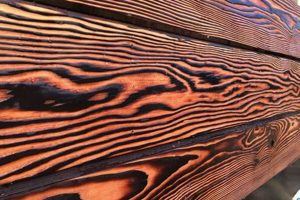
The deterioration of a coating that results in a pattern resembling the scales of an alligator is a common issue affecting wood surfaces. This network of cracks, often irregular in shape and size, develops over time, compromising both the aesthetic appeal and protective qualities of the finish. For example, a varnished antique table might display this effect after decades of exposure to environmental changes.
Understanding the underlying causes of this phenomenon is crucial for preventative maintenance and restoration efforts. Addressing it promptly preserves the integrity of the wood substrate, preventing further damage from moisture, sunlight, and other environmental factors. Recognizing and mitigating the risk also maintains the historical and monetary value of finished wooden objects.
The following discussion delves into the causes, prevention, and repair techniques associated with this form of finish failure. Exploring the selection of appropriate materials and application methods, alongside effective restoration strategies, provides a comprehensive approach to maintaining durable and visually appealing wood surfaces.
Preventative Measures for Finish Degradation
Implementing proactive steps is vital to minimize the occurrence of surface cracking on wood finishes. The following guidelines outline strategies to enhance the longevity and appearance of finished wood surfaces.
Tip 1: Surface Preparation: Ensure proper surface preparation prior to finish application. This includes thorough cleaning, sanding, and priming to promote optimal adhesion and prevent premature failure.
Tip 2: Thin Film Build-up: Apply multiple thin coats of finish, allowing each coat to dry completely. This approach minimizes stress within the finish layer, reducing the likelihood of cracking. Conversely, thick coats are prone to uneven drying and cracking.
Tip 3: Finish Compatibility: Verify the compatibility of different finish products. Using incompatible primers, stains, or topcoats can cause adhesion problems and lead to finish failure. Refer to manufacturer guidelines and conduct compatibility tests when combining different products.
Tip 4: Environmental Control: Maintain consistent temperature and humidity levels during the application and curing process. Drastic fluctuations can induce stress within the finish, leading to cracking. Aim for stable environmental conditions within recommended ranges.
Tip 5: UV Protection: Shield finished wood surfaces from prolonged exposure to direct sunlight. Ultraviolet radiation accelerates the degradation of finishes, contributing to cracking and discoloration. Consider using UV-resistant finishes or implementing shading strategies.
Tip 6: Regular Maintenance: Implement a routine maintenance schedule that includes periodic cleaning and inspection. Addressing minor issues promptly, such as scratches or water damage, can prevent the need for more extensive repairs later on.
Tip 7: Avoid Drastic Temperature Changes: Prevent finished wood from being exposed to sudden shifts in temperature. Significant fluctuations cause expansion and contraction of the wood, stressing the finish and potentially causing surface cracks.
By adhering to these preventative measures, one can significantly reduce the incidence of finish defects and prolong the lifespan of finished wood surfaces, thereby reducing repair costs in the long run.
The subsequent sections will address the appropriate restoration techniques to employ when surface cracking does occur, focusing on methods for repair and refinishing.
1. Incompatible topcoats

The application of incompatible topcoats is a primary instigator of the scaled surface effect on wood finishes. This incompatibility arises from fundamental differences in the chemical composition, drying characteristics, and flexibility of the applied coatings. When a topcoat is applied over a base coat to which it cannot properly bond, internal stresses develop within the finish system. These stresses, compounded by expansion and contraction of the wood substrate due to environmental changes, manifest as cracking. The resulting pattern directly reflects the compromised adhesion between the layers.
The selection of appropriate coatings necessitates a thorough understanding of their respective properties and potential interactions. For example, applying a rigid, solvent-based lacquer over a flexible, oil-based varnish is almost certain to produce this effect. The lacquer’s rigidity prevents it from accommodating the natural movement of the underlying varnish, ultimately leading to the cracking pattern as the wood expands and contracts. Similarly, applying a water-based finish over an oil-based finish without proper surface preparation will cause adhesion problems. This is because water-based finishes dont bond well with oil-based finishes, which are hydrophobic, or water-repelling.
In summary, the connection between incompatible topcoats and the scaled surface effect is direct and consequential. Selecting compatible coatings, understanding the importance of chemical interactions, and adhering to manufacturer recommendations are critical to achieving a durable and aesthetically pleasing wood finish. Failure to address these factors inevitably leads to a compromised finish, necessitating costly repairs or complete refinishing of the affected surfaces.
2. Excessive film thickness
Excessive film thickness serves as a significant contributing factor to the onset of finish cracking. The mechanism involves the uneven drying and curing of the applied coating. When a wood finish is applied too thickly, the surface layer tends to dry and harden more rapidly than the underlying layers. This differential drying creates internal stresses within the finish film. As the deeper layers slowly cure and release solvents, they contract, exerting force against the already hardened surface. This stress manifests as a network of cracks, resembling scales. For example, if a thick coat of varnish is applied to a door, the surface may skin over before the lower layers have fully dried. The continued outgassing of solvents from the underlying varnish results in stresses that lead to cracks in the surface.
The practical significance of understanding the impact of excessive film thickness lies in the ability to prevent its occurrence. Proper application techniques, including multiple thin coats rather than a single thick coat, are crucial. Thin coats allow for uniform drying and solvent evaporation, minimizing internal stress. Furthermore, selecting finishes with appropriate solids content and viscosity helps to control film thickness. For instance, a high-solids lacquer, when applied in a single thick coat, is particularly prone to cracking due to the large volume of solvent that must evaporate. Understanding the rheological properties of the finish, as well as environmental parameters such as temperature and humidity, are vital in optimizing the application process. A cabinet refinisher that ignores such details can result in visible defects.
In summary, excessive film thickness induces stress within the finish film, ultimately leading to a network of cracks. Preventing this involves applying thin, even coats, selecting appropriate finishes, and understanding application techniques. This approach minimizes internal stress, resulting in a more durable and aesthetically pleasing finish. Addressing this aspect of finish application enhances the overall longevity and visual quality of wooden surfaces, resulting in reduced maintenance and repairs.
3. Insufficient drying time

Insufficient drying time between coats of finish is a direct contributor to the formation of a surface cracking pattern. This defect arises from the trapping of solvents within the finish film. When subsequent coats are applied before the prior coat has adequately dried, the solvents from the earlier application are unable to fully evaporate. The trapped solvents continue to outgas over time, creating pressure and stress within the cured finish layers. The result is the characteristic pattern, where cracks develop as the finish attempts to relieve the internal pressure. A newly finished table may appear satisfactory initially, but if subsequent coats were applied prematurely, the effects will emerge weeks or months later, as solvents continue to evaporate beneath the surface.
The practical significance of this understanding centers on the necessity of adhering to manufacturer-specified drying times. Environmental conditions, such as humidity and temperature, can significantly influence drying rates; higher humidity and lower temperatures extend drying times. Therefore, a rigid adherence to timelines is crucial to the longevity of the finish. Moreover, the type of finish impacts drying requirements. Oil-based finishes generally require longer drying times compared to water-based finishes. Ignoring these factors results in premature finish failure and the need for costly repairs. Woodworkers should routinely monitor drying conditions, extend drying times accordingly, and ensure adequate ventilation to promote solvent evaporation. Failure to do so will introduce defect like finish cracking.
In summary, the link between insufficient drying time and this finish defect is causal and preventable. Adhering to recommended drying times, considering environmental conditions, and understanding the properties of different finishes are critical to producing durable and visually appealing wood surfaces. Recognizing this relationship enables woodworkers to mitigate the risk of solvent entrapment and ensures the longevity of the finished project. While challenges such as time constraints and production pressures may tempt deviation from recommended practices, the long-term consequences outweigh short-term gains.
4. Substrate movement

Substrate movement, specifically the expansion and contraction of wood due to fluctuations in moisture content and temperature, plays a crucial role in the development of a scaled surface on wood finishes. Wood is a hygroscopic material, meaning it readily absorbs and releases moisture from the surrounding environment. As moisture levels change, the wood swells or shrinks, resulting in dimensional changes. These dimensional changes exert stress on the finish layer, particularly if the finish lacks sufficient flexibility. The continuous cycle of expansion and contraction eventually exceeds the finish’s ability to withstand the stress, leading to the formation of cracks. For instance, a wooden door subjected to seasonal humidity changes will experience expansion during humid months and contraction during drier months. If the finish on the door is inflexible, these movements will inevitably result in cracks mirroring the wood’s grain pattern.
The significance of understanding substrate movement lies in the ability to mitigate its impact on the finish. Selecting flexible finishes, such as certain urethanes or acrylics, can accommodate some degree of substrate movement. Proper acclimatization of the wood prior to finishing is also essential. This involves allowing the wood to reach equilibrium with the ambient humidity of its intended environment, reducing the extent of subsequent movement. Controlling the environment, through the use of humidifiers or dehumidifiers, can further minimize fluctuations in moisture content. Furthermore, proper joint design in woodworking projects can allow for wood movement without stressing the finish. For example, a floating panel in a cabinet door is designed to expand and contract within the frame without placing stress on the surrounding joinery or the finish.
In conclusion, substrate movement is a primary driver of finish cracking due to the stresses it imposes on the finish layer. Employing flexible finishes, acclimatizing wood, controlling the environment, and utilizing appropriate joint designs are effective strategies for minimizing the detrimental effects of substrate movement and extending the lifespan of wood finishes. By recognizing this relationship and implementing preventative measures, one can significantly reduce the occurrence of finish defects and ensure the longevity and aesthetic appeal of finished wood surfaces. These practices are not merely aesthetic considerations, but also crucial for maintaining the structural integrity and value of wooden objects.
5. Environmental extremes

Environmental extremes, characterized by significant fluctuations in temperature and humidity, directly contribute to the degradation of wood finishes, manifesting as the distinct “alligatoring” effect. These environmental shifts induce expansion and contraction within both the wood substrate and the finish film. The differing rates of expansion and contraction between these materials generate internal stresses. When these stresses exceed the finish’s elasticity, cracks initiate and propagate, forming the characteristic scaled pattern. For instance, furniture subjected to alternating periods of intense sunlight and freezing temperatures, such as that found in uninsulated seasonal homes, is highly susceptible to this type of finish failure. The severity of the damage is directly proportional to the magnitude and frequency of these environmental cycles.
Understanding this connection allows for targeted preventative measures. Climate-controlled environments significantly reduce the risk. Finishes with inherent flexibility, formulated to accommodate dimensional changes, offer enhanced protection. Furthermore, mitigating direct exposure to extreme conditions, such as shading from direct sunlight or maintaining consistent humidity levels, reduces the likelihood of finish breakdown. An example includes museums, where stringent environmental controls are implemented to preserve artifacts with delicate wood finishes. These strategies are also applicable to residential settings, albeit often on a less rigorous scale, through the use of window treatments, humidifiers, and dehumidifiers. The appropriate use of such devices can dramatically extend the lifespan of a wood finish.
In summary, environmental extremes constitute a critical factor in the deterioration of wood finishes, particularly leading to the scaled surface effect. Managing environmental factors is essential for preserving the integrity and aesthetic quality of wood finishes. Employing appropriate finishes and implementing environmental controls significantly reduce the risk of finish failure, thus preserving the value and longevity of finished wood objects. While complete elimination of environmental fluctuations may be impractical, proactive management based on understanding their impact is crucial.
Frequently Asked Questions
The following questions address common concerns regarding finish cracking, providing concise and informative answers to assist in understanding and managing this issue.
Question 1: Is finish cracking always indicative of poor-quality finish?
Not necessarily. While low-quality finishes may be more susceptible, finish cracking can occur even with high-quality finishes if improper application techniques are used or the finish is subjected to environmental stressors.
Question 2: Can finish cracking be repaired without completely stripping the existing finish?
Depending on the severity, minor finish cracking can sometimes be addressed with localized repairs, such as cleaning, lightly sanding, and applying a compatible topcoat. However, extensive cracking often necessitates complete removal and refinishing.
Question 3: Does the type of wood affect the likelihood of finish cracking?
Yes, wood species with significant dimensional movement, such as certain hardwoods, may increase the risk of finish cracking compared to more stable species.
Question 4: How does humidity contribute to finish cracking?
Fluctuations in humidity cause wood to expand and contract, placing stress on the finish. This cyclical stress can lead to cracking, particularly in finishes that lack flexibility.
Question 5: Are some finish types more prone to finish cracking than others?
Yes, rigid finishes, such as certain lacquers, are generally more prone to cracking than flexible finishes, such as urethanes or acrylics.
Question 6: Is finish cracking purely an aesthetic issue, or does it compromise the wood’s protection?
Finish cracking compromises the wood’s protection by allowing moisture and other environmental elements to penetrate the finish layer. This can lead to wood damage, such as rot or warping.
In summary, finish cracking results from a combination of factors, including finish quality, application techniques, environmental conditions, and wood characteristics. Recognizing these factors is crucial for effective prevention and remediation.
The subsequent section will explore specific repair techniques for addressing finish cracking, ranging from minor touch-ups to complete refinishing procedures.
Conclusion
The preceding discussion has explored the phenomenon of a scaled wood finish in detail, emphasizing the contributing factors, preventative measures, and potential repair strategies. It is evident that the formation of this pattern represents a complex interaction of material properties, environmental conditions, and application techniques. Accurate diagnosis of the underlying cause is paramount to implementing effective and lasting solutions. Ignoring the fundamental principles of wood finishing and environmental control will invariably lead to recurring issues and compromised outcomes.
Ultimately, a commitment to proper preparation, compatible material selection, and diligent environmental management represents the most effective strategy for preserving the integrity and aesthetic value of finished wood surfaces. Further research and adherence to evolving best practices are essential for minimizing the incidence and impact of finish degradation. The preservation of wood finishes is not merely an aesthetic concern but a vital component of responsible stewardship of valuable resources.