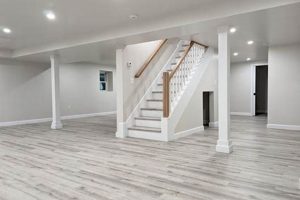
Professionals specializing in the completion of subterranean levels provide services encompassing design, construction, and finishing. Their expertise transforms unfinished spaces into functional living areas. For instance, they manage tasks ranging from framing walls and installing electrical and plumbing systems to applying drywall and flooring.
This type of service increases a property’s value and usable square footage. Historically, this approach has been utilized to create additional bedrooms, home offices, recreational spaces, or storage solutions. The investment in these services can significantly enhance homeowner lifestyle and overall property appeal.
Subsequent sections will elaborate on key considerations, including project planning, cost estimations, material selection, permitting processes, and strategies for achieving optimal results in the creation of a comfortable and aesthetically pleasing below-grade environment.
Expert Guidance for Below-Grade Transformations
The following guidance offers insights designed to optimize the successful conversion of unfinished basements into valuable living spaces. These points address critical aspects of the construction process and are intended to promote informed decision-making.
Tip 1: Comprehensive Planning is Paramount: Prior to commencing any physical alterations, establish a detailed plan encompassing spatial layout, intended use, and adherence to local building codes. A well-defined blueprint minimizes costly revisions and ensures compliance.
Tip 2: Moisture Mitigation is Essential: Before initiating interior finishing, implement robust waterproofing measures to prevent water intrusion. This may involve exterior excavation and sealing, interior drain tile installation, and the application of waterproof membranes to the foundation walls. Failure to address moisture issues can lead to mold growth and structural damage.
Tip 3: Prioritize Insulation for Energy Efficiency: Adequate insulation is critical for maintaining consistent temperatures and reducing energy consumption. Employ closed-cell spray foam or rigid foam board insulation with a high R-value to minimize heat loss and condensation.
Tip 4: Ensure Adequate Egress for Safety: If the space will be used as a bedroom or living area, ensure compliance with egress window requirements. Egress windows provide a safe escape route in the event of a fire and are mandated by building codes.
Tip 5: Consider Soundproofing for Enhanced Comfort: Implement soundproofing measures to minimize noise transmission from upper floors and external sources. This can involve the use of resilient channels, sound-dampening insulation, and solid-core doors.
Tip 6: Proper Ventilation is Crucial: Install a ventilation system to ensure adequate air circulation and prevent the buildup of moisture and pollutants. An exhaust fan in the bathroom and a whole-house ventilation system are recommended.
Tip 7: Strategic Lighting Enhances Ambiance: Plan lighting carefully to create a well-lit and inviting space. Incorporate a combination of recessed lighting, task lighting, and accent lighting to achieve optimal illumination and visual appeal.
These strategies serve to increase the livability, durability, and overall value of finished basements. Proper execution during the finishing process ensures a functional and enjoyable living space for years to come.
These guidelines should provide a foundation for beginning your finishing project. Subsequent sections will discuss material selection and other important factors to consider.
1. Competency

Competency, in the context of basement finishing, is not merely the ability to perform construction tasks, but a multifaceted proficiency crucial for transforming a subterranean space into a functional and habitable environment. Its significance lies in ensuring structural integrity, code compliance, and long-term comfort.
- Technical Proficiency in Basement-Specific Construction
This facet encompasses expertise in addressing unique challenges inherent to below-grade construction, such as moisture management, foundation reinforcement, and specialized insulation techniques. For instance, a competent professional understands the importance of installing a vapor barrier and drain tile system to mitigate water intrusion, preventing mold growth and structural damage. Without such technical proficiency, the finished basement may be susceptible to costly problems and health hazards.
- Code Compliance and Permitting Processes
Navigating local building codes and obtaining necessary permits is an integral aspect of competency. This requires in-depth knowledge of regulations pertaining to egress windows, ceiling heights, electrical wiring, and plumbing systems in basement settings. A failure to adhere to these codes can result in fines, mandatory corrections, and potential safety risks for occupants. Competent professionals are adept at managing the permitting process efficiently and ensuring all work meets regulatory requirements.
- Problem-Solving and Adaptability
Every basement presents unique challenges, such as uneven floors, low ceilings, or existing structural obstructions. Competency involves the ability to identify these challenges early and devise effective solutions. For example, a competent professional can propose innovative framing techniques to maximize headroom or develop creative strategies to conceal unsightly ductwork. This adaptability is critical for achieving a visually appealing and functional finished space.
- Effective Communication and Project Management
Competency extends beyond technical skills to include effective communication with clients and subcontractors. This involves clearly explaining design options, providing realistic timelines, and managing the project budget efficiently. A competent professional acts as a liaison between all parties involved, ensuring smooth coordination and minimizing potential conflicts. This level of professionalism contributes significantly to client satisfaction and the overall success of the project.
These facets of competency are essential for ensuring that the transformation of an unfinished basement into a valuable living space is executed with precision, safety, and lasting quality. The absence of any one of these elements can compromise the integrity and functionality of the finished space, underscoring the importance of selecting professionals with a proven track record of comprehensive competence.
2. Experience

The correlation between extensive experience and successful basement finishing outcomes is significant. Experience, in this context, encompasses a professional’s accumulated knowledge and practical application of that knowledge in diverse basement environments. A direct relationship exists between the breadth of experience and the ability to anticipate and mitigate challenges inherent in such projects. For example, a seasoned professional is more likely to recognize potential moisture issues prior to commencing construction, implementing proactive waterproofing measures that less experienced individuals might overlook. This preventative approach directly impacts the long-term structural integrity and habitability of the finished space. Moreover, experience allows for the efficient and cost-effective management of resources, as familiarity with various materials and construction techniques facilitates informed decision-making.
Real-world examples underscore the practical significance of this understanding. Consider two scenarios: In one instance, a homeowner selects a contractor with limited experience, resulting in inadequate insulation and subsequent condensation problems, necessitating costly remediation. In the second instance, a homeowner chooses a contractor with a portfolio of successful basement finishing projects. The experienced professional identifies and addresses potential issues proactively, delivering a finished space that is both aesthetically pleasing and structurally sound. This contrast demonstrates that the investment in experience translates directly into tangible benefits, including enhanced comfort, reduced maintenance costs, and increased property value.
In summary, the value of experience in basement finishing extends beyond mere technical skill. It encompasses the ability to anticipate challenges, manage resources effectively, and deliver results that meet or exceed homeowner expectations. While other factors, such as licensing and insurance, are also crucial, experience serves as a reliable indicator of a professional’s capacity to navigate the complexities of basement construction and achieve optimal outcomes. Therefore, prioritizing experience during the selection process is a prudent decision for homeowners seeking to transform their unfinished basements into valuable living spaces.
3. Licensure

Licensure, within the context of basement finishing, represents a formal acknowledgment by a governing body that a professional meets established standards of competency and ethical conduct. The absence of proper licensure can expose homeowners to significant risks, including substandard workmanship, code violations, and potential legal liabilities. Licensure provides a degree of assurance that the individual or company possesses the requisite knowledge, skills, and insurance coverage to perform the work safely and effectively. For instance, a licensed contractor typically undergoes rigorous testing and continuing education to maintain their credentials, ensuring they remain current with evolving building codes and best practices. This adherence to standards directly impacts the structural integrity and safety of the finished basement.
The practical significance of licensure becomes evident when considering potential scenarios. Without proper oversight, substandard electrical wiring can create fire hazards, while inadequate waterproofing can lead to mold growth and structural damage. Furthermore, unlicensed contractors may lack the necessary insurance coverage to protect homeowners from liability in the event of accidents or property damage during the construction process. By verifying licensure, homeowners mitigate these risks and gain recourse through regulatory agencies if issues arise. For example, if a licensed contractor fails to adhere to building codes, the homeowner can file a complaint with the licensing board, potentially leading to disciplinary action or financial restitution.
In summary, the importance of licensure in basement finishing cannot be overstated. It serves as a critical safeguard for homeowners, ensuring that the work is performed by qualified professionals who adhere to established standards of competency and ethical conduct. While licensure does not guarantee perfection, it significantly reduces the risk of encountering substandard workmanship, code violations, and potential legal liabilities. Therefore, verifying licensure should be a fundamental step in the selection process, providing homeowners with peace of mind and a greater likelihood of a successful project outcome.
4. Insurance
Insurance constitutes a critical component in the engagement of professionals for basement finishing projects. The potential for property damage or personal injury during construction activities necessitates comprehensive coverage. Contractors’ liability insurance protects homeowners from financial responsibility in the event of accidents occurring on their property. Worker’s compensation insurance covers medical expenses and lost wages for injured workers, preventing homeowners from being held liable for these costs. Without adequate insurance, homeowners may face significant financial burdens resulting from unforeseen events.
Consider the following scenarios: If a worker sustains an injury on the job site and the contractor lacks worker’s compensation insurance, the homeowner may be sued for medical expenses and damages. Similarly, if a contractor’s negligence leads to damage to the homeowner’s property or a neighbor’s property, liability insurance would cover the costs of repairs or replacements. In the absence of such coverage, homeowners would be personally responsible for these expenses. Furthermore, should the contractor fail to complete the project or perform substandard work, a surety bond (often required as part of insurance coverage) may provide financial recourse for the homeowner to rectify the situation.
Therefore, verification of adequate insurance coverage is a prudent measure for homeowners engaging professionals for basement finishing projects. This verification should include confirming the validity and scope of liability insurance, worker’s compensation insurance, and any applicable surety bonds. By ensuring that contractors maintain adequate insurance, homeowners mitigate their financial risk and protect themselves from potential liabilities arising from unforeseen events during the construction process. This proactive approach is essential for safeguarding their investment and ensuring a successful project outcome.
5. Reputation

In the context of basement finishing services, reputation serves as a critical indicator of reliability, quality of workmanship, and overall customer satisfaction. A strong reputation, built upon consistent performance and positive client feedback, functions as a surrogate for direct experience. Homeowners often rely on online reviews, testimonials, and referrals to assess the credibility and competence of potential service providers. The effect of a positive reputation can be substantial, leading to increased business opportunities and a competitive advantage within the market. Conversely, a negative reputation can deter prospective clients and damage a business’s long-term viability.
Consider the scenario of two competing basement finishing companies: Company A possesses numerous positive online reviews highlighting their attention to detail, adherence to timelines, and proactive communication. Company B, in contrast, has few reviews, with several indicating issues related to project delays and poor communication. A homeowner, unfamiliar with either company, is statistically more likely to engage Company A due to its established reputation for reliable service. This illustrates the practical significance of cultivating and maintaining a positive public image. Furthermore, a strong reputation often translates to a willingness to address and resolve issues promptly, further solidifying client trust and fostering long-term relationships.
In summary, reputation is not merely a superficial attribute but a fundamental element that directly impacts the success and sustainability of basement finishing businesses. It is a reflection of past performance, a predictor of future service quality, and a powerful marketing tool. While factors such as pricing and service offerings are undoubtedly important, reputation often serves as the deciding factor for discerning homeowners seeking to transform their unfinished basements into valuable living spaces. Consistent delivery of high-quality workmanship and proactive client communication are essential for building and preserving a positive reputation within this competitive industry.
Frequently Asked Questions for Basement Finishing
This section addresses common inquiries regarding the transformation of unfinished basements into functional living spaces. The following questions and answers provide clarity on key aspects of the construction process and related considerations.
Question 1: What is the typical timeframe for completing a basement finishing project?
The duration of a basement finishing project varies depending on the scope of work, size of the space, and complexity of the design. A standard project typically ranges from four to eight weeks, but this estimate can be influenced by factors such as permitting delays, material availability, and unforeseen structural issues.
Question 2: Is it necessary to obtain permits for basement finishing?
Obtaining building permits is generally required for basement finishing projects. These permits ensure compliance with local building codes and safety regulations. Failure to obtain necessary permits can result in fines, construction delays, and potential legal liabilities.
Question 3: What are the primary considerations for waterproofing a basement before finishing?
Effective waterproofing is essential for preventing moisture intrusion and protecting the finished basement from water damage. Primary considerations include addressing exterior grading, installing drain tile systems, applying waterproof membranes to foundation walls, and ensuring proper ventilation.
Question 4: How does finishing a basement impact property value?
Finishing a basement typically increases property value by adding usable square footage and enhancing the overall appeal of the home. The extent of the increase depends on factors such as the quality of workmanship, design aesthetics, and local real estate market conditions.
Question 5: What are the options for addressing low ceiling heights in a basement?
Several options exist for addressing low ceiling heights, including lowering the floor slab, modifying ductwork or plumbing, and employing design techniques that create a sense of vertical space. Consultation with a qualified professional is recommended to determine the most suitable approach.
Question 6: What are the common challenges encountered during basement finishing projects?
Common challenges include moisture issues, low ceiling heights, limited natural light, uneven floors, and the presence of obstructions such as pipes or ductwork. Proactive planning and careful attention to detail can mitigate these challenges and ensure a successful project outcome.
These answers provide a foundation for understanding the complexities of basement finishing. Consultation with experienced professionals is recommended for addressing specific project requirements and ensuring optimal results.
The next section will explore different design styles and trends to enhance the atmosphere of a finished basement.
Concluding Remarks on Subterranean Space Transformation
This exploration has illuminated critical facets pertaining to the utilization of specialists in below-grade area completion. Emphasis has been placed on core competencies, including demonstrable skill, extensive experience, regulatory compliance via licensure, financial safeguarding through insurance, and a verified history of client satisfaction, all contributing to the comprehensive understanding of successful project execution.
The decision to engage qualified professionals for this undertaking warrants careful consideration, as the long-term value and habitability of the enhanced space are contingent upon informed choices. Homeowners are therefore encouraged to prioritize these considerations in pursuit of optimal outcomes and sustained satisfaction with their newly renovated subterranean environments.