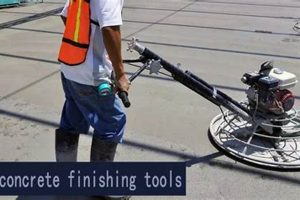
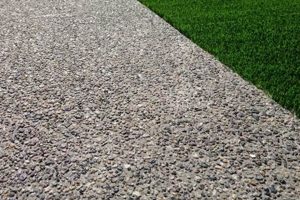
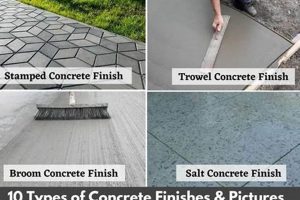
Devices utilized to refine and smooth the surface of freshly placed cementitious materials are essential for achieving desired aesthetic and functional properties. These implements, ranging from simple hand tools to powered machinery, manipulate the concrete at various stages of its setting process. For example, a bull float is used to level the surface and embed large aggregate immediately after placement, while a trowel creates a smooth, dense finish as the concrete hardens.
The appropriate application of these instruments is critical for ensuring durability, preventing surface defects such as cracking and dusting, and meeting specified design requirements. Historically, finishing was performed entirely by hand, requiring significant labor and skill. The introduction of mechanized equipment has increased efficiency and allowed for the completion of larger projects in a shorter timeframe. Furthermore, selecting the proper device impacts both the final appearance and the long-term performance of the structure.
The following sections will delve into specific types of these tools, examining their applications, advantages, and proper usage techniques. Discussions will include considerations for selecting the appropriate instrument based on project needs and desired outcomes, as well as best practices for maintenance and safety.
Concrete Finishing Tool Tips
Optimizing the utilization of devices designed for smoothing and refining cementitious surfaces requires adherence to best practices. Proper application ensures a durable, aesthetically pleasing, and functionally sound result.
Tip 1: Select the Appropriate Implement: The choice of device must align with the stage of concrete setting and the desired finish. Bull floats are suited for initial leveling, while hand floats and trowels are used for subsequent refinement. Employing the wrong implement at the wrong time can lead to surface imperfections.
Tip 2: Timing is Critical: Initiate finishing operations only after bleed water has evaporated from the surface. Premature finishing can trap water, leading to blisters and weakened surface integrity.
Tip 3: Employ Consistent Pressure: Maintain uniform pressure across the surface during troweling. Inconsistent pressure results in unevenness and potential for surface irregularities.
Tip 4: Overlap Each Pass: When using power trowels or hand tools, overlap each pass by approximately 50%. This technique prevents ridges and ensures a seamless, uniform finish.
Tip 5: Clean the Tool Regularly: Remove hardened concrete buildup from the tools surface frequently. Accumulated material can create imperfections and reduce the devices effectiveness.
Tip 6: Consider Environmental Conditions: Account for ambient temperature and humidity. Hot, dry conditions accelerate setting, requiring faster finishing, while cooler, humid conditions extend the working time.
Tip 7: Use Proper Safety Equipment: When operating power equipment, always wear appropriate safety gear, including eye protection, hearing protection, and sturdy footwear.
Following these tips enhances the quality and longevity of the finished concrete surface. Precise technique and careful equipment selection are fundamental to achieving optimal outcomes.
The subsequent sections will explore specific tool types and their respective applications in greater detail.
1. Material

The composition of devices utilized for surface refinement of concrete significantly influences their performance, lifespan, and suitability for specific applications. The selected constituent directly impacts durability, weight, and the ability to achieve the desired finish.
- Magnesium Alloys
Implements crafted from magnesium alloys are favored for their lightweight properties, reducing operator fatigue during extended use. Magnesium floats and darbies are particularly useful for initial leveling and floating operations. However, magnesium can react with wet concrete, potentially leading to slight surface discoloration if not properly managed. The light weight allows for greater control and finesse, but the reactivity requires careful consideration.
- Steel
Steel, particularly high-carbon steel, provides superior durability and resistance to abrasion. Steel trowels are essential for achieving a dense, smooth finish on concrete surfaces. Different grades of steel offer varying degrees of flexibility and hardness, influencing the final texture. The robustness of steel makes it suitable for demanding applications, but its weight can be a disadvantage for some users.
- Wood
Wood floats are traditionally used for creating a textured, non-slip surface. The porous nature of wood allows it to absorb excess moisture from the concrete, aiding in the setting process. Different types of wood, such as redwood or cedar, offer varying degrees of water resistance and durability. Wood implements are well-suited for achieving a rustic aesthetic or preparing a surface for subsequent coatings.
- Plastic/Composite Materials
Modern composite materials offer a balance of durability and light weight, making them suitable for a variety of finishing applications. Plastic floats and trowels are resistant to corrosion and easy to clean. They are often used for applying specialized coatings or achieving specific texture effects. The non-reactive nature of plastic minimizes the risk of surface discoloration, making them versatile and user-friendly.
The selection of appropriate material for concrete finishing implements is a critical factor in achieving the desired aesthetic and functional properties. Each constituent offers unique advantages and disadvantages, demanding careful consideration of the specific project requirements and desired outcome.
2. Size

The dimensions of implements used for cementitious surface refinement significantly impact maneuverability, coverage area, and ultimately, the quality of the finished product. The scale of the selected device must align with the scope of the project and the specific finishing task.
- Float/Trowel Blade Dimensions
The length and width of a float or trowel blade directly correlate to the area that can be covered with each pass. Larger blades are efficient for expansive surfaces, while smaller blades provide greater precision in confined spaces or along edges. For instance, a long bull float is suited for initial leveling of large slabs, while a smaller hand trowel is used for detailed edge work.
- Handle Length and Ergonomics
Handle length influences the user’s reach and leverage. Longer handles enable operators to cover a greater area without excessive bending, reducing fatigue. Ergonomic handle designs enhance comfort and control, particularly during prolonged use. The handle length and design should be appropriate for the user’s height and the specific finishing task.
- Power Trowel Diameter
The diameter of a power trowel’s rotating blades determines the coverage area and maneuverability of the machine. Larger diameter trowels are efficient for large open areas, while smaller diameter trowels are better suited for navigating around obstructions or working in tight spaces. The choice of trowel diameter depends on the size and complexity of the project.
- Edger Dimensions
The size and shape of edging implements are crucial for creating clean, defined edges along concrete slabs. Smaller, more pointed edgers are used for intricate details, while larger, rounded edgers are used for creating smooth, uniform edges on larger surfaces. The dimensions of the edger should be appropriate for the desired edge profile and the size of the slab.
Proper consideration of the size of concrete finishing tools ensures efficient operation, reduces user fatigue, and contributes to a high-quality finished surface. Selecting the appropriate dimensions for each task is a key element in achieving optimal results.
3. Weight

The mass of implements designed for refining concrete surfaces is a critical factor that directly influences operator fatigue, maneuverability, and the quality of the final finish. A heavier tool can provide more downward force, aiding in consolidation and smoothing, but can also lead to increased strain and reduced control, especially during prolonged use. Conversely, a lighter implement may be easier to handle, allowing for greater finesse and precision, but might lack the necessary force to effectively manipulate stiffer or more coarse concrete mixes. For example, a heavy steel hand tamper is effective for compacting concrete in small areas but is physically demanding to operate for extended periods. A lightweight magnesium float, on the other hand, is suitable for smoothing large surfaces with less exertion.
The optimal weight is often a compromise between the desired level of consolidation and the operator’s physical capacity. Power tools, such as power trowels, often incorporate weight as a deliberate design feature to enhance their finishing capabilities. In these cases, the weight is balanced by the machine’s motor and drive system, reducing the physical burden on the operator. Furthermore, adjustable weights are sometimes incorporated into power trowels, allowing users to fine-tune the pressure applied to the concrete surface. The selection of the appropriate device weight is thus a crucial consideration in planning and executing any concrete finishing project.
In summary, the mass of a concrete finishing implement plays a pivotal role in both the effectiveness of the finishing process and the comfort of the user. A thorough understanding of the trade-offs associated with different weight categories is essential for selecting the correct tool for a given application and ensuring a satisfactory outcome. The selection is also contingent on the type of concrete mix, environmental conditions, and operator skill level, highlighting the importance of experience and informed decision-making in concrete finishing.
4. Shape

The configuration of a device utilized for concrete surface refinement is a primary determinant of its function and the resulting texture. The geometry of a float, trowel, or edger directly influences its contact with the concrete, the distribution of pressure, and the manipulation of surface materials. For example, a bull float, characterized by its broad, flat rectangular shape, serves to level and consolidate large areas of freshly placed concrete. Conversely, a smaller, rectangular hand trowel, often with slightly rounded corners, is employed for achieving a smooth, dense finish in localized areas. The curve of an edging tool precisely shapes the concrete at slab perimeters, preventing chipping and creating a defined edge.
Specialized shapes cater to specific finishing needs. A Fresno trowel, distinguished by its long, narrow blade and swivel handle, allows for finishing large areas from a standing position, minimizing the need for kneeling or bending. Groovers, with their V-shaped or U-shaped blades, create control joints, pre-weakening the concrete to encourage cracking along predetermined lines and prevent random cracking. The absence of the appropriate shape for a task leads to inefficiency and potentially compromised results. Using a square-edged trowel to create a rounded edge, for instance, results in an uneven and unprofessional finish.
In conclusion, the shape of a concrete finishing implement is not merely an aesthetic consideration, but rather a critical design element dictating its effectiveness and the characteristics of the finished surface. Understanding the relationship between tool geometry and intended application is essential for achieving optimal results and ensuring the long-term performance of the concrete structure. Ignoring the significance of shape compromises both the visual appeal and the structural integrity of the finished work.
5. Power Source

The energy source that drives concrete finishing implements fundamentally determines their operational capabilities, portability, and suitability for specific project conditions. The choice of power source impacts both the efficiency and the environmental footprint of concrete finishing operations.
- Electric (Corded)
Corded electric models provide a consistent and readily available power supply, making them suitable for indoor or controlled outdoor environments where access to electrical outlets is guaranteed. Examples include electric concrete vibrators and some smaller power trowels. The limitation is the restricted mobility imposed by the power cord, which can be a hindrance on larger construction sites. The reliability and sustained power output are advantages for continuous operation.
- Electric (Cordless)
Battery-powered units offer enhanced portability, enabling operation in remote locations or areas lacking immediate access to electrical power. Cordless power trowels and handheld concrete grinders fall into this category. However, runtime is constrained by battery capacity, necessitating frequent recharging or the use of multiple battery packs. The convenience of cordless operation is balanced by the need for proactive battery management.
- Gasoline Powered
Gasoline engines provide high power output and extended operational durations, making them ideal for large-scale projects and outdoor environments where electrical power is unavailable. Large power trowels and concrete saws are often powered by gasoline engines. The disadvantages include increased noise levels, exhaust emissions, and the need for fuel storage and maintenance. The power and independence from electrical sources are primary advantages.
- Pneumatic (Air-Powered)
Air-powered tools, such as air-driven concrete breakers and compactors, offer a balance of power and safety, particularly in environments where flammable materials are present. They require a compressed air source, which can limit portability. Pneumatic tools are generally lighter and more durable than their electric counterparts, but their performance is dependent on the capacity and efficiency of the air compressor. Safety and durability are key benefits in specific applications.
The selection of the appropriate power source for a device used for concrete surface refinement is a critical decision that must consider project size, location, environmental factors, and operational requirements. Each power source offers a unique set of advantages and disadvantages, necessitating a comprehensive evaluation to optimize both efficiency and effectiveness in the finishing process.
6. Blade Type

The specific design of the working surface on a concrete finishing implement, often referred to as the blade, fundamentally dictates the texture and quality achievable on the finished concrete. Selection of the appropriate blade type is paramount for meeting project specifications and achieving desired aesthetic outcomes.
- Float Blades
Float blades, typically constructed from magnesium, wood, or composite materials, are designed to level and consolidate the concrete surface immediately following placement. Their broad, flat profile distributes pressure evenly, embedding aggregate and removing minor imperfections. The material composition influences the aggressiveness of the floating action, with magnesium providing a smoother finish than wood.
- Trowel Blades
Trowel blades, predominantly made of steel, are utilized to create a smooth, dense, and hard surface as the concrete begins to harden. Different types of steel trowel blades exist, ranging from flexible blue steel to hardened carbon steel, each offering varying degrees of flexibility and wear resistance. The blade’s flexibility influences the ease with which a tight, smooth finish can be achieved.
- Edging Blades
Edging blades are specifically shaped to create rounded or angled edges along concrete slabs, preventing chipping and providing a finished appearance. These blades are typically constructed from steel and feature a curved profile that conforms to the desired edge shape. The size and radius of the curve dictate the final edge profile.
- Combination Blades
Some specialized implements incorporate combination blades, featuring a segmented design that allows for both floating and troweling actions. These blades often consist of a series of alternating float and trowel sections, enabling a single tool to perform multiple finishing tasks. While offering versatility, combination blades may compromise the effectiveness of each individual finishing action.
The interplay between blade type and cementitious surface manipulation is a critical determinant of the final product. Each design presents unique advantages and disadvantages, demanding informed decision-making based on project-specific requirements and desired outcomes. Careful consideration ensures the optimal selection and utilization of devices designed for smoothing and refining cementitious surfaces in surface refinement.
Frequently Asked Questions
This section addresses common inquiries concerning implements utilized for refining concrete surfaces, providing essential information for optimal utilization and project outcomes.
Question 1: What is the proper method for cleaning a concrete finishing tool?
Residual concrete should be removed immediately after use with water and a stiff brush. For hardened concrete, a diluted muriatic acid solution can be used with caution, ensuring adequate ventilation and protective gear. Thoroughly rinse and dry the tool to prevent corrosion.
Question 2: How does the type of concrete mix affect the choice of finishing tool?
Concrete mixes with larger aggregate require heavier implements for initial leveling, such as a bull float. Mixes with finer aggregates are suitable for finishing with smaller hand trowels. The slump of the mix also influences the ease with which it can be finished.
Question 3: What are the signs of an improperly finished concrete surface?
Common indicators include surface cracking, dusting (the formation of a powdery surface layer), scaling (flaking of the surface), and unevenness. These issues can arise from premature finishing, improper tool selection, or inadequate curing.
Question 4: How often should a concrete finishing tool be replaced?
The lifespan of a tool depends on usage frequency, material, and maintenance. Steel trowels should be replaced when the blade becomes excessively worn or warped. Wood floats should be replaced when they become cracked or waterlogged. Regular inspection is essential.
Question 5: What safety precautions are necessary when using power concrete finishing tools?
Always wear appropriate personal protective equipment, including eye protection, hearing protection, and sturdy footwear. Ensure the tool is properly grounded or double-insulated. Follow the manufacturer’s instructions for safe operation and maintenance. Never operate power equipment in wet conditions.
Question 6: Can a single finishing tool be used for all types of concrete projects?
No. Different project requirements, such as the desired surface texture and the size of the pour, necessitate the use of specific implements. A versatile toolbox containing a range of floats, trowels, and edgers is essential for adapting to various project conditions.
Proper technique, meticulous maintenance, and adherence to safety protocols are critical for achieving quality concrete finishes.
The subsequent sections will offer advice on choosing the appropriate contractor for your concrete projects.
Conclusion
The preceding discussion has illuminated the diverse array of implements employed in the surface refinement of cementitious materials. From fundamental features such as the material and shape to the nuances of power source and blade type, each characteristic profoundly influences the final texture, durability, and overall quality of the concrete surface. Precise selection and application of each type of device are critical for achieving specified project requirements and ensuring long-term structural integrity.
Mastery of the concrete finishing process demands a thorough comprehension of each device’s capabilities, limitations, and proper usage techniques. The pursuit of excellence in concrete construction necessitates ongoing education, diligent adherence to best practices, and a steadfast commitment to safety. The appropriate use ensures enduring structures capable of withstanding the test of time.